


Editor’s note: An unedited draft of this essay was inadvertently published on October 31. It contained garbled passages, two misquotations and factual errors, including the wrong dates for Germany’s reactor moratorium and Hong Kong’s national security law. Those errors have been corrected.
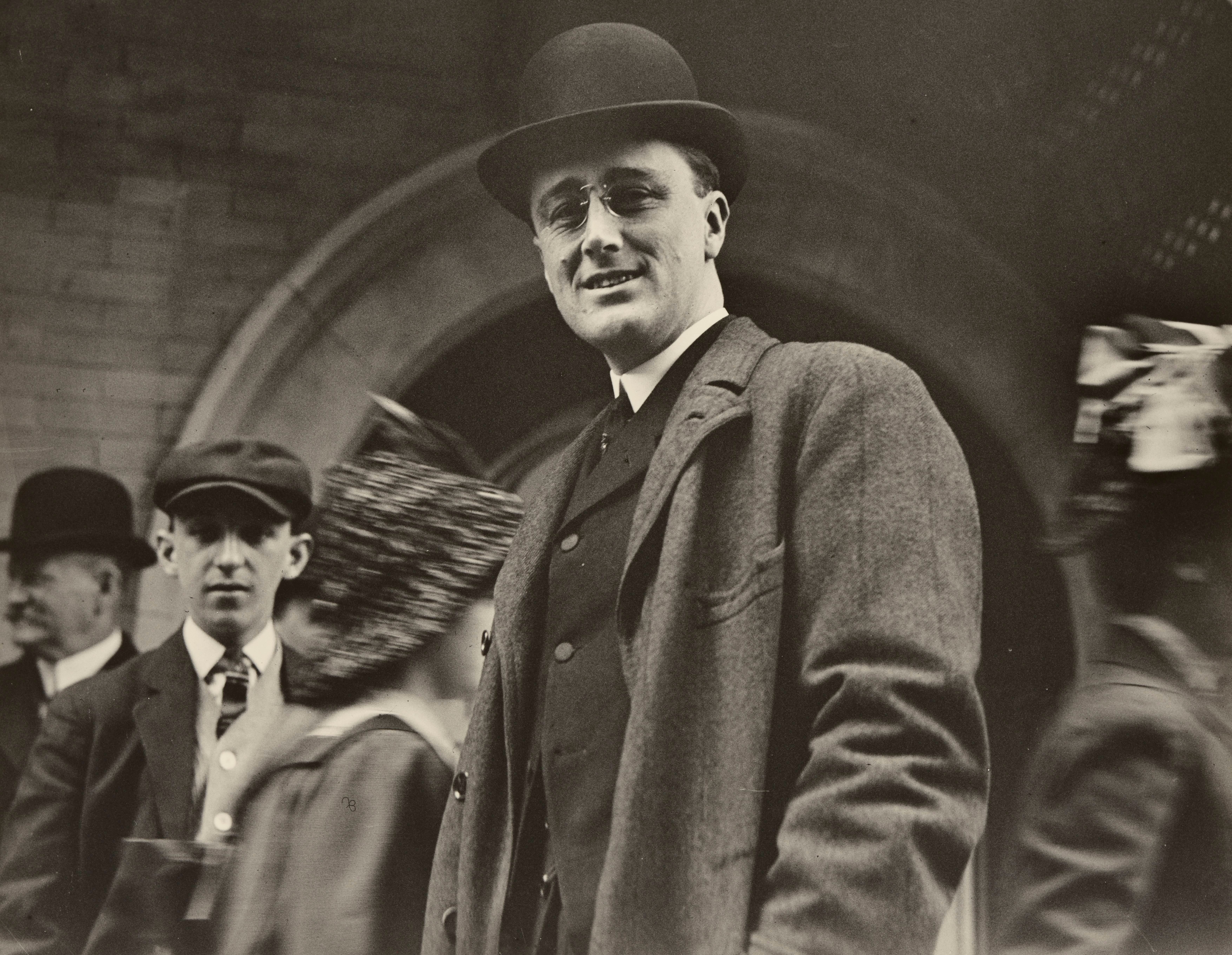
As long as there are authoritarian states on the planet, no free state is safe. I didn’t come up with that. Franklin Roosevelt said it in several ways during the war, and the plainest version came on Flag Day in 1942, when he closed a radio address with a prayer Stephen Vincent Benét had written for the occasion: “If their freedom is taken away, our freedom is not secure.” A year earlier, at Hyde Park, he had warned that the United States “will never survive as a happy and fertile oasis of liberty surrounded by a cruel desert of dictatorship.”
Roosevelt was proved right, and not only about the Axis. Those who won the Cold War decided his warning had expired. The desert could be irrigated, the theory went, and trade was the water: wire the dictatorships’ economies into ours and the habits of commerce would do slowly what tanks never could. It was a lovely theory, and most of us believed some version of it at what we thought was the end of history. I wrote two years ago that we messed up, really badly, and that market liberalism, sold as the Trojan horse that would carry democracy into China, had become the vehicle carrying authoritarianism into America.
The position I’m defending has a name, liberal internationalism, and I wear it proudly. Progressives and much of the far left hear it as neoconservatism, and the confusion is understandable, because the neoconservatives spent the Bush years borrowing its language. In his second inaugural address, in January 2005, George W. Bush said that “the survival of liberty in our land increasingly depends on the success of liberty in other lands,” which is close to a paraphrase of Roosevelt at Hyde Park, and he set the country the goal of “ending tyranny in our world.” The same speech said this was “not primarily the task of arms.” American troops had been in Iraq for twenty-two months.
Bush borrowed the language and left the method behind. In the Atlantic Charter, Roosevelt and Churchill declared that their countries sought “no aggrandizement, territorial or other” and respected “the right of all peoples to choose the form of government under which they will live,” and the order built on that charter bound American power inside alliances, treaties and the United Nations. The Bush administration’s 2002 National Security Strategy said the United States “will not hesitate to act alone,” and the next year it invaded Iraq without a second Security Council resolution, in a war that then-UN Secretary-General Kofi Annan would come to call illegal “from the charter point of view.” Neoconservatism treats international institutions as obstacles to American power. Liberal internationalism treats them as the way free countries pool their power and check one another’s, the United States included. And the liberal internationalist view is not a pacifist one. It supports the idea of humanitarian intervention, and UN peacekeeping is a great example. Unilateral action is not. The standard I argued for last spring is that no people should be ruled by force against its will, and the Iraqis were owed it as much as the Ukrainians are.
The first Iraq War belongs to liberal internationalism, and the second one to neoconservatism. Engagement was our mistake. Clinton made the bet in liberal internationalism’s name, and those of us who share the tradition owe the same honesty about it that we demanded from the people who sold the war. We trusted commerce to do the work that alliances and law had done after the war, and we let the dictatorships into the institutions on the promise that they would change once inside.
Engagement was a commonplace among the first generation of neoliberal politicians and the intellectuals who supplied their arguments. Milton Friedman gave it its respectable form in a 1958 essay, four years before his book of the same name, “Capitalism and Freedom“: a market separates economic power from political power and so provides, in his phrase, “numerous independent foci of potential opposition” to a government that would suppress freedom. Friedman was careful to add that “capitalism alone is not sufficient to guarantee freedom.” The politicians who borrowed his argument mostly left the caveat behind.
Margaret Thatcher built the Hong Kong handover on it. In the House of Lords in 1992 she said that an enterprise economy “has usually preceded a political democracy, but the latter usually follows from the establishment of the former,” and she projected that “there could be universal suffrage by 2007.” Two years later, marking the tenth anniversary of the Joint Declaration in a speech to the Asia Society in Kowloon, she said that as China’s economy was liberated, changes in how China was governed were “bound to follow.” “You cannot for long have a free economy without those who create it also having some say in the laws by which it is governed,” she said. “It doesn’t make any difference in the long term whether you start with economic reform or you start with political reform; you will finish up with both. That is the lesson of history.”
On March 8, 2000, Bill Clinton went to Johns Hopkins to give the theory its American closing argument and sell Congress on permanent normal trade relations with Beijing. “By joining the WTO,” he said, “China is not simply agreeing to import more of our products; it is agreeing to import one of democracy’s most cherished values -- economic freedom.” When he got to Beijing’s efforts to police the internet he got a laugh: “That’s sort of like trying to nail Jello to the wall.” Then he predicted that “in the knowledge economy, economic innovation and political empowerment, whether anyone likes it or not, will inevitably go hand in hand.”
China joined the WTO on December 11, 2001. The Communist Party nailed the Jello to the wall and then sold the world the hammer.
In 2017 Beijing’s foreign ministry said the Joint Declaration’s arrangements were “now history and of no practical significance” and not binding on how the central government ran the city. Three years later Beijing bypassed the Hong Kong legislature to impose a national security law, and the next year it rewrote the electoral system so that only 20 of the Legislative Council’s 90 seats are directly elected. That is where universal suffrage by 2007 ended up.
Here, stateside, Heather Cox Richardson has spent years pointing out that the 1850s featured, as our own decade does, a capital class trying to strangle the republic and bring it under oligarchic control. The planters of the slave South had grown rich selling cotton into a global market, and in How the South Won the Civil War she casts them as the oligarchs who had taken over the system in that decade, a small group “who controlled the money in society and therefore came to control the political system.” Their wealth didn’t make them want to share power. It made them afraid of sharing it. James Henry Hammond of South Carolina told the Senate in 1858 that “Cotton is king”, and in the same speech asked his colleagues where they would be if Northern workers ever learned “the tremendous secret, that the ballot-box is stronger than ‘an army with banners,’” and could combine. The men whose wealth Thatcher’s theory said would demand a say wanted to make sure no one else got one, and when they lost the presidency in 1860 they took their states out of the Union rather than accept the result.
Libertarians insist that capitalism is the linchpin of freedom. That the right to property protects all other rights. That the freer the markets, the freer the people. Fools, all. In 1857 Chief Justice Roger Taney wrote in Dred Scott that “the right of property in a slave is distinctly and expressly affirmed in the Constitution,” and on that ground he struck down Congress’s power to keep slavery out of the territories. Property rights didn’t protect Dred Scott’s other rights. In Taney’s hands they were part of the machinery for denying that he had any. A careful libertarian will answer that enslaved people were never rightful property, because every person owns himself. Self-ownership is a bullshit idea, because property is a social institution, not a unitary one. Ownership is a set of claims that other people are obliged to honor, and a community decides which claims it will enforce, so no one can own himself the way he owns a coat. Who may be owned is the question of who has rights, and a society answers it in its politics before any title is recorded. When the property theorist settles it by definition, the definition is the argument.
Clinton was probably sincere, and so was Thatcher, and the trade they championed did deliver part of what they promised. US-China trade has increased living standards for both the Chinese and Americans. China cut the number of people living in extreme poverty by close to 800 million over four decades, and cheaper goods from China raised the purchasing power of the average American household by about $1,500 a year by 2007, with the largest proportional gains going to low-income families. However, we are now paying the price, and are going to continue to pay the price, in decreased living standards and democratic decay. The same trade cost about a million American manufacturing jobs, concentrated in towns where the losses persisted for nearly two decades, and the districts it hit hardest moved toward the political extremes. History has not borne out a happy ending on this trade.
Integration didn’t give Beijing a reason to loosen its grip. It gave Beijing access to the industrial knowledge of every country that wanted a piece of its market, and the Party took a great deal of that knowledge without paying for it. When the United States Trade Representative finished its Section 301 investigation in 2018, it found that China conducts and supports cyber intrusions into American commercial networks to get at commercially valuable business information, and an interagency team put the damage to the American economy at $50 billion a year. The agency’s four-year review in 2024 concluded that Beijing had not changed course and had even become more aggressive in its cyber intrusions and theft.
Not all of China’s new technology mastery is IP theft. Some of it was just given to them by companies like Apple and Tesla as technology and knowledge transfers, in exchange for having certain requirements elided. Joint venture requirements are an example. Patrick McGee reports in Apple in China that after Xi Jinping came to power, Apple feared Beijing would force it into joint ventures, and that its answer was to show the government how much training it was doing in hundreds of Chinese factories, which McGee told ChinaTalk is why it could operate without one. In 2016, with regulators moving against Apple Pay, iCloud and the App Store, Tim Cook signed a memorandum with China’s National Development and Reform Commission that, according to The Information, committed Apple to help Chinese manufacturers develop “the most advanced manufacturing technologies” and to “support the training of high-quality Chinese talents,” in return for regulatory exemptions. Apple estimates it has trained at least 28 million workers since 2008, and it barred its suppliers from depending on it for more than half their business, so the factories it trained carried what they learned to Huawei, Xiaomi, Vivo and Oppo. The reason some Chinese smartphones are as well-engineered as they are is that Apple literally taught them its techniques, on purpose, in exchange for the government eliding the JV requirement.
For more than two decades Beijing let foreign automakers build cars only through joint ventures with Chinese partners, and in 2018, after it lifted the rule for electric vehicles, Tesla became the first to own its Chinese factory outright. The Shanghai government, then led by Li Qiang, who is now premier, pressed Tesla to build its supply chain out of Chinese firms. Kyle Chan told the U.S.-China Economic and Security Review Commission that Tesla has since trained “a whole generation of Chinese managers, engineers, and technicians” in its methods, and that Chinese carmakers quickly copied the giant casting machines it developed with a Chinese supplier. The capital class in America that reasoned it could hand the Chinese its technical know-how in exchange for market access is now competing with Chinese brands.
This capital class, which reckoned it could hand the Chinese its trade secrets in exchange for access to the Chinese labor and consumer markets, also reckons they are our intellectual betters, who should run the world. They are so short-sighted that they compromised their own long-term private interests, and we are supposed to then acquiesce to them?
Stolen know-how and state subsidy on a scale no democracy would tolerate helped push China’s trade surplus to a record $1.189 trillion last year. The European Union ran a €359.3 billion deficit with China in 2025, and France’s High Commission for Strategy and Planning estimates that a quarter of French exports are “directly threatened” by Chinese competition, and a third of Germany’s. In solar, the International Energy Agency reports that manufacturing moved from Europe, Japan and the United States to China in the decade before 2022, that China invested ten times more than Europe in new capacity after 2011, and that its share of every manufacturing stage of a solar panel exceeded 80 percent. Europe lost that industry to a state that treated market share as a strategic objective and would lose money for as long as it took to win it.
In Africa, Beijing has gone past selling goods to helping incumbents build the machinery of permanent rule. The Party’s Central Party School put $40 million into the Mwalimu Julius Nyerere Leadership School outside Dar es Salaam, which opened in 2022 as a joint project with the ruling parties of Tanzania, South Africa, Mozambique, Angola, Namibia and Zimbabwe. None of those parties has ever been voted out of power, and opposition politicians aren’t admitted. Reporters from Axios and Politiken who visited found Chinese instructors teaching that the ruling party should sit above the government and the courts. A Namibian official who attended came away with the lesson that “instead of going to court, instead of using judiciaries and those things, we must solve our own problems.”
Chinese firms supplied the hardware. In 2018 Zimbabwe agreed to let CloudWalk, a company the Treasury Department ties to the surveillance of Uyghurs and Tibetans, install a mass surveillance network, and the agreement required Harare to send the images back to China so CloudWalk could train its facial recognition on darker skin. The U.S.-China Economic and Security Review Commission cites reporting that Huawei technicians helped Zambian authorities get into the phones and Facebook pages of opposition bloggers, and that Ugandan authorities enlisted Huawei technicians to get into the communications of the opposition leader Bobi Wine. Researchers who study African elections have found limited evidence that Beijing reaches in to swing votes directly. It doesn’t need to when it supplies the incumbent with the tools to watch his opponents, and it asks no questions about what he does with what he sees.
⁂
Europe ran the same experiment on Russia with a different commodity. The German phrase for the policy was Wandel durch Handel, change through trade, and for two decades Berlin acted as though cheap Russian gas were a peace dividend rather than a leash. In 2021 Russia supplied 45 percent of the EU’s gas imports, and Germany’s Economy Ministry put Russia’s share of the German gas market at 55 percent on average. The IEA estimates that oil and gas revenues made up 45 percent of Russia’s federal budget in 2021, the year before the tanks rolled toward Kyiv. Europe paid for the army that invaded Ukraine, and it kept paying after Russia had already shown what it would do with the money.
After the Fukushima Daiichi disaster in Japan, which followed a devastating earthquake and tsunami, Germans collectively reckoned that deeper dependence on Russian energy was preferable to the distant threat of a nuclear meltdown in the Federal Republic of Germany. Three days after the tsunami struck on March 11, 2011, Angela Merkel’s government announced a moratorium and shut the oldest reactors, and on June 30 the Bundestag voted 513 to 79 to close every reactor in the country by 2022. The last three went dark on April 15, 2023, fourteen months after the invasion, while Germany was still scrambling to replace Russian gas.
Russia seized Crimea in 2014, and Germany kept building Nord Stream 2 anyway, over the objections of Washington and Warsaw and on a route that bypassed Ukraine and its transit fees. Frank-Walter Steinmeier, who defended the pipeline for years as foreign minister and then as president, said in April 2022 that “my adherence to Nord Stream 2 was clearly a mistake.” “We were sticking to a bridge in which Russia no longer believed and which other partners had warned us against.” He also conceded that Germany should have taken the warnings of its eastern European partners more seriously, “particularly regarding the time after 2014.”
Germany was also not willing to end its dependence on Russian gas until the pipeline was destroyed. Olaf Scholz froze certification of Nord Stream 2 on February 22, 2022, but that pipeline had never carried gas, and Berlin went on buying what came through Nord Stream 1 while Russian troops pushed toward Kyiv. Russia shut the tap itself. Gazprom cut Nord Stream 1 to 20 percent of capacity in July and shut it indefinitely at the start of September, and on September 26 explosions ruptured three of the four Nord Stream lines under the Baltic.
Europe has spent four years climbing out. Russia’s share of EU gas imports fell to 12 percent last year. The climb has cost Europe an energy crisis and a great deal of industrial output, and every euro of it was avoidable.
As Europeans look with horror to their west, across the Atlantic, they should remember that their continent helped Putin enrich himself and build up his military. And a war on its eastern frontier and a Kremlin actively collaborating with the fascists trying to seize American democracy are the prize they won. One ought not overstate the blame here. Americans are overwhelmingly responsible for their country. Neither Chinese nor Russian interference can be blamed. But it has certainly helped the far right at the margins, and in close elections, margins matter.
⁂
On October 9, Trump announced that Moscow had agreed to supply more than 300,000 metric tonnes of diesel, and his administration eased sanctions on Russian fuel exports to make it happen. The Atlantic reported that the arrangement undercuts the sanctions bill he signed into law in September, and that his aides threatened to withhold arms sales unless Kyiv stopped hitting Russian diesel plants. When Ukraine struck a Rosneft refinery anyway, he called the strike a “disgrace” because it was keeping world oil prices up. The Wall Street Journal then reported that Ukraine had quietly paused its refinery campaign under that pressure while Russia kept attacking Ukrainian cities and energy facilities. Monitoring channels say the strikes resumed overnight after about two weeks.
A democracy wants cheaper fuel before an election, and a dictatorship has fuel to sell and a war to finance. The democracy leans on the country being invaded to stop damaging the dictator’s refineries, because the refineries are now part of the democracy’s own supply calculation. Trump isn’t making the same mistake as Germany with the diesel import. He is intentionally aligning against democracy. Germany could at least tell itself, thinly after 2014, that it had not yet seen what Putin would do with a full-scale war. This administration has watched that war for its entire term.
Beijing has found its own way into this administration. The New York Times reported on October 29 that American intelligence had concluded that Alice Huang, also known as Huang Le, a Chinese citizen and senior executive at the Singapore data center company Megaspeed, was a Chinese intelligence asset funneling information to Beijing, and that she had developed a close relationship with Jensen Huang, the Nvidia chief executive who personally lobbied Trump to let his company sell more advanced chips in China. According to the Times, Trump was briefed roughly a year ago and chose to do nothing, and nobody warned Jensen Huang. In December he cleared Nvidia to sell its H200 chip to Chinese customers in exchange for a 25 percent cut of the revenue. Nothing in the reporting shows that Jensen Huang knew what she was, and Nvidia calls their dealings routine business with a customer, though the Times reports that some senior administration officials doubt he could have stayed unaware.
Moscow works through the people closest to Trump. When Putin met Kushner and Witkoff at the Kremlin on September 5, he asked them to get a deal done for Lukoil‘s oil fields, refineries and gas stations abroad, and the Times found that Trump, his three sons, Kushner, Ivanka Trump and the Witkoff family all have financial ties to partners in the investor group pursuing it. Sheikh Tahnoon bin Zayed Al Nahyan, whose fund is in that group, runs outfits that own nearly half of World Liberty Financial, the crypto company that Donald Trump Jr. and Barron Trump co-founded. None of them holds a direct stake in the transaction, but their business partners would profit from it.
Elon Musk’s SpaceX throttled Ukraine’s Starlink service for more than a week this month, and Musk said Ukraine’s military had violated the terms of service. Four days after he said so, Putin called him “a real genius” and said Moscow was in “close contact with our American partners, including with Mr. Musk.” The capital class is showing very little interest in democracy. In fact, they seem to be increasingly making peace with the idea of this oligarchy, rather than face an angry public that wants to tax and regulate them.
The dream of the capitalist class is that nations become platforms on which to do business. They view their relationship with a government as a customer relationship, with governments around the world competing for the best business environment. They talk about their mobility a lot, especially their ability to leave. But people live places. They have histories. Roots. Families. We don’t want to live in that world.
Dependence on an authoritarian state is a political arrangement wearing commercial clothes, and it was always an emergency whether or not we felt it as one. The dictator understands that far better than we do. Beijing and Moscow both bet that a free country with its economy wired into theirs would eventually start making excuses for them, and both were right.
⁂
Deserts don’t hold still. The sand blows in, and an oasis that stops tending its edges dries out from the rim inward. For a generation we told ourselves that our values would travel outward along the trade routes and nothing would travel back. What traveled back was stolen intellectual property, subsidized overcapacity, surveillance tools for African incumbents and gas money for the army that invaded Ukraine. This month it reached the Oval Office, where Donald Trump leaned on a country fighting for its life to spare the refineries of the country trying to erase it, so that diesel would be cheaper a few weeks before an election.
Concentrated wealth wants protection from the ballot and will make whatever bargain keeps the ballot weak. Hammond knew it, the engagement theorists forgot it, and Beijing and Moscow have never stopped knowing it. What they wanted was our dependence, a little more each year, until our own leaders could be counted on to make their case for them. Steinmeier at least had the decency to say he was wrong. Nobody in this administration will, because nobody in it thinks a mistake was made.
A government busy dismantling the rule of law at home is in no position to defend it anywhere else, and the first border the desert crossed was our own. On Tuesday, Americans get to use the thing Hammond feared most, his “tremendous secret” that the ballot-box is stronger than an army with banners. After that comes the harder work of treating reliance on a dictatorship for the fuel we burn or the parts our defense industry runs on as the security decision it always was, and of answering theft as theft instead of waving the answer off as protectionism. “If their freedom is taken away, our freedom is not secure,” Roosevelt read on Flag Day in 1942. We spent a generation betting against that sentence, and we lost.
Go Deeper into the Circus
No Right Without a Remedy

In 2010, a Border Patrol agent named Jesus Mesa Jr., standing on American soil between El Paso and Ciudad Juárez, fired across the border and killed Sergio Adrián Hernández Güereca. Sergio was fifteen. He was standing in Mexico. His parents sued, and ten years later the Supreme Court told them, by a vote of five to four, that they
No, Donald Trump Is Not Receiving Bad Advice

Recently, Thom Tillis sat opposite Stephanie Ruhle and attempted to clarify why the president continues to refer to the affordability crisis as a hoax. “I think he got bad advice,” the senator stated. Ruhle wouldn’t let it go. “Why do you talk about advice?”
I have, for a long time, understood your point. The irony that we brought Capitalism to China because Capitalism would bring freedom, and instead, we learned that Freedom was no longer necessary for Capitalism. So people on the Right began to abandon Freedom.
Very well put and wonderful documentation of the history. Just one important thing I would add that you are overlooking. Which is understandable since all the Western Capitalists and financiers have been overlooking it since the end of the Cold War, smug in their sense of inevitability and exceptionalism.
In the late Soviet Era, the CCCP started “investing” in western, and American companies in particular, with money received from criminal enterprises. Marx believed that Capitalism was CRIMINOGENIC, that Capitalism was based on crime, theft of wages, exploitation of labor. That in order to maintain the system it would have to legally restrain its workers. And as the system inevitably decayed it would lead to wealth consolidation that would seek protection from the political class and corrupt it. The End Stage of Capitalism, for Marx, would be naked criminal behavior and a political system designed to enslave the Proletariat. The West, of course, took the bait, and western capitalists were happy to take tainted rubles in the interest of fostering greater “infiltration” of capitalism into the Soviet system.
Then, unforeseen by either side, was the collapse of the Soviet Union. The West was delighted, figuring this a triumph of their system. The Communists, Putin chief among them, were deeply embarrassed at their failure and wanted revenge. In the meantime, the system was being rapidly dismantled by old party operatives who quickly became Oligarchs.
Instead of offering the old CCCP a modern version of the Marshall Plan, Americans in the Reagan/Bush administrations relied on their indomitable faith in the Free Market to cure all ills and sent Western companies in to reap the rewards of the chaos. When the Chaos and weakness of the Yeltsin years brought forth Putin as a well-trained bureaucrat who could help rebuild the Russian economy and state.
Clinton, Dubya and Obama wanted to guide Putin to try to turn Russia from an economic backwater to a potential new powerhouse. They invited him into the G7. They figured any competent leader would want prosperity and freedom for its citizens.
But as the old head of the KGB, Putin knew what had gone on in the Brezhnev era and the Trillions extracted from the Soviet collapse could do the exact opposite. Bent on revenge, instead of bringing Russia into the Modern World, Putin set on bringing the West DOWN to the level of Russia, by accelerating western capitalism’s descent into Criminogenic Capitalism by flooding the Banks with money for Laundering. And promoting their Oligarchs and investing in arms dealing, drugs, human trafficking, international prostitution, fraud schemes, hacking, industrial sabotage and other activities to bring Russian style Kleptocracy to supplant Capitalism.
This ongoing story is one example of how America embraces ethnocentrism, constructs myths to support misplaced ideas of exceptionalism, and has a perceived need to identify and battle “enemies” in order to thrive.
Serendipitous circumstances on the North American continent have resulted in hubris, not exceptionalism. It isn’t rocket science to build exceptional automobiles, smartphones, or any number of modern products. Stability, will, and resources will suffice.
Speaking of rocket science, how quickly Americans forget that without the intellectual spoils of WW2, the space race win would not have happened. The world is much smaller today than it was in the 20th century. Natural or artificial barriers no longer protect the oasis and limit the encroachment of the desert. We can bemoan IP theft and corporate espionage all we want, but the reality is that historically this has been ever-present, only now so much faster in our modern technological public swimming pool.
America and the West increasingly look unbecoming attempting to hold on to fortuitous (and sometimes ill-gotten) advantages here in the 21st century. Better to acknowledge, and lessen the chances of catastrophic war, that the American century has come to an end. This is not a defeatist stance at all.
If we truly want to thrive in this century we must accept as you point out, that open channels allow for the good and bad to flow equally both ways. Jingoism practiced by any country or block will not result in a better world now that the technological genie is out of the bottle.