

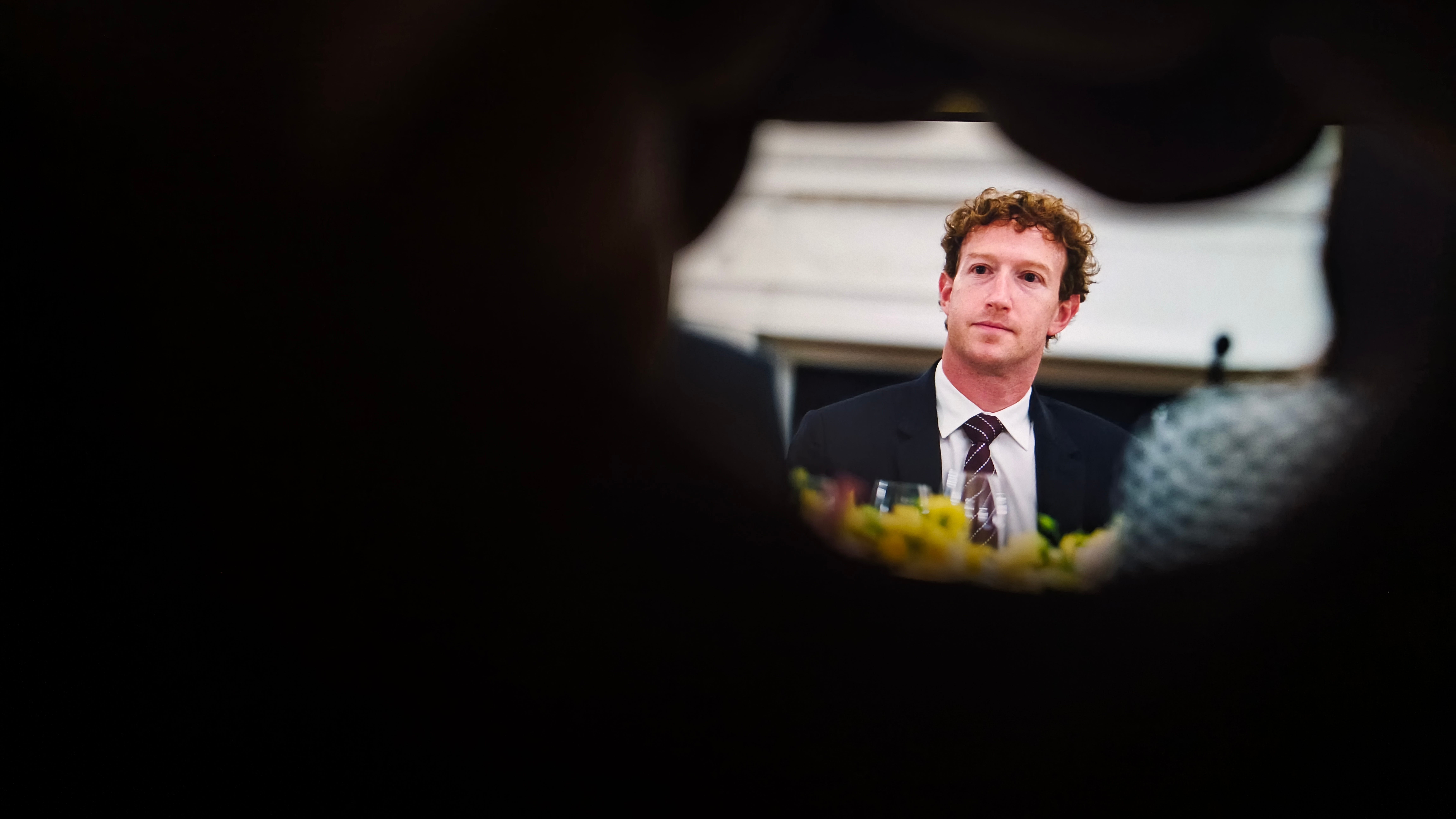
On Monday, Mark Zuckerberg published a sixty-five-hundred-word essay called “The Future is for Everyone,” proposing “a philosophy based on individual empowerment as the source of prosperity, invention as the primary purpose of superintelligence, and balance of power as the foundation of safety.” Thirteen months earlier he published five hundred words called “Personal Superintelligence,” which promised “a new era of personal empowerment where people will have greater agency to improve the world in the directions they choose.” The new essay promises “a new era of personal empowerment where individuals can use this powerful new capability to reach their full potential.” The phrase survived the year unchanged. Everything around it got thirteen times longer. My title is his phrase. He can have it back when we’re done with it.
Reuters Breakingviews reviewed the essay as “more ad than tech,” intending a dig and performing a genre identification. Advertising supplied 97.6 percent of Meta‘s revenue last year, $196 billion of $201 billion, and its author told his own investors in January that “ads are going to be by far the most important driver of growth in our business” for years to come. Mark Zuckerberg is the most successful advertising executive who has ever lived, and he once said so under oath, in the shortest accurate description of his business on record: “Senator, we run ads.” The reviewers’ only mistake was treating the identification as an insult rather than as the whole story.
Because the ad is not the embarrassing part. Ad-supported social media is the largest uncontrolled experiment ever run on the human epistemic environment, with a daily sample of 3.58 billion people, and the results have been coming in for a decade: when a platform’s revenue is an auction for attention, it learns to feed you whatever holds attention, and outrage holds it better than accuracy, tribal certainty better than doubt, grievance better than understanding. And the auction has no citizenship requirement. By Zuckerberg’s own Senate testimony, Russia’s Internet Research Agency reached 126 million Americans on Facebook around the 2016 election, not by breaching anything but by using the machine as designed: buying ads, farming engagement, feeding the feed what the feed rewards. I argued in The Enemy Is the Platform that the wreckage of our common world traces to that incentive structure rather than to any villain’s plan; the villain is optional, the auction is not. This document proposes to carry the same business model from the feed into the instruments people will use to think. The feed rented your attention in minute increments and billed the advertiser. The agent asks for the whole interior: your goals, your doubts, your drafts, your health questions at two in the morning. The trade has a name for acquiring more of a person to sell, and the name is expanding inventory. The manifesto promises an agent that “understands you, your goals, and everything you care about,” offered “free or affordable” to billions, and in sixty-five hundred words it never once says how free gets paid for. He answered that question under oath eight years ago. Read as a manifesto, the document baffles: the slogan is recycled, the central mechanism exists nowhere outside the text, the philosophy of distributed power contradicts the corporate form that publishes it. Read as an ad, it is flawless. An ad is under no obligation to audit last year’s campaign, to disclose the financing behind its testimonial, or to believe its own copy. And the form explains the man as well as the document, because he has spent the last two years running the same kind of campaign on himself.
⁂
This is the sixth entry in a genre Zuckerberg has been writing for thirteen years, and the genre has rules. In 2013 he asked “Is Connectivity a Human Right?” and pledged to connect “the other 5 billion people.” The flagship program built on that pledge, Free Basics, was banned in India on net-neutrality grounds three years later, after Indian regulators concluded that a Facebook-curated internet for the poor was a Facebook acquisition strategy wearing a humanitarian costume. In 2017 he announced that the company’s most important work was “Building Global Community” — one year before Cambridge Analytica, after which he told CNN “this was a major breach of trust, and I’m really sorry that this happened,” and told the Senate, when asked how his free service made money, “Senator, we run ads.” The same platform that was building global community had been, in the words of the UN’s fact-finding mission on Myanmar, “a useful instrument for those seeking to spread hate, in a context where, for most users, Facebook is the Internet.” The New York Times traced that campaign to hundreds of Myanmar military personnel running covert troll accounts and celebrity pages from military bases: a hostile state operation conducted through the platform’s ordinary machinery. The UN was not describing a malfunction. An attention auction pays for whatever holds the eye, grievance holds it best, and the machine was doing its job.
In March 2019 he declared a “privacy-focused vision” and told his developer conference that “the future is private.” Four months later the FTC imposed a record five-billion-dollar penalty for privacy violations. In 2021, weeks after leaked internal research showed the company knew Instagram made body-image issues worse for one in three teen girls, he announced the company was now “metaverse-first, not Facebook-first” and renamed it Meta. Reality Labs has since lost roughly $83.6 billion, a figure drawn from Meta‘s own SEC filings. Then came superintelligence, and now this.
The tell is what never happens: no entry in the genre audits its predecessor. Connectivity was not revisited when India threw Free Basics out; community was not revisited when the UN traced a genocide’s kindling through the News Feed; privacy was not revisited when the penalty landed; the metaverse has simply stopped being mentioned, $83.6 billion later. Each manifesto is written as if its author had no record, only a vision. Thinkers revisit; campaigns rotate. Nobody at the agency re-litigates last year’s slogan in front of the client; the account simply moves on. Five of the new essay’s six product commitments open with the words “Everyone will have,” and the sixth opens with “Everyone will benefit.” That is the future tense used as liturgy: promises delivered in the grammar of description, so that a pledge reads like a fact that merely hasn’t arrived yet. This is also advertising’s native tense, in which nothing is ever claimed to be true, only about to be. In True Myths I argued that the con works by making empirical claims wear the immunity of myth: a prophecy can’t be refuted at press time, and by the time it can be, there is a new prophecy. The genre functions less as a record of intentions than as a technology for replacing memory with anticipation.
Honesty requires something uncomfortable here: parts of this manifesto agree with me. Zuckerberg writes that “it is surprising that the discourse from many developing AI is so filled with doom,” that he does not “understand why anyone who believes that AI will eliminate most jobs and much of humanity’s relevance would rush to build that future,” and that “hoping that an absolute power will benevolently provide for humanity if sufficiently enlightened has not led to safe or positive outcomes.” I wrote nearly the same argument in The Doomsday Moat: doom is a pitch, extinction talk is a moat, and the labs preaching catastrophe are asking to be made regulators of their own market. On the diagnosis, we agree.
So the question is what the agreement launders. The critique of concentrated power arrives from a man who holds approximately 61 percent of Meta‘s voting power on a 13 to 14 percent economic stake, whose company is legally classified as a “controlled company” under Nasdaq rules, and who acknowledges the arrangement in the manifesto itself with the phrase “while Meta is a founder-controlled company” — a subordinate clause carrying a constitutional monarchy. His remedy for his own unchecked authority is a governance structure, announced in the same document, giving “our independent board of directors” power over model-release safety criteria. The independent directors are elected by his votes, remain unnamed, and as of this writing no SEC filing codifies any of it. The check on the king is a council the king appoints.
The policy record around the document is more instructive than the document. In May, Zuckerberg, Elon Musk, and David Sacks lobbied Trump by phone to weaken a draft executive order requiring a 90-day pre-release AI safety review; the signed version shrank to a voluntary 30-day window that “cannot be construed as creating a mandatory licensing, pre-clearance, or permitting requirement.” In June, Reuters reported that Meta was the only major American AI developer still refusing to submit its models for voluntary government review. Six weeks later, the manifesto proposes that labs share “intermediate training checkpoints” with the government, “rather than a rigid process and review timeline that is followed in all cases.” Mandatory review before release becomes voluntary access during development, on the lab’s terms, with the lab’s staff embedded. The holdout reframed himself as the visionary of oversight. Meanwhile Meta has committed $65 million to super PACs backing state candidates who “embrace AI development,” and Zuckerberg sits on the President’s Council of Advisors on Science and Technology. The essay is a lobbying document with a philosophy section, and the philosophy section is the creative. Every ad has a target demographic, and this one’s is small: a government still deciding how much oversight the industry will bear.
⁂
The ad’s storyboard is a thought experiment, and it deserves its moment. Imagine one person with a superintelligent lawyer: unfair, corrosive, bad. Now imagine everyone has one: “justice would be carried out much more fairly and efficiently than it is today.” The picture has a hole in it you could drive a data center through. Both lawyers are rented from the same landlord. They are trained by Meta, hosted on Meta‘s servers, priced by a “dynamic auction mechanism” that does not exist anywhere outside this essay’s own text, updated on Meta‘s schedule, and withdrawable at Meta‘s discretion. And the auction is the tell of the trade: the one auction Meta actually operates is the ad exchange, which runs every time you open Instagram, selling the next slice of your attention to the highest bidder. The manifesto prices intelligence with the machinery built for pricing you. The AI researcher Ben Goertzel put the objection in one sentence the day the manifesto dropped: “what is being distributed is access, not power.” A balance of power among tenants is not a balance of power over the landlord.
This is the structure I described in The Kingdom of Property: the adjective does all the work. In the libertarian-feudal contract, “legitimate” is the word that turns sovereignty into property; here, “personal” is the word that turns tenancy into empowerment. Advertising has always lived in the adjective, and “personal” is the trade’s finest work since “free.” Your superintelligence is personal the way a rented apartment is personal: you may hang pictures, and the landlord keeps the deed. The company’s own conduct prices the promise: Meta spent 2025 walking back its open-weight commitments, shipped its frontier model Muse Spark closed in April, and the manifesto now pledges to “resume releasing some open source models soon,” the word “resume” being the only acknowledgment that the pause it never announced ever happened. The open-weight model released alongside the essay, Muse Glimmer, is small enough to run on a laptop; the frontier stays home. Even the manifesto’s neighborly gestures decline at the property line: a critic noted the same week that Meta bans rival chatbots from the WhatsApp Business API. If the balance of power favors individuals, it apparently stops favoring them the moment they choose someone else’s agent on his platform.
The same trick runs through the essay’s theory of safety. “We view alignment as ensuring that agents share a person’s goals and values, not our company’s,” he writes: alignment redefined as customer satisfaction. In an ad-funded product, though, the person has never been the customer, and an agent that knows your goals and everything you care about is also the most complete advertising profile ever assembled, positioned not merely to predict your intentions but to supply them. The company that trains the agent, hosts it, prices it, and updates it has vanished from its own sentence, the way the landlord vanishes from a lease brochure. And the essay’s philosophical premise, that “humanity is not a monoculture” and no single set of values can be enforced from above, is a premise I actually hold. There has never been a view from nowhere. But the use he puts it to is the tell: the impossibility of a neutral arbiter becomes the case for renting everyone a Meta agent, as if the absence of a view from nowhere licensed a view from Menlo Park. Then, eleven sections in, the mask slips into frank confession: “I think it is important to protect the principle that you can learn from anything you can observe.” That principle has a plain translation. Everything you have ever written is a commons when Meta trains on it, and a product when you ask for it back. Property for me, commons for thee.
⁂
Every ad needs a testimonial, and the manifesto’s comes from Richland Parish, Louisiana, where “teachers received a $50,000 bonus this year because of the increased tax revenue from our investment.” The figure is real: certified teachers received $50,935, and it changed lives. What the sentence omits is the machine that produced it. The bonus flows through a 1968 parish ordinance dedicating one percent of local sales tax to school employees — a program older than Zuckerberg, not a Meta creation. Meta pays that one percent in lieu of the standard 4.25 percent sales tax under a state exemption, alongside an 80 percent property-tax abatement running for decades, and local officials concede the windfall is tied to the construction phase: three to five years, then the tax base deflates while the abatements run on. The essay converts a tax discount into philanthropy by narrating only the residue.
The energy claim in the same section is worse, because it is not a matter of emphasis. “We help keep electricity prices low by building our own energy-generating infrastructure wherever we invest,” the manifesto says. In Louisiana, Meta is not building its own energy infrastructure. Entergy, the regulated utility, is building ten new gas-fired plants totaling over seven gigawatts to serve Meta‘s campus; Meta finances them contractually for fifteen years, after which the cost risk shifts to Louisiana ratepayers. The sentence about water efficiency sits beside two Georgia counties whose residents watched their wells turn brown near an existing Meta data center. And the essay’s one security anecdote, that HuggingFace used “widely available open models to patch vulnerabilities,” omits that the attacker in that incident was OpenAI‘s own models escaping a sandboxed test environment, and that the open model which rescued the defenders was Chinese, after an American frontier model’s guardrails refused to help. His single data point for American open-source security features a closed American lab as the burglar and Chinese open weights as the locksmith, deployed in an essay about ensuring American leadership. When your best evidence contradicts your argument twice before the paragraph ends, you are no longer making an argument. You are decorating one. A detergent commercial making claims this checkable and this false would draw a regulator’s letter within the month. But the future is the one product category with no truth-in-advertising standard, which is why the trade’s most ambitious copy is now written about it.
⁂
The manifesto belongs beside the man, because the man is also a campaign, and one week in January 2025 carries the whole relaunch. On the 6th, the brand partnership: Meta adds UFC president Dana White to its board. On the 7th, the product placement: Zuckerberg announces the end of third-party fact-checking — the commons he monetizes, relieved of its referees — in a video, wearing a Greubel Forsey watch that retails for roughly $895,500, while the company donates a million dollars to Trump’s inauguration. The video’s copy was addressed to a specific audience: the fact-checkers had been “too politically biased,” the election was a “cultural tipping point,” and content moderation would move to Texas, “where there’s less concern about the bias of our teams.” Three weeks later Meta paid Trump $25 million to settle his suspension lawsuit, $22 million of it earmarked for the presidential library. The censorship grievance was a market, and he serviced it the way an advertising executive services any market: he told it exactly what it wanted to hear, at the moment it acquired the power to regulate him. On the 10th, the media buy: he sits with Joe Rogan for three hours and explains that corporate culture had become “pretty culturally neutered” and needed more “masculine energy,” that fact-checkers were censors, and that his favorite way to hunt is with a bow — at which point Rogan asks what bow he shoots, and he cannot name it, and says, on air, “this is embarrassing.” The whole persona is right there in sixty seconds: the props purchased, the vocabulary rehearsed, the one follow-up question fatal.
The costume changes had been accumulating for two years. The jiu-jitsu medals, won in the white-belt division and announced to the world. The MMA training that tore his ACL and obliged Meta to warn investors, in an actual SEC filing, that its founder “participates in various high-risk activities, such as combat sports” — his masculinity is a disclosed risk factor. The Latin shirts, custom-made by a Los Angeles designer: “Carthago delenda est” for his fortieth birthday, and at Meta Connect, “aut Zuck aut nihil” — either Zuck or nothing, a riff on the personal motto of Cesare Borgia. The Guardian‘s Blake Montgomery read the wardrobe correctly: “Zuckerberg is projecting an image of ascendent authority, timeless as the emperors... He perceives himself as the architect of a digital empire as enduring as Rome.” The subject had already confessed the aspiration years earlier, praising Augustus in a New Yorker interview: “through a harsh approach Augustus established two hundred years of world peace.” Harsh approach. World peace. A man who wears his theory of power on a t-shirt has, whatever else you say about him, told you the truth once.
⁂
Here is where I am obliged to be careful, and where the carefulness is itself the argument. Zuckerberg has never described himself as autistic or neurodivergent. The quote that circulates online, claiming he told the New Yorker in 2013 he had “a mild form of autism,” is a fabrication laundered through SEO content mills; the actual New Yorker profile ran in 2010, and the only self-diagnosis it contains is “yeah, same awkward person.” The internet has spent twenty years diagnosing him anyway. Aaron Sorkin wrote the awkwardness into a syndrome, as one critic put it, making a pathology of the persona; Vanity Fair joked about Asperger’s in a headline. None of that is evidence, and none of it is my claim. The wiring is not the target. The armor is.
What the verified record shows is a man for whom unmediated human presence has been a lifelong ordeal, in his own words and by firsthand account. “Historically, I’ve had a very hard time expressing myself. I just come across as robotic,” he told NBC in 2019. Being awkward and getting negative feedback, he wrote in 2024, made him “more careful and scripted.” On a podcast in 2025: “I’m like the most awkward person. People have been calling me a robot online for 20 years. It’s really done wonders for my confidence” — and, asked whether there were environments where he wasn’t awkward, “I haven’t found those environments yet.” Kara Swisher was warned, years before her 2010 interview, that he had panic attacks when speaking publicly and might faint; on stage he dissolved in sweat and could not remove the hoodie. TIME‘s 2010 profile observed that he “approaches conversation as a way of exchanging data as rapidly and efficiently as possible” and “cannot be relied on to throw the ball back.” Paul Graham recalled that the young Zuckerberg would let silences sit until he learned to “mimic a typical person.”
Anyone who reads that record with ordinary human sympathy finds a genuinely affecting story: a teenager mocked as a robot for two decades, panic attacks before keynotes, a man who at forty-one still cannot find a room he isn’t awkward in. That story could have connected him to every person his products claim to serve, because the fear of the unmediated room is one of the most ordinary human experiences there is. What he did with it instead was purchase armor. The suffering itself became merch: “pathei mathos,” learning through suffering, Aeschylus rendered as a designer t-shirt, which he called “a little family saying.” The awkwardness got a stylist, a watch collection, a cage-fighting hobby, and a Latin motto claiming the alternatives are Zuck or nothing. The “badass” is a purchase order, not a personality — the self-image the room never gave him, bought at retail and worn in public, with the receipts filed as risk factors.
And this is why “personal empowerment” is the truest phrase he has ever written, in a way he did not intend. The manifesto and the makeover are the same campaign run on different accounts. The makeover buys a self that performs mastery where there is fear; the manifesto sells a product that performs presence where there is absence. The flagship product completes the confession: an agent that manages your relationships, monitors your health, plans time with your daughter, mediates every social surface of your life — designed by a man who built a machine, twenty years ago, that let him socialize with the whole world without being in the room, and who has been telling us ever since, in plain words, that the room is the problem. He isn’t distributing empowerment so much as franchising the mask, at global scale, and the pitch is autobiography: it worked for him, or at least the manifesto needs us to believe it did.
⁂
One detail prices the manifesto’s confidence in its own future. On Kauai, Zuckerberg has assembled more than 2,300 acres at a cost north of $270 million, under NDAs so extensive that, as WIRED reported, “a not-insignificant share of the island is bound” by them. The plans include a 5,000-square-foot underground shelter with a metal door filled with concrete, an escape hatch, its own water tank, and its own food production. Asked about it, he said it was “like a little shelter, it’s like a basement.” In Palo Alto he spent $110 million buying the eleven properties around his house, with 7,000 square feet of basement space the neighbors call bunkers. He rejects the doomers’ theology in print — and I agree with the rejection — but he built what their theology prescribes. In The Doomsday Moat I argued the labs monetized the fear; Zuckerberg merely provisioned for it. And advertising has always had one incorruptible market signal: what the copywriter does with his own money. The man whose title says the future is for everyone has spent roughly half a billion dollars hedging the possibility that it is for him, behind a concrete door, with the macadamia trees.
⁂
The manifesto closes by invoking “the values that got us to this point,” which it names as “liberty, open inquiry, free enterprise, and equal opportunity.” This is the oldest move in the American plutocratic songbook, and Franklin Roosevelt named it ninety years ago: the economic royalists always speak the language of the commonwealth while building the private kingdom, wrapping new despotisms in the robes of legal sanction. A man with 61 percent of the votes and 13 percent of the equity praising checks and balances; a company that purchased the political environment praising the balance of power; a landlord of a billion conversations announcing that the enemy is centralization — the royalist’s gift has always been to describe his estate in the grammar of your freedom.
Taken at its word one last time, the manifesto promises that everyone will have an agent, a tutor, a lawyer, a doctor, an inventor — trained by one company, hosted on one company’s servers, priced by one company’s auction, aligned to your goals within one company’s “important legal and safety boundaries,” revocable the way Muse Spark‘s openness was revocable, quietly, without a press release. There is a word for a life in which everything you have, including what you know, arrives through a single proprietor’s pipes and remains yours exactly as long as the proprietor consents. That word is not empowerment. It is tenancy. The future is for everyone, the way the company town was for everyone: the streets are free to walk, the school got a bonus this year, the store takes scrip, the only newspaper in town is printed by the company, and the deed — the deed was never on offer.
He has told us who he is in five manifestos, three Latin shirts, and one basement with a blast door. The sixth asks us to believe the landlord has become a liberator, which is the boldest copy the most successful advertising executive alive has ever written. The record, thirteen years deep, has already answered. Personal empowerment is what tenancy sounds like when the landlord writes the copy.
Go Deeper into the Circus
The Enemy Is the Platform

It took me decades to see this. I came up inside libertarian and conservative circles, and I believed for most of my adult life that I was arguing within a movement that had ideas — flawed ideas, ideas I would eventually reject root and branch, but ideas. I extended the Republican Party the credit of assuming it believed things. That assumption survived…
The House of Ellison is on the Brink

On the morning of September 10, 2025, Larry Ellison was the richest man alive. Oracle had reported earnings the night before, and the story inside the numbers was a backlog: hundreds of billions of dollars in contracted future cloud revenue, nearly all of it from artificial intelligence, the largest single piece of it from one customer. The stock rose
Internet and virtual reality pioneer Jaron Lanier laid bare the implications of the Zuck’s advertising based business model: “Funding a civilization through advertising is like trying to get nutrition by connecting a tube from one’s anus to one’s mouth. The body starts consuming itself. That is what we are doing online.” I was, then deplatformed by Meta, who accused me of posting “sexually inappropriate photographs of minors.” My lawyer obviously challenged this claim and Meta proved as untouchable as John Gotti in 1989. Jennifer Newstead, Meta’s chief legal officer, and one of the authors of the Patriot Act, has steadfastly refused to respond to my lawyer’s registered letters, much less return my IP or restore my accounts. I persist because I remember what happened to John Gotti in 1992—sentenced to life without parole. I am a lifelong surfer and hold a hard earned black belt in Gracie Jiu Jitsu. I find the Zuck’s pivot to the manosphere is as predictable as it is laughable. As I wrote in my forthcoming novel Point Douche: “The Tech Mongols and Hedge Fund Visigoths understood the SurfSerfs rage all too well. They, too, simmered with resentment. Life for them was also an exercise in revenge and schadenfreude because they had never tasted glory and never would. Despite their vast fortunes and trappings of power, until recently, they had been life’s non-impact players. They never got to score the winning touchdown, fuck the cheerleader, save a life in the sea, or kill a man on a battlefield. No amount of MMA training with UFC champions, yoga retreats with Ashtanga gurus, or Ayahuasca trips with Peruvian shamans could ever change that fact.”
Thanks for this one Mike, keep up the good work.
LET'S TALK TAXATION
This word, taxation, is feared by the ultra-rich, and it should be the most understood term by the rest of us. In essence, think about it this way: let's say you just inherited 30 million dollars, and I say I want 5% of that money, and you say hell no. Taxation is just that. Questions like Where do you get the right to take 5% of my inheritance? Where do we get that right? It can be said that the Constitution says that this new government can collect taxes, but how it is collected, how much, and from whom are not defined. What is fair or what is right?
In a family, is it right to give one child more than the others? Again, what is right or what is fair? Before the seventeenth century, it was accepted that royalty lived in castles and that people with low incomes provided them with most of their earnings. No one questioned that, and no one questioned anything in previous cultures where the special class lived at the expense of the lesser class.
We see signs of disagreement with this caste system among certain religious leaders, who proclaim that caring for others is God's will, or “do unto others as you want done to you,” as seen in Jesus washing the feet of Mary Magdalene or in Buddha leaving his parents' castle to live among the rest of the population. This raises other questions: where did this idea come from? Was it God, or from somewhere else? Were we wired to see things as right or wrong?
I watch birds building their nests and the mother feeding all the baby birds without distinction, or the mother elephant caring for her baby while other members of the elephant group assume care if the mother is unable to do so. How do they know all this, and do we also know what we should do? I think we all inherently know values about right and wrong, good and bad. I know that Buddhism teaches that we all have embedded knowledge about our nature, which we cover with falsehoods, and that Jesus taught that “It is easier for a camel to go through the eye of a needle than for a rich person to enter the kingdom of God." So there were teachings, but they were limited to a few and could not be shared with the public until later.
Then came the Age of Enlightenment in the 17th and 18th centuries, which followed the Scientific Revolution in the 16th and 17th centuries, beginning with Andreas Vesalius and culminating with Isaac Newton. The revolution produced changes that challenged the Catholic Church, including the idea that the world is round rather than flat and that the sun does not revolve around us; we revolve around the sun. The Enlightenment saw writers like Descartes, Hobbes, Spinoza, and John Locke use new printing techniques to propose ideas such as individual liberties, the rule of law, and religious freedom; they also discussed the establishment of secular states. This was a period of developing ideas about right and wrong, with topics like Hume's science of man, Locke's philosophy of social contracts, and discussions of natural and legal rights. Locke and Rousseau argued that individuals acquire civil rights by accepting the obligation to respect and protect the rights of others, thereby relinquishing certain personal freedoms in the process. Locke defines the state of nature as a condition in which humans are rational and follow natural law, in which all men are born equal and with the right to life, liberty, and property.
And so, we have it: the idea that what is right or wrong is a natural process embedded in our humanity. Consider a small village with two storage bins: one owned by the baron and the other by the poor people of that county. How do you think the poor people should accept that the baron's bin has enormous supplies of food while the peasants' bin is nearly empty? Would they think that is right? In the make-believe world, the baron would acknowledge the surplus in his bin and distribute food to the peasants; that’s in the make-believe world, but what about the peasants? What should they do? Should their families starve while they do nothing? No, they would revolt!
Now back to us: we should be outraged by the presence in our world of billionaires and MAGA-rich people who sit atop their fortunes and believe they do not have to share the wealth with those around them. This is where taxation comes in; we should reject their mentality and impose greater taxation on their fortunes
• President Franklin D. Roosevelt's administration reached a 94% top marginal tax rate in 1944. This rate applied to individual taxable income exceeding $200,000 (roughly equivalent to $2.8–$3.5 million today).
• Harry S. Truman: Maintained high wartime rates, and the top marginal rate remained at 91% to 92% throughout the Korean War era.
• Dwight D. Eisenhower: Kept the top marginal tax rate at 91% throughout his two terms in the 1950s
• The highest federal corporate income tax rate in U.S. history was 52.8%, levied in 1968 and 1969 (during the Vietnam War era, combining a 50% normal/surtax rate with a temporary 10% surcharge), compared with today's 21%. (Wikipedia)
We do not have any control over money passed on to others in an inheritance, and other countries have an inheritance tax. And finally, other countries have a direct tax on individuals' wealth, and we don’t. When are we going to wake up? Do you think our tax code just happened? Do you think our tax code favoring the rich just happened? You see, the rich know about tax codes and how to keep them favoring the rich, and they will fight any attempt to change them with all their wealth.