


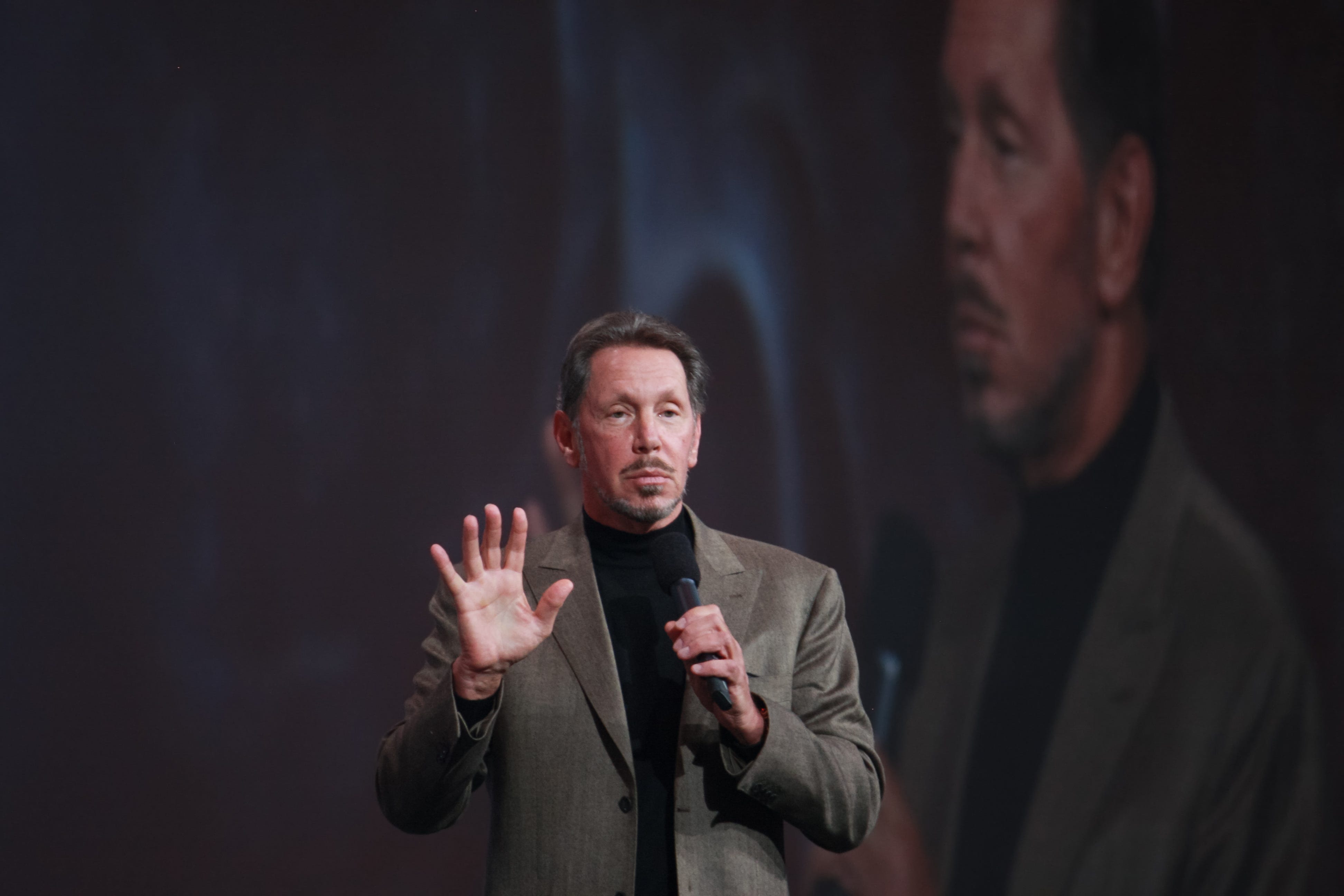
On the morning of September 10, 2025, Larry Ellison was the richest man alive. Oracle had reported earnings the night before, and the story inside the numbers was a backlog: hundreds of billions of dollars in contracted future cloud revenue, nearly all of it from artificial intelligence, the largest single piece of it from one customer. The stock rose as much as 43 percent in a day. Ellison, who owns roughly 40 percent of the company he founded in 1977, gained $101 billion overnight — the largest single-day wealth gain ever recorded on the Bloomberg Billionaires Index — and passed Elon Musk, his net worth cresting at $393 billion. He was eighty-one years old, and every bet he had ever placed appeared to pay off on the same morning.
The customer was OpenAI. The contract was three hundred billion dollars of computing capacity over roughly five years, sold to a company that has never earned a profit and burns billions in cash every year. The market heard the number and paid Ellison for it as if the money were already in the vault.
Ten months later, the ledger reads like a curse working its way through everything the man owns. Oracle‘s credit rating sits one notch above junk. Its credit default swaps trade at prices last seen eighteen years ago. The stock has collapsed from $345.72 to a fifty-two-week low under $115, a fall that erased around $600 billion in market value. Ellison’s personal fortune has shrunk by $213 billion in under ten months; Forbes now ranks him eighth in the world, one seat behind Jensen Huang, the man who sells him chips. His son’s $110.9 billion conquest of Warner Bros. Discovery is frozen by a federal judge, and twelve state attorneys general are suing to kill it. The news network his family bought is posting the worst ratings in its history. And the cause he has funded more generously than perhaps any living American — the state of Israel and its military — keeps surfacing in boycott pledges, blacklist accusations, and campaigns to pry his newest platforms out of his hands.
There is a line long attributed to Ellison, quoted by a biographer borrowing from Genghis Khan: it is not sufficient that I succeed — everyone else must fail. Whether he ever said it, he built like he believed it. The database monopoly, the litigation-as-strategy years, the acquisitions swallowed whole, the islands, the warplanes, the weddings. For five decades the universe declined to invoice him for any of it. What sets this past year apart is the synchronization: every wing of the empire drawing down at once, each failure feeding the next.
One may be tempted to reach for the word karma. Let’s go through the whole cosmology and see how we feel about that at the end.
One disclosure before anything else: I am short Oracle stock. I will profit if what I describe here keeps happening, and you deserve to know that before you weigh a word of it. I am at least in documented company — Michael Burry’s Oracle shorts have already paid — but weigh it all the same.
⁂
AI is a bubble. Everybody knows it’s a bubble. The market is running on magical thinking. AGI is a fever dream. And LLMs shouldn’t even really be considered AI.
Calling it a bubble, though, flatters it. A bubble at least requires strangers — a crowd of outside buyers chasing an asset they don’t understand. The AI economy stopped depending on strangers some time ago. Its largest transactions now run between a handful of related parties who invest in one another, sell to one another, and book one another’s money as growth. Bloomberg built a map of these deals, and the map is a circle. Yesterday, reporting on the newest wave of Nvidia commitments — more than $750 billion — Bloomberg‘s headline said the deals revive fear of AI circular financing. The fear is the correct response.
Walk the circle once. In September 2025, Nvidia pledged up to $100 billion to OpenAI, its own largest customer, and CNBC reported the cash would mostly be used to lease Nvidia‘s own hardware. Nvidia books the sale as revenue. Its own money, returned one accounting cycle later, arriving at a valuation its own investment helped set. The $100 billion headline did its work on the stock price and then quietly evaporated: negotiations broke down in January, and by February the figure had shrunk to $30 billion. The market repriced trillions of dollars of equity around a number that was never executed at scale.
Oracle signed the $300 billion contract that crowned Ellison in September. Microsoft holds 27 percent of OpenAI, a stake valued around $135 billion, while selling it compute and competing against it for the same customers. AMD went further than any of them: per its own SEC filing, it granted OpenAI warrants on 160 million shares — roughly a tenth of the company — exercisable at one cent apiece, vesting as OpenAI buys its chips. A chipmaker paying its customer, in equity, for the privilege of the customer’s business.
Then there is CoreWeave, the cleanest loop in the pile. Nvidia holds an equity stake in CoreWeave that it has kept topping up. CoreWeave raises debt collateralized by the GPUs themselves and spends the majority of everything it raises buying Nvidia hardware. And Nvidia has agreed, per CoreWeave‘s 8-K, to buy back $6.3 billion of whatever capacity CoreWeave fails to sell, through April 2032. Vendor, investor, and buyer of last resort: one company, all three seats. And who rents the capacity? Microsoft alone accounted for about two-thirds of CoreWeave‘s revenue — the same Microsoft that owns 27 percent of OpenAI, which holds its own $11.9 billion CoreWeave contract. Four companies, and every dollar visits all four before it rests.
Morgan Stanley added it up last October: contracts linked to OpenAI — one unprofitable startup — account for more than $330 billion of the $880 billion in combined booked future revenue at Microsoft, Oracle, and CoreWeave, including two-thirds of Oracle‘s entire backlog. Jensen Huang calls the circularity charge ridiculous. Senator Elizabeth Warren, in a formal letter to Sam Altman demanding answers about the spending commitments, wrote that OpenAI “appears to be privatizing profits while seeking ways to let the public defray the costs of any potential failures of its business strategy.”
Enron‘s signature device was the special-purpose entity: partnerships the company capitalized with its own stock, so it could trade with itself and call the results revenue. The structure had one fatal property — it worked only while the stock went up. When the shares fell, the entities that depended on the shares failed, and the failures dragged the shares down further, a machine that ran in both directions. The AI economy has rebuilt the reflexive machine — vendors capitalizing their customers with equity, buying back their unsold capacity — at a thousand times the scale and put it inside the S&P 500.
If the shape of this reminds you of something, it reminded Bloomberg Tax of the same thing. Their headline, July 21: Big Tech AI Spree Revives Accounting Devices That Toppled Enron. A technical accounting consultant named Tom Selling put the stakes in one sentence for them: “What if one of these companies was a house of cards and was propping itself up with this accounting treatment? To me, that’s the risk.” Jim Chanos, who saw Enron before anyone else did, calls the AI financing complex, with its generous GPU depreciation schedules at CoreWeave and Oracle, a confidence game. For scale: Enron‘s entire final-year revenue was about $100 billion; the Oracle–OpenAI contract alone is three times that. Enron‘s peak market value was roughly $70 billion; Nvidia‘s is five trillion. The Bank for International Settlements — an institution constitutionally incapable of hyperbole — compared the AI buildout to canal mania, railway mania, and the dot-com bubble, and observed that “these episodes ended with an eventual reversal in investment, inducing economy-wide recessions.”
For ten months, believing was free. Then the bond market asked to see the collateral.
On July 9, S&P Global cut Oracle‘s credit rating from BBB to BBB-minus, one notch above junk, and conceded in the rating action that it had “misjudged the magnitude of the investments needed.” The agency named the concentration plainly: OpenAI accounts for roughly half of Oracle‘s $638 billion backlog. Half the order book of one of America’s flagship enterprise-software companies now depends on a single money-losing startup honoring a $300 billion contract.
The numbers underneath explain the decision. Capital spending for fiscal 2027 is projected at $90 to $95 billion, up from an expected $60 billion. Free cash flow is projected at negative $42 billion. Total debt sits around $160 billion, and Moody’s holds a negative outlook, meaning a second agency sees a further cut as possible. The cost of insuring Oracle bonds against default has climbed to levels last seen in 2008. Microsoft runs its buildout on a AAA balance sheet; Oracle chose to bet the company, and the bet now trades one wobble from junk. Oracle is no startup, to be fair to the skeptics of this argument: the database business that built the house still throws off steady billions, and the company survives even if OpenAI stumbles. The floor is real. The bet was placed several stories above it. The souring is general, too: on Friday Moody’s warned that hyperscaler capital spending will approach a trillion dollars in 2027, “unprecedented levels of investment” that are pushing the most cash-rich companies on earth into borrowing, stock sales, and off-balance-sheet financing, the same week CNBC catalogued the bond market’s anxiety about the whole complex.
Hold the two moments side by side. In September, the equity market handed Ellison $101 billion in a single day for projected revenue from a contract that runs through 2032. No company in this cycle books unrealized contract revenue as earnings the way Enron did; the stock market does the booking on their behalf, pricing the projections into the shares the day the press release goes out. What the equity market booked in an afternoon, the credit market has spent this summer unwinding line by line. It marked the same contract to a different model — one that asks where the cash comes from — and the answer came back BBB-minus. In late June, Oracle logged its worst week since the dot-com bust of 2001 — an anniversary the company should recognize, having barely survived the original. The month of the downgrade, the stock fell 34 percent even as the company landed a $7 billion Pentagon contract. When credit sours, good news stops mattering.
⁂
The remaining bull case fits in one sentence: the models will get so good that the revenue has to arrive. It deserves its strongest form: these systems are the fastest-adopted technology in living memory, hundreds of millions of people use them every day, enterprises are writing real checks rather than running pilots, and the people making the trillion-dollar commitments include the most sophisticated capital allocators alive.
The canyon under that sentence is measurable. Sam Altman himself put OpenAI‘s revenue at about $20 billion annualized while acknowledging roughly $1.4 trillion in infrastructure commitments over eight years — seventy dollars of committed spending for every dollar currently coming in. The Wall Street Journal reported last week that the company’s planned cloud spending alone has reached $750 billion. HSBC estimates the financing shortfall exceeds $200 billion even on friendly assumptions. Ed Zitron, who has been documenting the mismatch since before the financial press would touch it, compressed the underlying economics into a single sentence: “In 2024, OpenAI spent $9 billion to lose $5 billion.” The losses have only grown since: by April, Yahoo Finance was reporting that OpenAI had missed its internal user and sales targets for 2026, putting Oracle‘s commitments “in focus.” The bridge over that canyon is a story about machines that will soon think.
I believe they will not. A large language model is a translation engine: it maps between representations of things humans have already written, and it does this so fluently that the fluency gets mistaken for understanding. That mistake is the entire equity story. Whatever these systems become, the gap between interpolation and mind is a difference in kind, and no quantity of capital expenditure converts one into the other. You cannot depreciate your way across a metaphysical boundary. But the bet does not need me to be right about any of that.
Suppose the fever dream is real and the machines learn to think. The loop still fails, because the AGI story has a second load-bearing assumption hiding under the first: that whoever builds the thinking machine gets to charge monopoly prices for it.
⁂
Beijing has decided that nobody will.
In May, DeepSeek made permanent a 75 percent price cut on its flagship model, fixing output at 87 cents per million tokens. OpenAI‘s comparable list price is $30 — a thirty-four-fold spread for work that most paying customers cannot tell apart. The models ship with open weights on Hugging Face, and the newest ones ship optimized for Huawei‘s silicon. On July 16, Moonshot released Kimi K3, the largest open-weight model ever published, benchmarking alongside the best American closed models; one independent leaderboard ranked it first outright. Fortune‘s read on the market reaction was exact: the release rattled investors “because it challenged the idea that U.S. firms could maintain their sizable lead in the global AI race simply by outspending Chinese rivals.” Customers noticed too. CNBC reports that American companies are moving growing shares of their workloads onto Chinese models while the American labs raise prices to cover their buildouts.
The hardware side of the squeeze is further along. Jensen Huang said in June that Nvidia‘s share of the Chinese market has gone from “90-some-odd percent” to — his words — “dropped to zero”, with domestic chipmakers having taken 41 percent of China’s accelerator market in 2025 on their way to shoving him out entirely. And Fortune gave the strategy its proper name yesterday: the steel playbook — scale, subsidies, and price pressure, cheap supply pushed into the world market until competitors have to absorb it. China ran this play on steel, then solar, then batteries, then electric vehicles. Intelligence is next on the list, and tokens, unlike steel, ship at the speed of light and clear customs nowhere.
This is what deprives the loop of its theological escape hatch. The AGI story requires scarcity rents — monopoly prices for a product nobody else can make. If the models plateau, the projected revenue never arrives. If the models keep improving, the improvement is replicated in Hangzhou within weeks and given away at 87 cents per million tokens. That is the whole decision tree, and the industry is standing under it. Heads, no product. Tails, no pricing power. The $300 billion does not pencil in either world, and Oracle borrowed $160 billion against the world where it did.
⁂
The man at the center spent the paper while it was still worth something.
In August 2025, his son David’s Skydance completed its merger with Paramount, the Ellison trust as controlling owner. In December, David went hostile for Warner Bros. Discovery — CNN, HBO, the Warner film library — and his father backed the bid with an irrevocable personal guarantee of $40.4 billion. The definitive agreement, signed in February, came to $110.9 billion in cash.
Where does an eighty-one-year-old get $40 billion in cash? He doesn’t have it. Forbes went through the estate: less than $10 billion in cash, only about $4.7 billion of Oracle stock sold this century, and a family trust whose asset is 1.16 billion Oracle shares. The guarantee is Oracle paper. Before the Warner bid, 346 million of his shares were already pledged as collateral for personal ventures — about 30 percent of his stake — and those pledged shares have lost roughly half their value since. Alongside the family money: $24 billion from the sovereign wealth funds of Saudi Arabia, Abu Dhabi, and Qatar, which would hold 38.5 percent of the combined company in non-voting shares. The DOJ approved the deal in June with zero conditions. The sitting president had already said out loud that he wanted CNN in the Ellisons’ hands.
The collateral chain runs in one direction. An AI circuit inflates Oracle equity. The equity backs a personal guarantee. The guarantee buys the American press, with Gulf autocracies as co-investors and the government waving from the curb. That was the play: convert circuit paper into hard, permanent assets — the third-largest news network, the second-biggest film library on earth, the cable channel the president most wanted delivered to friendly hands — before the paper deflated.
The paper is deflating first. On July 20, a federal judge issued a temporary restraining order blocking the close, with a preliminary-injunction hearing set for August 3 that could stall the deal for months. Twelve states are suing. Oracle fell 34 percent in July alone while the guarantee sat exposed underneath it.
Had the deal closed in the spring, the House of Ellison would hold real assets, immune to whatever happens to a cloud backlog. Instead a judge froze the conversion mid-transaction. The guarantee is signed and irrevocable; the assets are undelivered; the collateral loses value every week the courts deliberate. He is holding the obligation without the prize, which is the exact position a man who owns forty percent of a BBB-minus company cannot afford to hold. Margin calls do not read narrative strategy.
⁂
And what was the empire for? The first network the family captured answers the question.
In October, Paramount Skydance bought The Free Press for $150 million and installed its founder, Bari Weiss — a person who had never worked a day in television — as editor-in-chief of CBS News. “I wanna blow this up,” she reportedly told colleagues. Everyone understood the assignment. The network had already paid the Trump administration $16 million to settle a lawsuit most lawyers considered frivolous; the job was to pull the newsroom of Murrow and Cronkite to the right and make the pulling look like renewal.
She is nine months in. CBS Evening News just posted its lowest-rated first quarter this century, and CBS was the only broadcast network whose news audience shrank while NBC’s and ABC’s grew. A quarter of the Evening News staff took buyouts rather than work for her, one departing producer describing a newsroom pressured to self-censor. In March she shuttered CBS News Radio — the division whose London microphones carried Edward R. Murrow through the Blitz — and laid off six percent of the news division. By July, CBS Mornings had logged the least-watched week in the program’s history. Scott Pelley, fired in June after thirty-seven years, told the New York Times she was murdering 60 Minutes and putting a thumb on the scale for the president’s version of events — “a level of political influence that I had never seen in 37 years.” At the Golden Globes, on CBS‘s own air, Nikki Glaser told the room the network had become America’s newest place to see BS news, with David Ellison sitting in the audience.
The Ellisons sent in a fellow hack to move CBS News to the right. She could not manage even that. All she has accelerated is the decline: the audience the family bought the network to influence responded by ceasing to be an audience. Propaganda has a precondition, and the precondition is reach.
⁂
Ellison’s devotion to Israel is the least hidden thing about him. He made the largest single gift in the history of Friends of the IDF; Netanyahu is a personal friend; as far back as 2015 he was privately vetting Marco Rubio for loyalty to Israel in emails with Israel’s UN ambassador. Since 2021 he has given or pledged £257 million to the Tony Blair Institute — and when the Guardian reported that institute staff had taken part in a project reimagining postwar Gaza as a “Trump Riviera,” the money trail behind the institute ran straight back to him. Weiss, the family’s pick for CBS, is known above all for her advocacy on the subject.
He is entitled to his cause. The empire has been a catastrophe for it. After thousands of film workers signed a pledge to boycott complicit institutions, Paramount stood publicly accused of maintaining a blacklist of talent who criticized Israel. His move on TikTok spawned a national campaign to take the platform back. Every property he adds attaches his politics to it, and audiences keep responding the same way: by leaving. The machine he built to protect the cause now generates evidence against it. He bought the microphone, and the room walked out.
⁂
Add up the ledger. Every wing of the House rests on one column: Oracle equity. The equity rests on the OpenAI contract. The contract rests on the AGI story, and the story is being repriced out of Hangzhou at 87 cents per million tokens. A federal judge holds the Warner deal; twelve attorneys general hold the lawsuit; S&P Global holds the rating one notch off the floor. Underneath all of it, an eighty-one-year-old man holds a $40.4 billion promise, irrevocable by its own terms, written against a stock that has lost two-thirds of its value since the morning the promise became imaginable.
The exposure extends past him. The Magnificent Seven make up about 35 percent of the S&P 500; a standard index fund now holds more than 7 percent Nvidia whether its owner has ever heard of a GPU or not. Every teacher’s pension and every target-date retirement fund in America is a silent co-signer on the circuit. When the Oracle–OpenAI contract was priced into the indexes last September, they co-signed that too. Nobody asked them.
I am short Oracle because a short position is a bet that gravity still works. You can call what is happening to Ellison correlation risk, and a risk officer would. The older vocabulary has a better word. A man spent decades converting money into power and power into impunity, and the collateral under both is repricing at once. The bonds, the judge, the states, the rating, the price war — that much is one trade, and it is unwinding as one trade. The CBS collapse and the boycotts answer to no margin call; they are the same man making the same bet in a different arena, wagering that an audience can be bought the way a backlog can. Karma names the pattern rather than the mechanism — character meeting consequence, wherever the consequence chooses to book itself. The House of Ellison was assembled at the top of a circuit, out of paper, against collateral that reprices by the week. Karma is what a margin call feels like when you had it coming.
Go Deeper into the Circus
How to Publish a $1.43 Billion Bribe and Survive it

The strangest thing about the $1.43 billion is that we know about it.
The Doorbell

On Friday morning, with the Senate scrambling through its last items before a five-week August recess, Bill Cassidy of Louisiana walked to the floor and announced that Todd Blanche would have his vote. “This is not a referendum on President Trump,” he said. “It is a decision regarding Mr. Blanche. ... All considered, I will vote for Mr. Blanche.” It was…
The Great Moral Sorting

On Friday morning, Rand Paul posted an update for his followers: “It’s official: letters to prosecute Fauci have been hand delivered to @DOJ.” The day before, the Senate Homeland Security Committee he chairs had voted eight to five, along party lines
Thank you for another thought-provoking article. Whether readers agree with every conclusion or not, you've highlighted an important issue that deserves public discussion: the growing concentration of influence across technology, finance, artificial intelligence, and media.
Throughout my work on election transparency, I've learned that confidence is never built on trust alone—it is built on transparency and the public's ability to verify. That principle applies well beyond elections. When institutions become larger, more complex, and more interconnected, independent scrutiny becomes even more important.
Healthy democracies depend on competitive markets, a free and independent press, and systems that the public can verify rather than simply trust. Whatever happens with Oracle, AI, or media ownership, I hope this encourages more people to ask thoughtful questions and demand greater transparency from every powerful institution—not because we assume wrongdoing, but because openness builds confidence.
"Trust is strengthened by transparency and verification—not by asking the public to accept conclusions on faith." John R Brakey
"Karma names the pattern rather than the mechanism-character meeting consequence" Clarity. Thank you! Karma, like gravity, "Is A Law!" 😊 I studied Physics while teaching yoga and it still amazes me how the Laws of Physics relate to our actual everyday experiences. Like gravity, it's inevitable. Though I'll admit it seems more gratifying when we are around to watch.