


It took me decades to see this. I came up inside libertarian and conservative circles, and I believed for most of my adult life that I was arguing within a movement that had ideas — flawed ideas, ideas I would eventually reject root and branch, but ideas. I extended the Republican Party the credit of assuming it believed things. That assumption survived my exit from those circles by years, because it flattered everyone who held it: the party got to be wrong instead of empty, and I got to have spent my youth inside an intellectual tradition instead of a coalition of grievances wearing one. So before I hold anyone in this essay accountable for what they refused to see about their own movement, I should say plainly that I refused to see it too, from closer range, with fewer excuses.
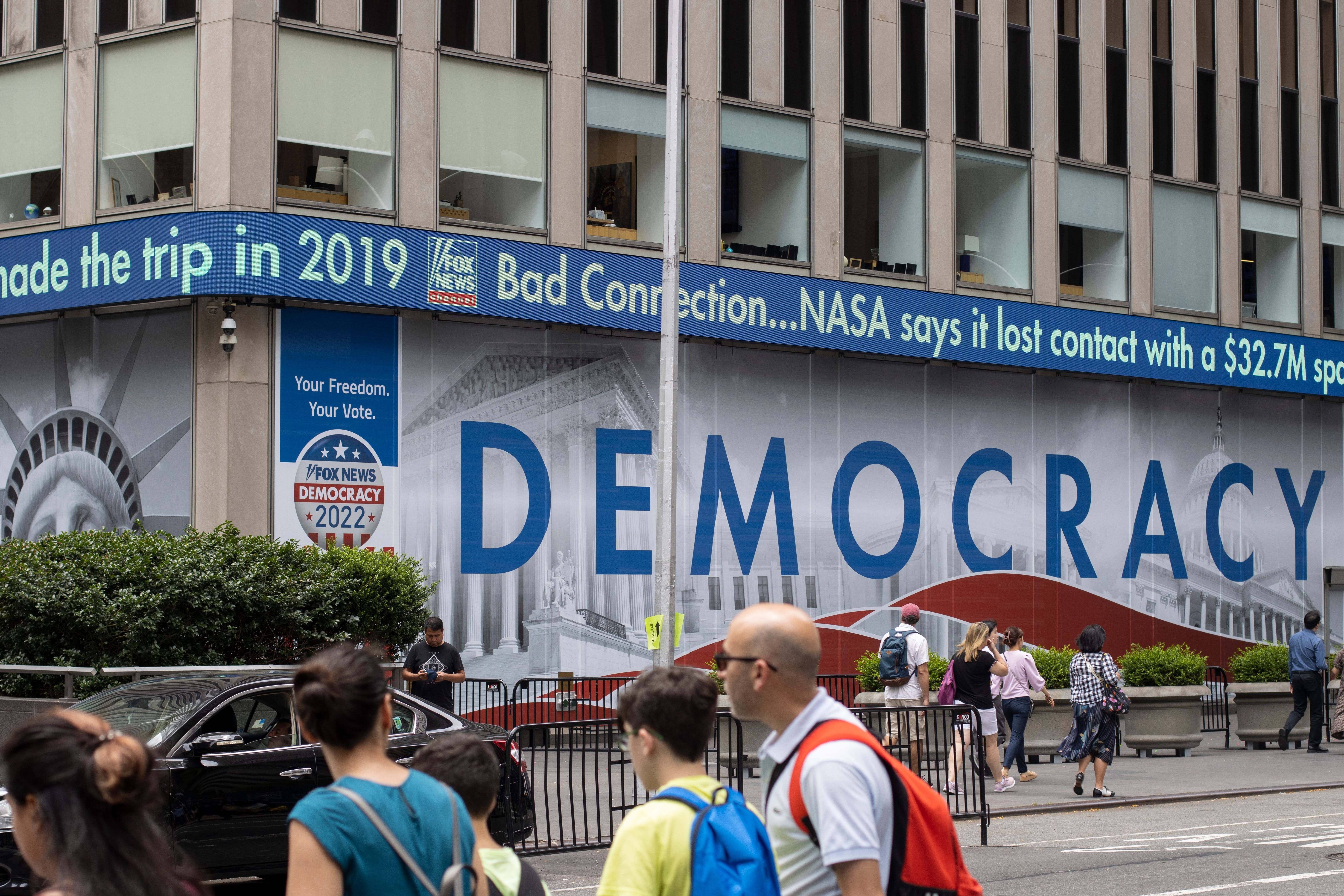
Here is what I eventually saw. The Republican Party is a party without an ideology. Reaganism is the closest thing it has ever had, and Reaganism was never an ideology either. It was a man — a genuinely kind and genuinely manipulable man — standing in front of a coalition held together by an enemy. When the enemy died, the coalition went looking for a replacement, found one at home, and reorganized itself around hating it. That reorganization is now complete. Everything that bewilders commentators about the modern GOP stops being bewildering once you see the party for what it is: an anti-left coalition whose only membership test is enemy selection, and whose only unforgivable offense is choosing the wrong one. The Reagan nostalgia draped over anti-Reagan policy, the platform that no longer exists, the movement’s helplessness before its own Nazis — all of it follows from that single structural fact.
The case runs in three layers: the man, the coalition behind him, and the party the coalition became once the search for a new enemy was over.
The man who believed his own stories
In November 1983, Ronald Reagan told Israeli Prime Minister Yitzhak Shamir that he had personally filmed the liberation of the Nazi death camps as an Army photographer, and that he had kept a copy of the film to show doubters. He told the story again three months later to Simon Wiesenthal. Lou Cannon, the Washington Post reporter who covered Reagan longer than any other journalist, reconstructed both tellings, and his verdict on the underlying fact was unequivocal: Reagan never left the United States during the Second World War. He served in Culver City, editing training films for the Army Air Corps. He had seen the liberation footage. He had not shot it. Somewhere between the screening room and the Oval Office, the film migrated from something he watched into something he lived.
This was a pattern, and the pattern is the point. In December 1983 Reagan stood before the Congressional Medal of Honor Society and told the story of a B-17 pilot who cradled his wounded ball-turret gunner as their plane went down: “We’ll ride it down together, son.” The pilot, Reagan said, received the Medal of Honor posthumously. Lars-Erik Nelson of the New York Daily News checked all 434 World War II Medal of Honor citations and found no such award; the scene tracks nearly word for word to the 1944 film Wing and a Prayer. The White House launched its own search of the records to vindicate the president and quietly gave up. His press secretary, Larry Speakes, offered the epitaph for the whole era: “If you tell the same story five times, it’s true.”
The famous “welfare queen” was the same mechanism running on a real chassis. Linda Taylor existed; the Chicago Tribune documented her aliases and her fraud in 1974, and Josh Levin’s investigation later found she was plausibly guilty of far worse than welfare fraud. But Reagan did what Reagan always did with a story: he improved it. The indictment charged roughly $8,000; by October 1976 Reagan had her at 127 names, a mink coat, and “a million dollars.” Levin went looking for the million and found nothing to support it. And when the 1980 campaign needed a line about air quality, Reagan announced that 93 percent of nitrogen oxides come from trees and vegetation, a garbled factoid that NASA later graded as mostly wrong, and that entered the folklore as “trees cause more pollution than automobiles do.”
The left’s preferred explanation for all this was stupidity. Clark Clifford’s crack that Reagan was an “amiable dunce” leaked from a Georgetown dinner party in 1981 and calcified into the official Democratic theory of the man. The theory has a problem, and the problem is archival. When scholars opened the boxes at the Reagan Library, they found handwritten drafts for 682 of the roughly 1,027 radio commentaries Reagan delivered between 1975 and 1979, composed by Reagan himself, in longhand, with his own cross-outs, on everything from monetary policy to the Soviet grain harvest. An amiable dunce does not produce two-thirds of a broadcast corpus in his own hand. Whatever was wrong with Reagan’s mind, it was working.
Cannon, who watched him for a quarter century, got closer than anyone: Reagan made sense of the world narratively. He had an actor’s memory, prodigious for story and anecdote, indifferent to the boundary between the filmed and the lived. He told a columnist a warm story about a drugstore in Lexington, Virginia, where his scenes for Brother Rat had supposedly been shot, then later admitted he had never been to Lexington; the scenes were filmed in Hollywood. In his first inaugural address he placed the grave of Martin Treptow, a Wisconsin soldier buried in Bloomer, Wisconsin, at Arlington. His aides had told him the truth, and Cannon records his reasoning: it made a better story. Cannon’s verdict was careful: he didn’t lie, he took dramatic license, sincerely, in the service of the story’s moral. The exaggeration was never cynical. That is precisely what made it exploitable.
Because a man who thinks in stories is governed by whoever writes them. From 1954 to 1962 the writer was General Electric. Reagan spent eight years as host of GE Theater and as the company’s traveling ambassador, visiting all 139 GE plants under the tutelage of Lemuel Boulware, the GE vice president whose union-breaking communications strategy was so distinctive that labor law still carries the word “Boulwarism.” Thomas Evans’s The Education of Ronald Reagan documents the conversion in detail: a former union president — Reagan led the Screen Actors Guild — was systematically steeped in free-market fundamentalism, anti-communism, low taxes, and limited government, on a corporate salary, in front of corporate audiences, for nearly a decade. Reagan himself called the GE years his “postgraduate education in political science”. He was not wrong. He just never asked who designed the curriculum, or why. The Cold War made the manipulation frictionless: with actual Soviet communism supplying the contrast, everything Boulware’s people handed him — every statistic about creeping collectivism, every parable of bureaucratic strangulation — slotted cleanly into the one big story Reagan already believed, the story of free men against the machine. Business interests did not have to corrupt Reagan. They only had to cast him.
None of this requires denying the decency, and the decency was real. Reagan wrote personal checks, sometimes four and five thousand dollars, to strangers who mailed their troubles to the White House. He kept a genuine friendship across the aisle; at Tip O’Neill’s testimonial dinner he offered a toast no speechwriter would risk today: “Tip, if I had a ticket to heaven and you didn’t have one too, I would give mine away and go to hell with you”, and for six years he opened their phone calls by asking whether it was after six o’clock, the hour after which, by O’Neill’s rule, they were friends rather than combatants.
But a kind heart attached to a narrative mind is a liability, and the record of the liability is brutal. In August 1980, Reagan campaigned at the Neshoba County Fair, a few miles from where Chaney, Goodman, and Schwerner were murdered in 1964, and told the crowd “I believe in state’s rights”. His defenders have spent four decades explaining that the speech was mostly about schools and taxes, and the historian Joseph Crespino has answered them with the campaign’s own paperwork: Mississippi’s Republican national committeeman had recommended the venue in writing as the way to reach “George Wallace inclined voters”. Reagan did not have to harbor racial animus for the welfare-queen story to do racialized work in the Deep South; he only had to keep telling the story that worked, and he always kept telling the story that worked. The same narrative machinery failed catastrophically on AIDS, where the storyteller simply had no story he wanted to tell: Reagan did not say the word publicly until September 1985, and by the night of his first major address on the epidemic in May 1987, twenty-one thousand Americans were dead. And when the Iran-Contra affair forced him to confront a story he had told the country that the facts would not sustain, he gave the most self-revealing sentence any modern president has spoken: “A few months ago I told the American people I did not trade arms for hostages. My heart and my best intentions still tell me that’s true, but the facts and the evidence tell me it is not.” There is the whole man in two sentences: the heart sincere, the intentions good, the facts elsewhere.
That is Reaganism: a performance of moral clarity by a decent confabulator, scripted by the business interests that trained him, made coherent by an enemy that did him the favor of being genuinely evil, with no doctrine underneath that could survive the performer’s exit. The modern party still calls itself Reaganite while inverting every position the man held. Reagan signed the 1986 immigration act that legalized nearly three million people. He warned in 1988 against “the demagogues who are ready to declare a trade war against our friends... all while cynically waving the American flag” — a warning so on the nose that when Ontario’s government built an anti-tariff ad out of Reagan’s own recorded words in 2025, Trump called the ad fraudulent and suspended trade talks with Canada. Reagan’s own arms-control officials now watch the party accommodate Putin and say so on the record. A party that reveres a man while reversing him has inherited the only thing it ever actually valued: the storytelling, minus the good faith. Reagan confabulated sincerely; his successor’s ghostwriter coined the phrase “truthful hyperbole” to dress the same behavior in knowingness. The exaggeration became a strategy. The kind heart became optional, then embarrassing, then gone.
The coalition that needed an enemy
If Reaganism was never an ideology, what held the movement together? The movement’s own historians have answered the question, repeatedly, in writing, and the answer is an enemy.
American conservatism as an organized force dates from 1955, when William F. Buckley launched National Review with a mission statement that is pure negation: the magazine “stands athwart history, yelling Stop”. What it stood athwart was a coalition problem from day one. Traditionalists wanted virtue enforced; libertarians wanted the state off everyone’s back; the two positions contradict each other on nearly every live policy question. Frank Meyer’s “fusionism” was the official solution, and George H. Nash, the movement’s definitive historian, has been candid about what actually made the fusion hold: “anti-communism supplied much of the glue that sustained the post-1945 conservative coalition,” and once the Cold War ended, “it soon became easier for former allies on the Right to splinter off.” Murray Rothbard, who watched fusionism assemble itself from the libertarian side, said it more brutally in “The New Fusionism”: Meyer’s strategic focus, “The Enemy for him and for the conservative movement, was not statism and socialism but Communism.” What looked like a shared philosophy with an enemies list attached was an enemies list with a philosophy attached, and the philosophy was negotiable.
Then, in 1991, the enemy had the poor manners to dissolve. What happened next is the most underrated event in modern American political history, because the people it happened to described it in real time. Irving Kristol, the godfather of neoconservatism, published an essay in 1993 called “My Cold War” that deserves to be read as the founding document of the party we now live with. Kristol confessed that the Soviet Union had never really been his enemy at all: “It was the fundamental assumptions of contemporary liberalism that were my enemy.” Freed from the pretense, he could finally say it plainly: “liberals were wrong, liberals are wrong, because they are liberals.” And then the sentence that explains the next three decades: “There is no ‘after the Cold War’ for me. So far from having ended, my cold war has increased in intensity... Now that the other ‘Cold War’ is over, the real cold war has begun.” He closed by bequeathing the conflict to his children and grandchildren, and the bequest was honored.
Kristol was the intellectual announcement. Pat Buchanan was the popular one. His 1992 convention speech named the replacement enemy from the podium, with the substitution made explicit in the text: “There is a religious war going on in this country. It is a cultural war, as critical to the kind of nation we shall be as was the Cold War itself.” As critical as the Cold War itself — the old war’s prestige transferred to the new one in a single clause. Even the word “conservative” was becoming dead weight: Sam Francis, the paleoconservative strategist, advised Buchanan privately to “call yourself a patriot, a nationalist, an America Firster, but don’t even use the word ‘conservative.’ It doesn’t mean anything anymore.”
The machinery for domesticating the enemy was already under construction before the Wall came down. In 1990, Newt Gingrich’s GOPAC mailed Republican candidates a memo titled “Language: A Key Mechanism of Control,” with a focus-group-tested vocabulary for describing Democrats: decay, sick, pathetic, lie, betray, traitors, destroy. The New York Times covered it at the time as a curiosity of campaign technique. It was a weapons transfer. The vocabulary that a generation had aimed at Moscow was being recalibrated, word by tested word, for Americans. Rush Limbaugh turned the recalibrated enemy into a daily entertainment product for millions of listeners, and in 1996 Roger Ailes built the enemy a dedicated cable channel, designed, in the words of one study of its founding, to give viewers “someone to root for, someone to root against, and someone to vote for.” Note the order of operations. Nobody in this story concealed anything: the memo was mailed, the essay was published, the speech was televised, the channel was launched at a press conference. The conversion of a geopolitical enemy into a domestic one was carried out in public, by people who wrote down what they were doing, and the only thing anyone failed to do was believe them.
The party that finished the search
Which brings us to the party in front of us, and to the man who keeps admitting what it is. Ben Shapiro has spent a decade functioning as the movement’s inadvertent court stenographer, and his testimony is consistent across three data points. In 2017, explaining Trump’s rise to the New York Times: “Trump secured the nomination due to his anti-left stance, not because of any particular political beliefs.” In October 2025, warning his own audience: “anti-left does not make you conservative.” And in April 2026, at the Hoover Institution, the taxonomy slipped out fully formed: the danger he sees is inside “the conservative movement, inside the Republican Party, or the broader anti-left movement” — three concentric things, of which the conservative movement is the smallest, and, as he added, “what used to be called the conservative movement and the Republican Party... are not the same thing.” Read that inventory again. The party’s most prominent ideological enforcer, under no duress, describes an anti-left movement of which conservatism is one shrinking province. Everyone from the man who just wants his taxes cut to the man who wants public floggings is inside the tent, because the tent was never pitched over a creed. It was pitched over an enemy.
The party has ratified Shapiro’s taxonomy in its own documents. In 2020, the Republican National Convention declined to write a platform at all. The resolution it adopted instead resolved that the party “has and will continue to enthusiastically support the President’s America-first agenda,” attacked the media in a formal clause, and ruled any attempt to adopt an actual platform “out of order.” Brookings rendered the verdict in the title of its analysis: “L’état, c’est moi.” Brendan Buck, who served the two previous Republican speakers of the House, was asked that same week what his party believed and answered: “Owning the libs and pissing off the media. That’s what we believe in now.” When a platform finally reappeared in 2024, it had shrunk from sixty-six pages to sixteen; the 2016 edition had mentioned Trump zero times, and the new one mentioned him nineteen.
The survey data says the voters got the message. Pew’s long-running party-identification instrument found that the share of Republicans citing the harm done by Democratic policies as a major reason for their affiliation rose from 68 percent in 2016 to 78 percent in 2022, and among the leaners who decide elections, the negative reason beats the positive one by double digits. Political scientists Alan Abramowitz and Steven Webster documented the underlying inversion: between 2000 and 2012, voters who liked their own party more than they disliked the other one fell from 61 percent to 38 percent of the electorate, while pure negative partisans more than doubled. The honest counterargument here belongs to Matt Grossmann and David Hopkins, whose Asymmetric Politics argues that the GOP, far from being empty, is the more ideological of the two parties — a vehicle for a creed where the Democrats are a coalition of interest groups. The observation is correct and the comfort is false, because the question is what the creed contains. A political identity can be organizationally creedal and substantively negational at the same time, and this one is: from Buckley’s “athwart,” through Meyer’s fusion against The Enemy, through Kristol’s liberals-are-wrong-because-they-are-liberals, the creed’s actual content has been opposition all the way down. Grossmann and Hopkins found the shape of an ideology. Kristol told us what was inside it.
And here is where the structure stops being an academic observation and becomes a civic emergency: a coalition whose only membership test is enemy selection cannot expel anyone who selects the correct enemy. The proof has been running in public for four years. In November 2022, Nick Fuentes — an open white nationalist and Holocaust revisionist — had dinner with the once-and-future president at Mar-a-Lago; the disavowals were procedural and the consequences were zero. In October 2025, Tucker Carlson gave Fuentes an hour-plus friendly interview at his home studio in Maine, and the president of the Heritage Foundation, Kevin Roberts, responded to the ensuing criticism by denouncing the critics as a “venomous coalition” of the “globalist class.” Roberts apologized to his staff a week later and kept his job, and by mid-2026 he was explaining his reasoning to the New York Times Magazine in the coalition’s native grammar: “You can’t have a governing coalition if you’re saying, I’m not even going to talk to people who occasionally listen to a podcast by someone who’s a total goofball.” A total goofball. The subject under discussion was Holocaust denial.
Watch what happened to the people who tried to police the boundary. Shapiro devoted a full show to calling Carlson an “ideological launderer” and warning that “if Republicans choose to cower in the face of Neo-Nazis and their propagandists, they deserve to fail.” At Turning Point’s AmericaFest in December he named Carlson, Megyn Kelly, Candace Owens, and Steve Bannon as “frauds and grifters.” And notice the vocabulary he reached for when he needed the groypers to sound maximally damning: he called them a “new left.” Even the man fighting the Nazis inside his own coalition can only frame the fight in the coalition’s single available category of condemnation. The insult proves the thesis. There is no word in the movement’s language for “evil in a right-wing way,” because the language was built by people for whom the enemy, by definition, stood on the left. Meanwhile the infiltration proceeds down the age pyramid: in March 2026, College Republicans of America installed a national political director with a documented history of attending Fuentes’s events and praising him on livestreams, and when the appointment blew up, the organization’s president announced he would apologize “to absolutely NOBODY.” The movement’s proudest legend about itself — Buckley purging the Birchers — turns out to prove the rule rather than the exception. Historians have dismantled the purge story in recent years: Buckley’s early editorials cordoned off Robert Welch while praising the society’s rank and file, and when National Review finally read the Birchers out in 1965, the triggering offense was their opposition to the Vietnam War. The one crime the coalition could actually punish, at its founding as now, was pointing at the wrong enemy. Buckley’s heirs cannot manage even that much, because a purge requires a creed to measure members against, and the creed was retired in 2020 by formal resolution.
The people who actually were conservatives noticed, and they left. George Will walked out in June 2016 with the cleanest statement of the whole migration: “I joined because I was a conservative, and I leave for the same reason: I’m a conservative.” Max Boot re-registered the day after the election. Tom Nichols concluded in 2018 that the party “now exists for one reason, and one reason only: for the exercise of raw political power.” Stuart Stevens, who ran five Republican presidential campaigns, announced he would work with Democrats and opened his book-length confession with “I have no one to blame but myself. I believed.” By May 2026, Bill Kristol — son of the man who declared the real cold war — had completed the arc and registered as a Democrat: “I’m pro-freedom, pro-law and order, pro-limited government... And so today I’m a Democrat.” The traditional conservatives were never the party’s core. They were a sub-faction that mistook itself for the whole, and when the mask came off, the ones who meant it discovered that the anti-left coalition had a place for everyone except people with a fixed belief that outranked the enemy.
So the three layers close into one picture. A coalition assembled against an enemy hired a kind, credulous storyteller to give it a face, and business interests wrote his lines. The enemy died, and the coalition’s own intellectuals — in essays, memos, and convention speeches you can still read — relocated the enemy inside the country rather than dissolve the coalition. Two generations later the relocation is complete, the platform is a loyalty oath, the membership test is enemy selection, and the movement watches Nazis walk in the front door with no mechanism for stopping them, because the only mechanism it ever had was pointing at the door and shouting “left.” Reagan’s tragedy was that he believed his stories. His party’s crime is that it kept the stories, kept the enemy, and threw away the belief. What remains calls itself conservatism, and there is exactly one thing it still conserves: the war.
Go Deeper into the Circus
The Great Moral Sorting

On Friday morning, Rand Paul posted an update for his followers: “It’s official: letters to prosecute Fauci have been hand delivered to @DOJ.” The day before, the Senate Homeland Security Committee he chairs had voted eight to five, along party lines
The House of Ellison is on the Brink

On the morning of September 10, 2025, Larry Ellison was the richest man alive. Oracle had reported earnings the night before, and the story inside the numbers was a backlog: hundreds of billions of dollars in contracted future cloud revenue, nearly all of it from artificial intelligence, the largest single piece of it from one customer. The stock rose
Excellent. One of your best.
What's happening today in the US is what happened to the Roman Republic. It grew so powerful that it no longer feared external enemies. So it turned inward to find its enemies and thereby destroyed itself.
The GOP is quite literally insane.