


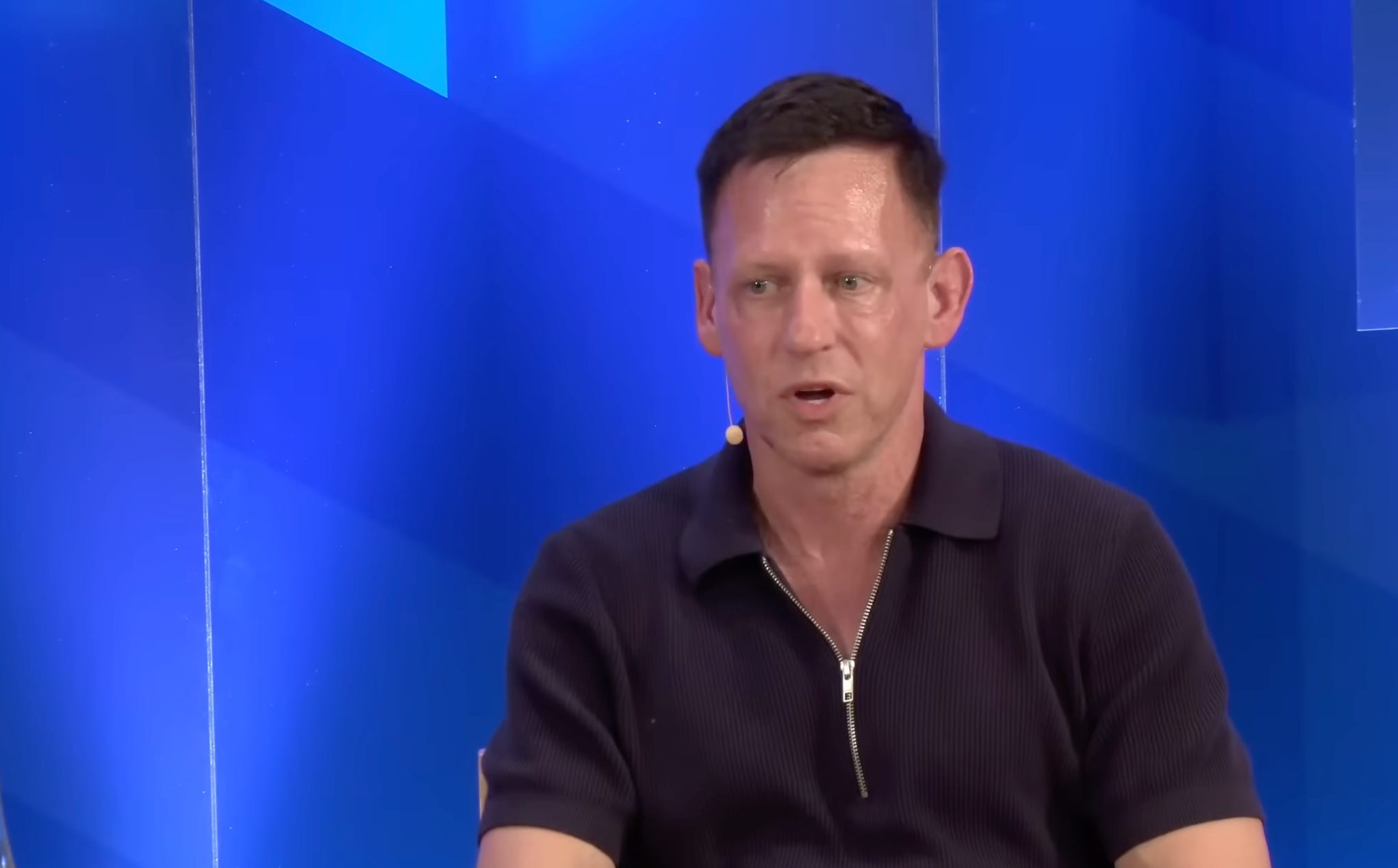
On Tuesday afternoon in Colorado, one of the most powerful venture capitalists in America stood on a panel at the Aspen Ideas Festival and told the room that the first American pope is working for the Chinese Communists.
The room laughed.
That is the story. Everything else is footnote.
⁂
The pope in question is Leo XIV, elected fourteen months ago, born in Chicago, formerly Robert Prevost. In May he released his first encyclical, Magnifica Humanitas, which declared that artificial intelligence “must be disarmed” and called for international regulation of the technology. The document is, as encyclicals go, restrained. It does not demand a treaty. It asks that the wealthiest men on earth pause long enough to consider whether the machines they are building might do damage they cannot repair. It is written in the voice of a pastor. It is signed by the Bishop of Rome. It carries the moral weight of two thousand years of continuous institutional teaching, exercised by a man born inside the country whose engineers are actually building the machines in question.
Peter Thiel’s response, on Tuesday, was to observe that because the pope’s message might be heard by Americans but will not be heard by the Chinese, the encyclical only slows one side of the race, and therefore Leo is inadvertently — the word is Thiel’s, and I will come back to it — “working for the Chinese Communists.”
The room laughed. That is the one thing about the room’s response that is not in doubt. The panel was nonrecorded and reporters were allowed to take notes, so what follows about the room’s silence is inference from what did not appear in the reporting. Reporters had every incentive to record a walkout, an audible objection, a visible groan. None of that appears. What appears is the laugh.
Francis Fukuyama, sharing the stage, made the case that the greatest danger to democracy is abandoning the institutions that have sustained it. Thiel replied that those institutions are what have “gone haywire,” that “the Republican Party doesn’t matter that much” because “it’s the less important one,” and that “when the Democratic Party goes, this country is over.” That is not a defense of American democracy from a right-wing libertarian. That is a man announcing that one of the two parties has already been captured and the other is next. Fukuyama, according to the reporting, did not press him on it.
He then argued, without evidence, that Anthropic — the AI company he cannot control — will “rig the elections in 2028” using its industry-leading models to “completely outwit” whatever Elon Musk tries with X. The reporter present, Tommy Walters, was clear-eyed enough to flag this in print as “an unsupported conspiratorial claim.” The reporting does not indicate that anyone on stage flagged it in the room.
He explained that the American Revolution was not a revolt against a king but against a “totalitarian” parliament, and that the Constitution was designed to make the American president “more powerful than King George III.” That is a claim Alexander Hamilton personally destroyed in Federalist 69, in a point-by-point demonstration that ends with the line what answer shall we give to those who would persuade us that things so unlike resemble each other? Hamilton wrote it in 1788 to answer exactly this argument. Two hundred and thirty-eight years later, on the eve of the two hundred and fiftieth anniversary of the Declaration of Independence, an American establishment audience heard the argument revived and, on the record, declined to answer.
He described the European Union as populated by “NPCs” — non-player characters, from video games — because “the EU is rule of law. It is like bad AI.” The reporting does not record an objection from the panelists whose careers were built on the rule of law.
And when he was asked about Palantir — the surveillance company he co-founded, named for the seeing-stones in Tolkien’s The Lord of the Rings, the stones that corrupt everyone who looks into them — he explained that the critics have simply misread Tolkien, that in the story the palantír “gets used by the good guys,” and that “anybody who tells you a different story of Tolkien doesn’t even know what they’re talking about, on the level of literature.” Any reader of Tolkien knows the palantíri are Sauron’s instruments of manipulation. Saruman falls through one. Denethor is destroyed by one. Pippin is seized through one. The one that Aragorn wrests to his own use in the third book is the exception that proves the rule, and Aragorn wins with it only because he is the rightful heir of Númenor, chosen by lineage and by grace, not by wealth.
But Thiel is not describing Tolkien. He is describing himself. He is telling the room what he thinks he is.
⁂
The question I want to sit with is not what Thiel said. Thiel has been saying versions of this for two decades, and The Sovereign Individual Was the Blueprint covers the ideological genealogy from Davidson and Rees-Mogg to Curtis Yarvin to the current administration. The question is what Aspen thought it was doing.
Aspen is not a fringe venue. The Aspen Ideas Festival is where the American governing class goes to be seen thinking. Its attendees include sitting senators, cabinet secretaries, hedge-fund principals, university presidents, foundation heads, editors of the country’s remaining serious magazines, and the CEOs of firms whose names appear on every school of public affairs in the country. The panel Thiel appeared on was titled Humanity at the End of History. The other panelist was Fukuyama. This was framed by the festival as a marquee event, one of the two or three sessions the week’s attendees would remember.
And on Tuesday afternoon that room laughed at a joke about the first American pope being an agent of the Chinese Communist Party.
The pope who was born in Chicago. The pope who took his name from the pope who wrote Rerum Novarum, the 1891 encyclical on labor and capital that the American establishment used to venerate as the foundation of Catholic social thought. The pope who is trying, in the tradition of his predecessors, to hold a moral line against a technology that its own builders will not disavow.
The room laughed.
⁂
I have written before about why Christianity is not a tribe — how it becomes one, always, when it is captured by power, and how it stops being what it says it is at that moment. What happened at Aspen on Tuesday is a different variation on the same process. The American governing class has decided that the pope’s warning is funny.
This is not because the American governing class has become theologically sophisticated and rejected the encyclical on its merits. It has not read the encyclical. It is because the American governing class has decided that Peter Thiel is one of them, that his money makes him one of them, that his taste and his manners and his Stanford degree and his Palantir contracts and his willingness to sit on a panel with Fukuyama make him one of them, and that anything he says from within the frame of “provocative tech billionaire” belongs inside the range of acceptable opinion.
He can lecture on the Antichrist in Rome in March, blocks from the Vatican, and remain welcome at Aspen in July. He has said, on the record, that the Antichrist will manifest not as an individual but as a world government promising to protect humanity from existential threats such as AI or global warming.
Now — the word Thiel used at Aspen was inadvertently. Leo is inadvertently serving Chinese interests. Leo is unintentionally advancing the CCP. The reporter, Walters, records the qualifier. I have been holding it back because I want it to do its work at exactly this point in the argument, which is the point where a careful reader might otherwise think I am overreading the joke.
I am not overreading the joke. I am reading Thiel’s own theology back into the joke, and his theology does not require intent. The Antichrist, in the Thiel schema, is not a person with a black hat and a plan. The Antichrist is a structural position — a world government promising to protect humanity from existential threats. The bishop who occupies that position does not have to mean to occupy it. He only has to occupy it. That is what makes the concept theological rather than criminal. The pope, by asking for international regulation of a technology to protect humanity from an existential threat, occupies the structural position Thiel has spent years describing as the mark of the Antichrist. Thiel adding inadvertently is not a softening. It is a clarification. It is Thiel saying the pope does not have to mean it; the position is what condemns him.
The room did not know this, because the room does not read the fringe lectures of the men it invites. The room heard “Chinese agent” — with or without the qualifier — and laughed at what it took to be a provocation. But the joke had a literal theology behind it, and the theology is that a bishop born in Chicago is the figure the New Testament warns against, and the reason he is that figure is that he asked billionaires to slow down. Intent is not required. The room was not asked to laugh at Leo the man. The room was asked to laugh at Leo the office — the office that is, in Thiel’s theology, the Antichrist by structural necessity. And it did.
⁂
Why does Aspen welcome him.
The honest answer, I think, is that Aspen no longer knows what it is. The Aspen Institute grew out of the Goethe Bicentennial Convocation of 1949, organized by the Chicago industrialist Walter Paepcke together with Robert Hutchins, then chancellor of the University of Chicago, and the philosopher Mortimer Adler, who believed that American business needed to be trained in the humanities so that its power would be tempered by learning. This is the founding premise of the American governing class as it constituted itself in the middle of the twentieth century. Wealth without cultivation was crass; power without moral formation was dangerous; and the point of an institution like Aspen was to build the cultivation and the formation into the wealthy and the powerful, so that they would rule with restraint. This is what put something back meant, in the language of the mid-century American upper class. You take, and then you put something back, and the putting-back is the moral center of the arrangement.
Paepcke’s Aspen was not a naive project. It was aware that the postwar American plutocracy could easily slide into the sort of European aristocratic decadence that had produced two world wars, and its mission was to prevent that slide by supplying its members with Aristotle and Homer and Kant, on the theory that a man who has spent two weeks with the Great Books cannot go home and become a fascist. It worked, for a while, in the sense that the men who ran American postwar capitalism did read Aristotle and did not, mostly, become fascists.
But the Aspen of 2026 is not that Aspen. The mission has been hollowed out. What remains is the setting — the mountains, the cocktails, the panels, the sense that being there is a mark of arrival — without the moral formation the setting was designed to serve. The room at Aspen still looks like the room Walter Paepcke built. But the purpose of the room has evaporated. What used to be a seminar in restraint is now a networking event. What used to be a place where American power sat with its texts is now a place where American power sits with its investors.
And when a man like Thiel walks into that room, the room has no immune system left. It has no shared canon to measure him against. It has no theological or philosophical vocabulary in which to name what he is doing when he calls the pope an agent of the Chinese Communist Party for asking billionaires to slow down. It has been trained, over three decades of business schools that never should have existed, to treat “provocative” as a compliment and “disruptive” as a virtue. And so it laughs.
The laughter is the mechanism.
The laughter is what tells Thiel he is inside. The laughter is what tells the young speechwriter in the third row that this is what serious people do now — you make the pope-as-Chinese-agent joke, and if it lands, you are in. The laughter is what tells the reporter, Tommy Walters, that the story is the joke rather than the room’s response to the joke, which is the story Walters, to his credit, actually wrote. The laughter is how the frame moves. The laughter is how the range of the sayable expands.
If the room had not laughed — if the room had, instead, produced even one visible person who stood and said the pope of the Catholic Church, an American, is not a Chinese agent, and it is beneath the dignity of this festival and the memory of Walter Paepcke to sit here and enjoy the suggestion that he is — the news out of Aspen would have been different. Not because the news is made by the person on stage, but because the news is always made, actually, by the room. The person on stage delivers the material. The room decides whether it is a joke or an obscenity. The room decides whether the speaker is a provocateur to be admired or a bigot to be walked out on. The room decides, in every generation, what belongs inside the frame of civilized discourse and what does not.
The room at Aspen decided, on Tuesday, that Peter Thiel’s remarks about the pope belonged inside the frame.
That is the most important political fact of last week.
⁂
I keep coming back to Fukuyama, because Fukuyama was the only person in the room whose job it was to push back, and Fukuyama tried. He said, essentially, that the institutions of liberal democracy are precious and must not be abandoned. Thiel replied by saying the institutions of liberal democracy are the problem, that the Democratic Party is on the verge of a democratic-socialist takeover, and that “when the Democratic Party goes, this country is over.”
Fukuyama did not, according to the reporting, push back on this. He did not say: Peter, you are talking about the two-party democratic system as though its collapse is a foregone conclusion. You are announcing the end of American democracy in the passive voice. If the country is over when the Democratic Party goes, what are you doing to preserve the Democratic Party? Nothing. You are backing an administration that is running against the constitutional order in real time. You cannot mourn the death of a system while funding the men killing it.
Fukuyama did not say that. I do not know if he thought it. But he did not say it, and the room did not say it for him.
This is what the end of history looks like, in practice, thirty years on. Not the calm liberal-democratic plateau Fukuyama imagined in 1992, but a panel on which the man who declared the end of history sits next to the man who is engineering its end, and the room cannot tell the difference between them.
⁂
I do not think the room at Aspen is stupid. I think the room at Aspen is afraid. It is afraid of what Thiel could do to it if it broke ranks. It is afraid that its universities, its foundations, its magazines, its research institutes, its NGOs, its very ability to keep the mountains-and-cocktails architecture funded, depend on the continued goodwill of a class of donors of which Thiel is now a leading member. It is afraid, correctly, that if it treats him as what he is — a man who has said, on the record, that he thinks the pope is the Antichrist for asking billionaires to slow down — it will lose the checks.
So it laughs. And in laughing, it makes the frame that the next Peter Thiel, and the one after that, will walk into. Each laugh raises the ceiling on what the next man can say. Each laugh trains the room in what is now sayable. Each laugh is a small deposit into an account that will be drawn down, at some point, by a man who is not joking.
Thiel is joking. He is joking with the deadly precision of a man who has spent decades studying exactly how to move the frame while claiming he is only being provocative. He is joking in the way the conspiracy is the cover story is a cover story. The joke is the delivery mechanism. What is being delivered is the theology.
The next man will not be joking.
⁂
The panel in Aspen is a specimen. Under a microscope, it explains why the Democratic Party is losing primaries it has not lost in thirty years.
Zohran Mamdani is the mayor of New York City. He was elected in November on a platform the Democratic establishment insisted, right up until election night, was too radical to win a general in America’s largest city. A run of democratic-socialist candidates have taken mayoralties and House primary seats in the twelve months since. The pattern is not a fluke. It is the story of every off-cycle election in the country. The establishment wing keeps losing, and it keeps being surprised, and the surprise itself is what tells you the wing has lost the plot.
The explanation the wing prefers is that voters have drifted left ideologically. That is not what has happened. The voters have not adopted a new theory of political economy. Most of them could not tell you the difference between a democratic socialist and a social democrat, and neither could the candidates, and neither, frankly, could I on some days. The DSA insurgency is not winning because it has developed a superior ideology. It has the same broad program it had in 2018, with better organizers and slightly more discipline. What has changed is not the challengers.
What has changed is the incumbents. What has changed is the room at Aspen.
For fifteen years, the Democratic establishment wing has been telling primary voters that the correct posture toward Peter Thiel is engagement. That the correct posture toward billionaires-in-general is productive partnership. That the correct posture toward the men who describe the European Union as populated by NPCs, and who describe the American presidency as designed to exceed King George III, and who now describe the Bishop of Rome as an agent of a hostile foreign power, is a knowing smile and a discreet reach for the check. The primary voter has been watching. The primary voter has watched Democratic senators share stages with these men and not walk out. The primary voter has watched Democratic-aligned magazines commission the profiles that call these men fascinating and complicated and worth engaging. The primary voter has been asked, over and over, to trust the judgment of the class of people who produced the room that laughed at the pope joke.
The DSA candidate does not need to make an argument against that class. The class is making the argument against itself in real time, at Aspen and Davos and Sun Valley and every downtown fundraiser where the drinks are catered by a firm the challenger’s grandmother could not afford. The DSA candidate only has to not be from the room. That is the entire electoral offer. It is winning because it is true.
When Thiel says when the Democratic Party goes, this country is over, he is describing a process he is causing. Not because he votes in Democratic primaries. He does not. But because he sits in Democratic rooms, and the Democratic rooms will not turn him away, and the voters have noticed that the rooms will not turn him away, and the voters are drawing the appropriate conclusion. Mamdani did not defeat the establishment by out-arguing it. He defeated it by standing where it could not stand, which was outside the room at Aspen.
The insurgency is downstream of the Aspen laugh. Every insurgency of the last five years is downstream of some version of the Aspen laugh. That laugh is a campaign ad. The DSA did not have to cut it. The room cut it for them. If the establishment wing wants to know why it is losing primaries in districts it held uncontested for thirty years, it should look at the reporting from Tuesday’s panel and study the face of the person sitting three rows back who did not walk out. That is the voter the wing is losing. That is the voter the wing has already lost.
The wing will not do this. The wing will conclude, once again, that the voters have moved too far left, or that the candidates were unusually talented, or that the incumbents ran unusually poor campaigns. It will conclude anything except the true thing, which is that the room at Aspen has become morally illegible to the people whose votes it needs, and that no amount of consultant polling and message discipline will fix an illegibility of that kind, because the illegibility is not a communications problem. It is a character problem. The room laughed at the pope joke. The voters saw the room laugh. The voters are not going to forget.
⁂
A word directly to whoever from that room happens to read this.
You know who you are. You were there. You laughed at the pope joke, or you did not laugh but did not walk out, or you did not walk out but told yourself afterward that Peter is provocative and that it is good to hear challenging voices.
Please understand what you did. You gave cover. You gave cover to a man who has told the world, in his own words, that he considers the Bishop of Rome to be the figure the New Testament warns against, because that bishop asked the wealthy to consider the possibility that they are building something dangerous. You laughed at the joke because you did not know the theology behind it. That is not exculpatory. You are supposed to know. That is the whole point of you being in that room in the first place. Walter Paepcke built the room so that you would know.
If you are not sure whether I am being fair, sit with a single sentence, and sit with it for a while, and notice what you feel while sitting with it. The sentence is this. A pope of the Roman Catholic Church, an American, called for international regulation of a technology that its builders will not restrain. And in response, one of the most powerful venture capitalists in America told a room of your peers that this pope is an agent of the Chinese Communist Party, and your peers laughed.
⁂
Notice what you feel. If you feel nothing, notice that.
That is the tell.

Go Deeper into the Circus
A More Powerful President Over a Weaker Presidency

On June 30, 2026, on the Advisory Opinions podcast, the day after the Supreme Court’s decision in Trump v. Slaughter, Sarah Isgur said this, on tape, in her own voice:
A More Powerful President Over a Weaker Presidency
On June 30, 2026, on the Advisory Opinions podcast, the day after the Supreme Court’s decision in Trump v. Slaughter, Sarah Isgur said this, on tape, in her own voice:
They Confirmed Her

The story that broke on Sunday in The Washington Post is being read as a story about a cult. It is not a story about a cult. It is a story about the United States Senate.
It is a convenient response. Label anyone and anything you do not like as the anti-Christ. My generation was raised on that in music lol. It is a major line in every right wing playbook. I am now wondering if having access to billions of dollars makes one mentally ill? It seems to cause all sorts of psychosis.
Peter Thiel does not look well, on any level. A sad, sad man.