


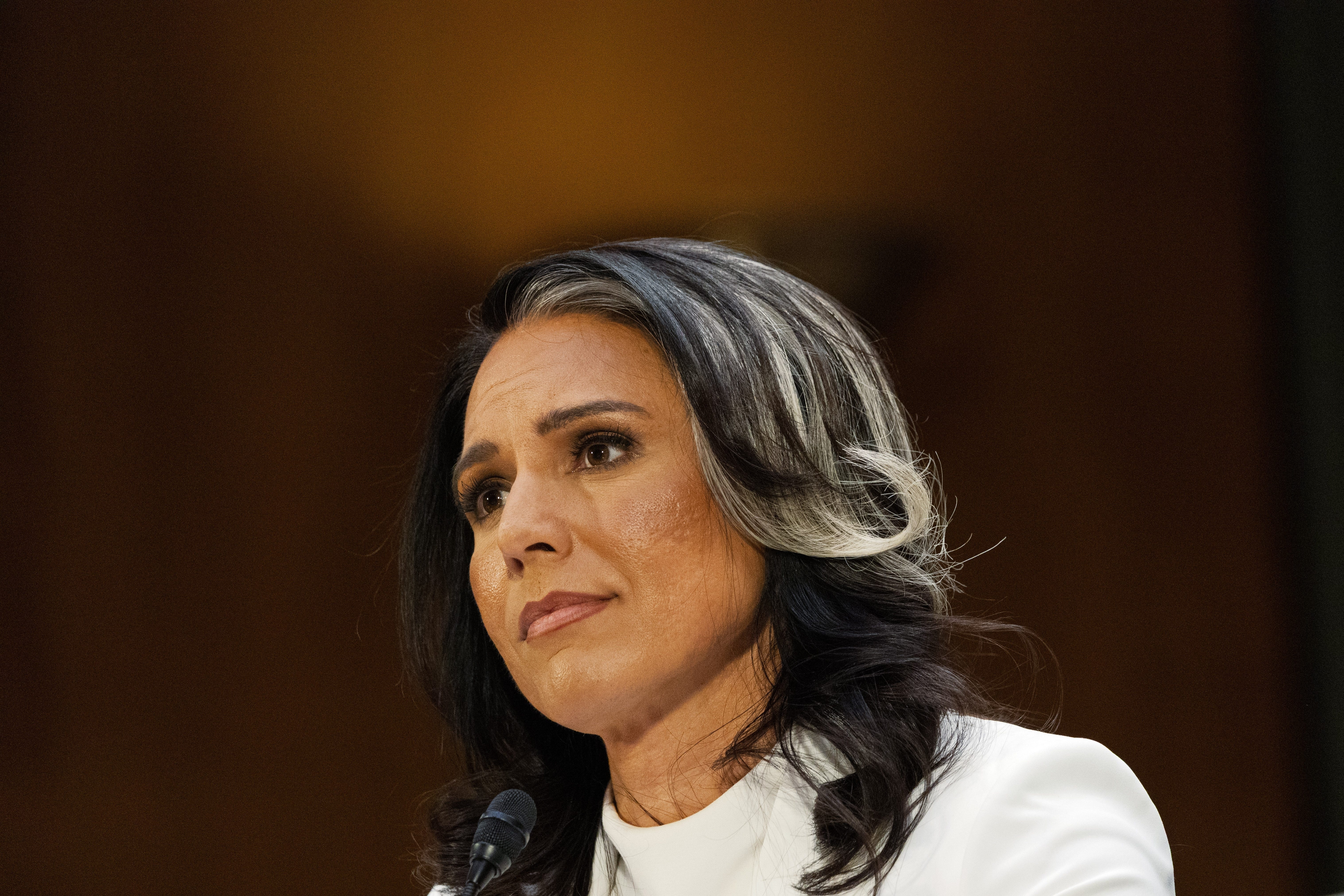
The story that broke on Sunday in The Washington Post is being read as a story about a cult. It is not a story about a cult. It is a story about the United States Senate.
Jon Swaine’s investigation — twenty-five thousand pages of documents, hundreds of memos, a 173-page policy compilation, talking-point directives compared against thirty-two of Tulsi Gabbard’s television interviews with twenty-four matches at the level of verbatim language — is the most thoroughly documented case in modern American history of a sitting member of Congress, and then a sitting Director of National Intelligence, operating as a downstream node of an outside authority. The authority is Chris Butler, the seventy-eight-year-old founder of the Science of Identity Foundation, an offshoot of the Hare Krishna movement headquartered in Kailua, Hawaii. Butler does not use a computer. He dictates verbally. His secretaries transcribe and circulate through an email domain called NineIsles.com, reserved for his inner circle. He has been Gabbard’s guru — her guru dev, the term she has used herself in print — since her childhood. Her parents are senior members. Her husband is a member. Her congressional staff was staffed with co-religionists. Her campaign vendors were SIF-linked. The Post’s documentation includes instructions on what legislation to introduce, what positions to take on Syria and ISIS, what to say on CNN, and — this is the detail that has gone around social media because the detail is unimprovable — how wide to open her eyes on camera.
This is the part of the story everyone is talking about. It is shocking. It deserves to be shocking. It is also not the part that matters.
The part that matters is that the United States Senate confirmed her.
⁂
On February 12, 2025, the Senate voted to confirm Tulsi Gabbard as Director of National Intelligence, head of the office that oversees eighteen federal intelligence agencies and a budget of approximately seventy-five billion dollars. The vote was 52–48. Every Senate Republican voted in favor except Mitch McConnell. Every Senate Democrat voted against. The Select Committee on Intelligence had reported her nomination to the floor on a party-line vote of 9–8 the previous day. The eight Republicans on the committee who voted yes were Tom Cotton, the chair, James Risch, Susan Collins, John Cornyn, Jerry Moran, James Lankford, Mike Rounds, and Todd Young. They are not naive people. They are not unsophisticated people. They have been briefed for years on the operational signatures of foreign influence, on the techniques by which states and non-state actors attempt to compromise public officials, on the patterns of behavior that the counterintelligence apparatus exists to catch. They voted yes anyway.
The question is what they knew when they voted yes. The answer is: everything.
The Civil Beat reporting on Gabbard’s ties to SIF dates to 2015. The New Yorker piece dates to 2017. The Business Insider piece dates to 2022. The Daily Beast photographs of Gabbard as a teenager at an altar to Butler in the Philippines, and the document from her 2015 wedding bearing a personal blessing from Butler under the religious name Siddhaswarupananda, were published in January 2025 — three weeks before the committee vote. The Wall Street Journal‘s investigation documenting Gabbard’s congressional campaign paying a public-relations agency to suppress media scrutiny of SIF’s connections to an alleged pyramid-scheme operation called QI Group appeared on January 29, 2025 — two weeks before the committee vote. The Civil Beat investigation showing that Gabbard had paid more than half a million dollars in campaign funds between 2013 and 2019 to a single SIF-linked vendor, Honu Creative, dates to 2019.
The single most direct piece of evidence was in their hands. In December 2024, Anita van Duyn — a former SIF member who had spent fifteen years inside the organization — sent letters to Democratic senators, including Tammy Duckworth, Elizabeth Warren, and to Representative Alexandria Ocasio-Cortez. The letters warned, in plain English, that Gabbard remained under Butler’s influence, that Butler had long-standing political ambitions, that he groomed disciples for political office, and that — these are her words — any sensitive intelligence Gabbard is privy to will be communicated to her guru. The Democratic recipients raised the matter publicly. The Republican members of the Intelligence Committee were aware. The Trump transition team’s response was a statement from spokesperson Alexa Henning calling the warnings “bigoted” and asserting that Gabbard had “no affiliation” with the Science of Identity Foundation — a claim refuted by the photographs that were published the next month, and the campaign records that had been public for years.
The aunt — Caroline Sinavaiana-Gabbard, a former professor at the University of Hawaii — had stated publicly that Gabbard’s 2020 presidential bid was undertaken at Butler’s direction. The 2015 video in which Gabbard herself acknowledged Butler as her guru was available on the public internet. The 2019 New York Times interview in which she described Butler and his work as continuing to guide her was a matter of public record. The connections were not concealed. They were the subject of a decade of investigative journalism. They had been raised, in writing, by a fifteen-year veteran of the organization, addressed to sitting senators, in the weeks before the vote.
The eight Republicans on the Intelligence Committee voted yes. The forty-five Republicans on the Senate floor voted yes. The constitutional immune system that exists for the express purpose of catching this — for the express purpose of refusing the confirmation of a person operating under undisclosed external authority — did not catch it. The system saw it. The system was told about it. The system confirmed her.
⁂
This is what institutional capture looks like when it has finished.
The mistake is to expect institutional capture to announce itself. The mistake is to expect that the failure of a constitutional safeguard will be dramatic, contested, marked by floor speeches and televised confrontations. The actual failure is procedurally quiet. It looks like a senator reading a file, conducting a closed-session hearing, voting yes, going to lunch. It looks like eight men and one woman, all of them experienced, all of them sworn to support and defend the Constitution against all enemies foreign and domestic, agreeing in sequence to install at the head of American intelligence a person whose lifelong vow of obedience to a man in Kailua was a matter of public record before they took their seats in the room.
There is no possible reading of the record under which they did not know. The information was there. The Democratic minority on the committee raised it. The Democratic senators on the floor raised it. The press raised it. Civil Beat had been raising it for a decade. The Wall Street Journal raised it two weeks before the vote, the Daily Beast one week before the vote, the Yahoo story carrying the Daily Beast photographs three weeks before the vote. The van Duyn letters were the operational summary, written by someone who had lived inside the organization for fifteen years and who described the mechanism by which Butler exerted control over disciples in political office.
The committee Republicans had the file. The committee Republicans had the briefings. The committee Republicans had the choice. Susan Collins — whose entire career has been performed inside the brand of moderate Republican who reads the file — had the choice. James Lankford — a Southern Baptist former pastor whose stated commitment to the integrity of the intelligence community has been a centerpiece of his public identity — had the choice. Todd Young — a former intelligence officer himself, a Marine, a man who has spoken at length about counterintelligence threats — had the choice. James Risch — vice chair of the committee, longest-serving Republican on it, a senator with three decades of legislative experience — had the choice. They all made the same choice. They confirmed her.
The choice they made is the operative-class signature this publication has been naming all month. It is the trained-not-to-ask move, performed at the constitutional altitude. The thing they could not afford to know was the thing in front of them. The cost of refusing the nominee was the cost of refusing a president of their own party in his first major intelligence appointment, and the cost of refusing him was higher, in their internal accounting, than the cost of admitting a compromised candidate to the directorship of American intelligence. They paid the second cost. They paid it knowing what they were paying.
What is in Loyalty — what was diagnosed at the level of the cable commentator — is here in its terminal form. Sarah Isgur cannot afford to know what the FBI was doing to Lisa Page because the knowing would disqualify her from her place in the system she has built her career inside. The Republicans on the Senate Select Committee on Intelligence cannot afford to know what Chris Butler has been doing to Tulsi Gabbard because the knowing would have disqualified them from the place they occupy in the party. The form is the same. The substrate is what differs. Isgur’s substrate is the operative class. The senators’ substrate is the Republican Party in its current configuration. The vow is to the same kind of thing. The vow runs above the oath of office, and when the two come into conflict, the vow wins.
⁂
The Mitch McConnell vote is worth holding for a moment, because it is the only thing in this record that does not damn the Republican Senate caucus entirely. McConnell, who is not on the Intelligence Committee and was therefore not in the room for the briefings, voted against confirmation on the floor. The vote cost him nothing. He had announced his decision not to seek another term in leadership. He was free, in a way the active leadership was not. He chose to use the freedom. Every other Republican senator did not.
The McConnell vote shows that it was possible to vote no. It was possible to look at the record and conclude that the nominee should not be confirmed. It was possible to break ranks. It was possible to act, in a moment when the Constitution gave a senator a single binary choice between protecting the country and confirming the president’s pick, on the side of the country. One Republican did. The other forty-five did not. The other forty-five did not because they had calculated that the political cost of voting no exceeded the constitutional cost of voting yes, and that calculation is the entire diagnosis of where we are.
The McConnell vote also shows that the I had no way of knowing defense will not survive the historical record. McConnell knew. Susan Collins, on the committee with the briefings in front of her, knew. James Risch, the vice chair, knew. They had more information than McConnell had. They voted yes anyway. McConnell, with less information and the same public record, voted no. The committee Republicans cannot claim ignorance. The committee Republicans must, sooner or later, defend the affirmative vote — defend it on the merits, with the file in front of them, against the record of what they knew at the time they cast it. They will not be able to. There is no defense available. There is only the silence they will choose to maintain, and the silence is its own form of confession.
⁂
The institutional consequences are larger than the Gabbard case. The Senate Select Committee on Intelligence is one of the small number of bodies on which the constitutional system relies to maintain the wall between politics and the intelligence apparatus. The committee was created in the wake of the Church Committee revelations of the mid-1970s, when it became clear that the intelligence agencies required serious congressional oversight and that the oversight required a body that could be trusted with classified information and that could discipline its members to act in the national interest above the partisan interest. The committee has functioned, imperfectly but recognizably, in that mode for fifty years. The 2025 confirmation vote on Gabbard is the marker of when it stopped functioning in that mode.
Stopped, not stumbled. The vote was not a close call missed by a few senators. The vote was nine to eight on party lines, with the entire Republican delegation supporting a nominee whose ties to a sectarian guru who actively sought political influence had been documented for a decade and who had been the subject of an explicit written warning from a former member of his organization addressed to other senators in the building. The vote was a deliberate, coordinated decision by the Republican members of the committee to convert the body from an oversight institution into a ratification institution for the executive’s preferred personnel. The conversion is now complete. The committee, going forward, is not the constitutional safeguard it was designed to be. It is a body that performs the ritual of the safeguard while delivering the outcome the executive wants. That is the failure. The Gabbard nomination is the instance. The instance documents the failure.
This is what capture means. It does not mean infiltration. It does not mean compromise by foreign agents. It means that the institution still meets, still holds hearings, still issues reports, still votes — and the votes have stopped tracking the function the institution was created to perform. The institution looks the same. The institution is not the same. The Republican members of the Senate Select Committee on Intelligence in February 2025 made the institution into something other than what it had been, and they did it by a single act of collective ratification of a nominee they knew should not have been confirmed.
⁂
There is a piece of this story that has not yet been told and that the Post investigation makes possible to tell. For fourteen months after her confirmation — from February 12, 2025 until her resignation on June 13, 2026 — Tulsi Gabbard sat as Director of National Intelligence. She received the briefings. She convened the principals. She represented the intelligence community in meetings of the National Security Council. She held the President’s Daily Brief in her hands. She had access to the most sensitive classified material the American state produces, including signals intelligence, human-source intelligence, covert-action findings, and the deepest compartments of the special-access programs.
The question the Post investigation forces, and that the senators who confirmed her must now answer, is whether any of that material — any briefing, any document, any conversation — was communicated to Chris Butler. The van Duyn letter warned exactly this, in writing, before the vote: any sensitive intelligence Gabbard is privy to will be communicated to her guru. The Post documentation shows that during her congressional career Butler directed her position-taking down to the level of language used on cable news. There is no evidence in the public record that the dynamic changed when she moved from Congress to the directorship. There is, on the contrary, every reason to expect that it continued — that a relationship of total spiritual obedience formed in childhood and operative through fourteen years in Congress did not lapse when the disciple assumed a higher office.
The question of what was communicated is now an empirical question with a binary answer. Either it was or it was not. The intelligence community has the records. The communications are traceable. The classified holdings have audit logs. The investigation that the Post has begun — the investigation that the Senate Intelligence Committee should have conducted before the confirmation — must now be conducted retroactively, by a body that can compel testimony and access classified material. That body cannot be the Senate Select Committee on Intelligence as currently constituted, because the senators who would be conducting the investigation are the senators who confirmed her. The investigation must be conducted by an independent counsel or by a special body convened for the purpose, with members who were not part of the confirmation vote and who have no political interest in the outcome.
If the investigation finds that classified material was communicated to Butler, the consequences extend beyond Gabbard. The consequences extend to every Republican who voted to confirm her on the committee and on the floor. The vote will have been the proximate cause of the breach. The breach will have been foreseeable at the time of the vote. The senators will have been on notice. The notice will be a matter of record. The constitutional gravity of what they did, in that case, becomes a different category of thing — not a partisan misjudgment, not a closing-ranks for a president, but a documented foreseeable failure of the oath of office that resulted in the compromise of American intelligence.
That, too, is the operative-class signature. The class does the thing it has been warned not to do, in pursuit of a smaller objective, and trusts that the larger consequence will not arrive on its watch, or will arrive in a form that can be deflected, or will arrive against someone else. The class makes the calculation and pays the cost as it comes. The cost on the country is not the cost on the class. The class has been making this calculation for years.
⁂
The piece in The Washington Post is being received as a story about Tulsi Gabbard. It is also that. But the story about Tulsi Gabbard is the story of a woman who did what she was raised to do, in a tradition that bound her by vows she made before she could understand what vows were. There is a tragedy in that story. There is a person inside the disciple who can be argued with, who can be addressed, who might in a different life have chosen differently. The story about her is not the story that needs to be written.
The story that needs to be written is the story about the men and woman who knew what she was, knew it from the public record and the closed briefings and the explicit written warnings from a witness who had spent fifteen years inside the organization, and who confirmed her anyway. Cotton. Risch. Collins. Cornyn. Moran. Lankford. Rounds. Young. The eight names that need to be in the historical record as the names of the senators who, in February 2025, in possession of the full file, on a party-line vote, delivered the Director of National Intelligence chair to a person operating under undisclosed external authority. These are not victims of an information deficit. These are not actors in a situation of ambiguity. These are senators on the Intelligence Committee, the body whose specific constitutional function was to prevent the thing they enabled. The historical record will hold their names. The historical record should hold their names. The names are how the failure stays attached to the people who chose it.
We are not at the beginning of the story of what they did. We are not even at the middle. We are at the moment when the documentation of what they confirmed has finally caught up to the public record of what they knew, and the gap between the two has closed, and the closing of the gap has produced the question they will spend the rest of their political lives trying not to answer.
What did you do, in February 2025, when you had the file in front of you, and what was your reason?
There is no answer to that question that will survive being asked. The senators know this. That is why they will not be asked. The intelligence committee does not investigate itself. The party will not investigate its own. The press will move on to the next story, as the press does. The eight names will pass into the background.
The publication’s job is to refuse the passing.
They confirmed her. They knew. They did it anyway.
That is the story. That is the only story. The cult is the occasion. The senators are the subject. The thing they did is what we are now living inside, and the living-inside will continue for as long as the doing is not named, and the naming is what is required.
Name them. The naming is the move and the naming has been deferred for too long.
Cotton. Risch. Collins. Cornyn. Moran. Lankford. Rounds. Young.
They confirmed her.

Go Deeper into the Circus
Loyalty

The word has been ruined by the people who use it most. Loyalty, in the contemporary American political vocabulary, has come to mean the operative’s willingness to serve a principal — a candidate, a faction, a party, a movement — without regard to the cost the service imposes on anyone else, including the country. This is loyalty as the mob understands …
The Orbit is Fracturing

Maggie Haberman and Jonathan Swan have a book coming out. The book is called Time Change, and Simon & Schuster has put substantial weight behind it, and the New York Times Magazine has run the set-piece excerpt this morning. The piece is framed, with the careful gentleness of the trade, as an inside look at the White House freakout over the Epstein file…
The real scandal is not that Tulsi had a guru whispering through the incense machine. Washington is full of men taking orders from donors, think tanks, lobbyists, cable producers, and whatever haunted meatloaf advises Stephen Miller. The scandal is that the Senate saw the strings, read the warnings, checked the file, and still handed her the keys to the intelligence cathedral. They didn’t miss the red flags. They saluted them.
It’s not shocking to me.
They confirmed Kristi Noem, Pam Bondi, Markwayne Mullin, RFK Jr., and - don’t forget - failed to convict an insurrectionist on impeachment charges.
This is nothing new.