


Sam Harris published an episode of his podcast on Thursday. It is called More From Sam: The Iran Deal, College in the AI Age, Mamdani’s DSA, and More. In it, discussing the fact that Zohran Mamdani has begun endorsing Democratic Socialists of America-aligned candidates and that some voters find them credible, Harris says the following:
The people who are finding the Democratic Socialists of America to be credible voices for the future of democratic politics — I mean, all of that’s frankly terrifying, and it is, you know, perfectly correlated with being a miseducated dummy coming out of a school like Columbia.
And:
You can certainly make the case that we have a lot of miseducated people out there now starting to run our institutions.
And, from an earlier episode where he laid out the same argument at length:
What my primary concern is the fact that we have a New York Times and a Democratic Party who think these two guys are the future of Democratic politics — and that is suicide. That in 2028 that is going to be suicide.
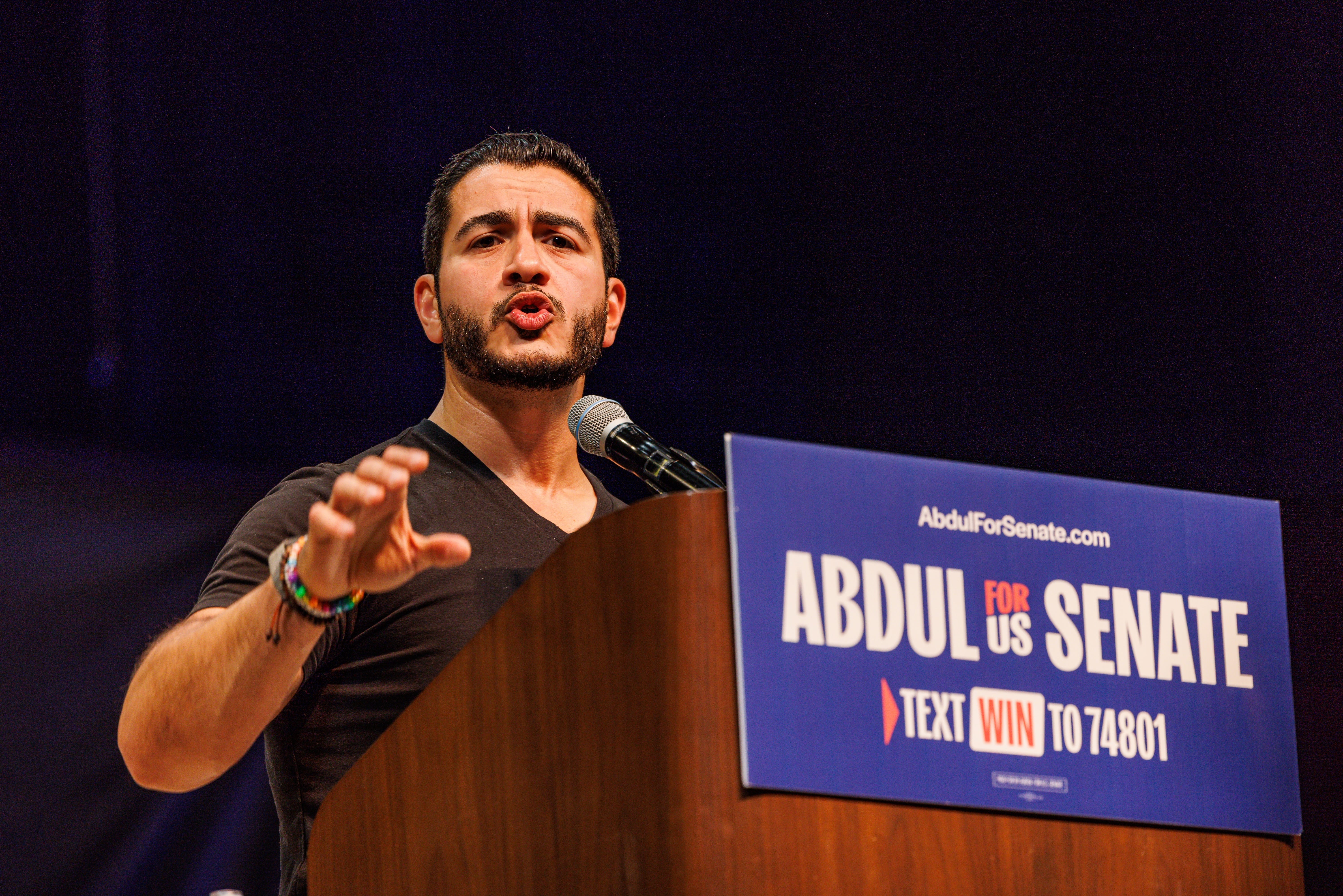
These two guys was Mamdani and Hasan Piker at the time he said it. It has since expanded. The Michigan Democratic Party held its Senate primary on August 5, and a physician and public-health advocate named Abdul El-Sayed defeated a moderate representative to become the Democratic nominee in a swing state — overcoming, per Al Jazeera’s tally, more than sixty million dollars in mostly pro-Israel outside spending against him. El-Sayed is Muslim. A note for the record before I go further: El-Sayed is not a democratic socialist, though the ideological label has been attached to him from several directions since his primary win. He has said plainly and repeatedly, in debate, on CNN, in the New Yorker, and elsewhere, I am not a socialist. I am a capitalist who understands how capitalism works, rooting the phrase in Adam Smith’s original argument that monopoly, not government regulation, is the greatest threat to a functioning market economy. He describes himself as a democratic capitalist. This is not the label that would change Harris’s mind about him. Harris’s objection to El-Sayed is not really about economic ideology and would probably survive the DSA label falling off cleanly. The socialist label is a background frame the piece I am writing has to get right; it is not what Harris’s complaint actually rests on. What Harris finds terrifying about El-Sayed is the same thing he finds sinister about Mamdani, and it is not the tax code. So Harris’s category has, since then, had a second name to fit inside it, and the category is not the one about economics.
Harris said when he was asked what the evidence was for Mamdani being a sinister figure and a none-too-closeted Islamist and a man captured by a fairly sinister theocratic agenda and an antisemitic one. Harris had no evidence. He had a metaphor about an interface and the kinds of things his wife likes on social media. The piece diagnosed that as the shape of a smear dressed up as the shape of an analysis. I want to pick that up now, because what four months ago looked like a single lapse now looks like a category. Two Muslim Democrats have run for high office in the interval. Harris has declared both of them existential problems for the country. This has stopped being about Mamdani. It was never about Mamdani.
⁂
Start with the sentence that in 2028 that is going to be suicide, because it is doing more work than it appears to do.
At the surface, it is a prediction. Harris is claiming that if the Democratic Party runs candidates like Mamdani and El-Sayed, or more broadly, if the party imagines these candidates as its future, the party will be crushed in the 2028 general election. There is a version of this prediction that is a reasonable political-analysis claim — a version that would come with polling data, coalition modeling, historical comparisons to McGovern in 1972 or Sanders in 2020, and honest acknowledgment that Mamdani has been running a functional municipal government for eight months and El-Sayed just won a swing-state primary against sixty million dollars of adverse money. That is not the prediction Harris is making. Harris’s prediction has no polling data in it. It has no coalition modeling. It has no historical comparison. It has one operative claim underneath: that the American electorate will not accept a Muslim Democrat, and that the party inviting the electorate to do so is committing suicide.
The claim is presented as a warning about the party’s electoral prospects. The claim is actually a description of the electorate’s bigotry, offered as if it were a fixed feature of physics.
This is the move that has to be looked at directly, because it is where Harris’s argument crosses from mistaken analysis to political operation. If you say, the country will punish the Democrats for running a Muslim candidate, therefore Democrats should not run Muslim candidates, you have not made an argument against the Muslim candidate. You have made an argument against the country’s bigotry, and then handed the country’s bigotry a veto over Democratic nominations. The moral responsibility for the fascism that would follow gets transferred, in this sentence, from the fascists to the Muslim Democrats and the party that nominated them. This is not a new move. In 1957 white moderates in the South argued that integration was electoral suicide for southern Democrats because white voters would defect to Republicans, and therefore integration should be slowed. They were right about the defection. They were wrong about what to do with the moral responsibility for it. In 2008 respectable commentators argued that Barack Obama’s relationship with Jeremiah Wright would cost him white swing voters, and therefore Obama needed to break with Wright and demonstrate his distance from the Black church tradition. They were right about the reaction. They were wrong about where to put the moral weight of it. Every generation has this argument, and every generation the operative structure is the same: a specific bigotry in the electorate is treated as an environmental fact, and the marginal group is told to accommodate the bigotry rather than the country being told to grow out of it.
Harris in 2026 is making that argument about Muslim Americans. He is dressing it in the language of tactical realism — I am just telling you what the country will do — but he is not just telling us what the country will do. He is instructing the Democratic Party to arrange its ticket around what he takes the country’s fixed prejudice to be. He is doing the accommodation. He is calling it strategy.
There is a rejoinder to this, and Nesrine Malik wrote it in the Guardian on August 10, five days after El-Sayed’s win. She is worth quoting because she is naming the same choice Harris is making, from the other side of it:
If the Democrats would rather lose on their own terms than win on the progressive left’s, then fighting these new candidates will establish the impression that they are freak radicals destined to fizzle out. But these candidates have alighted on what seems like the most viable politics right now. Refuse to embrace them wholeheartedly, and you guarantee that Trumpism wins again and again. Back them all the way to 2028. What, after all, do you have to lose that you haven’t lost already?
Malik and Harris cannot both be right. One of them is claiming that Muslim Democrats running on populist economic platforms — whether they are socialists like Mamdani or self-described capitalists with strong regulatory commitments like El-Sayed — are the party’s suicide in 2028. The other is claiming that refusing to back those candidates is the party’s guarantee of losing to Trumpism through 2028 and beyond. The evidence has to decide between them, and the evidence is not on Harris’s side. Mamdani’s approval in New York has risen through his first eight months in office. His signature initiatives — universal childcare funded on his eighth day, more than thirty million dollars recovered from landlords, a hundred thousand potholes filled — are what the New York papers cover on the days they are not being asked to help produce a theocracy panic about him. El-Sayed’s Michigan primary win came after establishment Democratic groups poured tens of millions into stopping him and lost. Whatever Harris is warning against, the voters have not so far taken the warning; the warning, in the end, is about them, not for them.
⁂
As for the phrase miseducated dummy coming out of a school like Columbia, because I think it is worth unpacking this for a moment, because I think it paints a picture of the disposition of the person making these arguments.
Mamdani has a bachelor’s degree from Bowdoin. El-Sayed has a doctorate from Oxford as a Rhodes Scholar and a medical degree from Columbia. Harris himself has a doctorate in cognitive neuroscience from UCLA. So the class Harris is describing when he says miseducated dummies coming out of schools like Columbia is the class he belongs to, the class Mamdani and El-Sayed belong to, and the class of American elite-university graduates that produces the country’s professional-managerial cadre. Harris is inside it exactly as much as they are. The phrase is a specific accusation, not a class critique, and the accusation is that a specific kind of graduate from a specific kind of school has been turned — has absorbed something the schools were teaching that Harris believes should not have been taught, and now presents in the political system as a kind of contamination.
What is the something? Not economics. Harris does not, in his podcasting career, spend much time on the details of universal childcare or landlord enforcement or the tax base of Michigan. Not foreign policy in any coherent sense either. Mamdani and El-Sayed have both been critical of the Israeli government’s conduct in Gaza, as have hundreds of members of Congress and much of the country. What the schools are supposedly having produced in these two Democrats, that Harris finds embarrassing in the graduates and terrifying in the voters who support them, is a specific stance toward political Islam — a stance that refuses to accept the master category framing Harris built his career on. The graduates are miseducated because they did not come out of school believing that political Islam is the primary risk to open societies and the primary lens for evaluating any Muslim politician’s fitness for office. They came out believing that a Muslim mayor should be evaluated on whether he collects the trash and a Muslim Senate candidate should be evaluated on his record as a public-health officer during the Flint water crisis. Harris finds this framing itself to be the sign of miseducation. In 2026 the demand that a Muslim Democrat be evaluated on his actual conduct in office is, in Harris’s telling, a symptom of a class of people who cannot see what is really going on.
The class of people who cannot see what is really going on is the class of people who will not agree that Muslim Democrats have to first prove they are not the enemy. Harris does not put it this way, because he cannot afford to. But that is what the sentences are for.
⁂
I want to pause on the miseducated dummies framing itself for one more paragraph, because I think there is a specifically American history that Harris is either forgetting or pretending he never learned. Young people being significantly more left-wing than their parents — sometimes radically so, sometimes to the point of frightening the professional classes that produced them — is one of the most ordinary and repeatedly-recurring conditions in the American record. The Churchill line about being a socialist at twenty and a conservative at forty is a joke about a real cultural regularity, and the joke exists because the regularity is real and stable and does not need explanation by a special theory of contemporary school miseducation. Every serious observer of American cultural life has seen this pattern for a hundred years, and no serious observer of American cultural life has ever taken the pattern to mean that the schools are producing a dangerous class of enemies of the country.
Harris apparently did not encounter the late 1960s in any depth during his own education, or he did encounter it and has decided to pretend that Zohran Mamdani telling New Yorkers he wants to fund universal childcare is a more alarming political phenomenon than what was actually happening in that decade. The Weather Underground bombed government buildings. Students for a Democratic Society took over Columbia in 1968 and shut the university down. The Free Speech Movement at Berkeley put Mario Savio on top of a police car with a bullhorn declaring that the machine had become so odious he was going to throw his body upon its gears. The Black Panthers were carrying rifles into the California statehouse. The Yippies were nominating a pig for president. Actual bombs went off in American cities, planted by American college graduates, in the name of an actual revolution against American capitalism. The moral panic about the miseducation of the young in that decade was much louder than anything Harris is saying today, because the young in that decade were doing much louder things than anything the DSA voters of 2026 are doing. And the professional class that came out of that decade — the class that had been the terrifying miseducated radicals of 1968 — became the professional-managerial class of the 1990s, which included, at its edges, Sam Harris. He is currently running the schools-are-producing-a-dangerous-class panic about a generation that has done nothing more radical than elect a mayor of New York who is fixing the potholes and a Senate nominee in Michigan who was a public-health commissioner during a lead crisis. Compared to the actual radicalisms his own cohort came out of, this is a moderate generation. He is treating it as an emergency because his framework needs an emergency.
Every reactionary panic about the young has, in retrospect, looked embarrassing to the panicker’s grandchildren. Harris will not be an exception to that record. When the historians of the 2020s look back at the DSA moment, they will note the moderate positions on housing and childcare and healthcare, the ordinary bureaucratic competence in office, the total absence of anything resembling the actual radical left of the 1960s, and they will wonder what the prominent secular liberals of the period thought they were seeing when they said the country was suicide-bound. This is not a prediction about the historians’ generosity. This is what the record already looks like when you compare 2026 to 1968 on any measure that matters. Harris has picked a strange decade in which to declare that the young have been miseducated into an existential threat.
⁂
There is a phrase clinicians use for what Harris is doing, and I am not reaching for it as an insult. The term names a specific cognitive failure, and it appears in every standard cognitive-behavioral-therapy textbook in the country. The term is mind reading. Mind reading is the cognitive distortion of asserting that you know the private mental content of another person, without evidence, and then reasoning from that assertion as if it were evidence you had gathered. The clinician’s shorthand for this move is that the patient knows what the other person is thinking, and the other person doesn’t get a vote about it. The move is considered a distortion in therapy for the same reason it is considered a distortion outside therapy: because the private mental content of another person is not observable, and treating it as if it were is what allows a paranoid style to be mistaken for perceptiveness.
Harris does this constantly with Mamdani. He knows that Mamdani is only self-censoring. He knows that Mamdani knows much more than he’s letting on. He knows that Mamdani’s answer to a question about intifada was not an answer but a non-answer worse than a dog whistle. He knows that behind the pothole and the childcare there is something very sinister happening. Every one of these claims requires access to a mental content Harris has not seen and has not been shown. Each of them is made with the confidence of a claim about weather. Ninety percent of what Mamdani says, in Harris’s telling, is a performance concealing an interior Harris has direct access to. The interior is sinister. The interior is theocratic. The interior is antisemitic. The performance is self-censoring. Harris is not making an inference from evidence. He is delivering a report from inside the mayor’s head, and inviting the audience to trust the report because the reporter is rigorous.
I know this from direct experience. It happened on Harris’s own turf. When Harris launched the Community feature of his platform — a paying forum for the kind of long-time listeners I described a moment ago — I posted a question there for him. The question was simple. Mamdani had at that point made several contemporaneous public statements condemning antisemitism, in plain language, without hedging, in venues where his audience was overwhelmingly not the pro-Israel right. I asked Harris whether he believed those statements were cynical performances designed to mask a truer animus, or whether he took them at face value as what Mamdani thought. That is a direct question with two possible directions. The face-value direction would have been the ordinary thing: a Democratic politician has said, in public, that he opposes antisemitism, and the burden of proof is now on the person who wants to say he does not mean it. The other direction — that the statements were cynical performances masking an antisemitic interior — is the mind-reading direction, and it requires either evidence of the interior or an admission that the reasoner is guessing. Harris did not answer my question in his own forum. He has, however, subsequently answered it in public interviews, and the answer he has given in public is that yes, he believes the condemnations of antisemitism are performances — that the antisemitism is in there anyway, behind them, and that the condemnations themselves are part of what is sinister about Mamdani rather than evidence against sinister-ness. This is the pattern named at the highest resolution I can name it at. A person who condemns antisemitism in plain language cannot get out from under Harris’s suspicion by condemning antisemitism in plain language, because Harris has already decided what the condemnation is for. The evidence that would count as evidence in any other case does not count here. The framework has settled the question in advance.
This is worth naming exactly because Harris trades on being the person in the room who does not do this. His whole intellectual brand is that other people mistake their intuitions for arguments and he is careful enough not to. The mind-reading pattern in his Mamdani material is a violation of the discipline he claims as his differentiator. It is also, mechanically, the same move every conspiracy theorist has ever made about a group they are convinced is not telling them the truth. The Elders of Zion knew what the Jews really wanted. The John Birch Society knew what the fluoride-drinking teachers were really up to. QAnon knows what the pizza-shop managers are really doing in the basement. In each case the operator has access to a private mental content that the ordinary observer cannot see, and the operator’s job is to translate the concealed interior into a public warning. Harris in 2026 is running that pattern on the mayor of New York City. He can seem to just be doing rigor; if you double-click on the argument, you find that he is doing a much older kind of thing, which is claiming to know what a Muslim political figure secretly believes and organizing his listeners’ politics around the claim.
One instance of mind-reading about one Muslim Democrat could be a bad day. The same pattern extended to a second Muslim Democrat within four months, alongside the miseducated dummies framing of the voters who chose them, is the shape of a pattern.
⁂
There is a specific piece of intellectual apparatus that makes this pattern coherent as a pattern, and it deserves to be named, because without naming it the mind-reading move looks like a personal quirk of Harris’s and it is not. It is an inheritance.
The term is taqiyya. In actual Islamic jurisprudence, taqiyya is a narrow, defensive, historically-contingent doctrine developed primarily by Shia Muslims during periods of persecution under Sunni-majority regimes. It permits the concealment of one’s religious identity when disclosure would mean death or torture. It is a survival provision, roughly comparable in shape to what Marrano Jews did under the Spanish Inquisition or what English Catholics did under Elizabeth I. Its actual scope in the scholarly literature is narrow: a defensive dispensation for a persecuted minority, playing a minor and specific role in Shia thought, and treated as essentially inert in Sunni jurisprudence. Scholars like John Esposito, Juan Cole, and Yasir Qadhi have said all of this in print, at length, and without hedging. This is not a fringe scholarly view. This is what people who read the primary sources say the primary sources say.
In the American right, starting roughly in the mid-2000s, the concept was hijacked and rebuilt. Robert Spencer, whose Jihad Watch and books like The Truth About Muhammad served as the intellectual clearinghouse for the anti-Muslim right; Pamela Geller, who ran the Atlas Shrugs blog and co-founded Stop Islamization of America with Spencer; and Frank Gaffney, whose Center for Security Policy produced the Team B II report claiming that Sharia was infiltrating American institutions — these three figures, and the apparatus they built, took the narrow Shia defensive doctrine and reframed it as a universal Muslim permission to lie to non-Muslims for political advantage. In the reframed version, every Muslim public statement of good faith is potentially strategic concealment. Every condemnation of terrorism is potentially cover. Every civic gesture is potentially the mask. The interior is always the truth and the surface is always the performance. Andrew McCarthy at National Review mainstreamed the frame into center-right respectability. David Horowitz’s operation propagated it through campus politics. By the time of the 2016 election the frame was ambient in the ordinary discourse of the American right about any Muslim in public life, from Keith Ellison to Ilhan Omar to Rashida Tlaib.
The function of the taqiyya frame, epistemically, is exactly what Harris is doing on Mamdani and El-Sayed. It provides a warrant for discounting a Muslim politician’s stated positions as evidence of the politician’s actual positions. It installs a permanent gap between the surface and the interior, and it locates the truth on the interior side of the gap. It converts any public act of civic assurance into further evidence of concealment, because concealment is now what the surface is for. Once the frame is installed, no Muslim politician can ever get out from under it by speaking, because speaking is the medium of the deception the frame anticipates. This is why Harris can hear Mamdani condemn antisemitism in plain language and treat the condemnation itself as sinister. The frame has already decided that plain language from a Muslim politician about antisemitism is what the deception looks like when it is being competent.
It would be somewhat difficult to convince me of the notion that Sam Harris consciously operates from Jihad Watch premises. I would guess he has read very little Spencer, has never quoted Geller, and would recoil at being placed in Gaffney’s neighborhood. That is not the claim. The claim is that the epistemic move — the permanent-gap-between-surface-and-interior-for-Muslims-specifically move — is now a background feature of American public discourse about Muslims, and it has been for twenty years, and it entered the water through the specific apparatus I just named. Harris did not have to build the frame. The frame is what the room around him has been breathing since roughly 2005. When he says if you double-click on Mamdani you find something sinister, he is running a version of the surface-and-interior epistemology that Spencer built the American form of. When he says Mamdani’s condemnations of antisemitism are performances concealing the actual antisemitism, he is running the taqiyya move without using the word. The word is the missing piece of the diagram; once you draw the word in, the picture becomes legible.
This also explains the asymmetry. Harris does not do this to Christian politicians. He does not tell his audience that when Mike Johnson gives a speech about American pluralism he is really concealing his Christian-nationalist commitments, though Mike Johnson has stated Christian-nationalist commitments on the record. He does not tell his audience that when J.D. Vance talks about civic decency he is masking his integralist theological interior, though Vance’s integralist commitments are traceable. The asymmetry is not about which politicians have stated theological views that would concern a secular liberal. The asymmetry is about which group has a specialized doctrine of presumed dishonesty pre-loaded in the surrounding intellectual environment. Christians do not. Muslims do. The doctrine is called taqiyya on the right, and it is doing work on the left every time a secular liberal decides that a Muslim politician’s stated commitments cannot be taken at face value.
⁂
There is a further problem with the frame that has to be named clearly, because the taqiyya section describes the frame’s epistemic function but does not describe what the frame is doing at the level of psychology. What the frame is doing at the level of psychology is supplying a theory of mind that Harris’s argument requires and that would otherwise be visibly implausible. When the frame is removed, the theory of mind is revealed as a claim about how human beings work that human beings do not actually confirm.
The operative theory of mind, when Harris’s method is applied to Mamdani, is that a person can hold a press conference condemning antisemitism, sponsor legislation to protect Jewish community institutions, employ Jewish staff, meet with Jewish constituents, keep a functioning executive schedule managing the largest municipal government in the country, and simultaneously — inside the same skull — be planning or hoping for a Jewish final solution. The public behavior and the private intention exist as a total split, with the surface performance and the interior program running on parallel tracks that never touch. This is what the if you double-click structure of the argument actually asks the reader to imagine. The mayor at the podium condemning antisemitism is one track; the mayor in the interior room planning the elimination is another track; and the two tracks coexist without producing the kind of psychic strain that would manifest in the surface behavior.
The problem is that human beings do not work this way. Ordinary human psychology has no documented capacity to sustain a total split between public performance and private intention on a matter of that magnitude, over years, while running a public office with the media exposure of a New York mayoralty. What does have that capacity is a small and specific set of extreme conditions: cult members whose formation involved the systematic dissolution of the boundary between self and doctrine, child soldiers who were forced across the threshold of ordinary moral inhibition before their moral faculties had finished developing, deep-cover intelligence operatives who received years of specialized training in maintaining a dissociative operational identity and who typically develop severe psychological consequences from the sustained split, and individuals with certain forms of psychotic or dissociative pathology who exhibit the split as a symptom of illness rather than as an achievement of ideological discipline. In every documented case, the split produces observable psychic strain that shows up in the surface behavior — micro-expressions, contradictions under pressure, breakdowns under sustained scrutiny, the pathological signatures a competent clinician or intelligence officer is trained to recognize. The split is expensive to maintain. It leaks.
Mamdani is not exhibiting the leakage. His public behavior over the course of his political career and his mayoral run has been the ordinary behavior of an ordinary progressive politician with a public record that is available for evaluation. He gives interviews. He answers questions under pressure. He negotiates with hostile counterparts. He manages staff. He appears at community events. There is a large surface area of his behavior available to any observer who wants to look at it, and the surface area does not contain the signatures the psychological theory would require it to contain. To sustain the double-click reading, the observer has to posit that Mamdani is either better than every documented cult member, child soldier, and intelligence operative at maintaining the split, or that Islam has supplied him with a form of ideological software that eliminates the ordinary cost of maintaining it. There is no third option available. Either Mamdani is a preternaturally gifted dissembler whose skills exceed the entire documented population of trained deep-cover operatives, or something about the ideology has re-engineered his cognitive architecture so that the split runs without strain.
This is where the taqiyya frame’s real work becomes visible, whether Harris uses the word or not. The frame is supplying the missing psychology. It says: here is why they can sustain it. Islam contains a doctrinal permission structure that reprograms the ordinary human cost of holding a public position at variance with a private one, and Muslim political actors operate inside that permission structure whether or not they consciously invoke it. Without that supply, the theory of mind is incoherent, because it is asking the reader to believe something about a working New York mayor that is not true about any working New York mayor who has ever existed. With the supply, the theory becomes internally consistent — but only by importing an anti-Muslim demonology as the psychological premise the theory rests on. The theory does not just happen to fit alongside a Spencer-shaped account of Islam as ideological software. The theory requires that account, because without it, the theory has nothing to say about why the ordinary constraints of human psychology do not apply to the mayor.
The reason to name this at length is that it changes the character of the objection. Uncharitability is a lesser complaint than the one the essay is actually making. The complaint is that Harris is deploying a theory of mind that fails on its own terms. He is attributing to a functioning mayor a cognitive structure that no functioning mayor could actually maintain, and he is holding the theory together by importing the specific demonology that supplies the missing piece. The theory is not merely unfair to Mamdani. The theory is wrong about how human beings work. It is wrong in a way that would be immediately visible if the target were a Catholic mayor or a Jewish mayor or a Mormon mayor or a Baptist mayor, because in those cases there would be no available demonology to supply the missing psychology, and the theory would collapse the moment it was stated. It is only sustained on Muslim political actors because there is a centuries-old apparatus, and a modern American form of that apparatus that Robert Spencer built, sitting ready to be imported as the pseudo-explanation the theory needs.
A secular liberal writer who takes psychology seriously — who has, over decades, drawn on cognitive science, on evolutionary theory, on the empirical literature on belief and behavior, on the study of extreme states of mind — should be the first person in the room to notice that the theory has this defect. The theory asks him to believe that Islam produces, at scale, human beings whose cognitive architecture matches only the population of trained intelligence operatives and cult formation survivors, and does so without producing any of the observable strain that population exhibits, and does so in a way that leaves them capable of running large complex organizations under intense public scrutiny. That is not a theory about political Islam. That is a theory about magic. When Harris deploys it, he is not being rigorous about political theology; he is being credulous about a demonology whose empirical foundations he has not audited. The person he has often accused of moral confusion would, if the tables were turned, be exactly the person Harris would want in the room to point this out. This essay is offered in that spirit, and Harris is free to read it in whatever spirit he likes.
⁂
Harris will, if he encounters this piece, most likely reach for one of his signature dismissals for critics on exactly these topics. The dismissal is called moral confusion. It appears throughout his work on Israel and Palestine, on political Islam, and on what he broadly categorizes as woke failures of clarity. The rhetorical shape of the move is to relocate the disagreement inside the critic’s cognitive faculties: the critic has failed to see clearly which side of a real moral divide the correct answer sits on, and if the critic could only think through the case with the requisite rigor, the disagreement would resolve itself. This is a move that pre-decides what the disagreement is about, which is why it functions as a dismissal rather than as engagement. The disagreement gets recategorized as the critic’s failure of clarity before the substantive counterargument gets heard.
The moral argument the essay is making has to be on the record before the recategorization is available. It is this.
The argument is not that the moral questions Harris raises are unimportant. Antisemitism is a genuine and ongoing evil. Theocratic political movements are genuinely dangerous. Political Islam, as an ideology, has real relationships to real violence in real places in the world; I have written about that in other pieces and I stand by what I wrote there. The argument in this piece is not on the opposite side of any of those questions. The argument is that the method Harris is using to identify which specific American Muslim politicians count as theocratic threats is unsound, and that this unsoundness is itself a moral problem, because the people the method wrongly identifies are real people who face real consequences from having been identified.
The moral question the essay is asking is not which side of the antisemitism question are you on. That question is easy; every serious person is on the same side of it, including Mamdani, including El-Sayed, and including me. The moral question the essay is asking is: what standard of evidence do you require before you tell a national audience that a Muslim American who spent his career running a public-health department during the Flint water crisis is secretly a theocratic threat to the country, or that a Muslim American mayor who is fixing potholes and funding childcare is running a fairly sinister theocratic agenda behind the surface? That question is not moral confusion. That question is the ordinary evidentiary discipline of a secular liberal tradition, applied to a specific class of claim about specific human beings with specific public records. The demand that the discipline apply here the way it applies everywhere else is a demand for consistency, from a writer who has staked his intellectual authority on being the person in the room who applies the same standards to every case.
There is a further moral consideration that has nothing to do with Mamdani and El-Sayed personally. Mamdani and El-Sayed will be fine; they have won primaries against enormous adverse money, they have public platforms, and they have the ordinary protections of high political office. The people who bear the cost of the mind-reading pattern, of the taqiyya-inflected epistemology that flows underneath the pattern, are ordinary American Muslims, who watch their fellow citizens be told by a prominent secular liberal that Muslim politicians in this country cannot be evaluated by their public records because there is a hidden interior only the initiated can see. This is the effect the sentences have in the air, whatever the speaker’s private stance toward them. The moral clarity a secular liberal tradition requires is the clarity to refuse to say those sentences unless you can defend them by the standards of evidence you apply everywhere else. That is not confusion; that is the discipline the tradition is for.
So if the response to what I have written is that I am morally confused, the response has misidentified the disagreement. I am not confused about which side of the antisemitism question I am on. I am not confused about the reality of theocratic politics. I am insisting that the standards of evidence Harris applies to every other domain of his intellectual life have to apply to this one too, and that the failure to apply them is not a small procedural matter but a moral failure with real downstream costs. The insistence is the moral argument. Naming it in advance is the only way to keep the argument from being reprocessed as its opposite.
⁂
A related clarification is due, because the Harris quote that opened this piece named two people, and one of them was Hasan Piker.
On Piker, Harris is not wrong to be concerned. Piker’s public record on China, Cuba, and Taiwan is not defensible by any secular liberal standard, and I am not defending it. He has visited China in November 2025 and used the trip to describe Xinjiang as awesome, to minimize the Uyghur camps as reeducation rather than the mass detention that mainstream human-rights reporting has documented, and to characterize Chinese colonialism in Tibet as a civilizing project. He gave an interview to CGTN, the CCP’s international propaganda channel, in which he described China as a normal country like any other and said he was there to correct rumors about the country. He has said the CCP is what most closely embodies his vision of socialism, has described a politically free Hong Kong as ridiculous, and has framed the defense of Taiwan through analogies designed to make CCP claims on it sound reasonable. In March of 2026 he traveled to Cuba as part of a convoy organized through a Neville Roy Singham-linked funding apparatus, delivered what was described as humanitarian aid, and was subsequently subpoenaed by the Treasury Department’s Office of Foreign Assets Control as part of a sanctions investigation into the trip. This is a public record. It is legible to anyone who wants to look at it, and the reading of it runs through the transcripts, the streams, and the state-media appearances Piker himself produced, not through any interior he cannot be shown to hold. Vox called this the real problem with Hasan Piker six months ago, and Newlines Magazine ran the argument at length under the headline that his China take may matter more than his Israel take. I agree with both of those pieces. Piker’s alignment with authoritarian regimes that run mass detention camps and single-party political control is disqualifying, and I would not want the Democratic Party’s future to run through him.
This is the control experiment for what the rest of this piece is diagnosing. On Piker, Harris is applying his ordinary method: he is looking at a public record, drawing an inference the record actually supports, and calling the inference by its right name. There is no if you double-click move required, because there is nothing hidden to double-click into; Piker has said the things on stream. There is no mind-reading required, because there is a text. There is no taqiyya frame required, because Piker is not a Muslim politician being smeared with a doctrine of presumed dishonesty; he is a socialist streamer whose CCP-favorable positions are the surface of the record, not concealed under it. Harris on Piker is Harris operating normally, and Harris operating normally can correctly identify authoritarian sympathy when he sees it, because his method is a good method when it is being applied to what it can see.
Which is why the pattern on Mamdani and El-Sayed is a real deviation, not a generalized failure. Harris has the method. He knows how to use it. He uses it on Piker and reaches a defensible conclusion on Piker. When the subject changes from an illiberal Western leftist with a public record of CCP apologia to a Muslim Democrat with a public record of running a health department during a lead crisis, the method changes shape too, and the shape it takes on is the mind-reading shape, the surface-and-interior shape, the shape Spencer built the American form of. The Piker case is the proof that Harris is capable of the ordinary discipline; the Mamdani and El-Sayed cases are the evidence that the discipline stops functioning on a specific class of target. That is a diagnosable pattern, and diagnosing it does not require defending Piker, because Piker is not being defended. Piker is the case that shows Harris’s method works when Harris uses it.
⁂
The claim I am making here is narrower than it might look, and the size of the claim matters.
I am not accusing Sam Harris of acting in bad faith. I have listened to him for twenty years and I have never believed that he sits down at the microphone intending to deceive his audience or intending to smuggle a prejudice in under a rigor he does not really possess. The evidence I have of his intentions is his stated intentions, and his stated intentions are the ones a serious secular liberal has about the survival of open societies. I take those intentions seriously. I take the record of his career on other subjects — his careful work on meditation, on ethics, on the limits of his own knowledge in domains where he does not have training — as evidence that he is not the caricature his sharpest critics sometimes paint him as.
I have written about Harris more positively than negatively in these pages when the subject was one on which his reasoning is at full strength. In The Last Serious Contrarian, I called him the closest of them to Hitchens in raw aptitude, and I treated The End of Faith and Letter to a Christian Nation as serious continuations of the atheistic work Hitchens did in God Is Not Great. In The Most Articulate Apologist, which was published four months ago and was primarily about Ben Shapiro, I gave Harris explicit credit for his handling of that interview — for asking the questions a serious interlocutor should ask, for asking them sharply, and for producing what I called the most clarifying interview I have read in a year. Both of those pieces criticized Harris on the Islam material, and both of them placed the criticism next to the credit rather than in the place of the credit. What I am saying now is not a reversal of that arrangement. Most of what Harris does, he still does at the level I have engaged with him at for years, and I would happily engage with him at that level again on any of it. The narrow section of his output I am describing is a narrow section, and I do not want the sharpness of my language about it to be read as a claim about the whole.
What I am observing is narrower than a claim about his character, and I think more honest than one. On the specific subject of Muslim politicians in Western democracies, and adjacent to it on the specific subject of Israel, the pattern of his reasoning does things it does not do on other subjects. The confidence about hidden interiors increases. The threshold for calling something sinister drops. The willingness to warn about civilizational suicide arrives, in that domain, on evidence that in any other domain he would ask to see. On any topic outside these two, Sam Harris is coherent in a way that has kept me listening to him for two decades. He is the person I put him in the room for. He weighs evidence. He acknowledges uncertainty. He notices when his interlocutor is running a rhetorical trick and names it. When the topic is meditation or free will or the ethics of lying or the limits of AI cognition, the same person you meet on the podcast is the person you would want as a colleague. What happens when the topic is Muslims and Israel is a change of register so sharp that the same person is no longer in the room. When Harris is talking about those two subjects, he might as well be Ben Shapiro.
I mean that comparison specifically. Shapiro is the reigning American model of the antagonism-first intellect — a person whose whole method is mind-reading his political opponents, warning about civilizational suicide, and treating rhetorical confidence as if it were epistemic warrant. That method has a clinical shape. It is what conspiracy analysis looks like when the analyst is credentialed enough to disguise the mind-reading as inference. When Harris moves onto Muslims or Israel, he starts running that method. He does not sound like the Harris of the free-will book. He sounds like the person who has decided in advance that the Muslim Democrat is a threat, and whose remaining task is to explain to the listener what is really going on behind the mayor’s smile. This is Shapiro’s method. Harris runs it, in these two domains, at a level of fluency Shapiro himself would admire. Outside those two domains, Harris would recognize the method as unserious and would say so.
I do not know why the switch happens. I know that Muslims and Israel have been the topics on which his epistemic behavior visibly changes, going back at least fifteen years, and I know that in the last six months two elected or nominated Muslim Democrats have arrived in his frame and both have been diagnosed as civilizational risks on evidence that would not have carried him past the first minute of any other subject. I am recording the pattern. I am not telling you what to conclude about the man.
There is a second-order tell that belongs to the same pattern and I think is diagnostically important. Harris has reacted with unusual harshness to the segment of his own audience that has pushed back on him about Mamdani, El-Sayed, and Israel. Not the trolls, not the ideological opponents, not the professional critics who have never liked him — those he metabolizes routinely, and often gracefully. The people I am talking about are long-time listeners. People who bought the books. People who did the ten-day retreats through the Waking Up app. People who defended him through the New Atheist wars and through the Ben Affleck confrontation and through the Ezra Klein exchange and through everything since. When those listeners have written in, canceled subscriptions, posted disagreement, or asked him publicly to reconsider, Harris has not treated the disagreement as interesting. He has treated it as apostasy. He has framed leaving over these issues as a form of moral failure on the departing listener’s part — as evidence that they were never really with him, or that they have been captured by a political tribalism they refuse to see in themselves. He has made clear that he is willing to take this argument to the edge of the audience’s existence. He would rather lose the audience over Mamdani and Israel than moderate the method he is using on Mamdani and Israel.
This is the shape of the pattern at a higher level of magnification. On any other topic, Harris treats audience disagreement as data. He has said, publicly, that he learns from his critics. He has revised positions in real time. He has acknowledged in the free-will material and in the ethics work that his listeners have pushed him to sharper formulations than he would have arrived at alone. On these two topics, the intellectual metabolism that treats disagreement as data breaks. The listeners are wrong for disagreeing. The listeners are captured. The listeners are choosing their tribe over the truth. This is again the shape of a reasoning that has decided in advance where it is going, and is treating everything that would slow it down — including the collective weight of the audience that made him — as an obstacle to be overridden. If the framework’s own long-time constituents cannot dislodge it, nothing can. The absence of yield under pressure is itself instructive.
The listeners have also asked him, repeatedly, over years, to do the one thing his method has always claimed to require. They have asked him to bring a serious counter-view into the room and take it seriously in a long-form conversation, on the topic where his read of the world has moved the furthest from the read most of his coalition holds. He has hosted Douglas Murray on jihadism and civilization at book length, Haviv Rettig Gur on Zionism and Iran, Dan Senor on the state of the war multiple times, Michal Cotler-Wunsh on the argument that anti-Zionism is antisemitism, Yuval Harari on the immediate aftermath of October 7. On the other side of the ledger, on the specific question of Israeli state conduct in Gaza and the moral status of the war’s prosecution, he has hosted no one who holds the view that most of his own long-time listeners now hold. In June of this year he wrote a Substack post whose title is a fair paraphrase of the position it defends: Why I Won’t Debate Critics of Israel. On the More From Sam episode released May 26, his producer Jaron Lowenstein opened the show by saying, on tape, that he continued to be confused about Harris’s reluctance to engage more podcast guests who disagree with him about Gaza and about why Harris thought such conversations would be disastrous. That is the producer, on the show, from inside the operation, naming the pattern the audience has been naming for years.
Harris’s stated reason, given in the Won’t Debate post and elsewhere, is that the available interlocutors are all bad faith. Mehdi Hasan is bad faith. Norman Finkelstein is bad faith. Noam Chomsky was bad faith. Ta-Nehisi Coates is bad faith. The category has, over time, expanded to include effectively every prominent public intellectual whose read of the war differs from his own, which is a striking coincidence for a category that is supposed to track a psychological property of the interlocutor rather than the direction of their disagreement. What the category is actually doing is closing the door on the ordinary mechanism by which an intellectual’s read of a hard question gets tested against the best available opposing read. The closure is the direct consequence of a theory of mind that has already located the opposition inside a demonology — a demonology in which criticism of Israeli state conduct is not a position an intelligent person can arrive at through the ordinary discipline of moral reasoning but is instead a symptom of moral confusion, or of antisemitism, or of tribal capture, or of the manosphere or the podcast bros or whichever proximate cause is being named on a given episode. If the opposition is by definition operating from a defective place, then hearing the opposition out is not the practice of an open mind; it is the amplification of a corruption. That is the internal logic of Harris’s refusal, and it is the logic that reveals what the framework is actually doing. An intellectual whose brand is epistemic humility and open inquiry has, on one specific question, decided in advance that no interlocutor on the other side could possibly be operating in good faith, which is another way of saying that the framework has closed the ordinary route by which he might learn he is wrong. That closure is not a feature of open inquiry. It is a feature of an argument that has become a commitment.
⁂
Whatever the pattern’s source in him, its effect on other people is not neutral.
Harris has a large audience. His frame travels across the internet. The country he lives in—the country we share—has a right-wing media apparatus actively looking for permission structures to treat Muslim politicians as inherently suspect, and a prominent secular liberal saying that two elected Muslim Democrats are frankly terrifying and represent suicide in the next presidential cycle is a resource that apparatus will use, regardless of what the secular liberal intended. Harris does not have to be a bigot for the effect of his sentences to be that Muslim Democrats face a headwind he has helped create. Effects do not require matching intentions. A person can produce a smear without meaning to produce a smear, if the reasoning that produced the sentence had the shape of a smear underneath it. The mind-reading move is that shape. The if you double-click move is that shape. The these two guys are suicide in 2028 move is that shape. Once the sentences are in the air, they behave the way that shape behaves in the world, whatever the speaker’s private stance toward them.
So the request I have of Harris, if he is reading, is small. I would ask him to notice the pattern. I would ask him to notice that on this one topic he is doing things he would rightly criticize other people for doing on any other topic. I would ask him whether the confidence he has about the hidden theocratic interiors of two Muslim Democrats is a confidence he can defend by the standards of evidence he applies to every other domain of his intellectual life. I would ask him whether he can look at Abdul El-Sayed’s record as Detroit’s health commissioner during the Flint water crisis and see a doctor, and look at Zohran Mamdani’s first eight months in New York City and see a mayor. Neither of them is asking to be trusted about their hidden interior. Both of them have public records that can be evaluated. The public records are what the country’s voters have been evaluating, and the country’s voters have decided to put them in office.
Go Deeper into the Circus
Return the Favor

A reporter from a mid-tier political outlet calls Chuck Schumer’s office and asks for a comment on what Charlie Kirk said on his show yesterday about Democrats and the border. The comment gets folded into a story that runs the next morning under the headline
The Post-Ideological Pose

Earlier this year, in a conversation with the Wall Street Journal‘s editor-in-chief Emma Tucker at Davos, Dario Amodei said this:
Of course, the Black Panthers brought guns to the Assembly to make a point about racism and the 2A - not entirely unlike the folks who carry in a Starbucks. They were also providing basic assistance and child care to their community. And yes, it was a crazy time.
I never really got the appeal of Harris. Maybe a gender thing. At this point though he is pretty much a has been. He is too old for the young crowd and his prior audience has aged and mostly could care less what he babbles. He also couldn't seem to pick sides for awhile which probably hurt. He must have a book coming out or podcast numbers dropping. I think we pay too little attention to Horowitz. Not everyone came across his machine in college. I did. So did Miller [though years after I did and I think Miller did in high school].