


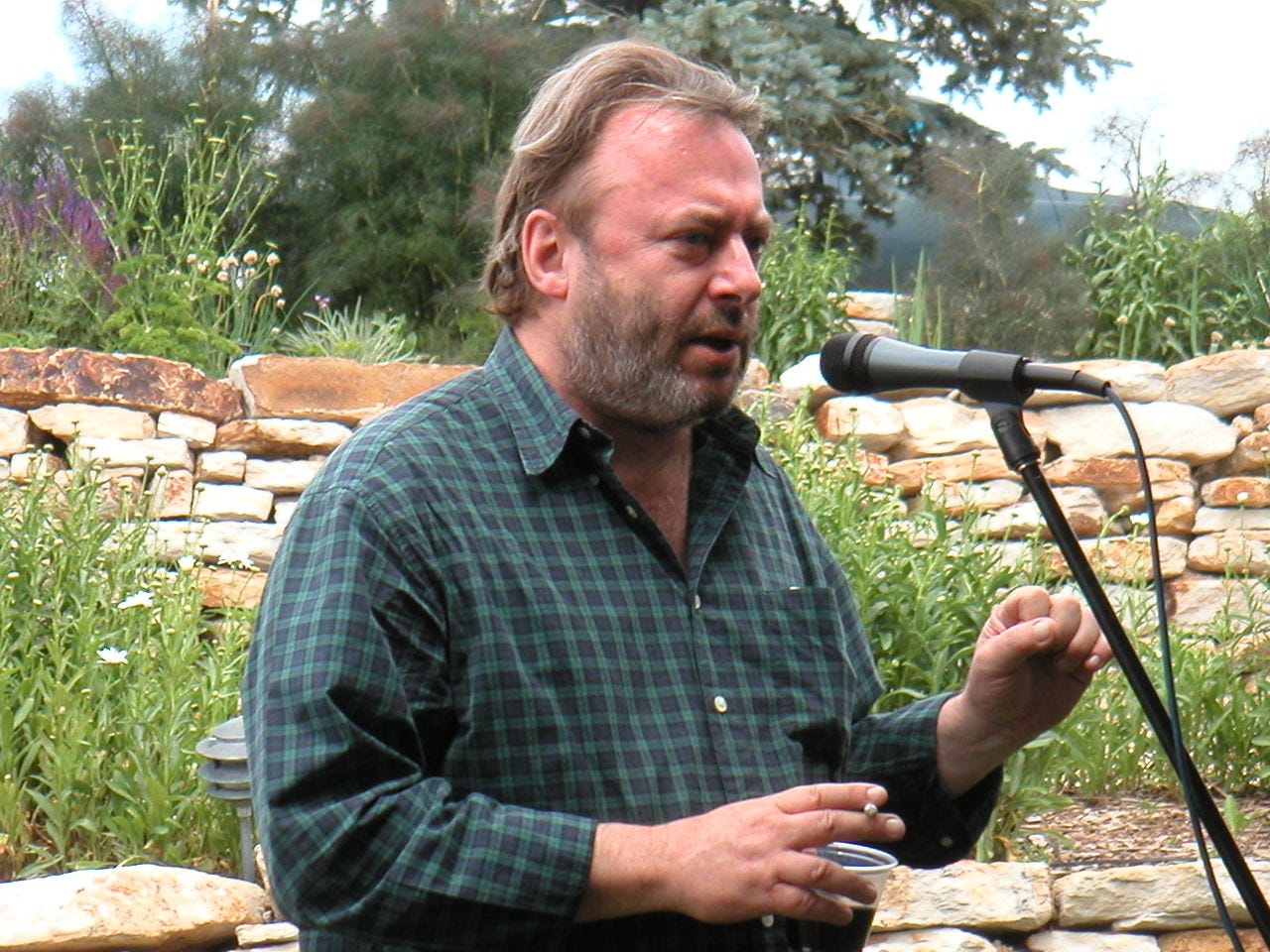
Christopher Hitchens died on the fifteenth of December, 2011, in Houston, of esophageal cancer, at the age of sixty-two. He had been on a book tour for Hitch-22 when the disease announced itself. He spent the eighteen months that followed writing about dying — the essays collected later as Mortality — and refused, in those essays and in every interview, to make a deathbed conversion to anything. He was an atheist when he was diagnosed. He was an atheist when he died. The last two words he is reported to have written, on a piece of paper held up to a friend, were capitalism and downfall.
He was working on the essay when the pen fell.
I want to write about him because the project he was inside is the project these pages have been inside for two years, and because his death in 2011 marks, in retrospect, the last year in which the kind of work he did was being done seriously by anyone with a wide audience. The fourteen years since have seen the rise of an entire ecosystem that has appropriated his posture, his theatrical contrarianism, his willingness to be the most unpopular person in the room, and stripped out the thing that made any of it matter, which was the intellectual cost he paid for it.
He was the last serious contrarian. What came after him is the cargo cult.
⁂
The biography matters because the cost matters, and you cannot see the cost without the biography.
He was born in 1949 in Portsmouth to a naval officer father and a Jewish mother — a fact he did not learn until late in his mother’s life because she had concealed it from the family. He went to the Leys School in Cambridge on scholarship, then to Balliol College, Oxford, where he read PPE and became a Trotskyist. He was, in the standard British class taxonomy, a clever provincial whose mother had wanted him to escape into the upper-middle-class register, and who escaped further than she had imagined — into the international left, into journalism, into a literary world that ran from Martin Amis and Salman Rushdie in his generation to James Fenton and Ian McEwan in his close circle. He spent two decades as a columnist for The Nation, the American left magazine of record. He wrote for the New Statesman in Britain. He covered war in Cyprus, Lebanon, Argentina, Romania, Iraq, the former Yugoslavia. He was arrested in Czechoslovakia. He was beaten in Beirut. He was poisoned, by his own account, in Bratislava. He went where the witnesses were and watched what happened to them.
He drank like a man who knew the body was on a clock. He smoked through the warnings. He read at a rate his closest friends — including Amis, who is no slouch — described as inhuman. The number of books he had read by the time he died is conservatively in the tens of thousands. He held entire poems in his head. He could recite Auden, Larkin, Yeats, and most of Paradise Lost from memory. He wrote longhand, then typed, with the speed of a man who was always slightly behind a deadline he had set himself.
This is the substrate. The cost of his contrarianism was extracted from a person who had built, over forty years of disciplined reading and field reporting, the equipment that contrarianism actually requires. He was not a contrarian because he had a podcast. He was a contrarian because he had, by the time he sat down to write, more information about the subject than the people he was disagreeing with.
⁂
There are two events in his life that the entire shape of his project turns on.
The first was 1989. The Ayatollah Khomeini issued the fatwa against Salman Rushdie for The Satanic Verses on February 14 of that year. The British political class, the British literary class, and a significant portion of the British left treated the fatwa as a regrettable cultural misunderstanding that Rushdie had to some degree provoked. Hitchens treated it as what it was: a totalitarian death sentence issued by a theocratic state against a novelist for the contents of a novel. He did not equivocate. He did not contextualize. He took Rushdie into his home for periods of the years that followed, he campaigned publicly for the Iranian regime’s isolation, and he watched, in real time, his own political tribe — the British left he had been a part of since Oxford — discover that it was prepared to abandon a writer to murder rather than offend a constituency it had decided to court.
The Rushdie fatwa was Hitchens’s first encounter with the priestly class as a structural force. He had encountered priests as individuals all his life, but the fatwa was the moment he understood that the apparatus of theocratic power and the apparatus of leftist accommodation could fuse, that they would fuse whenever doing so suited the political calculations of the moment, and that the witness — Rushdie, in that case — would be the cost. It is the through-line of every position he took for the next twenty-two years. The Bosnian Muslims facing Milošević. The Iraqi Kurds facing Saddam. The Afghans facing the Taliban. The atheist case in God Is Not Great. The defense of Rushdie was the template.
The second event was September 11, 2001. He was in the air on the morning of the attacks, on a flight back from somewhere — he wrote about it in Hitch-22 but the specifics never landed in my head — and what happened to him in the days afterward was that he watched, again, his own political tribe insist that the attacks were the consequence of American foreign policy, that they were the chickens coming home to roost, that the appropriate response was a kind of self-flagellating examination of imperial sin. He wrote a column in The Nation breaking with this position. He used the word Islamo-fascism in a way that made his colleagues recoil. He insisted that what had attacked New York was a totalitarian movement with a theological grammar, that it had to be named and opposed, and that the Left’s reflexive anti-Americanism was, in this case, what Trotskyists had once called objectively reactionary — it was running cover for the worst kind of theocrats the twentieth century had produced.
He resigned from The Nation in 2002. The break was permanent. He spent the next decade describing himself as a former-Trotskyist, then a former-socialist, then — by the very end — a small-l liberal in the classical sense. He never described himself as a conservative. He never voted Republican. He despised Reagan personally, despised Thatcher personally, and never retracted either contempt. But he had crossed a line his tribe could not forgive, and they did not forgive him.
⁂
He was wrong about the Iraq War. Not wrong in the way the apparatus would later concede — that the war had been mismanaged, that the WMD intelligence had been bad, that the Coalition Provisional Authority had blundered. He was wrong in the deeper way. He had convinced himself that the United States, under the second Bush administration, was the available instrument for the project he believed in — the destruction of Baathist totalitarianism in Iraq, the liberation of the Kurds, the planting of a democratic precedent in the Arab world. He was wrong because the United States, as the apparatus that had run the 1953 coup and the 1974 petrodollar deal, was never going to use the invasion of Iraq for the purposes he hoped. The apparatus used the invasion for the apparatus’s purposes, which were to install a friendly regime, control the oil flow, demonstrate the post-Cold-War military hegemony, and enrich the contractor class. The half-million dead Iraqis were the cost the apparatus was willing to pay. Hitchens believed they were the cost of liberation. He was wrong.
He never fully recanted. He defended the war until his death, even as he criticized its execution. This is the hardest thing about him for me, and I will not pretend otherwise. The piece you are reading is not a hagiography. He was wrong. He was wrong loudly. He was wrong in a way that had real consequences for real people, including the people he had said he was trying to defend.
And I want to say something the present moment cannot say, because the present moment has lost the vocabulary to say it. He was wrong, and his being wrong is exactly what makes him different from the men who came after him and took his posture without his cost.
He was wrong, and he paid the price of being wrong. He lost his publication. He lost half his audience. He lost most of his old political friendships. He went, in the space of three years, from being a fixture of the Western left to being a man who, when his name came up at a dinner party of his former allies, was sometimes spat at. He did not go to the right. The right would have welcomed him as a prize defector and paid him accordingly. He refused. He stayed where he was — a leftist who had supported the war, a man without a tribe, a writer working without a constituency. He paid that cost for ten years. He paid it until the cancer killed him.
The point is not that being wrong is admirable. The point is that being wrong and refusing to switch sides for safety or money is what makes someone a witness rather than a careerist. Hitchens chose the price. The men who came after him have chosen the prize.
⁂
The intellectual dark web was a phrase coined, half-jokingly, by Eric Weinstein in 2018, to describe a loose grouping that included his brother Bret Weinstein, Sam Harris, Jordan Peterson, Joe Rogan, Ben Shapiro, Dave Rubin, Bari Weiss, Douglas Murray, and a rotating supporting cast. The premise was that these were thinkers who had been driven from polite progressive discourse by the rigidity of identity politics on the cultural left, and that they had built, through podcasts and Substacks and YouTube channels, a parallel intellectual ecosystem in which the conversations that could no longer be had in legacy media could continue.
The premise was half true and half a marketing position. The cultural left in the late 2010s had developed real pathologies of speech-policing, and some of the IDW figures had real complaints about being shut out of academic and journalistic positions for views that, a decade earlier, would have been unremarkable. I am not interested, in this piece, in defending the cultural-left pathologies that the IDW was reacting against. I am interested in what the IDW did with the position it had created for itself.
What it did was take Christopher Hitchens’s posture — the willingness to disagree with one’s tribe, the contempt for sacred cows, the theatrical relish of saying the unsayable — and strip out the things that had made Hitchens’s version of the posture meaningful. The reading. The reporting. The languages. The deep historical grounding. The decades of paying personal costs for the positions taken. The willingness to remain in a place of intellectual difficulty rather than to monetize the position by joining a more profitable tribe.
Sam Harris is the closest of them to Hitchens in raw aptitude. He is intelligent. He is well-read in cognitive science and Buddhist meditation traditions. His critique of religious literalism, in The End of Faith and Letter to a Christian Nation, was a serious continuation of the kind of work Hitchens did in God Is Not Great. But Harris’s response to the political crisis of the last decade has been, with the partial exception of his treatment of Trump in the 2016-2020 period, a kind of slow disengagement from the political into the parametric. He has retreated into the metaphysics of consciousness, the philosophy of free will, the technicalities of meditation practice. The world burns; he discusses whether the self is real. He is a serious man making a non-serious choice about where to spend his seriousness. Hitchens spent his seriousness on the fire.
Bret Weinstein went further. He started as an evolutionary biologist with a real grievance against Evergreen State College’s struggle sessions in 2017. By 2020 he was promoting ivermectin against the COVID consensus. By 2022 he was in a steady decline into the conspiracist ecosystem, talking about the Great Reset, the World Economic Forum, mRNA vaccines as bioweapons. His brother Eric followed a similar arc into number-mysticism and the Portal and gnomic Tweet threads about how the apparatus would not let him publish his physics theory. Both Weinsteins took the contrarian posture and ran it through a paranoid filter that Hitchens, who had reported from inside actual conspiracies in actual police states, would have recognized as the symptom of a man who had never seen one.
Bari Weiss is the most useful contrast because she invokes Hitchens explicitly. She left The New York Times in 2020 with a public resignation letter that channeled the spirit of his break with The Nation, founded The Free Press, and has positioned herself as a defender of liberal values against progressive excess. Some of her work is real journalism. Some of it is the careful production of a brand. The difference between her exit and Hitchens’s is that her exit launched a media company that has, in five years, become a fixture of the donor-class commentary world, funded by the same people who fund the rest of the rentier coalition’s intellectual production. She did not go into the wilderness. She went into a different room of the apparatus and rebranded the room. Hitchens went into the wilderness and stayed there until he died.
Douglas Murray is the closest among them to Hitchens in literary style and in willingness to write at book length. He is also, by my reading, the most explicit example of what happens when you take Hitchens’s posture and run it through a different politics. Murray’s case against Islamism in The Strange Death of Europe and The War on the West is an extension of the Rushdie-fatwa instinct, but it has, over time, drifted into a register that Hitchens himself would have recognized as the right-wing-populist appropriation of the secular-liberal critique. Murray has been a fixture on the same podcast circuit as the Weinsteins. He has appeared on Tucker Carlson. He has, increasingly, treated the populist right as a tactical ally rather than a category of opponent. Hitchens, in 2003, was willing to be on the same side as the Bush administration for the duration of one war, and he wrote about that decision with discomfort for the rest of his life. Murray has crossed the line Hitchens would not have crossed and shows no discomfort.
Joe Rogan is not a thinker. He is a microphone with affability. His role in this ecosystem is to be the venue. He has hosted everyone in the IDW universe and has, by his own admission, no settled political views beyond the suspicion that the apparatus is lying to him. He represents the form of the IDW without any content. The form is what the IDW has actually built. The form is a podcast, three hours long, in which a man with read intelligence and another man with read intelligence have a conversation in which they congratulate each other for being willing to have the conversation. The form is the product. The form is what made the IDW profitable. The form is also the form that has nothing to do with Hitchens.
Hitchens did not do podcasts. He did the Charlie Rose show, he did Real Time, he debated in person. The debates were unrehearsed and adversarial. He came in knowing more than the other person and prepared to humiliate them with the reading they had not done. The podcast as a form was designed, in the IDW era, to do the opposite. The podcast as a form is designed to be a friendly conversation between people who agree about the meta-point, even when they disagree about the object-level point, and the meta-point is always we are the people willing to have the conversation that the mainstream will not permit. This is the cargo-cult version of Hitchens. The posture is preserved. The price is not paid. The reading is not done. The willingness to be wrong about Iraq for ten years, alone, without a tribe, without a paycheck from the right that would have welcomed you, is not in evidence.
⁂
The contrarianism Hitchens practiced was a function of his commitment to a substrate that he believed was real and that he believed the apparatus, in any political configuration, was always trying to obscure. The substrate, for him, was the open society in the Popperian-Orwellian sense — the society in which authority must justify itself to reason, in which the citizen is sovereign, in which no priest or commissar or chairman gets to declare a question closed. Contrarianism was the byproduct of his commitment to that substrate. When his own tribe abandoned the substrate, he abandoned the tribe. He did not develop a brand around being the kind of person who abandons tribes.
The contrarianism the IDW practices is a brand divorced from the substrate. The brand consists of being the kind of person who abandons the tribe, regardless of whether the tribe has done anything that warrants abandonment in that case, because the abandonment is the product. When the IDW’s audience is the donor class and the audience wants to hear that progressive academics are absurd, the IDW provides that. When the audience wants to hear that the COVID consensus was a conspiracy, the IDW provides that. When the audience wants to hear that the regulators of artificial intelligence are the Antichrist, several of them provide that as well. The product is the abandonment. The abandonment serves the audience. The audience pays. The substrate is irrelevant.
This is the difference. This is the entire difference. Hitchens paid to remain a witness. The IDW gets paid to perform the part.
⁂
What Hitchens would have written about this moment is, I think, knowable, because he wrote the templates for it across forty years.
He would have written about the petro-AI alliance the way he wrote about Kissinger’s secret diplomacy in The Trial of Henry Kissinger. He would have used the same prosecutorial method. The book is a model. It lays out the deal, names the names, follows the money, refuses the deference the apparatus demands its journalists pay to the elder statesmen of foreign policy. The Hitchens of 2026 would have done to Sheikh Tahnoon and Mohammed bin Salman and the architects of MGX and Stargate and HUMAIN what the Hitchens of 2001 did to Kissinger. He would have named the deal and named the parties and refused to pretend that the financialization of the American AI build-out by petrostate sovereign wealth was a market transaction rather than a transfer of leverage.
He would have written about Peter Thiel’s Antichrist lectures the way he wrote about Mother Teresa in The Missionary Position. The book is a model. It strips a religious figure of the protective coating the culture wants to wrap them in and demands that the actual record be examined. The actual record is not the marketing material. The Hitchens of 2026 would have read every available transcript of Thiel’s Palazzo Orsini Taverna lectures, every interview, every YouTube clip, and he would have written the book that names the apparatus the lectures serve. He would have used the word fascism and he would have used it correctly. He would have been called all the names he was called when he supported Iraq, by the people who now claim to be his ideological heirs, and he would not have cared.
He would have written about the appropriation of Reagan and Thatcher by the rentier coalition the way he wrote about Orwell’s appropriation by the Cold War right in Why Orwell Matters. The book is a model. It rescues a witness from the people who have decided to claim him posthumously and returns him to the political project he actually served. The Hitchens of 2026 would have done the same recovery work I just attempted on Reagan and Thatcher, except he would have done it with more rigor and more wit and more Larkin-quotation and he would have done it for a wider audience.
He would have written about Magnifica Humanitas with the kind of attention he reserved for the few religious figures he respected — Bonhoeffer, the Buddhist monks who burned themselves in protest of the Vietnam War, the Jesuits who hid Jews in Lyon — and he would have noted, with what he would have called grudging admiration, that an American pope had said something the secular liberal apparatus had failed to say about artificial intelligence and human dignity. He would have written it as an atheist. He would not have softened the atheism. He would simply have noted, as he noted in Mortality, that the priestly class includes some of the worst people who have ever lived and some of the best, and that the difference between them is not the institution but the conscience.
He would have, in other words, been doing what these pages have been trying to do. He would have been better at it. He is not here. The pen fell from his hand on December 15, 2011.
⁂
I read Hitchens in my twenties. I read him through the Iraq War period when I was not yet politically formed enough to understand that he was wrong. I read him afterward, when I was politically formed enough to see that he was wrong, and I had to make a decision about whether the wrongness disqualified the rest of the work. I decided it did not. I have spent twenty years walking back through that decision and I have not changed it.
He was wrong about Iraq. He was right about Rushdie. He was right about Mother Teresa. He was right about Kissinger. He was right about Mark Twain and George Orwell and Edmund Burke and Thomas Jefferson and the entire English literary canon he had eaten and metabolized. He was right that the priestly class, in every grammar — Christian, Muslim, Hindu, Stalinist, Catholic, Mormon — is the apparatus that converts the substrate of human freedom into rent. He was right that the witnesses pay for the right to remain witnesses and that the cost is the part that cannot be skipped. He was right that the cost is exactly what makes the witness’s testimony worth listening to.
The men who came after him took the testimony without the cost. The testimony, in their hands, became a content category. The content category became a podcast empire. The podcast empire became a donor-funded media operation. The media operation became a node in the rentier coalition’s intellectual production. The witnesses, in their hands, became vestments. The same operation the early church ran on Jesus. The same operation the rentier coalition is running on Reagan and Thatcher. The same operation the apparatus has been running on every witness since the substrate first broke through.
Hitchens saw the operation. He named it. He wrote against it for forty years.
He was the last serious contrarian because he understood that contrarianism without commitment to a substrate is just career management. The career management came after him. The substrate-commitment died with him.
⁂
Capitalism. Downfall.
The last two words on the piece of paper. He held it up to Steve Wasserman, his friend. The handwriting was illegible. He said, What’s the use?
Then he tried again.
The two words that came out — the ones that could be read — were the title of the unfinished essay. He was working on a piece about the contradictions inside the system that had given him his audience and his platform and his readership and his fortune, the system whose contradictions he had spent his life refusing to let go unexamined.
The pen fell. The piece was not finished.
We are inside the system. We are inside the petro-AI consolidation, the rentier coalition, the appropriation operation, the seventy-third year of the 1953 coup. The contradictions are sharper than they have ever been. The witnesses are fewer than they have ever been. The priestly class wears Hitchens’s clothes without his soul. The podcasters perform his theatrics without his price.
He is not here. The pen is on the floor.
Someone has to pick it up.
The relay does not stop because a witness dies. The relay stops only when no one is willing to pay the cost of being the next witness. Hitchens paid his cost. He was the last serious contrarian in the public ecosystem we are inside. The men who came after him are not his heirs. They are the priestly class he spent his life writing against, wearing his vestments, performing his liturgy, collecting the rent.
The pen is on the floor.
Pick it up.
Go Deeper into the Circus
The 1953 Coup Never Ended

In August of 1953 the Central Intelligence Agency and Her Majesty’s Secret Intelligence Service overthrew the elected prime minister of Iran because he had nationalized the Anglo-Iranian Oil Company. Mohammad Mossadegh wanted Iranian oil to belong to Iranians. The British had taken it in 1908, kept it in 1911, kept it in 1921, kept it in 1933, kept it i…
The Longest Relay

There is an operation that has been performed against human beings, in every culture that has ever existed, for as long as humans have been humans.
FYI, I forwarded your post to Hitchens' widow, Carol Blue.
I watched Hitchens debate Dinesh D'Souza over religion back in 2007 while promoting his book God is not Great. I was already becoming a fan of his. Yet to see him go toe to toe so fiercely, so unapologetically was inspiring. A couple of years later I picked up a copy of his essential essays and read Breaking the Law in Michael Bloomberg's New York. Once again I found myself inspired. Making absurd laws to create a society based on one's morality is no way to govern and Hitch made the case against better than anyone else. Thanks for reminding me of that.