


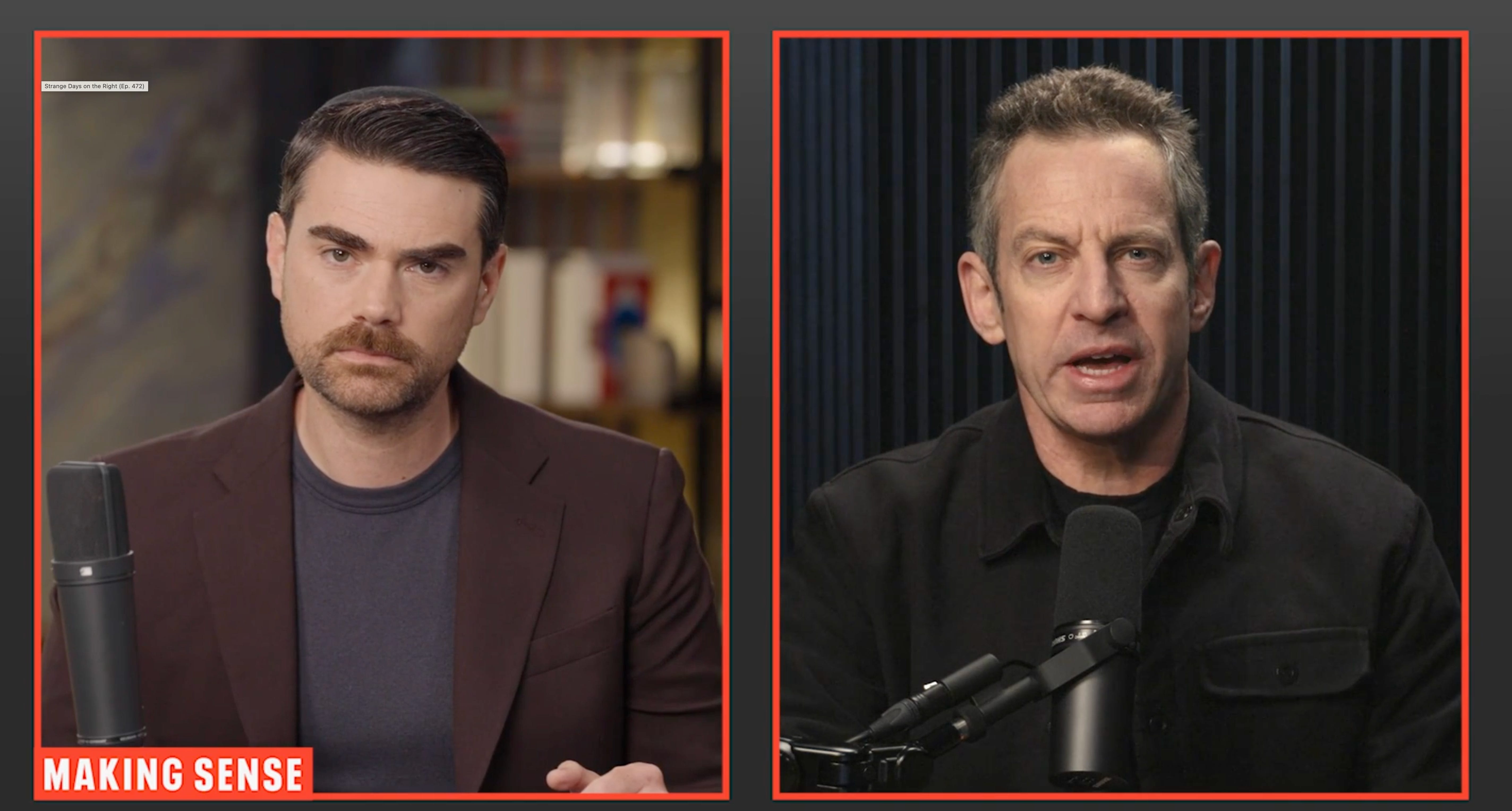
Ben Shapiro went on Sam Harris’ podcast this week and gave the most clarifying interview I have read in a year. Not clarifying about Donald Trump, who has been clarified for some time. Clarifying about Ben Shapiro, and about the specific kind of figure that has been keeping the Republican coalition welded together while it converts itself into something its own apologists will not name.
Credit, before I continue, where it is due. Sam Harris asked the questions a serious interlocutor should ask, and asked them sharply. Whatever frustrations the conversation produced, Sam was the one who produced the record. I should also say, because I do not write what I do not believe and I am not going to pretend to a unanimity I do not feel, that I find Sam’s views on Islam to be painfully incoherent and obsessive — a fixation that has flattened, across two decades of his work, into a posture that confuses more than it clarifies. That disagreement is real and I am not setting it aside. I note it and place it next to the credit, because what Sam did in this interview is what I am writing about, and what he gets wrong elsewhere does not change what he got right here. The Republican apologist class, on the evidence of this exchange, is incapable of holding two such judgments about the same person at the same time. The capacity to do so is part of what is at stake.
⁂
Sam asked Shapiro about the reframing of January 6 as a day of love — the pardons, the great patriots designation, the hostages framing, the official White House website now advertising this revisionism to the world. Sam pointed out that Shapiro himself, in 2021, called January 6 “the most horrifying thing I’ve seen in American politics in my lifetime,” “inexcusable,” “unjustifiable,” “awful on every level, disgusting on every level and just terrible.” Sam asked: at what point does this become disqualifying.
Shapiro’s reply, verbatim:
“Again, in what way? We keep coming back to this word disqualifying. And the question is disqualifying in what sense?”
The toilet has to be fixed. That is the metaphor Shapiro reached for, earlier in the same interview, to explain his theory of the presidency. “The president is a plumber. Is he going to fix my toilet or is he not going to fix my toilet?” The man who incited a violent attempt to overturn an American election, who has retroactively legalized the violence and lionized its participants, who has on the official .gov website rewritten the history of an attack on the Capitol of the United States — this man, in Shapiro’s mind, is a plumber. The question is whether the plumber leaves footprints on the floor.
⁂
Begin with what Shapiro concedes in this interview, because it is not nothing. It is, in fact, almost everything.
He concedes Trump’s family corruption “has surprised” him. He concedes the tariff catastrophe. He concedes the loyalists are unqualified. He concedes the reframing of January 6 is “corrosive of American culture.” He concedes Trump’s response to political murders is “truly terrible and I think morally egregious stuff.” He concedes Trump “called for the arrests of governors and mayors and even called for members of Congress to be hung for sedition.” He does not contest Sam’s characterization that Trump tried to overturn the 2020 election. He explicitly affirms it: “I think that it was quite risky what he did between the election and January 6th, as I made clear over and over and over.”
He concedes, in other words, the central claim of every liberal critic of the Trump project for the past decade: that the man at the center of it is a wannabe usurper who would have ended the constitutional order in 2020 if the institutional resistance had been weaker, who continues to test those institutions, and whose personal corruption has reached scales that would have ended the political career of any previous American president before lunch.
And then, having conceded all of this, he explains why he voted for Trump anyway, why he would do it again, and why anyone who finds this position scandalous is engaged in hysteria.
The reasoning is the lunacy:
“The guardrails would largely hold... his worst mistakes would end up being mitigated by the pushback of reality.”
This is the argument. The president of the United States is a man who would, if he could, end the constitutional order. The reason it is acceptable to elect him is that he probably cannot. The institutions are strong enough to contain him. The Madisonian architecture will hold, the Supreme Court will strike things down, the Treasury Secretary lives on Earth, the bad picks will be replaced by the merely bad picks. The wannabe dictator is, in the Shapiro analysis, a manageable risk.
Sam pressed him. What if the guardrails do not hold. What if Trump nationalizes the elections, sends federal agents to seize ballots, declares emergency powers, refuses to leave. At what point does the risk to the constitutional order outweigh the policy gains.
Shapiro’s answer: “I also think that the guardrails are significantly stronger than people give them credit for.” And then, the move that names what he is:
“If you actually believe that electoral politics are worthwhile, then I do think that in the same way that I oppose what President Trump did between November of 2020 and January 6th in suggesting that the election was illegitimate and that he had won and that it was all voter fraud, I oppose that. In the same way, I oppose the sort of broad scale narrative that there is gigantic voter suppression happening because when you do that in evidence-free fashion, what you end up doing is undermining the very possibility of of acceptance of elections in general.”
The man who agrees Trump tried to steal the 2020 election is now arguing that the real threat to American democracy is people who worry Trump might try to steal the next one. The hysteria, in his framework, lies not with the man who attempted to overturn an American election but with the citizens who notice that he attempted it and might attempt it again. The proper civic posture, in Shapiro’s view, is to vote for the wannabe usurper, trust the guardrails, and treat the people warning about the usurper as the dangerous extremists corroding democratic legitimacy.
It is not even fair to call Ben Shapiro an ideologue. That would imply a coherent ideology being defended. What Shapiro is, is a partisan apologist of the most elite kind, whose job is to make the most plausible steelman case for voting his clan, in the language of the liberal intellectual tradition, in order to confuse people into going along with it.
The job is apologetics. Apologetics in the technical sense — the production of articulate defense for a position whose adoption preceded the argument and whose retention does not depend on the argument’s success. The position is the tribal commitment to vote Republican and defend the Republican coalition. The argument is whatever construction is required, in any given week, to make that commitment look like a considered judgment rather than a reflex. The arguments change. The commitment does not. The arguments change because reality changes — the Republican coalition produces new outrages, new figures, new contradictions, and the apologist’s task is to incorporate each new development into a defense of the unchanged commitment. This is what apologetics has always been. It is what the church fathers did. It is what the court philosophers of every regime have done. It is an honorable enough trade when the regime being defended is honorable. It becomes something else when the regime is what the Republican coalition has become.
The specific elite quality of the apologetics is what makes Shapiro distinctive. He has chosen to perform the apologetics in the vocabulary of the liberal intellectual tradition. He cites the right philosophers. He distinguishes the right concepts. He uses the rhetorical structures — the careful definitional move, the on one hand and on the other, the I try not to attribute motive, the appeal to consequences over intentions, the binary-choice framing — that the liberal intellectual tradition uses for its own internal debates. The performance is convincing enough that liberals who encounter it often mistake it for genuine engagement with the tradition, and engage with it on those terms, and lose, because the apologetics is not actually engaging with the tradition. It is borrowing the tradition’s vocabulary to confuse its members into accepting conclusions the tradition would never reach if it were doing its own work.
This is what Sam Harris was doing in this interview, whether or not he fully realized it. He was treating Shapiro as a fellow inhabitant of the liberal intellectual tradition who had reached different conclusions through different reasoning. The model is wrong. Shapiro is not a fellow inhabitant. He is a translator stationed at the border, whose job is to render his clan’s commitments into the local language for export. The exports are the long careful Sam-Harris-podcast appearances, the Daily Wire op-eds in the register of Commentary circa 1985, the polished debate performances at universities, the books with respectable academic-publisher imprints. Each export is calibrated for the specific audience receiving it. Each export uses the audience’s own vocabulary against itself. And each export’s job is to make the tribal commitment look, to that audience, like a position that a serious person might reach if they thought carefully.
⁂
The structure is one-way and worth naming plainly.
You concede every factual claim your interlocutor makes. Yes, Trump is corrupt. Yes, Trump tried to overturn the election. Yes, Trump’s loyalists are unfit. Yes, the reframing of January 6 is awful. Yes, the family enrichment is unprecedented. Yes, the response to political murders is morally egregious. You concede all of it.
You then argue that none of these concessions can justify changing your vote, because what you are voting for is policy. The policy is what matters. The character, the corruption, the constitutional vandalism — all of these are bundled with the policy and you cannot get the policy without the bundle. So you take the bundle. You take the wannabe dictator because you also get the tax cut, the conservative judges, the Israel alignment, the DEI rollback. The plumber fixes the toilet. The footprints on the floor are the cost of doing business.
When the interviewer asks what would constitute disqualifying behavior — the level of corruption, the level of constitutional violation, the level of cultural degradation — you respond that disqualifying is not a meaningful concept, because politics is binary and the alternative is worse. There is no level. There is no threshold. There is only the comparison. As long as Kamala Harris exists, Trump cannot be disqualified. As long as a Democrat exists who would do the wrong things on Israel or DEI or taxes, no Republican can be disqualified.
The implication, which Shapiro does not quite state but which is the only honest reading of his position, is this: there is no Republican who could be disqualified by character or conduct, because the alternative is always a Democrat, and the Democrat is always worse on policy. The category of disqualifying has been emptied. There is nothing a Republican president can do that would cause Ben Shapiro to vote against him, because the only available alternative would be a Democrat, and Shapiro has decided in advance that no Democrat can ever be acceptable.
This is not a political philosophy. This is a one-way ratchet. And the ratchet has a name. It is what authoritarian movements have always required from their apologist class, in every country where they have come to power: a class of articulate people who concede every factual point about the authoritarian, who acknowledge his crimes, who profess discomfort with his methods, and who continue to vote for him anyway because the alternative is the left. The apologists do not have to believe in the project. They only have to provide cover for the people who do, and to refuse, when asked directly, to ever pull the lever the other way.
Shapiro is functioning as exactly such a class, in real time, in front of Sam Harris, with his eyes open, in 2026.
⁂
Sam asks Shapiro about Trump’s response to a recent political murder — the “truly terrible and morally egregious” commentary Trump produced about the death of someone he disliked. Shapiro agrees it is corrosive of American culture. Sam then asks: “why not price that in as one of the consequences of having this person in the Oval Office?”
Shapiro’s answer:
“I mean, that is priced in as one of the consequences. Again, it comes as a bundle.”
It comes as a bundle. The dehumanization of political opponents at the level of the presidency, the rewriting of constitutional history on official government websites, the corruption running into the billions of dollars, the wannabe coup d’état, the dictator-talk about hanging legislators — all of it bundled together with the policy preferences Shapiro likes, and the bundle, in his accounting, comes out positive. The plumber fixes the toilet. The footprints are priced in.
This is the move that makes him a lunatic. Not because the policy preferences are wrong — that is a separate argument. He is a lunatic because he has constructed an accounting framework in which constitutional vandalism is a line item to be weighed against tax policy, in which an attempted coup is comparable to a trade deficit with Ethiopia, in which the mockery of a widow’s forgiveness at her husband’s memorial service is priced in alongside questions of whether the Department of Education should exist. The categories he is putting on the same ledger are not the same kind of category. The framework that treats them as commensurable is the framework of a person who has lost the capacity to recognize what kind of question is in front of him.
A constitutional crisis is not a policy preference. A wannabe dictator is not a tariff schedule. The reframing of January 6 as a day of love is not on the same ledger as the marginal tax rate. To treat them as if they are, to price them in, to bundle them — this is the cognitive operation that produces the German conservative intellectuals who voted for Hitler in 1933 because the alternative was the communists and Hitler had, on balance, the better economic policy. This is the cognitive operation that produced every collaborationist apologist class in the twentieth century. It is the move that has been recognized, after the fact, as the move that destroyed those figures’ moral credibility forever, that has been recognized as a move that should never be made again, and that Ben Shapiro is making, on a podcast, in the spring of 2026, with his eyes wide open.
⁂
Shapiro performs clarity about Tucker. He calls Carlson’s worldview “truly nefarious and terrible and anti-American in the extreme.” He identifies Carlson’s foreign policy as indistinguishable from Hassan Piker’s. He names the grievance party horseshoe. He notes that Carlson believes “America went fundamentally wrong basically with World War II and everything since has been a disaster area.” He notes that Carlson has hosted Nick Fuentes sympathetically. He identifies the Candace Owens conspiracism around Erika Kirk as “evil.” He identifies Megyn Kelly’s cynicism — she does not believe what Tucker and Candace believe but she “thinks that’s where the clicks are.”
Shapiro has the diagnostic vocabulary. He can deploy it. He can produce paragraphs of accurate, specific, well-sourced critique of figures on his ostensible side. He went to TPUSA and gave a speech against it.
He deploys this vocabulary against Tucker, against Candace, against Megyn Kelly. He does not deploy it against Trump. He does not deploy it against Vance. He does not deploy it, in any sustained way, against any figure whose continued goodwill matters to his audience share or his tribal standing. The vocabulary is not a faculty. It is a costume, worn when the wearing is useful and removed when it is not.
The costume includes specific accessories: the citation of source material, the careful parsing of definitions, the rhetorical posture of intellectual humility, the I try not to attribute motive line, the willingness to disagree with allies on narrow points so that the broader allegiance reads as principled. The accessories are real. Shapiro is genuinely well-read. He genuinely can construct an argument. He genuinely does, sometimes, criticize his own side. None of this is affectation.
The affectation is what the costume is being used for. By denouncing Tucker, Shapiro positions himself as the responsible conservative, the one who can be trusted to denounce the bad actors, the one whose subsequent votes for Trump and Vance can therefore be received as considered judgments rather than tribal reflex. The Tucker criticism is the alibi. The vote is the act. Tucker is, in this specific structural sense, the foil against which Shapiro can be the responsible adult — and the responsible-adult posture is what allows Shapiro to keep delivering, week after week, the long careful defense of the political coalition that is producing Tucker, has produced Trump, and will produce whoever comes after Trump.
This is what makes him different from Tucker, and worse. Tucker is what he is. He has stopped pretending. He says what he thinks, or close enough to it, on his show, in front of his audience, and the audience knows what they are getting. Shapiro produces, week after week, the long careful reasoned defense of why a man who believes none of what Tucker believes will continue to vote for the political coalition that has produced and continues to elevate Tucker. Tucker is the symptom. Shapiro is the immune system that has decided not to fight the infection because the infection is on the same team as the host.
He cannot connect any of this to Trump.
The man who has been cultivating, defending, platforming, and pardoning the precise people Shapiro identifies as “truly nefarious and terrible and anti-American” — the man whose vice president stood at TPUSA explicitly defending the inclusion of those same figures — that man is, in Shapiro’s framework, still the plumber. The toilet is still being fixed. The fact that the plumber has spent a decade enabling, funding, organizing, and now consolidating the movement Shapiro is denouncing is priced in. The fact that JD Vance, the heir apparent, has made the political calculation that the future of the Republican Party lies with Tucker and Candace and Fuentes — this is concerning, Shapiro says, but he can already foresee voting for Vance anyway, because the alternative will be a Democrat.
The figures the apologetics denounces are not aberrations of the coalition. They are expressions of it. It is not a faction within the Republican Party. It is not a tendency the responsible adults can wall off. It is the political coalition that elected and is reelecting the man Shapiro voted for, and it is the coalition that will pick Trump’s successor, and it is the coalition Shapiro will vote for again because the Democrat will be worse.
He is denouncing the symptom while writing prescriptions for the disease. The denunciation is part of the prescription. By denouncing the symptom, he authorizes himself, in his own mind and in the minds of his audience, to continue prescribing what produces it. And when asked whether at some point the symptom might force a reconsideration of the prescription, he returns to the binary. Disqualifying in what sense. The toilet still needs to be fixed.
⁂
Shapiro is explaining why he tries not to attribute motive to political actors. “Motivism is a great way to shortcut politics and actually prevent sane conversations because you can always attribute motive to somebody’s political position.” He says this as a virtue. He frames it as intellectual discipline.
In any normal moment of American political history, this would be a defensible posture. We do not know what is in another person’s heart. The respectable conservative tradition has always been suspicious of motivism, for reasons going back to the Christian tradition of refusing to judge the unseen interior of another’s soul. Fine.
But in 2026, applied to Donald Trump, this posture is no longer intellectual humility. It is willful blindness. Trump’s motives are not unseen. They are the most visible motives of any public figure in American history. He has stated them explicitly, repeatedly, in public, on his own platforms, for ten years. He has told us he wants to be a dictator on day one. He has told us he wants to terminate the Constitution. He has told us he wants his political opponents prosecuted, jailed, executed. He has told us his policy on January 6 was a day of love. He has told us he wants to nationalize elections. He has told us he wants the military to deal with the enemy within. There is no interpretive labor required to discern Trump’s motives. He has done the labor for us, and the labor consists of describing his motives to anyone who will listen.
Shapiro’s I try not to attribute motive posture, applied to Trump, requires him to ignore what Trump has explicitly said about himself, in order to maintain the position that Trump’s policy effects can be evaluated separately from Trump’s stated intentions. The motivism Shapiro is refusing is not Sam Harris’s. It is Trump’s. Trump has told us his motives. Shapiro is refusing to credit Trump’s own self-disclosure, in order to preserve the framework in which Trump can be reduced to a policy bundle.
This is not intellectual discipline. This is the construction of a permission structure. The permission structure exists so that Shapiro and the people who think like him do not have to confront, in the privacy of their own conscience, the fact that they have spent a decade enabling a man who has told them, plainly and repeatedly, what he intends to do to the constitutional order they claim to revere.
⁂
Shapiro is not convertible at this point. The structure of his apologetics is too deeply invested in the framework that allows him to vote for Trump and feel reasonable about it. He has been performing this work for a decade. He will perform it for the next one. The next Republican president, whoever it is, will receive the same treatment from him: a long catalog of concerns, a bundle analysis, a binary framing, and the vote.
What we have been told, by one of the most articulate apologists the Republican coalition has produced, on a podcast with three million listeners, is this.
We have been told that this class agrees with the liberal critics of Trump on every factual claim about Trump’s character, conduct, and intentions. We have been told that they will vote for him anyway. We have been told that the framework they have constructed to make this defensible treats constitutional vandalism as a line item commensurable with tariff schedules. We have been told that they will continue voting Republican regardless of who the Republican is or what the Republican does, because the Democrat will always be worse on the policies they care about. We have been told that anyone who treats the wannabe-dictatorship as a serious threat is engaged in “hysteria” and is themselves “undermining the very possibility of acceptance of elections.”
This is the position. It has now been stated, in plain English, by Ben Shapiro, on the record, with Sam Harris listening.
The position is that the institutional architecture of the United States can be trusted to contain a wannabe usurper, that the people who are not sure it can be trusted are the real threat to the institutional architecture, and that the proper civic response to a man who tried to overturn an American election is to vote for him again so long as the alternative is a Democrat.
The position is lunacy, and one must understand, in the case of Mr. Shapiro, that the lunacy is also very much the point. It is not a matter of his believing what he says. It is a matter of his believing that it must be said, regardless of truth, in order to convince people, in the language of liberal discourse, why they should vote for illiberalism.
The reason it matters that we name it, plainly and on the record, is that this is the thinking that will deliver the next election to the next strongman the Republican Party nominates. JD Vance, if he runs, will inherit Shapiro’s vote on the same logic that delivered Trump’s. So will whoever comes after Vance. The framework has been emptied of any threshold at which Republican conduct becomes disqualifying. The bundle analysis has eaten the political philosophy that was supposed to be doing the bundling.
This is what conservatism has become in the year 2026. Not Burke, not Buckley, not even Kristol. A binary calculation, performed by articulate apologists on podcasts, that yields vote Republican under all conditions for the rest of the foreseeable future.
⁂
The carriers Shapiro mocks — the people refusing to price in a constitutional crisis as a line item against the marginal tax rate — are the people who still understand what kind of question is being asked. They are the ones who can see that the framework Shapiro is operating in is not a framework. It is a permission structure. It is the cognitive apparatus a coalition adopts when it has decided, beneath the level of explicit argument, that there is nothing the strongman can do that would cause it to vote for the other side.
That decision has been made. Shapiro has just told us so. The plumber will be voted for again. The toilet will be fixed. The footprints on the floor — the constitutional ones, the cultural ones, the moral ones, the dead — will be priced in.
The Republican apologist class will go on producing the long, articulate, disqualifying-in-what-sense replies that history will read with the same grim clarity it reads the German conservative intellectuals of 1933.
The costume is well-made. The accessories are convincing. The vocabulary is real, the citations are real, the rhetorical posture of intellectual humility is performed with the practiced ease of a man who has been performing it for fifteen years. None of that changes what is underneath. A tribal commitment that has eaten the philosophy it was supposed to be in service of. An apologetic apparatus trained to produce permission structures rather than judgments. A man who agreed, on a podcast, with three million people listening, that the president of the United States is a wannabe dictator, and who will vote for the wannabe dictator’s chosen successor in 2028 because the alternative will be a Democrat.
Shapiro is an intellectual imposter of the grandest sense. What a waste of mind and life.
Go Deeper into the Circus
The Bell

I argued against monarchy in Las Vegas on Tuesday. I debated Curtis Yarvin at a Bitcoin conference, on a stage, in front of an audience that had paid to attend, on the resolution that liberal democracy is an obsolete operating system that should be replaced by a sovereign corporation

How Elon Musk Thinks, and Why It Is Killing Us

People have been trying, for years, to reconcile two observations about Elon Musk that seem difficult to hold simultaneously. The first is that he is one of the most consequential industrial operators of the twenty-first century, responsible for two companies —
I’m halfway through your EXCELLENT deconstruction of Shapiro & his ilk. Before my head explodes I must stop to emote in common street parlance, as I make no claim of being an intellectual or trained philosopher.
Shapiro is a flaming bundle of steaming hot bullshit.
I watched him being “raised” by Ann C for -unt. Or “Unty Ann” as I think of her now. I watched Mini-Spock the wunderkind’s star as it rose — along with his Alvin the Chipmunk voice — via FoxNews. And I bought it all for an uncomfortably long period of time.
TY Mike, this piece is very helpful as a teaching piece, especially for ppl like me who will, till my last day, be in recovery from Rightwinkthink, even tho I officially got out in 2016.
*** returning now to finish your teaching module ***
What an elegant explication of Shapiro’s motivated lunacy you’ve written for us!
I see Shapiro now as the high-dollar, tail-case equivalent of Baghdad Bob. All the call backs to enlightenment traditions collapse as soon as he states his conclusions.
He’s leapt into the running dog sector of the public yapper Venn diagram for reasons that have to include hubris, avarice, and fear.
Simultaneously pathetic and dangerous.