


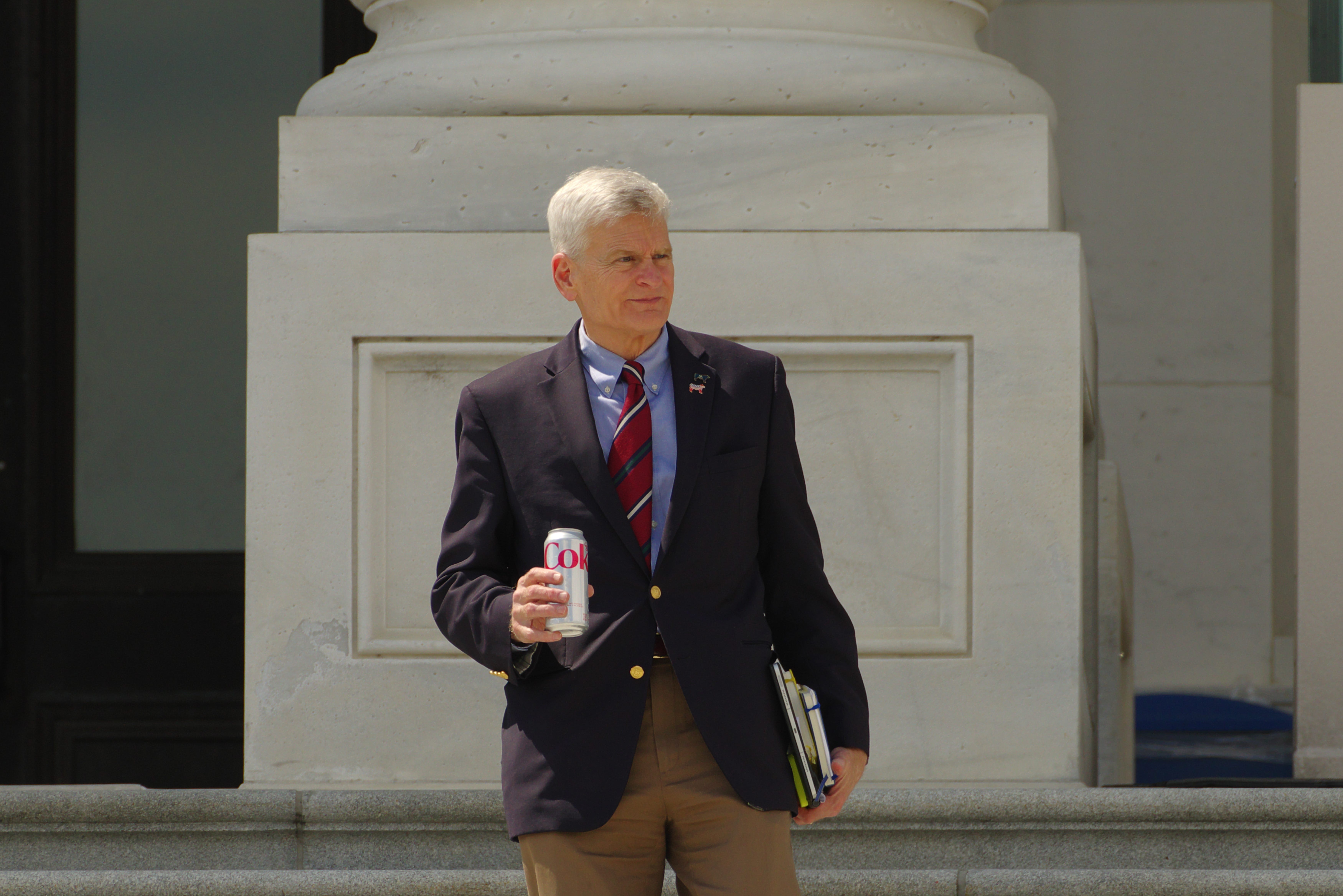
On Friday morning, with the Senate scrambling through its last items before a five-week August recess, Bill Cassidy of Louisiana walked to the floor and announced that Todd Blanche would have his vote. “This is not a referendum on President Trump,” he said. “It is a decision regarding Mr. Blanche. ... All considered, I will vote for Mr. Blanche.” It was the fiftieth vote, the one that settled it. With Susan Collins and Lisa Murkowski opposed and Mitch McConnell absent, Blanche could afford exactly two Republican defections, and he had exactly two. Cassidy ended the arithmetic. In an overnight vote gaveled down at 4:31 Saturday morning to light applause in the chamber, the Senate confirmed Blanche 50 to 49. The president’s criminal defense lawyer now runs the Department of Justice, and the man who put him there did it with nothing at stake but his own comfort.
Blanche defended Trump in his criminal cases, then followed him into government, confirmed as deputy attorney general in March 2025 by a vote of 52 to 46. When Trump fired Pam Bondi on April 2, Blanche became acting attorney general, and on June 8 Trump nominated him to hold the job outright. Between those dates he settled a lawsuit. Trump had sued the IRS for $10 billion over the leak of his tax returns, which means the government Blanche helped run was the defendant, and the settlement his department signed gave the plaintiff a $1.776 billion “Anti-Weaponization Fund” for people claiming the government had been turned against them, along with an order granting Trump, his family members, and their business entities effective immunity from IRS audits, prosecution, and regulatory enforcement for every return already filed. Working Americans get audited on a clerical error. The president’s family got a signed release, drafted by the president’s former defense lawyer, paid for out of the Treasury.
In July a federal judge, Kathleen Williams, examined how that settlement came to exist and wrote sentences that would end careers in a country that still enforced its own standards. There was never adverseness between the Parties, she wrote, “there was never a case or controversy; and there was never a question as to who would prevail.” The suit was an attempt to use the Court to provide some legitimacy to an agreement to confer immunity to people and entities affiliated with the President “and to earmark billions of dollars from American taxpayers to redress grievances not defined in the law.” She referred Trump’s outside lawyer to the Florida Bar and sent copies of her order to the bar associations of New York and the District of Columbia, where Blanche and his associate attorney general hold their licenses.
The fund did not die. Two Republican senators, John Cornyn and Thom Tillis, both of whom leave the Senate in January, refused to vote for Blanche in committee until he rescinded it in writing, which he did late on a Sunday night to save his nomination, in an order stating that the fund “is rescinded and shall have no force or effect” and that “this order establishes, beyond any doubt, that there is no fund.” What it rescinded was his own May order. The settlement underneath it survives, and that settlement can by its own terms be “modified only with the written agreement of the parties”, which means Trump, who told reporters the next day that he had neither signed the rescission nor read it. Blanche himself conceded under Cornyn’s questioning that the settlement remained an “enforceable document.”
Cornyn had said all of this himself in July. The fund was “still part of the settlement agreement,” he said then, and “it hasn’t been changed in writing, which is what the agreement requires, and it could be revived later on through a breach of contract lawsuit.” The remedy he named was a bill passed by unanimous consent “to basically bar a weaponization fund that I could support.” He got no bill. He got a memo from the man whose confirmation depended on it, unsigned by the president, and he voted yes. Asked what would happen if the department went back on it, he said he expected them “to live up to that in any future litigation.” Tillis had been more explicit still. On the Saturday before the deal he posted that Trump “clearly intends to resurrect the payout pot for punks either by inappropriately establishing another bogus fund or pushing Congress to vote for a bill.” Two days later he accepted a written promise against the thing he had just said the president clearly intended to do. Sheldon Whitehouse called the two documents “decorative” and said neither had “any legal effect whatsoever.”
Mike Howell, a Republican lawyer who had applied to sit on the fund’s board, was less delicate about it: “Can be undone after Tuesday. The Anti-Weaponization Fund is great.” Trump had already said what he wanted in public, calling the fund dead on a Friday and adding “I wish it weren’t, to be honest with you,” then promising the next morning that “it will immediately be back on the table, and I will get it done.” The audit immunity survived as well, narrowed on paper by a companion document Blanche did not sign. An attorney general’s order can be superseded by the next attorney general’s order, and the man who signed this one was asking the Senate to make him permanent. That is what Bill Cassidy voted to promote.
⁂
Two Republicans voted no, and the record they cited was sitting in front of every senator in the chamber. Collins posted a bill of particulars: Blanche “approved an order to shield the President, his sons, and the family business from IRS audits, protections unavailable to other American taxpayers,” approved the $1.8 billion fund, promised an anti-abortion organization he would seek to prohibit the mailing of abortion medication nationwide, and led a department that “attempted to indict Senators Mark Kelly and Elissa Slotkin over their ill-advised, but constitutionally protected, videos encouraging resistance to unlawful orders.”
The list is accurate, and Collins cast that vote in the safest year of her career to cast it, running in the closest race she has faced, tied or trailing in Maine polling with a November election ahead of her in a state Kamala Harris carried. Ideology has never been the best predictor of how she votes. What she sells Maine is concrete: she has chaired the Senate Appropriations Committee since January 2025, the first Republican woman to hold that gavel, and by her office’s count she has directed nearly $1.5 billion to 670 projects in the state since earmarks returned in 2021, giving Maine more directed spending per capita than any other state. Fire stations, hospitals, the community colleges, the shipyard at Kittery. That is a real product, and the price of it is a vote when the leadership needs one.
Kavanaugh is the working example. She had already told reporters in August 2018 that Brett Kavanaugh considered Roe settled law, and in October she held the floor for forty-five minutes to read the rest of the private assurances into the public record. “In his testimony, he noted repeatedly that Roe had been upheld by Planned Parenthood v. Casey, describing it as ‘precedent on precedent,’” she said. “When I asked him would it be sufficient to overturn a long-established precedent if five current justices believed it was wrongly decided, he emphatically said ‘no.’” Kavanaugh was confirmed 50 to 48, and her vote was not the margin. Murkowski had paired with an absent Steve Daines and voted present while Joe Manchin crossed over, so a Collins no would have produced a tie for Mike Pence to break, and Pence was presiding. Four years later the Court overturned Roe, and Collins issued a statement calling the decision “inconsistent with what Justices Gorsuch and Kavanaugh said in their testimony and their meetings with me, where they both were insistent on the importance of supporting long-standing precedents that the country has relied upon.” Asked whether Kavanaugh had misled her, she said, “My statement speaks for itself.”
Extract the assurances, read them into the record, supply the vote, and keep the statement of disappointment in reserve. Susan Collins Watch, which has tracked her votes for decades, counts not one tie-breaking vote against a Republican nominee across her entire career, against dozens cast for them. “The moment Collins announced she was a no on Blanche,” Chris Hayes wrote, “you knew they had the votes.” Her particulars on Blanche are worth having anyway, because they establish what every senator knew before the roll was called. But the procedure she has run for twenty-nine years is the same one Cassidy ran with Kennedy, and ran again on Friday. Collins still holds the gavel. Cassidy ran it once and lost his seat, then ran it a second time with the seat already gone.
Murkowski named the structure underneath all of it, that the politicization “even weaponization” of the Department “did not start with this administration but has accelerated during it,” before arriving at the sentence that mattered: “The country needs an Attorney General who will check the worst impulses of this administration. I hope Mr. Blanche is able to achieve that, if confirmed, but I simply do not have confidence that will be the case.”
Murkowski also pointed out that the rescission of the fund holds only while the nomination is pending. The Senate’s grip on the department’s conduct lived entirely in the gap between nomination and confirmation, and confirmation closed the gap. Every assurance Blanche gave to win his committee votes became unenforceable the moment Cassidy finished speaking, and Cassidy was told this by a colleague, on the record, hours before he spoke.

Cassidy is not a bystander who wandered into this. On February 13, 2021, he voted to convict Donald Trump of incitement of insurrection and explained himself in two sentences: “Our Constitution and our country is more important than any one person. I voted to convict President Trump because he is guilty.” The Executive Committee of the Republican Party of Louisiana voted unanimously to censure him within hours.
The bill for that vote came due this May. Trump endorsed a primary challenger, and Cassidy finished third in his own party’s primary, behind the Trump-endorsed candidate and one other, his Senate career ended by the voters of his own party. Two days later he stood in the Capitol and told reporters he regretted nothing: “I voted to uphold the constitution. It may have cost me my seat, but who cares?” And: “I had the privilege of voting to uphold the constitution – isn’t that a great thing?” He described himself as “a man who loves his country, who feels very, very good about how I serve my country and my constitution and my fellow Americans.”
Eleven weeks later he handed the Justice Department to the president’s defense lawyer. Whatever those May sentences were, they were not a description of a man who would do that, and the distance between them measures what his professions of love were worth once they were finally asked to cost him something other than an election he had already lost.
The standard story about Republican senators is careerism: they vote with Trump because they watched what happened to the ones who didn’t, and they would like to keep their jobs. Politico spent the spring describing Cassidy as freed from political constraints, a man with veto power over nominees and nothing left for Trump to take. There was no primary left to lose and no seat left to protect, because the president had already spent his endorsement taking both. If self-preservation were the mechanism, Cassidy was the one man in the Republican conference it could not reach, which is exactly why his vote is the most damning one cast this week.
He voted yes anyway. He acknowledged from the floor that he and Trump “have a history,” then insisted “that history does not matter one bit,” and he anticipated the reaction: “I will be criticized for this vote... What’s new? But the people of Louisiana can be assured that I worked hard to understand the issue and to make the right decision.” Then came the reasoning he chose to leave in the record: “The choice is not between perfection and Mr. Blanche. It is between Mr. Blanche and another acting attorney general who may not run the department effectively under President Trump and who indeed may not be as good as Mr. Blanche.”
The sentence surrenders everything while sounding like prudence. Whoever runs the department, it will be run “under President Trump,” staffed from the supply of people Trump is willing to install. Whether the Justice Department should function as the president’s law firm has been retired from consideration, and what remains is a personnel comparison inside the president’s shortlist. This is the lesser evil method that has confirmed every increment of the past two years. Each nominee is measured against a hypothetical worse one rather than against the office as the law describes it, and by that method no nominee can ever be rejected, because the supply of hypothetical worse ones is infinite. Cassidy conceded that Blanche showed “poor judgment” in the payout fund and the IRS settlement, then voted to reward him for it.
The decisive argument, by his own telling, came to him overnight. He had slept on it, he said, and concluded that Trump will be “unrelenting” in going after his political enemies, that “this will be true no matter who the attorney general is,” and that a confirmed Blanche would have “more leverage to push back” than an acting one. The office does not work that way, and a physician who spent eleven years in the Senate had every means available to learn so. Blanche already had all the powers of the attorney general, with “that little word ‘acting’ in front of his title” and no formal powers waiting to be unlocked by confirmation, Eric Columbus, a lawyer who served in the deputy attorney general’s office and now edits Lawfare, told Politico a week before the vote, and Blanche could likely have stayed in the acting role for another year or more. Confirmation subtracts nothing from the president’s removal power either. The Senate-confirmed attorney general Blanche had been standing in for was fired in April. Confirmation added one thing, and it was the only thing Cassidy’s chamber controlled: the Senate’s blessing. Followed to its end, his argument is that the Senate should certify the president’s choice so the choice can better resist the president who made it. No one who thought about it for a night believes that.
He had tested this argument already, on himself, in public, and pronounced it a failure six weeks before he made it again. In February 2025, Cassidy was the vote that decided whether Robert F. Kennedy Jr. would run the Department of Health and Human Services. He is a physician, and he had spent a hearing telling Kennedy that he was afraid people would die of vaccine-preventable diseases “because of policies or attitudes that you bring to the department”. Then he voted to advance the nomination out of committee, and read into the record the assurances he said he had extracted over the preceding weekend: that Kennedy would work within the current vaccine approval and safety monitoring systems, and not establish parallel systems, that if confirmed he would maintain the CDC’s Advisory Committee on Immunization Practices without changes, that the CDC would not remove statements on its website pointing out that vaccines do not cause autism, that the department would give his committee thirty days’ notice before touching vaccine safety monitoring. The Senate confirmed Kennedy 52 to 48.
Four months later Kennedy fired all seventeen members of the advisory committee and replaced them with members who largely share his vaccine skepticism. The reconstituted panel downgraded recommendations including those for hepatitis B and Covid-19, and Kennedy twice bypassed the panel entirely, changing the childhood schedule without its deliberation. By December, Cassidy was reduced to warning the public away from the body he had promised to protect: “The ACIP is totally discredited. They are not protecting children.” The autism page kept its headline and acquired an asterisk, and at the bottom of the page a line explaining that the sentence survives due to an agreement with the chair of the U.S. Senate Health, Education, Labor, and Pensions Committee. His concession is now a footnote on a government website, cited to explain why a true sentence is still permitted to appear above the material contradicting it.
On June 28, six weeks before the Blanche vote, Cassidy sat with Margaret Brennan and said it plainly. “The commitments that were made to me have been violated.” Asked whether the promises had been made only to win his vote, he answered: “Easy to surmise.” He described what that does to a man’s judgment going forward: “once you lose trust in somebody, you’re not quite sure what to trust going forward. In fact, you don’t trust anything.” And: “if you build public health upon a foundation of lies, then you’re going to have the absence of adequate public health.”
Brennan asked him to explain the vote. His answer, given in the last week of June 2026, was the Blanche speech in advance: “either he was going to be in a position where there were guardrails, and I did have commitments made as to kind of guardrails. Or he was going to be appointed White House health Czar, in which case he would have the President’s ear without the guardrails.” The choice is between the confirmed man and the unconfirmed one, and confirmation buys guardrails. “You can criticize it, but I chose to have the one with the guardrails.”
The guardrails were promises, and the promises expired the day they became inconvenient, and the man who extracted them told a national television audience that they had been violated and were probably insincere when made. Then he walked onto the Senate floor six weeks later, faced a nominee whose single concession was a written rescission that a colleague had told him from that same floor would lapse on confirmation, and reached for the identical reasoning, the same argument entire, with the department changed and the word guardrails traded for the word leverage. He was played once in front of the whole country, said so himself, described the humiliation as a lesson about trust, and then volunteered for it again on a larger stake, for a president who had destroyed his career and could not reward him for it.
⁂
I cannot speak to the interiority of experience that forms the memories of Mr. Cassidy from February 2021 to August of 2026, and I do not need to. The record he built between those dates is a complete descent into moral depravity. He cast a vote that will condemn innocent fellow Americans to further abuse of their constitutional inheritance, to their rights disappearing into weaponized prosecutions, and to the further coarsening of our public life, and he decided that this was the preferable path. I am sure he loves his family. I do not believe he loves this country. He is a selfish, small man, concerned merely with his own position, and history shall remember him as such.
The fear is not conjecture and it is not mine. Thom Tillis, one of the two senators who forced the rescission of the anti-weaponization fund, spent January of 2025 preparing to vote against Pete Hegseth for secretary of defense, and went so far as to solicit testimony against him from Hegseth’s former sister-in-law. He also told people that the FBI had warned him about “credible death threats” while he was weighing the vote. He supplied the fiftieth vote to confirm. Three months later, asked at an Anchorage summit what she would say to Alaskans who were afraid, Lisa Murkowski paused a long time and answered, “We are all afraid.” Then: “It’s quite a statement. But we are in a time and a place where I certainly have not been here before. And I’ll tell ya, I’m oftentimes very anxious myself about using my voice, because retaliation is real. And that’s not right.” She said afterward that the “we” meant the five hundred nonprofit directors sitting in front of her rather than her colleagues, which leaves the sentence about her own voice exactly where she left it. McKay Coppins, reporting Mitt Romney’s account of the second impeachment trial, described a small group of Republican senators talking one of their own out of a conviction vote he was leaning toward: you can’t do that, one of them said; think of your personal safety; think of your children. The senator decided they were right. Romney was by then paying five thousand dollars a day to keep private security on his family.
The word for what they did with that fear is cowardice. Coppins reached for the same word, calling what emerged after January 6 “a new, more existential brand of cowardice.” Someday one of them will sit on a talk-show couch or flog a memoir and confess exactly that, and the confession will be received as revelation and sold as courage.
Someday was Thursday. Two days before the floor vote, with Blanche one senator short and the chamber waiting on Cassidy or Murkowski, Tillis went on television to announce How to Lose Friends and Antagonize Presidents: The Trouble with Sycophants, Courage Outsourcing, and Partisan Groupthink, out October 6 at thirty-two dollars, in time for the midterms. His publisher promises a “bare-knuckled, darkly funny wake-up call” from “a true conservative who doesn’t mind a good scrap in a Congress that has lost its nerve,” and the flap copy names the pathology outright: “Fear, outsourced courage, and groupthink are hollowing out the party.” Tillis said the people he meant to expose were the ones around Trump who “are not giving the president honest advice”, and he named two of them: “I’m here for the American people, not to score points with Stephen Miller, Pete Hegseth or these other folks.” Asked whether Trump deserved any share of the blame, he compared the president to a chief executive who cannot be expected to have expertise in every part of an organization. He had supplied the fiftieth vote for Hegseth and voted Blanche out of committee on Tuesday, and the outsourced courage in his subtitle always belongs to somebody else. The book is coming from Broadside Books, the conservative imprint of HarperCollins, which News Corp owns.
The couch has an owner. David Ellison closed his purchase of Paramount in August of 2025, which made him the proprietor of CBS News and 60 Minutes, then bought Bari Weiss’s Free Press for a reported $150 million and installed her as editor in chief of the news division with no television experience and a direct line to him. He is trying to buy CNN and HBO as well, through a $110 billion acquisition of Warner Bros. Discovery that Trump’s Justice Department cleared in June after an eight-month review, that Brussels cleared in July, and that Britain cleared on Thursday. What remains in the way is twelve state attorneys general and a trial set for March. Ellison arrived at this year’s State of the Union alongside Lindsey Graham, and his father Larry, who has cultivated Trump for years, is financing the purchase. Writing in the Times on Tuesday, Ellison said the real objection to his deal is “whether I can be trusted as a steward of Warner’s CNN.” At the other end of the dial the Murdochs settled their succession war last September: Lachlan takes the trust, his three elder siblings are bought out at roughly $1.1 billion apiece, and the direction of Fox News, the Wall Street Journal, and the New York Post is fixed past Rupert’s death. Nobody has to give an order for any of this to work. It exonerates no one. The record was made in public, in daylight, by men who understood precisely what they were doing while they did it.
The same man, holding the same information about the same president, cast a vote in 2021 that he knew would cost him his party’s love and eventually his seat, and afterward called it the privilege of his career. In 2026, with nothing left to lose, he cast the deciding vote to place that president’s own defense counsel over federal law enforcement, on the announced reasoning that the alternative was a different Trump appointee.
If the vote was sincere — it wasn’t — then the settled judgment of the most liberated member of the Republican conference, the one who paid full price for his conscience and said it was worth it, is that a president gets to staff the Justice Department with his personal lawyer and immunize his own family from the tax code, and that a promise from that administration is still worth a vote after he went on television and said the last promise made to him was violated and probably insincere when it was given. And if it was something other than sincere, then whatever moved it reaches a senator who has already lost everything a political threat can take, and the machinery no longer needs a career to work on. A system of rule by pressure announces itself in the compliance of people with things to lose. You measure how far it has matured by the compliance of the people without them.
⁂
“Our Constitution and our country is more important than any one person.”
“This is not a referendum on President Trump.”
The first sentence had a price, and he paid all of it. The second was free, delivered on the session’s final Friday by a senator with five months left to serve, about a nominee whose signature settlement a federal judge had already unwound as having “no viable basis in law or fact.” The vote came in the dark and the chamber left town. The word acting is off the attorney general’s door, and the Americans who will be investigated, indicted, audited, and ruined by the department Bill Cassidy just certified do not know their names yet. He will be retired by the time they learn them.
Go Deeper into the Circus
The Great Moral Sorting

On Friday morning, Rand Paul posted an update for his followers: “It’s official: letters to prosecute Fauci have been hand delivered to @DOJ.” The day before, the Senate Homeland Security Committee he chairs had voted eight to five, along party lines
The House of Ellison is on the Brink

On the morning of September 10, 2025, Larry Ellison was the richest man alive. Oracle had reported earnings the night before, and the story inside the numbers was a backlog: hundreds of billions of dollars in contracted future cloud revenue, nearly all of it from artificial intelligence, the largest single piece of it from one customer. The stock rose
Surely Cassidy's dilemma, calculation and tragic fall will be the content of an epic poem in the next century. It might be hard to pick the central character for the era -- oh so many good candidates. But with RFK, Jr., Blanche and the Hippocratic oath he took, Cassidy may just be the archetype of moral failure.
When I ask if Republicans fear violent retribution from a very unpopular president, I'm not kidding.