


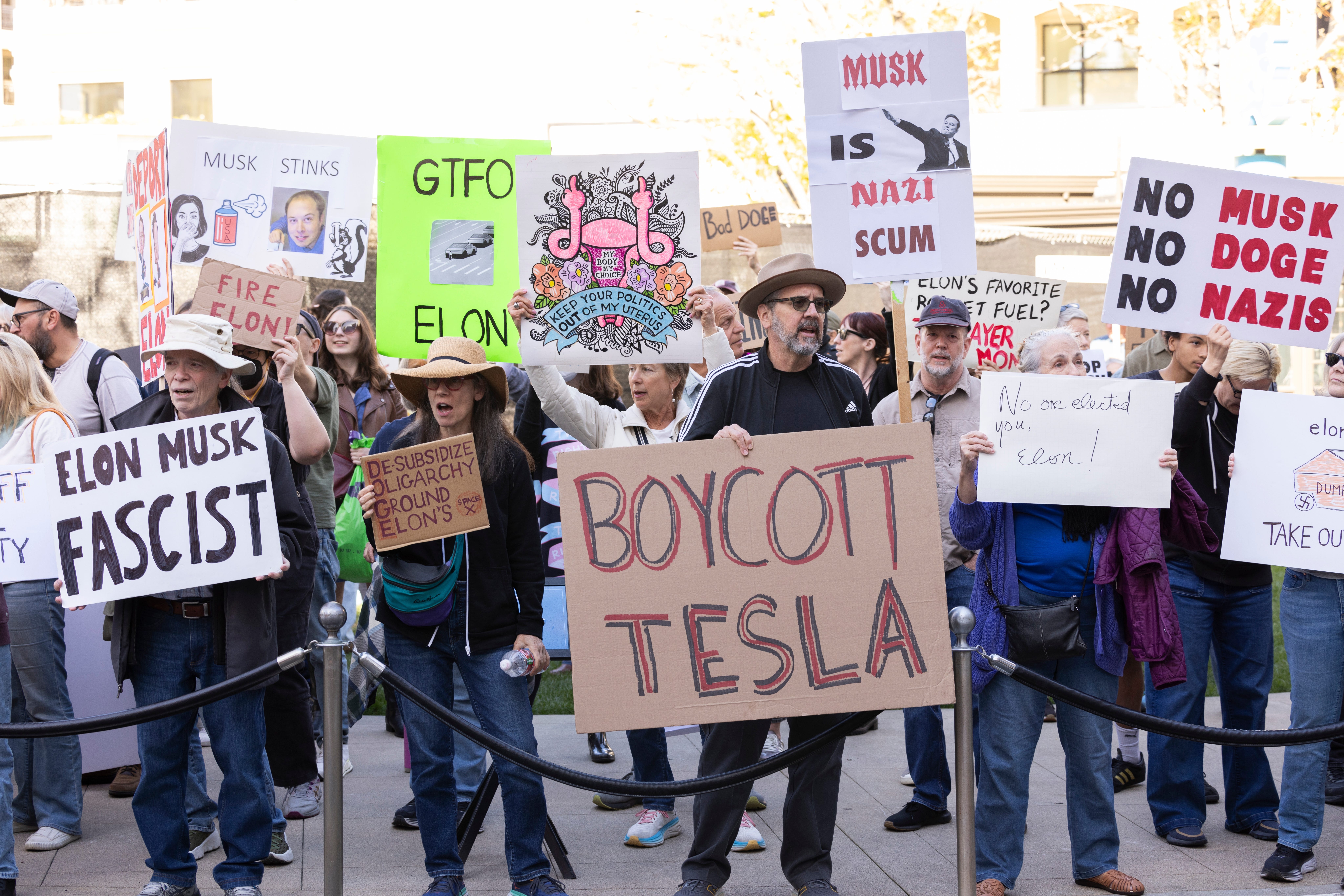
At a rally in October 2024, Elon Musk said he could cut “at least $2 trillion” from the federal budget. By January he had downgraded that number to a “best-case scenario”, with maybe a trillion actually achievable. By April 2025 the target was $150 billion. And this month the Government Accountability Office, having reviewed $110 billion of DOGE’s “Wall of Receipts,” reported that DOGE could not substantiate the method behind 96 percent of its claimed savings.
The auditors who got there earlier found the same thing in miniature. In March 2025, NPR could verify just over $2.3 billion of a claimed $65 billion, and found along the way an $8 billion line item that was a typo on an $8 million contract, and a USAID project counted three times. BBC Verify found a $1.9 billion IRS contract claimed as savings that had been terminated under Biden. The GAO found 108 of 264 claimed lease cancellations were already scheduled to end before DOGE touched them, and a $1.7 billion Defense Department IT contract that was never terminated at all. Musk left in May 2025. The department’s own closure post announced that “the formal mission of Doge has come to an end.”
The failure itself is ordinary. Budget promises die young; governments are hard; every administration buries a reform initiative or two. The part worth dwelling on is the credit that preceded the failure. Millions of people believed the $2 trillion figure when it had no receipts behind it, could have had no receipts behind it, because the man saying it spoke fluent engineer. He talked about the federal government the way a staff engineer talks about a legacy codebase, and an enormous audience of engineers, and of people who trade on sounding like engineers, heard their native language and extended credit on the accent alone.
That transaction now supports an industry. There is a standing occupational genre of political commentator: the software-engineer political influencer, the finance political influencer, the crypto political influencer. These are people whose political authority is denominated in a professional idiom, whose audiences sorted themselves by profession, and whose pronouncements travel down feeds of followers who chose them because they reason in a familiar style — a different animal from the engineer who merely holds opinions, which describes everyone. The genre exists because the audience built it. Understanding how requires taking apart the explanation everyone prefers.
⁂
The preferred explanation is the algorithm. The bubble, in this story, is something done to us: the machine learned our weaknesses, fed us agreement, and herded us into pens. It is a comforting account, because a machine that did this to us could be adjusted to undo it, and because it locates the fault somewhere other than in our own choices.
The evidence for it keeps failing to arrive. In 2023, Meta opened its platforms to an academic consortium that ran the experiments everyone had demanded for a decade. Users switched to reverse-chronological feeds saw substantially different content and spent less time on the platforms, and yet the switch “did not significantly alter levels of issue polarization, affective polarization, political knowledge, or other key attitudes”. Removing reshared content cut exposure to political news and measurably lowered news knowledge, and did not detectably move beliefs or opinions. A third experiment took 23,377 consenting users and cut their exposure to like-minded sources by about one-third, the mechanical definition of popping the bubble, and found the intervention “had no measurable effects on eight preregistered attitudinal measures such as affective polarization, ideological extremity, candidate evaluations and belief in false claims.”
This should have been bigger news than it was. The most direct tests ever run of the algorithmic-bubble hypothesis, run on the platforms themselves with the company’s cooperation, came back with exposure changing and minds not. And it confirmed what the earlier data already suggested: a 2015 study of 10.1 million Facebook users found the ranking algorithm reduced cross-cutting content by 5 percent for conservatives and 8 percent for liberals, while what users chose to click on filtered far more. “Compared with algorithmic ranking,” the authors wrote, “individuals’ choices played a stronger role.” The sociologist Chris Bail, who has spent a career on this literature, put the conclusion plainly: the most important driver of political polarization on our platforms “is us”.
The machine curates the menu at the margins. The diner does the ordering. What we select for, when we do the ordering, is mostly people like ourselves.
Sociology has measured this for decades under the name homophily. The canonical review opens with “Similarity breeds connection” and ranks the axes along which we sort: race and ethnicity first, then “age, religion, education, occupation, and gender following in roughly that order.” Occupation sits in the middle of the list of forces that assemble your personal world. The philosopher C. Thi Nguyen, in the paper that gave “epistemic bubble” its precise meaning, identified the consequence: bubbles rarely require malice or machinery, because ordinary social selection builds them for free. “Friends make for good parties,” he wrote, “but poor information networks.”
What the newer research adds is that the sorting runs on style, independent of substance. A 2024 study of livestream audiences found that when a streamer’s communication style matches a viewer’s own, the viewer feels a stronger quasi-social connection and is measurably more willing to buy what the streamer is selling, and the effect amplifies in viewers with a high need for cognitive closure, the ones who most want ambiguity resolved. The finding concerns shopping, which makes it worse: the mechanism is so basic it sells soap. Aim the same machinery at politics and you get the engineer who hears first-principles decomposition and recognizes home, the lawyer who hears issue-spotting, the trader who hears expected value and position sizing. Recognition arrives disguised as credibility.
And the disguise works because the heuristic is genuinely sound where it was learned. Inside your field, style is real evidence. The colleague who reasons like you was probably trained like you, checks errors the way you do, has been burned by the same failure modes. Trusting the person who sounds like a good engineer is, on an engineering team, a good bet, and the same holds at the trading desk and in the courtroom. The error happens in transit. The style survives the trip out of the domain; the verification practices that made the style trustworthy stay behind. What crosses the border is an accent, and the rigor it once signaled does not cross with it.
⁂
There is a deeper reason the transfer fails, and it explains why the failure is so reliable. The engineering method assumes society is a machine, and society is a game.
The distinction is a difference in the kind of knowledge available, which is why these are not equivalent epistemic categories. A machine’s parts have no model of you. You stand outside it, probe it, delete a component to see what breaks, and the machine never learns it is being studied. A game’s participants model the other players, including anyone attempting to steer the game, and they update the moment you move. Every intervention in a society is therefore also a communication, and the system you measured has changed by the time you act on the measurement. Economics keeps rediscovering this and naming the discoveries: the Lucas critique, which holds that policy changes alter the very behavioral regularities the policy was built on, and Goodhart’s law, which holds that a measure targeted stops measuring. Game theory’s equilibria are fixed points of mutual anticipation, a different mathematical object entirely from the resting state of a mechanism. The ancient Buddhists arrived earlier and went further: dependent origination places the observer inside the web of mutual conditioning, with no standpoint left over from which to engineer. You are always a player. The engineering stance smuggles in a view from nowhere, and the view from nowhere does not exist.
Engineers are not wrong to use the method. The method is calibrated for objects without intentions, and on such objects it is the most powerful epistemic technology our species has produced. Applied to participants, it does something worse than underperform: it returns confident wrong answers, because the feedback it trusts (did the thing break?) is itself a move in the game, and the other players get to decide what breaking looks like.
⁂
DOGE was the cleanest natural experiment in method transfer ever run at national scale, and it should be read in exactly these terms.
The method was never hidden; it was the brand. Musk’s five-step “algorithm,” recited across his companies: question every requirement, delete any part you can, simplify, accelerate, automate. It is a genuinely good method for building rockets, and it built them. In February 2025 he addressed the World Governments Summit in Dubai by video link and applied step two to the state, saying the U.S. should “delete entire agencies,” because “if you don’t remove the roots of the weed, then it’s easy for the weed to grow back.” Even his concession to resistance stayed botanical. A weed grows back; it does not hire lawyers, leak to the press, slow-walk compliance, reorganize under a new line item, or wait out a news cycle — which is roughly what the federal government proceeded to do.
Set the audit trail beside the machine-game distinction and the errors resolve into the method’s signature. An $8 billion typo survives when your verification loop is “does the dashboard look right” rather than “will an adversarial auditor with subpoena power agree.” Leases already scheduled to die get counted as kills because the machine frame assumes anything you deleted was alive until you deleted it. Savings triple-count because in a factory a removed part stays removed, while in a government a canceled contract resurrects in litigation, and a contract claimed as terminated can turn out never to have been terminated, because termination in a machine is a state and termination in a bureaucracy is a negotiation. The rocket does not resent the deletion. Everyone in Washington does, and resentment is a force with attorneys. The same brain, running the same five steps, produced Falcon 9 and produced 96 percent unverifiable, and the variable that changed is the category of the object.
Still, the deeper story is the audience’s side of the trade. The walk-down from $2 trillion to $150 billion to a shuttered department happened in public, step by step, and at each step the constituency that had priced the promise at face value mostly did not reprice, because what it had bought, rather than the number, was the sound of the mind producing it, and the sound never changed.
⁂
Philosophy has a name for the supply side of this trade. Nathan Ballantyne, in Mind in 2019, defined epistemic trespassers as “thinkers who have competence or expertise to make good judgments in one field, but move to another field where they lack competence—and pass judgment nevertheless,” and he catalogued the standard self-defence: “my own field’s skills successfully ‘transfer’ to the other field.” That sentence, offered by trespassers in their own voice, is the entire prospectus of the engineer-influencer economy. I examined the supply side in July, in the person of the man who productized himself — the guru who converts domain credibility into ambient authority and sells it back as wisdom.
But supply is the boring half of a market. The trespasser crosses the boundary because someone on the far side holds the door, and the door is held by millions of people, each running a heuristic that serves them well at work, each issuing a hall pass to the voice that sounds like a colleague. The demand side is now institutionalized to the point of appearing in official government documents. When Trump appointed David Sacks as White House AI and crypto czar, the announcement gave his qualification in so many words: “David is co-host of the All-In Podcast, the top podcast in Tech, where he and his friends discuss economic, political and social issues.” The podcast is the credential. An audience assembled by professional-idiom affinity had become a constituency, and the constituency had become a qualification for federal office.
The same show had already produced the speed-run version of the whole arc. In January 2022, Chamath Palihapitiya told the audience that “nobody, nobody cares about what’s happening to the Uyghurs” — a portfolio manager’s expected-value read of a genocide, delivered in the register of hard truths. The collision with the world outside the accent took about seventy-two hours, and the retraction followed: “I believe that human rights matter, whether in China, the United States, or elsewhere.” The method produced the confident wrong answer; the game corrected it; the audience stayed.
⁂
Each of these tribes carries a flattering meta-belief about why its hall pass is valid, and the beliefs deserve a name: method narcissism, the conviction that politics is secretly the kind of problem your profession solves. The engineer holds that society is a systems problem, the financier that it is an incentives problem, the crypto founder that it is a consensus problem. Each conviction is a category claim about what society is, and each principal has stated it in writing.
Marc Andreessen’s “Techno-Optimist Manifesto” declares that “there is no material problem – whether created by nature or by technology – that cannot be solved with more technology,” and then names the enemy: “the ivory tower, the know-it-all credentialed expert worldview,” along with an enemies list of phrases that includes “trust and safety” and “tech ethics.” Notice the structure, because Nguyen described it before Andreessen wrote it. An epistemic bubble merely omits outside voices; an echo chamber actively discredits them while amplifying insiders. The manifesto is the echo-chamber mechanism executed in prose: a standing instruction to the audience that expertise from outside the idiom is the adversary.
Balaji Srinivasan wrote an entire book defining his replacement for the country, the network state, as “a highly aligned online community with a capacity for collective action that crowdfunds territory around the world and eventually gains diplomatic recognition from pre-existing states” — the polity as a startup, complete with an “on-chain census” to prove “traction in the face of skepticism,” governance reimagined as a cap table. Michael Saylor compressed the crypto version into liturgy: “We say in the Bitcoin world: Fix the money, fix the world,” telling the Atlas Society that Bitcoin is “the best choice we have to save our civilization and realize the ideal world envisioned by Ayn Rand and the Objectivist movement.” And Bill Ackman supplied the finance version in the first person, telling Bloomberg, “I stopped being an activist in the corporate world, but I’m still an activist in the rest of the world”: more than ten thousand posts on X, universities and cities and wars treated as underperforming positions. NPR’s assessment of his campus campaigns needed one sentence: “But Ackman’s methods are the same.” The methods are always the same. That is the tell. A thinker responding to the world adjusts the method to the object; a method narcissist adjusts the object to the method.
⁂
If the sorting were ideological at root, it would show up evenly wherever politics shows up. It does not. When Axios surveyed young Americans’ podcast habits, the audiences split violently by tribe on identity-coded talk shows (Joe Rogan reached 27 percent of young Trump voters and 6 percent of young Harris voters, a Barstool podcast 34 against 9) and the split nearly vanished on shows defined by format instead of voice: Call Her Daddy reached 9 percent of each, TED Talks 23 and 17. The polarization lives in the voice. Where the voice carries no tribal accent, the audience desegregates.
The demand-side demographics complete the picture. Podcast news consumers skew college-educated and male, and 23 percent of them trust podcast news more than any other source. Among men eighteen to twenty-nine, YouTube reaches 95 percent every week, and after gaming, the categories they select are Learning, News, and How-To — politics consumed inside a tutorial register, explanation as a genre preference. This is an audience trained by its own media diet to receive political claims the way it receives a systems-design walkthrough, and to extend the walkthrough’s presumption of competence to whoever can perform the walkthrough’s style.
Everyone in that audience, asked why they follow whom they follow, gives the same answer, and the answer is sincere: I follow him because he reasons well. It feels like discrimination in the old sense, the exercise of taste, the very opposite of tribalism. But nobody in the audience verified the reasoning; they recognized it. Rigor would have required checking the claims against the world, and what got selected instead was the accent of rigor — and the two are indistinguishable from inside the bubble, because the bubble is precisely the set of people who share your criteria for what rigor sounds like. The closure comes dressed as its own opposite. That costume is why it holds.
⁂
The engineer’s idiom is only the loudest case. Every profession mints its own version of the accent, and the sober ones are more dangerous than the brash ones, because sobriety reads as the absence of ideology rather than as a style. The legal profession’s version is a cadence of doctrinal caution, and audiences trained on it will extend the presumption of competence to whoever performs it, on whatever question, a mechanism I took apart yesterday in the case of a lawyer narrating a constitutional crisis as a docket. The pundit-generalist, trespassing on everything at a weekly deadline, is the genre’s ancestor and never needed a feed to find an audience. No algorithm built any of this. We built it, profession by profession, voice by voice, and we did it because the heuristic feels like prudence all the way down.
⁂
Nguyen’s taxonomy carries one piece of good news: epistemic bubbles, unlike echo chambers, are “ramshackle – they go up easily, but they are easy to take down.” A structure built by omission is repaired by inclusion. But the Meta experiments warn against the lazy repair: exposure alone, mechanically administered, moved nothing. What has to change is the sorting rule itself. Stop arranging your informational life by communication-style affinity and start arranging it by verification: for any domain that matters, find the voices that the domain’s own error-catchers check and correct and have failed to catch out, whatever those voices sound like. The right test of a source asks who is positioned to catch it when it is wrong, and whether they have; the accent was never a test at all.
In practice this means following people whose style grates on you and whose sourcing survives you, and it means treating the little glow of recognition, he thinks like me, as what it is, a conflict of interest between you and your own beliefs. Ballantyne ends his paper with the observation that “we human beings are trespassers at heart.” So we are, and no audit of the trespassers will fix a market where the passes keep getting issued. The hall pass is written at the door, by whoever stands there, and the person standing at the door of your attention is you. The next time a voice sounds exactly like home, ask whether it has ever been checked by someone who could catch it — and what it has cost the last audience that never asked.
Go Deeper into the Circus
The Doorbell

On Friday morning, with the Senate scrambling through its last items before a five-week August recess, Bill Cassidy of Louisiana walked to the floor and announced that Todd Blanche would have his vote. “This is not a referendum on President Trump,” he said. “It is a decision regarding Mr. Blanche. ... All considered, I will vote for Mr. Blanche.” It was…
The Great Moral Sorting

On Friday morning, Rand Paul posted an update for his followers: “It’s official: letters to prosecute Fauci have been hand delivered to @DOJ.” The day before, the Senate Homeland Security Committee he chairs had voted eight to five, along party lines
As a civil engineer I kind of would like my profession more precisely cleaved off from "software engineers." Like, not because I think I'm smarter, or more important - far from it - but just because what they do is SO different and involves SUCH different mental processes and day-to-day routines and workflows. There are hundreds of jobs more similar to mine that are not called "engineering" so it's a weird umbrella to end up under.
Actually, let's go one step further: split me and and software engineers not just from each other, but from the fancy mechanical/electrical/nuclear engineers, the people with whom I'm always a little embarrassed to be associating my stupid highway design when I call myself "an engineer."
The scales of those studies are massively too small to exonerate social media from anything. And the study of people that were self-selected is basically worthless. I would also point out that there are problems with social media that don’t express themselves as political polarization at all.
You're right that we can't just blame the algorithms. The work of polarizing the American public began after Watergate, with the big breakthroughs being the rise of right-wing radio and Fox News. I think you're right that we didn't need social media to polarize us; they had figured out how to do it on their own. Roughly our current form of polarization was called out by Jon Stewart on "Crossfire" in 1998 (which is ironic, since Stewart eventually hardened into his own partisan/culture war position so completely). I'm not even sure if the New York Times even ran their stories online yet in 1998.
So, I accept that the polarization is not the doing of social media - but I don't think the polarization is a natural expression of human instinct. It is, like Hillary Clinton was once mocked for 100% correctly calling "a vast right wing conspiracy."
I DO, however, think that social media makes people MISERABLE. Which would be worth fixing even if it wasn't coming alongside political dysfunction. And it's likely causing polarization to lead to worse decisions, through giving people bad information. That's what got Trump in office in 2016, fake news - a term hadn't been judo'd into a catchphrase by Trump himself, and still meant "news stories, based on events that did not happen, presented as real, on fake websites, to deceive people". (You know, "fake news.")