


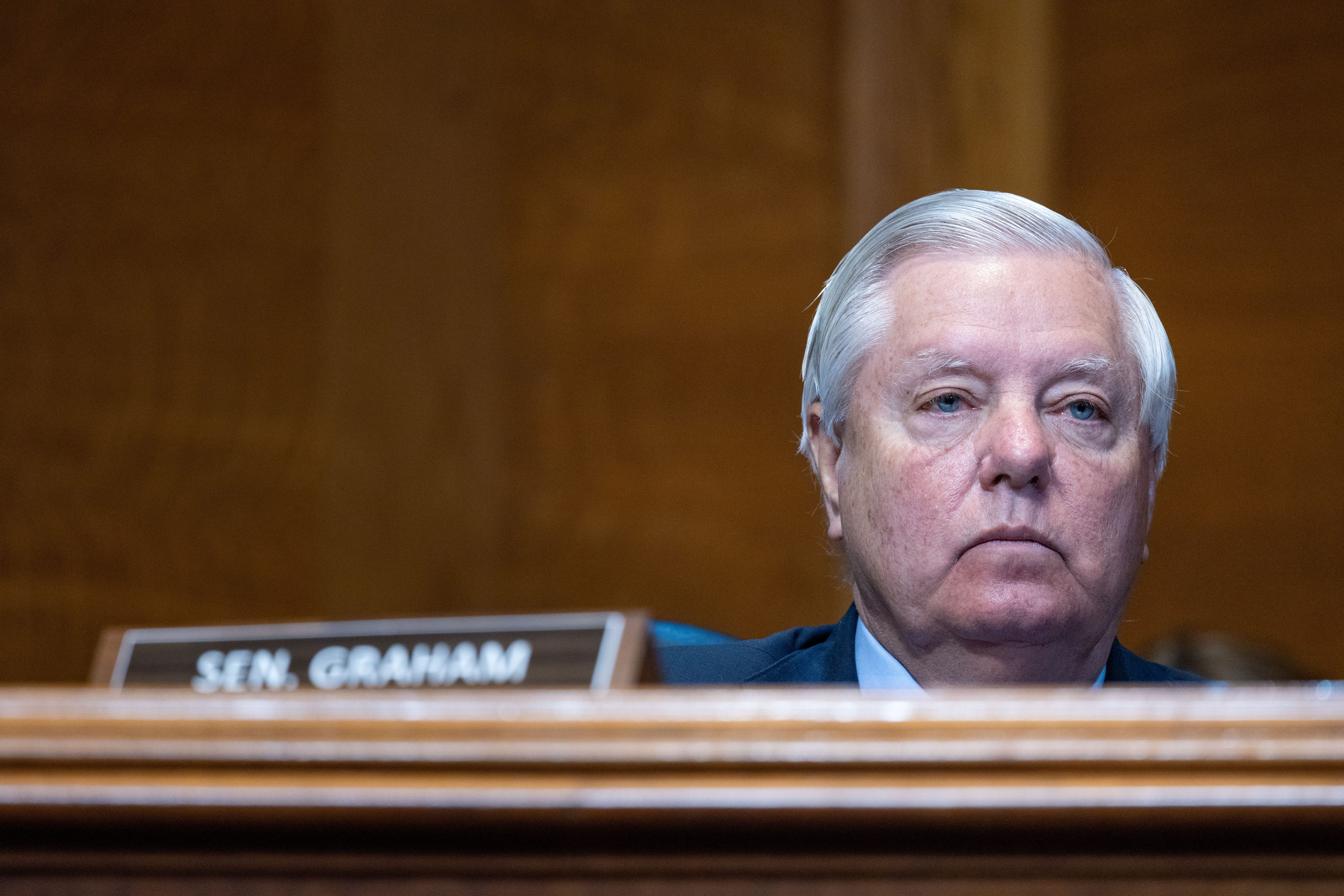
Senator Lindsey Graham of South Carolina died on Saturday evening, two days after his seventy-first birthday. His office attributed his death to “a brief and sudden illness” and disclosed nothing further. NBC News reported that emergency personnel responded to a call for cardiac arrest at a residence belonging to Graham, citing police-scanner audio. The President’s tribute arrived on Truth Social within hours: “Senator Lindsey Graham, one of the greatest people and Senators I have ever known, is dead!” It ended: “DETAILS AND ARRANGEMENTS TO FOLLOW. So sad!”
The machinery of Washington obituary has already begun its work. In short order the cable segments will have been produced and the wire pieces filed and the “greatest defender of the American military” tributes assembled from B-roll of Graham on aircraft carriers, and by the funeral the composite portrait will be complete: the war hero’s best friend, the bipartisan dealmaker, the son of South Carolina, the happy warrior, the man who — whatever you thought of his politics — loved his country in his own way.
That piece will not come from me. The ritual by which American public life launders men like Lindsey Graham at their deaths is one of the ways American public life keeps producing men like Lindsey Graham, and I do not intend to participate in it. The truth about a public life does not become false the day the man dies. And the truth about this public life, held plainly and without the softening that death is thought to require, is that Lindsey Graham spent the last decade of his career doing specific, nameable damage to the country he claimed to love, and the country will be living with that damage long after the eulogies have faded.
⁂
On June 21, three weeks before he died, Graham sat across from Margaret Brennan on Face the Nation after a four-and-a-half-hour meeting with the President. He granted diplomacy its fig leaf. “Let’s try a diplomatic solution,” he said. “I think it’s going to fail.” Then came the message dressed as a forecast: “I spent four-and-a-half hours with President Trump, Friday. Here’s what I think will happen next.” If the memorandum of understanding with Tehran collapsed, Graham predicted, “President Trump is going to take the Strait of Hormuz over by force. The United States will control the Strait of Hormuz. We’ll charge a fee for all those who go through to pay for the operation.” And then, in the sentence that will follow his name in the archives, he said what would happen if Iran resisted this seizure of its own maritime border: “If Iran contests control of the Strait of Hormuz by the United States, we will obliterate them.”
Obliterate. A nation of ninety million people, discussed on Sunday morning television in the register of a man previewing a real estate transaction. Graham’s forecast performed the courtier’s signature function. He emerged from the principal’s rooms to predict, with evident authority, what the principal would do, delivering the threat while preserving the deniability. His place in the ecology of this administration was to translate the President’s belligerence into a form that could pass through the Senate without requiring the Senate to think about what it was passing.
Three days later, on June 24, Graham posted on X calling for the Senate to re-vote the Iran War Powers Resolution and defeat it, on the ground that the earlier vote — which had asserted Congress’s constitutional authority to authorize the very war Graham had helped launch — was “emboldening” Iran during negotiations. He wrote: “If possible, we should re-vote.” The stated concern was tactical. The actual meaning was that the last legislative check on a war Graham had spent fifteen years lobbying for should be removed, retroactively, so that the executive branch could prosecute the war without interruption. This was a senior senator asking his colleagues to disable the Constitution’s principal restraint on presidential war-making for the convenience of the President he served. It was three weeks before he died.
This completed a fifteen-year arc.
⁂
Graham had been calling for war with Iran since 2010. In March of that year he stood at an AIPAC dinner and told the audience that “sometimes it is better to go to war than to allow the Holocaust to develop a second time” — a rhetorical move so morally reckless in its analogy that the room, one imagines, cannot have entirely known what to do with it — and by November he was at a security forum in Halifax explaining that any American strike on Iran should aim not merely at the nuclear program but at “sinking their navy, destroying their air force, and delivering a decisive blow to the Revolutionary Guard.” “In other words,” he added, “neuter that regime.” Sixteen years later, three weeks before his death, he compared Western funding for Iran’s reconstruction to “a Marshall Plan with a Nazi still in charge for Germany.” The analogy had become a habit of mind, a mechanism for making every restraint sound like complicity in extermination. Graham was a senator on the Armed Services Committee, speaking as a person whose words had operational consequence.
For the next fifteen years he never stopped. He supported the Iraq surge in 2007 and opposed the withdrawal in 2011, warning that leaving Iraq would let it “go to hell.” He wanted twenty thousand American ground troops in Iraq and Syria in 2015 to fight the Islamic State. He wanted to bomb Iran in 2015 to prevent the nuclear deal, and he wanted to bomb Iran in 2018 after the deal was canceled, and he wanted to bomb Iran in 2020 after Soleimani. Within days of October 7, 2023, he called for Iran’s oil refineries to be destroyed if Hezbollah escalated the war. That November he introduced a bipartisan Senate resolution urging that all options, including military force, remain available if Iranian proxies widened the conflict or killed Americans.
The war we are now in is the war he wanted. The Fordow strike, the B-2 sortie, the memorandum of understanding, the sixty-day window, the threatened seizure of the Strait — all of it exists in the shape it exists in because Lindsey Graham, and the small caucus of hawks around him, spent fifteen years pushing every administration they served in and every administration they opposed toward this outcome. He got what he wanted, and the country is going to be paying for what he wanted for a generation. This is the plain factual account of what he did with the Senate seat he held for twenty-three years, and it is inseparable from the larger project of executive-power consolidation that has organized American conservative politics for the last decade.
On Friday, one day before he died, Graham returned from his tenth wartime visit to Kyiv after helping secure an agreement with the Trump administration to move new Russia-sanctions legislation forward. His support for Ukraine was real. It was probably the best sustained thing he did with his final years, and the gratitude expressed by Ukrainians was earned. A man can be right about one war and spend fifteen years manufacturing another. The tributes will use Ukraine to erase Iran, converting the courage he showed on one question into absolution for the recklessness he cultivated on another. An honest accounting keeps both truths on the page.
⁂
The tribute writers face a harder problem in Graham’s own voice, which cannot be filed down without editing him away.
In July of 2015, when Donald Trump insulted John McCain by saying that being captured did not make a man a war hero, Graham — McCain’s closest friend in the Senate and, as of Saturday, the last survivor of what Graham, McCain, and Joe Lieberman had called the Three Amigos — went on television and called Trump “a jackass.” Then, on CBS the next morning, he called him “the world’s biggest jackass.” Then, in December of that year, after Trump proposed banning Muslims from entering the United States, Graham went on CNN and said, in one of the more direct sentences an American senator has delivered on camera: “You know how you make America great again? Tell Donald Trump to go to hell. He’s a race-baiting, xenophobic, religious bigot. He doesn’t represent my party. He doesn’t represent the values that the men and women who wear the uniform are fighting for.”
He was right. That is the difficulty for his tributes. These were the settled judgments of a man speaking deliberately. He identified precisely what Donald Trump was, in public, on national television, in the sentences of a man who understood what he was seeing and understood the danger and had the words available to name it. He called Trump a demagogue. He called him unfit for office. He said, on the day Trump effectively secured the nomination in May of 2016, “If we nominate Trump, we will get destroyed, and we will deserve it.” He said conservatism as a movement would take generations to recover from Trump’s damage. He said, in the primary that year, that choosing between Trump and Cruz was like choosing between being shot and being poisoned. He said, of the possibility that he might be Trump’s running mate, that it would be “like buying a ticket on the Titanic.”
Then Trump won.
And Lindsey Graham became one of the most consistent, most public, most operationally consequential defenders of the man he had accurately described as a race-baiting demagogue unfit for command — the man whose administration is now conducting the systematic gaslighting of the country about what it is doing to the constitutional order. He played golf with him at Bedminster. He rode with him on Air Force One. He whispered in his ear about Iran and Syria and Ukraine, and he came out of those meetings to translate what he had heard into legislative pressure and cable-news framing that made the President’s belligerence appear ratified by seasoned senatorial judgment. When John McCain gave the thumbs-down that saved the Affordable Care Act in 2017, Graham stayed friends with McCain — that friendship was real, and I will not diminish it — but he did not extend the moral framework that had made McCain the man he was to the political fights ahead. When McCain died in 2018, and Trump refused for days to lower the White House flags to half-staff, and denigrated McCain’s memory at every opportunity for years afterward, Graham absorbed the insult to his friend’s memory, explained it away, and carried on.
By 2019 he was telling the country, on the record, that Donald Trump had never made “a single racist statement. Not even close.” By 2024 he was on stage at Trump rallies. On June 28, 2025, during Senate floor debate, he defended the strikes on Iranian nuclear facilities and said the War Powers Act was “not worth in my view the papers written on.” By 2026 he was in the Oval Office for four and a half hours at a stretch, coming out to tell the country that if Iran resisted the seizure of the Strait of Hormuz, “we will obliterate them.”
The tributes will describe this arc as a “shift” or an “evolution.” What actually happened was a conversion undertaken with full knowledge of what he was converting to. In his own voice, on the record, in sentences that will outlast every eulogy his colleagues will offer, he had told us exactly what Donald Trump was and exactly what supporting him would cost the party and the country. And then, when the choice presented itself between being right in exile and being wrong at the elbow of power, he chose. He chose knowingly. And what he chose is the ongoing degradation of American constitutional government, the humiliation of the Senate as an institution, the elevation of a man he himself had named as unfit, and, in the last three weeks of his life, the public delivery of a threat to wage war against a country of ninety million people in language his former friend McCain would not have recognized as the language of a serious statesman.
⁂
The eulogists will say he was a patriot in his own way, that he served his country, that the Senate is diminished by his absence and we should remember him for his best moments and let the ambiguities go. This is the ritual, and I understand why it exists. It is the ritual by which political communities smooth over the frictions that would otherwise make continued cooperation impossible, and it is a ritual that has served American public life reasonably well in ordinary times, when the men and women it laundered were within some tolerable range of ordinary imperfection.
These are not ordinary times, and Lindsey Graham was not within that range.
He knew what Donald Trump was, said so in public with more precision than most of his colleagues managed, and then spent nine years making Donald Trump possible. In the last month of his life he was in the Oval Office building the war that will define the second Trump administration and probably the decade to follow, working alongside the men who returned the spoils system to the executive branch and dismantled the machinery of impartial government. He is not the worst senator of his generation, but he is worse than the worst of them, because the worst of them believed what they said. Graham did not believe. He knew. And knowing, he chose the road he chose, and he took the party and the Senate and a substantial portion of what remained of American foreign policy with him.
The country he leaves behind is worse for what he did to it. That is the honest sentence, and it is the one his eulogists will not speak. Most of them know it, some will say it in private, and a few have already said it to me. The ritual forbids them to say it in public, reinforced by a widely shared and largely unexamined feeling that to say what is true about a man on the day of his death is a kind of cruelty. I do not accept that feeling. I think the cruelty runs the other way. I think the cruelty is to the people who will suffer, and are already suffering, from what Lindsey Graham helped build. The dead senator does not need our discretion. The living need our truth-telling.
⁂
The eulogy ritual is dangerous because the next Lindsey Graham is watching. There is always a next Lindsey Graham. He is somewhere in the Senate right now, or in a governor’s office, or in a House committee room, calculating what a public life of accommodation to a demagogue will finally cost him. He is looking at the tributes rolling in for the senior senator from South Carolina, and he is drawing his conclusions. The conclusions he is drawing right now, as the “great American” and “consummate legislator” and “warm friend” tributes accumulate in his feed, are that the cost is manageable, that the record can be smoothed, that the moment of death will wash the ledger clean and hand his family a folded flag and hand history a portrait suitable for the Senate wall.
The next Lindsey Graham should draw a different conclusion. Some records cannot be smoothed. Some men have done enough damage that the ritual cannot hold, and if he takes the road Graham took, the piece he will get is the piece I am writing right now. There are writers who will refuse the laundering and readers who will refuse to accept it, in a country that has begun — slowly, imperfectly, but really — to recognize that a democracy in the condition ours is in cannot afford the courtesies it once extended to its own destroyers.
The civic function of the honest obituary is to send a message forward in time to the men and women who have not yet made the choice Graham made, telling them what the record will say when their moment comes. Vengeance and celebration have no part in it. Graham himself, I suspect, understood this. He was, whatever else he was, a shrewd political operator, and he had watched enough public lives end to know how the ritual worked. He counted on it. He believed the ritual would carry him through, as it had carried through worse men before him. And he was probably right that most of the ritual will hold: flags at half-staff, tributes filed on schedule, acceptable words found for the eulogies.
But not all of them. This one will not. And if enough writers and readers refuse the ritual, if enough citizens understand what is at stake in what a country chooses to remember about its powerful men, then the next Lindsey Graham may draw the conclusion we need him to draw. At the moment of his own conversion, he may remember that the piece he will get is not the piece he wants.
Graham’s death is an occasion for the country to speak more honestly about what he was and, by doing so, to make it marginally harder for the next one to become what he became.
Senator Graham has departed us. He was a race-baiting, xenophobic, religious bigot’s most consequential enabler. He said so himself, once, when it still cost him something to say it. In the end, his own sentence became his epitaph: a description of the man he served and of the choice by which Graham will be remembered. The eulogists may decline to name that tragedy. It stands without them.
May the country he leaves behind find the courage to look at what he built and, looking at it, resolve to build something else. That is the only tribute that would honor what was best in him. The tributes his colleagues will offer will honor only what was worst.

Go Deeper into the Circus
The Great Gaslighting of America

I endorsed Graham Platner. My reasons for endorsing him stand. I believe we need more people who speak like him in our politics, and none who act like this. He needs to drop out of the race for the United States Senate, and he needs to do it today.
A More Powerful President Over a Weaker Presidency

On June 30, 2026, on the Advisory Opinions podcast, the day after the Supreme Court’s decision in Trump v. Slaughter, Sarah Isgur said this, on tape, in her own voice:
Wilde was correct: "Some men improve the world only by leaving it."
Glad to see it being told like it is- dying doesn’t make you a hero