


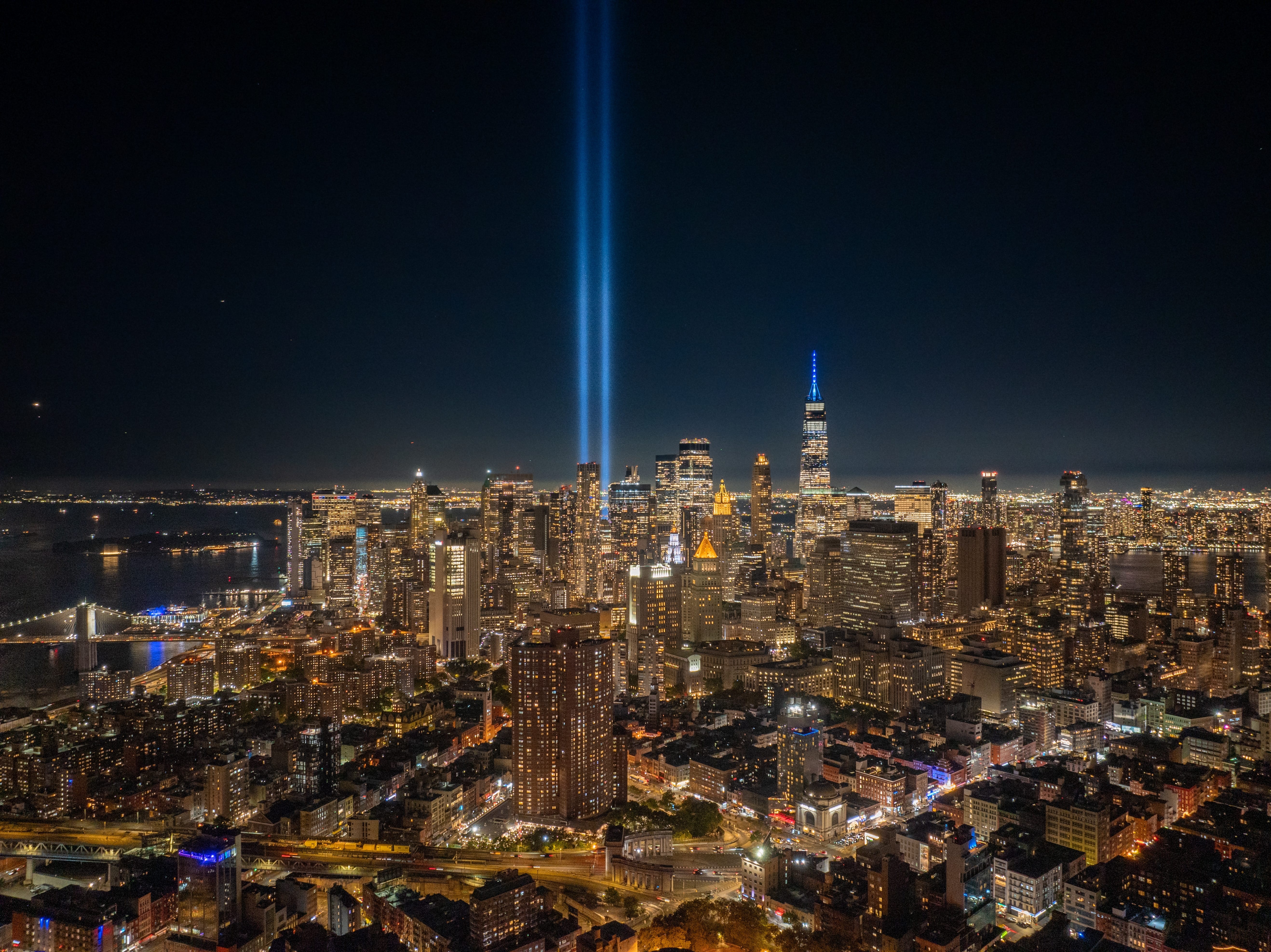
On the morning of September 11, 2001, nineteen men, fifteen of them Saudi nationals, hijacked four commercial airliners and used three of them as weapons against the World Trade Center towers in New York and the Pentagon outside Washington. The fourth was brought down by its passengers in a field outside Shanksville, Pennsylvania. Nearly three thousand people died. The operation was conceived by Osama bin Laden and Khalid Sheikh Mohammed, planned and financed through al-Qaeda’s apparatus in Afghanistan under the protection of the Taliban government, and executed by men who had been living, training, and praying in the United States for the better part of two years. The 9/11 Commission Report documents this. The Senate Intelligence Committee documents this. The FBI files document this. The pre-attack intelligence — the August 6, 2001, Presidential Daily Brief titled Bin Laden Determined to Strike in U.S. — documents this.
9/11 was a conspiracy. It happened. The conspirators were named, the network was mapped, the protectors were identified. The documentary record is complete.
The conspiracy that came next was different.
⁂
George W. Bush was, by the lights I can apply from this distance, a decent man.
I will say it first, before anything else the piece has to say about what was done in his name, because what was done is difficult to forgive, and the difficulty of it must not be allowed to bleed backward into a flat verdict on the man at the center of it. He was a believer. He prayed. He had given up drink. He loved his wife and his daughters and his dogs and his ranch. He had, in his governorship of Texas, behaved in ways that suggested an instinct for bipartisanship and a temperament not given to cruelty. When he stood on the rubble of the towers three days after the attacks, with the bullhorn and the firefighter beside him, and said that the people who knocked these buildings down would hear from all of us soon, he meant it the way a decent man means a vow at a graveside. He was not lying. He was not performing. He was responding, in the language available to him, to a wound the country had taken and to a duty he believed had fallen to him.
What I am about to describe is what was done to him, and what was done through him, by men who did not share his decency and who had been waiting, some of them for a decade, for exactly the kind of wound the country had just taken.
⁂
In 1992, three months after the dissolution of the Soviet Union, the Department of Defense circulated an internal document called the Defense Planning Guidance for fiscal years 1994 through 1999. The document was prepared under the authority of Paul Wolfowitz, then Under Secretary of Defense for Policy, with the drafting work done by Zalmay Khalilzad and I. Lewis Scooter Libby, and with the overall sponsorship of the Secretary of Defense, Dick Cheney. The document argued that, with the Soviet Union gone, the central strategic objective of the United States must be to prevent the emergence of any other power, anywhere in the world, capable of rivaling American military and economic supremacy. It argued for unilateral action where necessary. It argued for preemptive military force. It identified, by name and region, the theaters where the United States might have to fight in the coming decade in order to maintain its position. One of those theaters was Iraq.
The document leaked to The New York Times on March 7, 1992. The leak was greeted with public horror. Senators of both parties denounced it. The document was hastily revised, sanitized, and reissued in a softer version in April. Wolfowitz, asked about it years later, said the Times had exaggerated.
But the document existed. The thinking existed. The men who had written it remained in place — in think tanks, in defense contractors, in the universities, in the apparatus — for the eight years of the Clinton administration, waiting for the next Republican president and the next opportunity to put their planning into practice.
In 1997, several of these men founded the Project for the New American Century. The signatories of its founding Statement of Principles included Dick Cheney, Donald Rumsfeld, Paul Wolfowitz, Scooter Libby, Zalmay Khalilzad, Jeb Bush, Steve Forbes, Francis Fukuyama, Norman Podhoretz, William Kristol, and Dan Quayle. In January 1998 the Project for the New American Century sent an open letter to President Clinton calling for the military overthrow of Saddam Hussein. The letter was signed by Donald Rumsfeld, Paul Wolfowitz, Richard Armitage, John Bolton, Elliott Abrams, Francis Fukuyama, Robert Kagan, William Kristol, Richard Perle, and others. The letter argued that containment of Iraq had failed, that diplomacy had failed, that sanctions had failed, and that only the removal of Saddam Hussein and his replacement by a government friendly to American interests would secure the region’s oil supplies and prevent the rise of a hostile regional power. Clinton declined. The letter was published. It remains available, in its original form, on the open internet.
In September of 2000, two months before the presidential election, the Project for the New American Century released a longer document, Rebuilding America’s Defenses. The document called for a vast expansion of American military power, the establishment of permanent bases in the Persian Gulf, the development of an anti-missile shield, the militarization of space, and a fundamental reorientation of American defense policy toward preemptive war. It noted, in a passage that became infamous after the fact, that such a transformation was likely to be a long one in the absence of some catastrophic and catalyzing event — like a new Pearl Harbor.
That sentence was published in September 2000. It was not a prediction. It was a wish.
⁂
Dick Cheney was sworn in as Vice President of the United States on January 20, 2001. Within days, he had been put in charge of an entity called the National Energy Policy Development Group, which the press came to call the Energy Task Force. The Task Force met in secret. Its membership was concealed. Its agenda was concealed. Judicial Watch, the conservative legal organization, sued under the Freedom of Information Act for the records of the Task Force’s deliberations. The case went to the Supreme Court. The Court ruled, in a decision authored by Justice Antonin Scalia after Scalia had gone duck-hunting with Cheney during the pendency of the case, that the Vice President was not required to disclose the Task Force’s membership or its proceedings.
Some of the Task Force’s documents did, however, emerge. In July 2003, Judicial Watch released a set of documents obtained from the Commerce Department under a parallel FOIA order. Among those documents, dated March 2001 — six months before the attacks of September 11 — were a detailed map of the oil fields, pipelines, refineries, and tanker terminals of Iraq, a chart titled Iraqi Oil and Gas Projects, and a second chart titled Foreign Suitors for Iraqi Oilfield Contracts. The documents named the foreign companies — French, Russian, Chinese — that had begun negotiating with the Saddam Hussein regime for post-sanctions access to Iraqi reserves. The documents made clear what was at stake. The documents were prepared, in March of 2001, by a task force chaired by a Vice President whose previous job had been the chief executive officer of Halliburton, the world’s largest oilfield services company, and whose previous job before that had been Secretary of Defense for George H. W. Bush during the first Gulf War. The documents are available, in their original form, on Judicial Watch’s website. Anyone can read them. They have been there for twenty-three years.
The Iraqi oil fields were on the table in March of 2001. The attacks of September 11 were the catalyzing event the Project for the New American Century had publicly wished for six months earlier. The decade-old Wolfowitz Doctrine of preventing the rise of any rival in the Persian Gulf was waiting in the same drawer as the Iraqi pipeline maps. The men who had written all of it were now sitting at the head of the table — Cheney in the West Wing, Rumsfeld at the Pentagon, Wolfowitz as his deputy, Libby as Cheney’s chief of staff, Khalilzad on the National Security Council, Bolton at State, Perle on the Defense Policy Board.
Bush walked into the Oval Office on the morning of September 12, 2001, and the men who had been waiting since 1992 began to walk him through the plan.
⁂
According to Richard Clarke, who was at the time the National Coordinator for Security, Infrastructure Protection, and Counter-terrorism, and who had served four presidents, the question of Iraq came up on the afternoon of September 11 itself. Rumsfeld asked, in a meeting at the White House, whether the attacks did not present an opportunity to go after Saddam. Clarke pointed out that the attacks had been carried out by al-Qaeda, which was based in Afghanistan, and that Iraq had no documented connection to them. Rumsfeld replied that there were not enough good targets in Afghanistan, and that Iraq had better targets. Clarke recounts this conversation in his book, Against All Enemies. He recounts being asked by the President, on September 12, to find a link between Saddam Hussein and the 9/11 attacks. Clarke replied that there was no such link. He was asked again. He replied again. The President, Clarke writes, did not seem satisfied with the answer.
The campaign to manufacture the link began almost immediately. It was run, in its most important early phase, out of an entity called the Office of Special Plans, established at the Pentagon under Douglas Feith. The Office of Special Plans was, as the Senate Intelligence Committee later documented, a parallel intelligence apparatus designed to stovepipe raw, unvetted, and in many cases knowingly false intelligence to the offices of the Vice President and the Secretary of Defense, bypassing the CIA’s analytical process. The Office of Special Plans was the conduit through which the Chalabi-supplied fabrications of Curveball and other Iraqi exile sources became the basis for public claims about weapons of mass destruction, mobile biological weapons laboratories, aluminum tubes for uranium enrichment, and yellowcake uranium purchases from Niger.
The yellowcake claim survived long enough to be inserted, despite the CIA’s repeated objections, into the President’s State of the Union address of January 28, 2003. The British government has learned that Saddam Hussein recently sought significant quantities of uranium from Africa. The sixteen words. The documents that the claim rested on were forgeries. The forgeries had been known to be forgeries by the Italian intelligence service. The CIA had been told, repeatedly, that the documents were forgeries. The sentence was put into the State of the Union anyway. The President of the United States read it from the teleprompter. A decent man reading a lie that had been placed in front of him by the men he trusted to write his speeches.
On February 5, 2003, Colin Powell, the Secretary of State, stood before the United Nations Security Council and presented what he described as the United States government’s case for the existence of an Iraqi weapons-of-mass-destruction program. He held up a small vial. He pointed to satellite photographs. He played intercepted communications. He spoke for over an hour. Almost everything he said was wrong. The aluminum tubes were not for uranium enrichment. The mobile biological weapons laboratories did not exist. The connections to al-Qaeda were not real. Powell, who had resisted the war privately and who had insisted on this UN presentation as a condition of his participation, was later to describe the speech as a blot on his record that would never be removed. He had been, in his word, played. He had also been used. He was the most respected man in the cabinet. He was the trusted face. He was the one whose voice would carry into the homes of skeptics and the chambers of allies. He was deployed because his credibility was the last asset the administration had not yet spent, and they spent it.
The invasion began on March 19, 2003.
⁂
Bush stood on the deck of the aircraft carrier USS Abraham Lincoln on May 1, 2003, under a banner that read MISSION ACCOMPLISHED. He was wearing a flight suit. The image was choreographed by his communications staff. The mission was not accomplished. The mission was just beginning. The mission would last another eight years, and in some sense it has not ended yet.
Within months of the fall of Baghdad, the Coalition Provisional Authority, under L. Paul Bremer, issued the orders that would shape the post-invasion period. Order Number 2 dissolved the Iraqi Army, putting four hundred thousand armed men out of work overnight and into the recruitment streams of the insurgency. Order Number 1 banned the Baath Party, eliminating from the new state every administrator, teacher, doctor, and engineer who had been required to hold party membership in order to practice their profession. The country’s institutional memory was deleted. The country’s security forces were turned into the country’s enemies. The vacuum was filled, over the next decade, by sectarian militias, by al-Qaeda in Iraq, and eventually by the Islamic State, which captured Mosul in 2014 with weapons abandoned by an Iraqi army that the United States had built and rebuilt and built again.
The contracts went out. Halliburton, Dick Cheney’s former company, received no-bid contracts worth tens of billions of dollars through its subsidiary Kellogg, Brown & Root. The contracts covered everything from base construction to oil-field restoration to laundry services for the troops. The contracts were sole-sourced, in the early years, on the grounds that no other firm had the capacity to perform the work at scale. The audits that followed found systematic overbilling, ghost employees, and serial fraud. The men who had drafted the Defense Planning Guidance of 1992 had been honest, in their way, about what the strategy was for. It was for access. It was for control. It was for the maintenance of American supremacy in the region from which the world drew its oil. The contracts were the strategy made visible. The contracts went to the firms that the men around the table had spent their careers serving.
The cost, in dollars, has been estimated at three to four trillion when all the long-tail expenses are counted — Veterans Affairs care, interest on the war debt, the wars in Afghanistan and Pakistan that ran on the same authorization, the reconstruction that never reconstructed. The cost, in lives, is the figure that the country has not been able to bring itself to settle. The Iraqi government’s own conservative count is over a hundred thousand civilian deaths. The Lancet‘s 2006 study put the excess mortality at over six hundred thousand. The Iraq Body Count project, which uses only documented media reports, has the number at over two hundred thousand civilian deaths and rising. The number of American military dead is forty-five hundred. The wounded, the traumatized, the families broken — those figures run into the millions on both sides.
The weapons of mass destruction were not found, because they did not exist. The connection to al-Qaeda was not established, because it did not exist. The democratic transformation of the Middle East, which had been the back-up justification once the WMD case collapsed, did not occur. What occurred was the disintegration of Iraq, the rise of Iran as the regional hegemon, the migration of jihadist energy out of Afghanistan and Iraq into Syria and Libya and across the Sahel, and the production of a generation of new enemies whose grievances against the United States were neither imagined nor exaggerated. They were a generation of people whose parents had been killed in the night by men in helmets speaking a language they did not understand. The recruitment material wrote itself.
⁂
I want to come back to George W. Bush, because the piece cannot end without coming back to him.
I do not believe he wanted the war for the oil. I do not believe he sat in the Oval Office and read the Halliburton contracts and licked his lips. I believe he wanted, after September 11, to do something large enough to honor the dead, to protect the country, and to demonstrate that an attack on the United States would be met with a response that no other power on earth could match. I believe he wanted, in some part of himself that had been formed by his faith and by his family, to be the President who liberated a people. I believe he believed Colin Powell when Powell told him the intelligence on the weapons of mass destruction was solid. I believe he believed Cheney when Cheney told him the threat was imminent. I believe he believed the speechwriters when they handed him the sixteen words. I believe he was lied to, repeatedly, by men who had a project predating his presidency by a decade, and that he allowed himself to be lied to because the alternative was to confront the fact that the men around him were not the patriots he had taken them for but operators in service of an agenda older and colder than his own.
There is a name for what was done to him. The name is seizure.
A real attack happened. The real attack was the work of a real network of real conspirators whose names are documented. The decent man at the head of the country wanted to respond, and the response he would have made, on his own, would likely have been the destruction of al-Qaeda in Afghanistan and the dismantlement of the Taliban government that sheltered them. That war was, by most accounts, supported by ninety percent of the American public and by virtually every government on earth. It was begun on October 7, 2001, and within two months the Taliban had fallen and bin Laden was on the run in the mountains.
What happened next was the seizure. The men who had wanted Iraq for a decade saw, in the catalyzing event they had publicly wished for, the opportunity they had been waiting for. They walked the decent man, step by step, from the war he had said he wanted into the war they had wanted for years. They walked him through the intelligence and they walked him past the contrary intelligence. They walked him to the United Nations and they walked his Secretary of State up to the podium with the vial. They walked him into the Rose Garden and they walked him onto the carrier deck and they walked him into the long unraveling. They walked him out, at the end of two terms, with his approval ratings in the twenties, his party in tatters, his country broken, and an Iraqi state in pieces that would over the next decade produce the Islamic State and the deaths of hundreds of thousands more.
He has, in the years since, done the small kind, private work of a man trying to make a peace with what he was part of. He paints portraits of veterans. He visits Walter Reed. He raises money for the families. He does not speak much in public about the war. There is a humility in him that was not there before. Whether the humility is enough to balance the ledger is not for me to say. I do not believe the ledger can be balanced. I think he knows that too.
⁂
This piece is about the seizure, not the man.
The men who seized the moment did not disappear when Bush left office. They wrote books. They went to AEI and Hudson and the Hoover Institution. They became contributors at Fox News. They mentored the next generation. Robert Kagan and William Kristol and Bill Kristol’s Weekly Standard nurtured the writers who would later, when the moment came, retool their analytical apparatus from neoconservatism to postliberalism without ever quite acknowledging that the new project rhymed with the old. Donald Rumsfeld died. Paul Wolfowitz lived to write op-eds about how the Iraq War had been a noble idea undone by bad implementation. The apparatus of think tanks and journals and contracted commentators and rotating Pentagon billets continued, and the men who had been junior staffers in Cheney’s office in 2001 became, twenty years later, the senior writers and policy entrepreneurs of the project that James Pogue would document in 2022 and that I described in the piece I published yesterday.
The line is unbroken. It runs from the Defense Planning Guidance of 1992 to the PNAC letter of 1998 to Rebuilding America’s Defenses of 2000 to the Energy Task Force of 2001 to the Office of Special Plans to the sixteen words to the vial at the United Nations to the Mission Accomplished banner to the no-bid Halliburton contracts to the disintegration of Iraq to the rise of the Islamic State to the radicalization of the postliberal right by the failure of the war it had wanted to the J. D. Vance who in 2022 told James Pogue that what he was building was not fascism, it was something different, and that the answer to whether it was fascism was that it would produce a world where his son’s masculinity mattered more than whether it worked for fucking McKinsey.
The men who walked George W. Bush into the war were not the same men who walked J. D. Vance into the Senate. But they share the same shelves. They share the same donor lists. They share the same conferences. They share the same conviction that the American constitutional order is an obstacle to the kind of American power they believe the country needs. They differ only in whether they wish to exercise that power through democratic forms or whether they have decided, after the Iraq disaster and the Trump rupture and the long delegitimization that followed, that the democratic forms must finally be retired.
The 1953 coup was the first seizure. It seized the elected government of Iran for the oil. The 1974 petrodollar handshake was the second seizure. It seized the global currency for the oil. The 2003 invasion of Iraq was the third seizure. It seized a real attack on the country to launch a planned war for the oil. The current project — the one Pogue documented, the one Vance speaks for, the one Yarvin writes for, the one Thiel funds — is the fourth seizure. It is the seizure of the American constitutional order itself, on behalf of a coalition of petro-states and the technology firms they have purchased, to install a regime that will guarantee them the next century the way the petrodollar guaranteed them the last one.
⁂
George W. Bush was a decent man. The men around him were not. The men who came after them are not. The decent man was, in the end, the instrument through which a long project advanced one large step.
The instrument can be a decent man. The project does not need every operative to be cruel. The project needs only that the operative at the center of the photograph be the kind of man whose decency makes the cruelty harder to see.
This is the lesson of the war on terror. The terror was real. The response to the terror was hijacked by men who had been waiting for the terror, and the war they launched in the name of the terror was a war they had wanted for a decade for reasons that had nothing to do with the terror.
The conspiracy is the cover story. The cover story this time was they hate us for our freedoms. The cover story this time was weapons of mass destruction. The cover story this time was democracy in the Middle East. The cover story was the language a decent man could be persuaded to speak in front of cameras while the contracts were being written and the maps were being unfolded.
The cover story this time was the war itself.
⁂
I do not know how to close this piece in a way that does not feel inadequate to what it has covered. A million people are dead. A trillion dollars are spent. A region is in ruins. A republic is being walked, by the same apparatus, toward the next seizure.
I keep thinking about the man on the rubble with the bullhorn. He meant it. He was telling the truth in that moment. He was a President responding to a wound. The country was with him. The country would have followed him anywhere he led that week, that month, that year.
And the men around him led him into the wrong war. They led the country into the wrong war. They did it knowing what they were doing. They had the maps in March. They had the plan in 1992. They had the wish for a new Pearl Harbor in print in September of 2000.
The dead deserve more than this piece can give them. The country deserves an accounting that I cannot deliver from where I sit. The most I can do is name what happened, point to the documents, refuse the cover story, and refuse it again the next time the same operators come back with new language and the same map.
The cover story will come back. It always does. The donor lists will be the same. The think tanks will be the same. The men giving interviews will be different but they will have studied under the same advisors. The next catalyzing event will produce the same kind of opportunity, and the same kind of men will be waiting in the same kind of offices to walk the next decent or indecent President through the next plan they have been keeping in the drawer.
The work, when it comes, is to recognize them on sight. To know the shape. To know the names. To know that the cover story is the cover story.
Pogue gave us the names of the present generation. The 9/11 Commission and the Senate Intelligence Committee and Judicial Watch and The New York Times and Vanity Fair gave us the names of the last one. The names are in the documents. The documents are on the internet. The internet still works, for the moment, the way an archive works. Anyone can go and read.
Read.
Then refuse the cover story.
Then look at the man on the rubble with the bullhorn, and the man on the carrier deck under the banner, and the men behind him in suits, and learn to tell the decent man from the operators, and learn to tell the decent man that he is being used.
It is the only protection a republic has against the men who have been waiting in the drawer.
Go Deeper into the Circus
The Conspiracy Is the Cover Story

Iran-Contra was a conspiracy. Members of the executive branch of the United States, operating outside the knowledge of Congress and in direct violation of the Boland Amendment, ran a covert weapons-sales program to Iran and used the proceeds to fund a paramilitary force in Nicaragua. The operation involved Oliver North in the National Security Council, …
The Last Serious Contrarian

Christopher Hitchens died on the fifteenth of December, 2011, in Houston, of esophageal cancer, at the age of sixty-two. He had been on a book tour for Hitch-22 when the disease announced itself. He spent the eighteen months that followed writing about dying — the essays collected later as
Dude! You are producing so much so fast. I hope you are protecting your health and well-being. Great stuff!
Decency is simply not enough.
Unless it comes clothed in principled empathy, hard worked for intelligence and ethical anger it is always vulnerable to those with a hard nose for the gullible.