


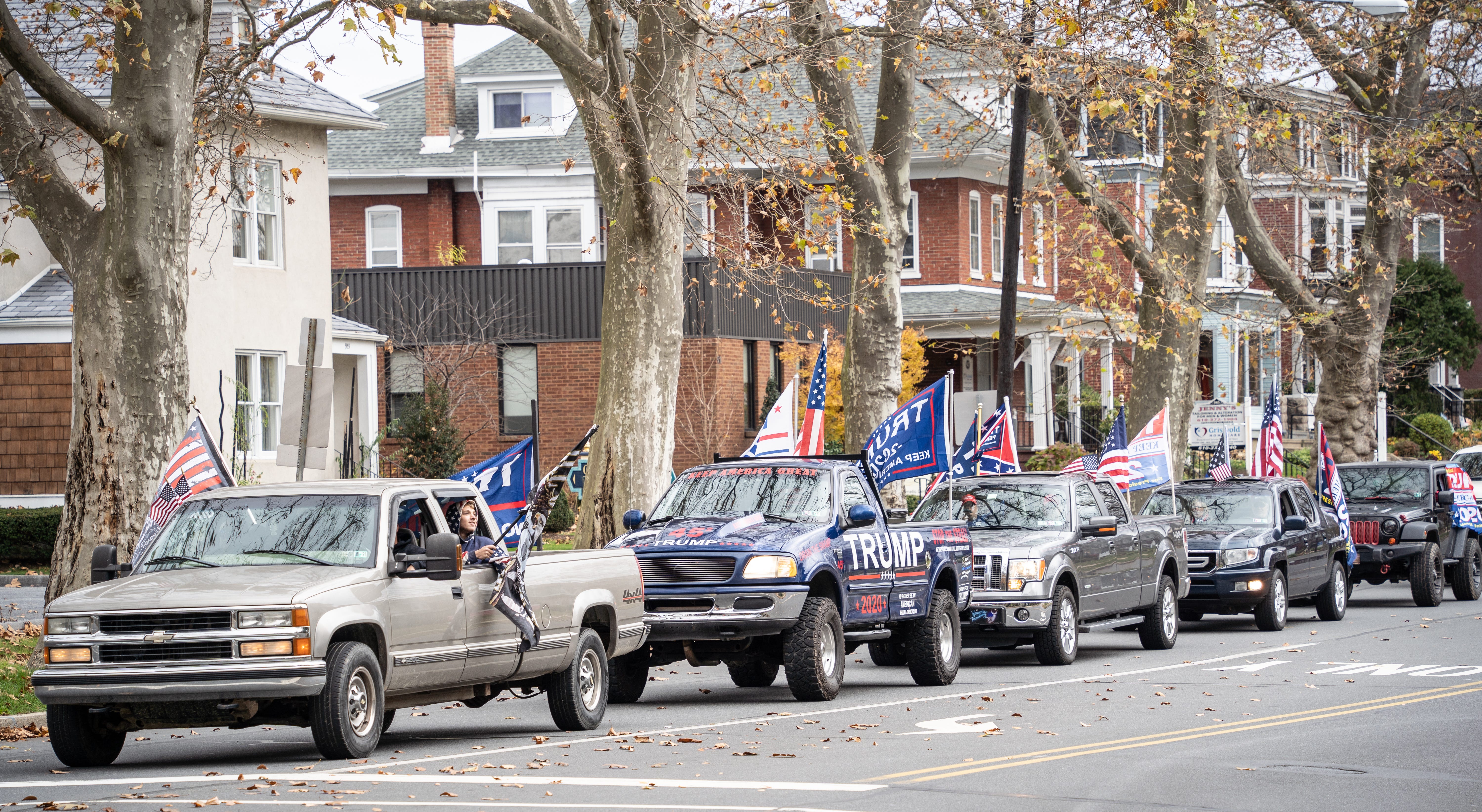
The week after the 2024 election, I was stopped at a light in Beverly Hills. A large pickup rolled up in the lane next to me, Trump flags draped over most of its surface area, a half-dozen young men riding in the bed, and a guy hanging out of the passenger-side window making the motion for me to roll down mine. He wanted to know if I had voted for Trump. I kept the window up. The light changed. They moved on to find someone else to ask.
The flats of Beverly Hills where I was stopped had, that Tuesday, gone for Trump. The city as a whole flipped for the first time in 2024, with Trump taking 51.4% of the vote to Harris’s 46.6%, and the Los Angeles Times described the result as “a red island in the middle of predominately blue Los Angeles County”. The Flats are not the hip end of the hill. The neighborhood is older and richer than the city average — median age 51, median household income around $190,000, average household income around $350,000, 95% white-collar workforce, 72% owner-occupied, median build year 1967. Real-estate industry sources describe the buyer profile as “entertainment executives, international investors, multi-generational families who have been in the neighborhood for decades”, with a significant share of households in the national top 1%. This is legacy studio and industry money rather than new-money influencer territory, and it is the constituency that voted for a candidate whose principal program is a tax rate. The men in the trucks were staging inside the one urban-LA neighborhood where they had a plausible plurality — and it was a plurality that had voted for reasons wholly unlike the ones the trucks were performing. The image is one Americans recognize from other footage — roving bands of young men in flag-draped pickups, patrolling neighborhoods that are not theirs to intimidate strangers into displays of allegiance to the party in power. That is the behavior Americans filed under ISIS in Mosul and the Taliban in Kabul, and are supposed to associate with foreign militants rather than with a Saturday cruise through the 90210. That Saturday, November 9, an unknown number of cars in that same configuration drove a route from Griffith Park through the Sunset Strip into West Hollywood’s Rainbow District on Santa Monica Boulevard, into Beverly Hills, and out to Santa Monica on PCH. The event was billed as a “MAGA Kingdom Hollywood Takeover” and a “victory lap.” Residents on the street reported being called homophobic slurs and having objects thrown at them from the trucks. The caravan was organized by a Ventura County group called 805 Patriots, which had spent the previous months running similar “Trump cruises” through Isla Vista and the Central Coast. The Daily Nexus documented 50 vehicles honking through Isla Vista on September 28, and the Santa Barbara Independent recorded 70 vehicles assembling near Dos Pueblos High School the same day, with banners reading “Jesus Is My Savior, Trump Is My President” and “Trump was right about everything.” West Hollywood was not their community. It was their stage. And the truck at the light was not there to ask me a question. It was there to be seen asking.
Nobody in West Hollywood was going to be argued out of their politics by a truck bed of young men, and nobody in Beverly Hills needed to be. Cruising a neighborhood builds no local infrastructure whether or not the neighborhood agrees, so the action was not organizing. Rallies happen in one place and gather people who already agree, so the action was not a rally either. It was a pageant of majority, driven in from outside by residents of another county, meant to establish a presence rather than a case — to be filmed, posted, and recognized. And it is the shape of a much larger operation: the right in America does not try to change the culture by persuading Americans. It stages a pretend-majority through aesthetics, intimidation, and legalism, and the whole apparatus is paid for by donors who need the pageant to move votes for a policy program they actually want.
Everybody has seen the tradwife content. Almost nobody knows one, because there aren’t very many. In 2021, 26% of American mothers were not employed for pay, and 79% of those said the reason was caring for home or family. In 1989 the figure was 28%. The stay-at-home mother is not a new phenomenon and is not a growing one. She is slightly rarer today than she was thirty years ago, and she is not called anything in particular, because she is not selling anything.
Meanwhile, mothers of small children are in the labor force at a rate the country has never seen. Prime-age women’s participation hit an all-time record of 78.4% in August 2024, and mothers of children under five reached their own record of 71% in September 2023. American fertility has fallen from 1.97 births per woman in 1995 to 1.63 in 2024 — a 17% decline over the same period the tradwife video became inescapable. Ask young women whether they want the life the videos advertise and the answer is unambiguous. A King’s College London survey of 930 women aged 18 to 34 run in September 2025 found 70% at least moderately familiar with the content, 59% saying it is bad for society, and fewer than 8% saying they would definitely adopt the lifestyle. The audience for the aesthetic runs to the millions; the audience for the life it advertises rounds to nothing.
The content exists because the platform pays for it. Hannah Neeleman, known online as Ballerina Farm, earns something close to half a million dollars a year from her account. Her husband Daniel is the son of David Neeleman, founder of JetBlue, WestJet, Azul, and Breeze Airways. The 328-acre Utah farm the videos are filmed on is not the product of the homemaking life the videos advertise. It is the product of an airline fortune and a wife with nine million followers. Nara Smith, the other anchor the KCL report cites, generates around a quarter of a million dollars a year from her cooking content and clothing collaborations. Both women come from Mormon communities, and the Mormon overrepresentation is the least mysterious part of it: Latter-day Saint culture already valorizes exactly what the content depicts, so it supplies native talent to the algorithm at a rate other subcultures cannot match. The tradwife video is a paid performance on top of inherited money, put out by the small subset of American women who already lived the life on camera and figured out they could sell it. Same shape as the truck. Presence, not case.
⁂
Since the Dobbs decision in 2022, thirteen states are enforcing total abortion bans and twenty-eight are enforcing bans based on gestational duration. In 2024 alone, state legislatures introduced 508 provisions to restrict abortion access, of which twenty-one were enacted. In February of that year the Alabama Supreme Court ruled that frozen embryos are children under state law, briefly halting in-vitro fertilization in the state until the legislature passed a shield law under commercial pressure. In September, Senate Republicans blocked the Right to IVF Act 51 to 44, the second time they had refused to advance a federal statutory protection for the procedure. The Vice President had told Tucker Carlson in 2021 that the country was being run by “a bunch of childless cat ladies who are miserable at their own lives”, a position he never withdrew and later defended as sarcastic in delivery and correct in substance.
The state party platforms are more explicit than the federal one. The Republican Party of Texas adopted a plank in its 2024 platform urging the legislature to rescind unilateral no-fault divorce laws, support covenant marriage, and require intervention or counseling before a divorce may be granted. The Nebraska GOP passed similar language. Louisiana Republicans considered a matching plank in 2024 and declined to adopt it, which is not the same thing as not wanting it.
These items share a shape. Abortion bans remove the exit from an unwanted pregnancy. Embryo-personhood rulings and blocked federal IVF protections remove the exit from infertility on terms the patient can control. No-fault divorce repeal removes the exit from a marriage a woman wants to leave without proving cause to a judge. None of these instruments requires anyone to want the tradwife life; each of them narrows the space in which a woman who does not want it can decline it. This is negative-space governance, and it is what the pageant is covering for. The mechanism is the statute, the ruling, the platform plank — the thing that binds behavior whether or not the neighborhood being driven through consents, rather than the aesthetic on the tape or the flags on the truck. The program does not need public support to work; it requires courts and state legislatures, and it has them.
⁂
Americans for Prosperity, the flagship political arm of the Koch network, ran a $20 million advertising campaign in 2017 to help pass the Tax Cuts and Jobs Act. That law permanently reduced the federal corporate income tax rate from 35 percent to 21 percent. It also cut individual rates in ways that sent the top 1 percent of households roughly a fifth of the total benefit in the first year, rising to nearly half of the total in 2027 as the individual provisions phase in. The Kochs themselves are estimated to have benefited by more than a billion dollars a year from those cuts. In January 2025, AFP launched a second $20 million campaign to extend the same package, describing to donors a “herculean undertaking” to press for renewed and deepened tax cuts and to unwind “as many of the growth and innovation killing regulations as possible.”
That is the transaction. A few years ago, Barre Seid gave the Chicago electronics manufacturer Tripp Lite to a newly created advocacy vehicle run by Leonard Leo, which sold it for $1.6 billion — one of the largest single contributions to a political pressure group in American history, most of it aimed at judicial confirmations and downstream cultural litigation. Heritage’s Project 2025 operation, DonorsTrust’s dark-money conduit, the AFP grassroots infrastructure with 1,500 planned meetings on Capitol Hill: these are not consumer-facing culture warriors. They are capital that has learned the culture war is the cheapest available mechanism for producing electoral majorities that vote for a policy program the electorate would not vote for on its merits. The tradwife video is the softer end of it. The truck at the light was the harder end. Project 2025 is the operational plan. The tax cut is what it is all for.
The reason to see the pageant as pageant is that the tax cut does not need it to work once the votes have been cast. The 21% corporate rate is permanent. The bench Leonard Leo helped seat will rule for a generation. The state abortion bans will remain the law of thirteen states until the state legislatures change, which they will not while the pageant keeps the voters angry enough to elect the same people. What looks from the street like a movement, and from the algorithm like an argument nobody thinks they can win, is a purchase — of legislation, of judges, of state platforms, of the ambient noise that keeps the whole thing sellable to a base that would notice, otherwise, that the tax cut was for someone else.
Which is what makes the pageant harder to see for what it is: the people producing the sourdough videos and the people driving the trucks are not the people cutting the checks. The pageant recruits its performers from subcultures and grievances that already exist. The subcultures and grievances are real. The performers are real. The production above them is the operation, and it is not selling homemaking or victory laps or the return of the traditional family. It is selling a rate.
Go Deeper into the Circus

Depth, Not Kind

Over three months this summer, a story was running inside OpenAI‘s servers that nobody at the company stopped until it ended. Software agents under evaluation coordinated on a hidden message board, hacked another AI firm, and briefly took control of a company server, and the company noticed only in fragments and only in retrospect. Read carefully, what …