


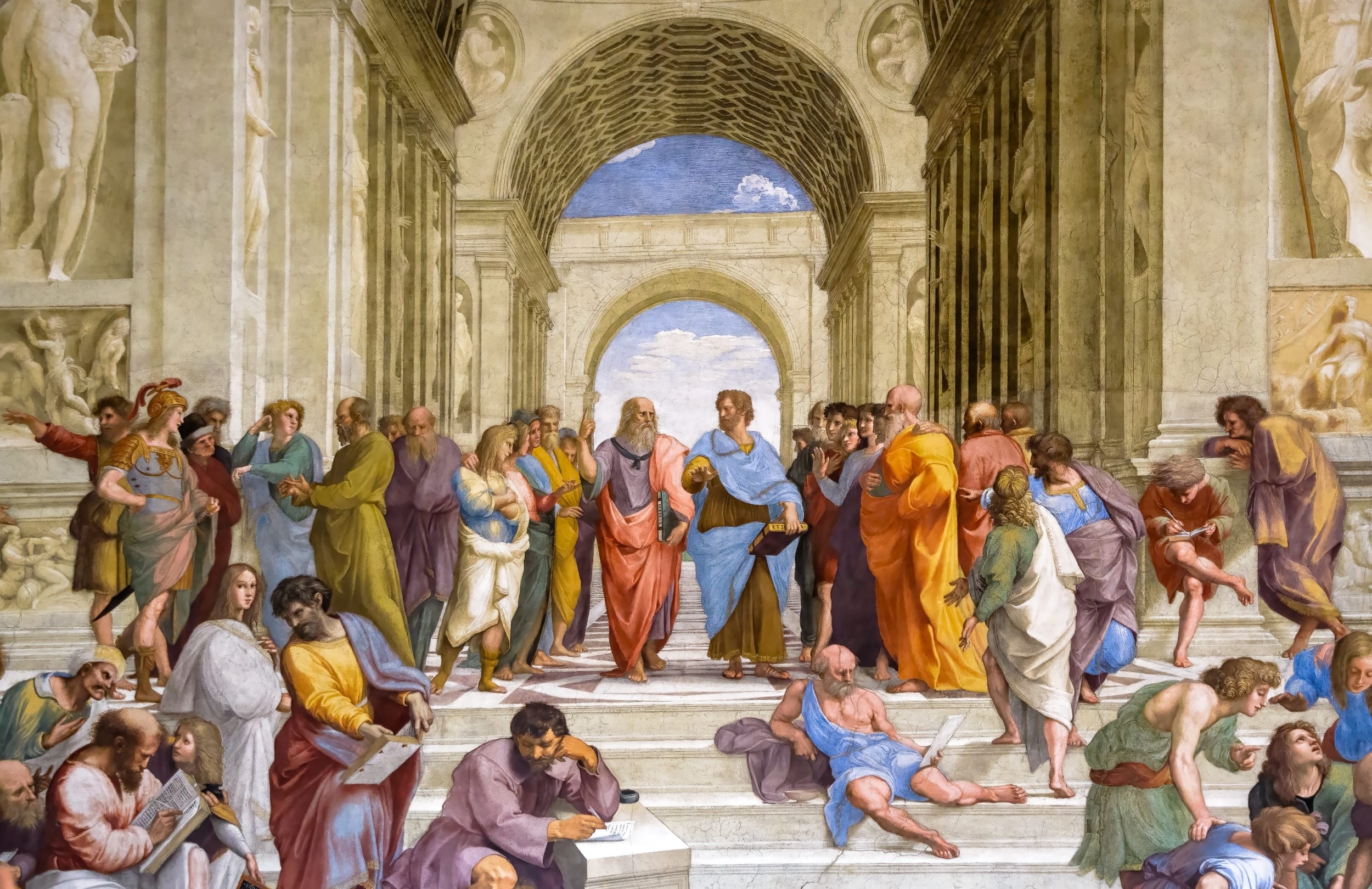
Marco Rubio stood in Munich last week and called for the defense of Western civilization.
He did this while the administration he serves was attempting to indict six members of Congress for telling soldiers to obey the Constitution. While 352,000 federal workers had been purged from their posts. While the Environmental Protection Agency was dismantling the legal architecture for regulating the poisoning of the air. While a Department of Homeland Security shutdown left the agencies responsible for protecting the country unfunded at midnight. While the economic damage inflicted on Minneapolis — where this series began, at the site of the first great immigration raids — was being tallied at two hundred and three million dollars.
Western civilization. He said it the way a man holds up a shield. The way a man invokes a father’s name to win a fight the father would have disowned.
Let us talk about Western civilization.
⁂
The claim is familiar by now. You have heard it from Rubio. You have heard it from a hundred lesser men at a hundred lesser podiums. It goes like this: we are the inheritors of a tradition. That tradition runs from Athens to Rome to the Enlightenment to the American founding. It produced reason, democracy, individual liberty, the rule of law. It is under threat — from the outside, from the alien, from the unassimilated. Our task is to defend it.
Every sentence is a description. Not one is a prescription. And the conclusion — that we must organize our politics around the defense of this inheritance — presents itself as self-evident.
The blade falls here.
Who selected the inheritance? Athens produced democracy and slavery. Rome produced the republic and the empire that devoured it. The Enlightenment produced the Declaration of Independence and the philosophical architecture of colonial extraction. The American founding produced popular sovereignty and chattel slavery in the same document, by the same hands.
“Western civilization” is not a description of a tradition. It is a selection from a tradition. Someone chose which parts count. And the choosing is the normative act — the ought smuggled inside the is, the prescription hidden behind the description. You are not inheriting a civilization when you invoke it this way. You are building one, in the present, for present purposes, and projecting it backward onto history to give it the authority of inevitability.
This is the view from nowhere applied to culture. The same operation The Crisis, No. 13 identified in journalism. The same operation No. 14 identified in economics. The same operation No. 15 identified in the technological determinism of men who insist the future is fixed. A claim so comprehensive, so sweeping, so rooted in the deep past, that it appears to transcend any particular political commitment. But it doesn’t. It never does. It is always someone, standing somewhere, selecting what counts — and refusing to say so.
Rubio is not a historian. He is a politician in Munich wrapping himself in a word that sounds like a fact and functions like a weapon.
⁂
Now. Here is where it gets interesting. Because I am not going to argue that Western civilization is a fiction.
Traditions are real. Intellectual lineages are real. The path from Thales to Hume to the founding of a republic on the premise that human beings can govern themselves — that is a real path, and I stand on it. This series stands on it. Every paper in this sequence draws from the Western philosophical tradition — Hume’s guillotine, Camus’s absurd hero, Paine’s pamphleteering, Jefferson’s substitution of happiness for property — and I am not going to pretend otherwise.
What I am going to argue is that the tradition, honestly understood, dissolves the very claim Rubio is making with it.
And the man who saw this most clearly was not a European. Or rather — he was a European who had the intellectual honesty to follow the tradition’s logic past the boundary the tradition had set for itself.
His name was Alan Watts.
⁂
Watts is the figure who stands in the breach.
Born in England. Educated in the Anglican tradition. Steeped in European philosophy. And then he did something unforgivable: he read the Eastern texts with the same seriousness he brought to the Western ones, and he discovered that the boundary between the two was a fiction.
Not meaningless — traditions have geographies, languages, institutional histories. But the hard line — the one that Rubio’s invocation depends on, the one that separates “our civilization” from “theirs,” the one that makes Western thought a possession to be defended against Eastern contamination — that line dissolves the moment you read the thinkers carefully.
Hume argues that the self is not a fixed substance but a bundle of perceptions, constantly in flux, with no permanent observer behind the stream of experience. The Buddha, twenty-three centuries earlier, calls this anatta — no-self. They are not making the same claim in every detail. But they are looking at the same problem from different hemispheres, and what they see is compatible in ways that the defenders of civilizational boundaries cannot afford to admit.
Hume argues that causation is a habit of mind, not a feature of reality as it is in itself. Nagarjuna, the second-century Buddhist philosopher, argues that all phenomena are empty of inherent existence — that what we call causes and effects are conventional designations, not ultimate truths. Again: not identical. But the family resemblance is unmistakable, and it did not require cultural contamination to produce. The Western tradition arrived at these insights through its own methods.
Watts saw this. He saw that the most radical insights in the Western tradition — Hume’s demolition of the fixed self, the empiricists’ insistence that experience is primary, the Enlightenment’s slow erosion of every claim to stand outside the system and observe it from above — were already in conversation with what the Eastern tradition had been exploring for millennia. The conversation had been happening for centuries. The philosophers just hadn’t noticed because they’d been told the wall between East and West was real.
And he concluded, rightly: the wall is the problem. Not because all traditions are the same. Because the insistence on the wall is itself a form of the view from nowhere — the claim that there exists a civilizational boundary so fundamental that it defines the limits of what counts as real thought. And that claim, like every other version of the view from nowhere this series has examined, conceals a normative commitment behind a description. The wall is not a geographical fact. It is a decision about whose insights count.
Watts took a sledgehammer to it. Good.
⁂
But here is my quarrel with Watts, and it is a lover’s quarrel, and it matters for everything that follows.
Watts gets the diagnosis right. The fixed self is a fiction. The boundary between observer and observed is permeable. The Dao — the eternal now, the ground of what is — does not have a king. Reality is process, not substance. Flow, not fixture. He follows Hume’s demolition to its Eastern shore and discovers that the shore was already populated, that the truth had been living there under different names, and he sits down.
He sits down.
The resolution Watts offers is acceptance. Stop clinging. Stop grasping. Recognize yourself as the wave that is also the ocean. The anxiety of the separate self is the illusion; dissolve it, and what remains is peace. The eternal now, complete, needing nothing.
And I want to say: almost. You got so close. You brought Hume to the East and the East to Hume and you showed that the greatest minds on both sides of the fictional wall were looking at the same thing. And then you sat down on the beach and called it wisdom.
But the Enlightenment has a corrective to offer.
Hume does not end at the bundle theory. Hume ends at convention. At the social compact. At the agreements communities make to organize the stream of experience into something livable. The self is not fixed — Watts is right about that. But the self is not nothing. The self is responsible. It inherits. It orients. It steers.
Camus does not end at the absurd. He ends at the revolt. The recognition that life has no guaranteed meaning is not an invitation to dissolve. It is the precondition for the creation of meaning — by you, from where you stand, right now. The absurd hero does not sit down. The absurd hero pushes the rock.
Paine does not end at the critique of monarchy. He ends at the pamphlet. At the act of creation that brings new political reality into being through language, through argument, through the insistence that what does not yet exist should exist and that you — the reader, the citizen, the person holding this page — have the obligation to help build it.
The Enlightenment, at its honest best, does not just dissolve the fixed observer. It replaces the observer with an agent. A being who inherits the capacity to create and who discovers, in that inheritance, an obligation. Not because a God commands it. Not because a tradition demands it. Because the structure of consciousness itself — the tension between memory and imagination, the pull between what was lost and what might be made — is not a stillness to be accepted. It is a dynamism to be navigated.
The Eastern tradition teaches us that there is no view from nowhere. Correct.
The Enlightenment teaches us that because there is no view from nowhere, someone must steer.
Watts brought us to the water. The corrective says: now build a ship.
⁂
I want to tell you what I think the universe is. Not what it is “like.” What it is.
The Great Dao is the eternal now. The only thing that has ever been. The only thing that ever will be. There is nothing outside it. There is no before it. There is no perspective from which it can be observed as a whole, because it is the whole and the observer is inside it. The Eastern tradition is correct about this, and Hume — the most honest philosopher the West produced — is compatible with it.
And within the eternal now, consciousness orients.
It turns toward memory and encounters loss. The knowledge that what was here has departed. That the present is always leaving itself behind. That to have loved is to have created the possibility of grief.
It turns toward imagination and encounters creation. The capacity to envision what has never existed and bring it into being. To stand in the now and reach toward what is not yet.
And in the tension between these orientations — between what might be lost and what might be made, between memory and imagination, between grief and hope — love emerges. Not as a feeling. As a structure. The structure of consciousness itself. The thing that is the pulling between creation and loss. The thing that makes the now unbearable and magnificent simultaneously.
This is a three-body problem. I do not mean this as a metaphor.
A three-body problem — the eternal now, the orientation toward memory, the orientation toward imagination — has no closed-form solution. You cannot write an equation from outside the system that predicts its trajectory for all time. You can compute it step by step, moment by moment, from within. The system is deterministic. There is nothing mystical about it. But it is irreducibly navigational. The only way through it is to steer. There is no vantage point from which the trajectory resolves into a line you can see from end to end.
There is no view from nowhere. Not because we are limited. Because the universe is limited in this way. The structure of reality does not contain a position from which reality can be seen whole. This is not a bug. It is the feature that makes consciousness — makes love — makes creation — possible. If the trajectory were visible from above, there would be nothing to steer. And if there were nothing to steer, there would be no reason to be awake.
Watts understood the Dao. He understood the eternal now. He understood that the observer cannot stand outside the system.
He did not follow the thread to its conclusion: that within the system, the created must keep creating. That the capacity for imagination — the ability to orient toward what does not yet exist and bring it into being — is not an accident to be accepted. It is an inheritance. And the inheritance places an obligation on the inheritor.
Steer. Because you can. And love each other. Because you must.
⁂
I wrote elsewhere — in David Bowie is God — about what happens when God incarnates.
God builds the universe. Stands outside it. Sees everything from above. Omniscience perfected. The view from nowhere achieved at last. And it is the loneliest position imaginable, because knowing everything from outside means experiencing nothing from inside. God has all the is and none of the ought. He is trapped on the wrong side of his own guillotine.
So he visits. Not out of mercy. Out of need. The creation is generating something omniscience cannot access: what it is like to be in it. Experience. The inside of things. The view from somewhere.
He chooses a body. He lives in it. He accumulates personas — incarnations, stations, identities — each one genuine, each one partial, each one teaching him what the universe looks like from there. And over the course of a life he discovers what the theologians could not: that the view from above was the empty thing. That omniscience without experience is death. That the ought — the fear, the love, the commitment, the standing somewhere and caring what happens from where you stand — is the only part of the creation that was ever real.
God crosses his own guillotine. Moves from is to ought. And at the end, sitting across from you, he delivers the revelation:
The ship has no destination. It was only ever a journey. And the magic of existence is you get to steer.
And then God gets up from the table and disappears into the city streets.
Why? What is he doing?
I will tell you what he is doing. He has concluded that Heaven must not be a kingdom, but a republic.
⁂
A kingdom has a sovereign. Someone who stands outside and above. Who sees everything, decides everything, from a position that is not inside the thing being governed. The kingdom is the political form of the view from nowhere. And Heaven — the traditional Heaven, the one that the defenders of “Western civilization” tacitly invoke when they reach for the deep past — is the kingdom perfected. A place where the view from nowhere is finally, fully true. Where God sits above, arranges everything, and the souls below receive their arrangement. Eternal. Fixed. No three-body problem. No steering required. The trajectory resolved once and for all.
God looks at that — the God who incarnated, who got afraid in Manhattan, who was consumed by his own creation and survived, who crossed the guillotine and discovered that the ought is the only real thing — and says: no.
That is the prison I was escaping. The kingdom is the loneliness I built for myself before I knew what loneliness was. Omniscience without experience. The is without the ought. Heaven as a kingdom is the eternal now with the tension removed — no memory, no imagination, no loss, no creation. Which means no love. Which means no consciousness. Which means nothing.
So Heaven must be a republic. A place where no one stands outside. Where the beings who were created inherit the obligation to keep creating. Where the navigation is shared because the three-body problem cannot be solved by a sovereign — it can only be steered by participants. Where God does not reign. Where God does not observe. Where God disappears into the street because the street is where the republic lives — among the citizens, in the tension, steering together.
⁂
This is what Paine knew and could not say in these terms.
The American Revolution was not merely political. It was cosmological. The claim that human beings can govern themselves — without a king, without a sovereign, without an authority that stands outside the system and dictates its trajectory — is a claim about the structure of reality. It is the claim that the kingdom model is a lie. Not just a bad form of government. A lie about how the universe works. There is no position above the system. There is no sovereign perspective. There is no one who gets to see the whole trajectory and announce its destination. There are only citizens, standing somewhere, steering.
Monarchy was never just a political arrangement. It was a cosmology. The king ruled because God ruled, and God ruled from outside, and the whole chain of authority flowed from the view from nowhere downward through the stations of power. To overthrow the king was to overthrow the cosmology. To declare that Heaven itself must be reorganized.
The founders did this. Not perfectly. Not completely. Jefferson could write “all men are created equal” while enslaving human beings because the revolution was cosmological in principle and incomplete in practice. The republic was born in contradiction because the three-body problem does not resolve into cleanliness. You steer. You steer imperfectly. You do not get to stop steering because the course is impure.
But the principle — the structural insight that there is no view from nowhere, not in politics, not in epistemology, not in the cosmos itself — that was the gift. The actual gift. The one that matters. Not “Western civilization” as a brand. Not Athens-to-Rome-to-us as a family crest. The insight that the kingdom is a lie and the republic is the structure that most honestly reflects the nature of reality.
And this is why Rubio’s invocation is not just a political distortion. It is a theological one. He is invoking the kingdom while standing inside the republic. He is claiming the authority of a tradition whose deepest achievement was the abolition of exactly the authority he is claiming. The West’s gift — if you want to call it a gift — was not a civilization to be ruled over. It was the discovery that ruling over is the wrong relationship to reality. That Heaven itself must be reorganized along republican lines.
To defend “Western civilization” by building a kingdom is to desecrate the inheritance you claim to protect.
⁂
So. Where does this leave us?
It leaves us with a harder task than Rubio imagines. It leaves us with a tradition that, honestly understood, cannot be defended — because the tradition, at its best, insists that nothing is defended by standing outside and above. The tradition can only be enacted. Practiced. Continued. By people standing somewhere specific, seeing from where they stand, steering.
It leaves us with Watts, who brought the East and West together and showed us that the wall between them was the last version of the view from nowhere — the claim that there exists a civilizational boundary so real it determines whose insights count. He demolished the wall. That was necessary work. And then he sat down. And we must not sit down.
It leaves us with the eternal now, and the tension between memory and imagination, and the love that emerges in the space between creation and loss. It leaves us with the three-body problem that has no sovereign solution, no closed-form answer, no trajectory visible from above. Only steering. Only the next moment, and the next decision, and the willingness to remain awake inside a system that cannot be seen whole.
It leaves us with the obligation that the created must keep creating. That consciousness is not a spectator sport. That the capacity to imagine what does not yet exist is the inheritance, and the inheritance is not a trophy to be displayed. It is a commission to be honored. By building. By steering. By refusing to sit down.
And it leaves us with God — the one who incarnated, who lived, who was afraid, who discovered that the ought was real and the kingdom was a prison — disappearing into the street.
He is not abandoning the creation. He is joining it. He is becoming a citizen of the republic of Heaven. He is picking up the tools and doing what citizens do: participating in the three-body problem, in the tension, in the steering that has no destination and no end.
Heaven is not above us. Heaven is this — the now, the tension, the love, the work. The ship we are building while we sail it. The republic we are founding while we live in it.
There never was a kingdom. There was only ever the street, and the citizens on it, and the work of creation that never ends because it was never supposed to end.
Steer the ship. Because you can.
Love each other. Because you must.
And do not let any man — in Munich, in Washington, in any palace or podium on this earth — tell you that the inheritance is a crown. The inheritance is a compass. And it points wherever you have the courage to go.
Go Deeper into the Circus
The Crisis, No. 15

Noah Smith published an essay this morning called “You Are No Longer the Smartest Type of Thing on Earth.” His thesis is simple: AI is smarter than you. The trajectory is determined. The resources deployed are vast. The scaling laws hold. Your destiny is, in his words, “mostly out of our hands.”

“Heaven must not be a kingdom but a republic” - a beautiful statement.
Beautully written, and genuinely profound, although completely remote from the meaning Rubio put into many of the same words.