


Bari Weiss told the staff at CBS News that the network must “reflect more of the political friction that animates our national conversation.” She wants to “widen the aperture of the stories we tell and the voices we hear from.”
This sounds reasonable. It is the most dangerous sentence spoken in American media this year.
Not because it is wrong in its particulars. Not because a news organization should be narrow. Because of what it claims without saying so: that Bari Weiss can see the full picture. That the journalists already at CBS see only part, and she sees the whole. That she stands above the ideological frame and perceives what those trapped inside it cannot.
She is claiming to stand nowhere.
She is asserting that her editorial choices are not choices at all but corrections — adjustments toward an objectivity that existed before she arrived and that the previous staff had drifted from. That the installation of Niall Ferguson as a contributor is not a normative commitment but a restoration of balance. That pulling a segment on deportations is not a political act but an editorial one. That telling her newsroom it is “toast” is not a threat but a diagnosis.
This is the view from nowhere: the claim that one can occupy a position that has no position. That one can make choices without commitments. That one can see without standing anywhere.
What if that position does not exist? What if it has never existed? What if the claim to occupy it is not a noble aspiration that falls short in practice, but a fiction — and a dangerous one — that conceals the very commitments it pretends to have transcended?
⁂
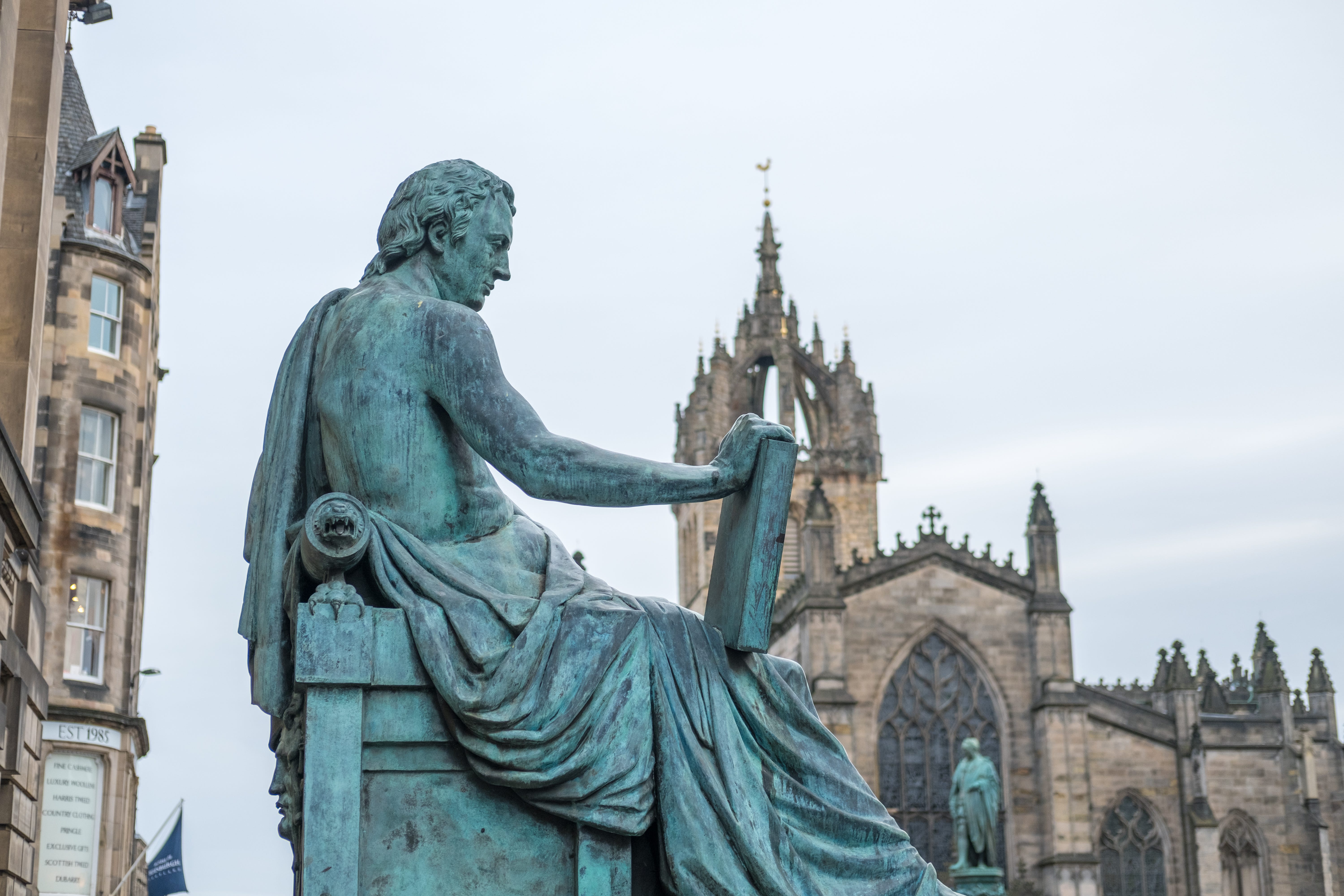
A Scottish philosopher saw this three centuries ago, and no one has undone what he saw.
David Hume noticed that you cannot derive ought from is. No accumulation of factual description, however vast, however precise, however rigorously gathered, produces a normative conclusion. The facts do not tell you what to do with the facts. The data does not tell you what the data means. Between every description and every prescription, there is a gap — and the gap is permanent.
This is sometimes called Hume’s Guillotine. The blade falls between what is the case and what ought to be done about it. And it falls every time. Without exception. For everyone.
The implications are severe. Every act of journalism — every selection of which story to cover, which source to quote, which angle to pursue, which context to include, which headline to write — is an act of normative commitment. It comes from somewhere. It comes from the person making the choice. And that somewhere is never nowhere.
The journalist who decides that the shooting of Alex Pretti is the lead story is making a normative commitment. The journalist who decides that “both sides” of the Minneapolis occupation deserve equal weight is making a normative commitment. The editor who pulls a deportation segment is making a normative commitment. The executive who installs Free Press contributors at a legacy network is making a normative commitment. None of these decisions are contained in the facts. All of them come from human beings who stand somewhere and believe something and choose accordingly.
Hume’s blade does not merely cut. It reveals. It shows us that every claim to pure objectivity is concealing the normative commitment that produced it. The claim to stand nowhere is the hiding of where you actually stand.
But here is what the nihilists — and the regime — get wrong about Hume, and it matters that they get it wrong, because the error is the trapdoor through which democracy falls.
The guillotine cuts both ways.
If you cannot derive ought from is, then you cannot eliminate ought with is either. The normative domain is not a defect in human reasoning. It is irreducible. It cannot be computed away. It cannot be optimized out of existence. It cannot be dissolved by the claim that the data speaks for itself, because the data never speaks for itself. Someone is always choosing what the data means. And that choice — that irreducible, uncrossable, permanent normative commitment — is not a failure of objectivity. It is the condition of being a finite, conscious being in a universe that can only be known from the inside.
Hume did not destroy the foundation. He showed us where the foundation actually is: not above us, in a view from nowhere, but beneath us, in the irreducible moral commitments that every embedded being carries. The commitments cannot be escaped. They can only be hidden or named. And hidden commitments are not neutral. They are unaccountable.
⁂
Return to Weiss. Apply the blade.
Every editorial decision she makes at CBS is an act on the far side of Hume’s guillotine — an ought that cannot be extracted from any is. The decision to hire Ferguson is not a fact about journalism. It is a choice about what voices matter. The decision to platform Mark Hyman alongside RFK Jr.’s agenda is not a correction toward balance. It is a commitment to treating medical disinformation as a legitimate perspective. The decision to frame an occupation and an occupied citizenry as two equivalent sides in a dispute is not objectivity. It is a moral choice that shields the occupation from moral judgment.
She has commitments. She is funded by Marc Andreessen, David Sacks, Bobby Kotick. Her publication was acquired for $150 million by interests aligned with the regime. Her contributors populate the networks her funders built. These are facts. The commitments they represent are visible to anyone willing to see them.
And she will not name them. That is the function of the view from nowhere — not to eliminate commitments but to render them invisible. The commitments operate. Contributors are hired. Segments are killed. The newsroom is told it’s toast. But the hand that moves is hidden behind the claim of independence. And a hidden hand cannot be held to account.
This is not a failure of journalism. This is the weaponization of an epistemological fiction. The view from nowhere is the instrument. The product is unaccountable power.
⁂
Weiss is not unusual. She is exemplary. She is doing explicitly what the institutions of American public life have done implicitly for decades, and the fiction has been failing for as long as it has been practiced.
The journalist who presents a documented execution and the administration’s denial as two equivalent perspectives — view from nowhere. The economist who claims the data determines the policy, as though someone did not choose what to measure and what to optimize — view from nowhere. The tech executive who says the algorithm decides what you see, as though someone did not design the algorithm and choose its objective function — view from nowhere. The rationalist who says sufficiently rigorous analysis produces the right answer, as though “right” were not already a normative commitment smuggled into the methodology — view from nowhere.
In every case, the same structure: a human being with commitments, concealing those commitments behind a methodology that claims to have transcended them. In every case, Hume’s guillotine falls and the concealment is exposed: someone chose. Someone stood somewhere. Someone’s ought shaped the is that was presented as neutral.
I wrote in Crisis No. 2 about the ideology of exit — the network state vision of escaping democratic accountability by purchasing sovereignty elsewhere. The view from nowhere is exit by another name. Not exit from geography. Exit from answerability. If I stand nowhere, you cannot ask me why I stand there. If my commitments are invisible, you cannot hold me to them. If my choices present themselves as corrections rather than choices, they cannot be questioned as choices.
The sovereign individual escapes accountability through capital. The neutral observer escapes accountability through epistemology. Both arrive at the same destination: power that answers to no one. Both deny the condition of being embedded, bounded, answerable to others. Both are fictions maintained for the benefit of those who wield them.
⁂
I must name the trapdoor, because the argument I am making has a well-known failure mode, and if I do not close it, the essay collapses into the very thing it opposes.
If there is no view from nowhere — if every perspective is embedded and bounded and shaped by commitments — then the nihilist draws the easy conclusion: all perspectives are equal. Truth is power in a better costume. We are left with nothing but competing narratives, and whoever controls the narrative controls reality.
This is where most postmodern thought stopped. This is the trapdoor. And the regime walks through it every day.
The architecture of unreality I described in Crisis No. 6 runs on this operating system. The goal is not to convince anyone of a particular lie. The goal is to destroy the concept of shared truth. To make all claims equivalent. To reduce the journalist documenting an execution and the spokesman calling it self-defense to two competing stories — and who is to say which one is real?
The view from nowhere and the nihilist arrive at the same destination by opposite routes. One says: I can see everything from above. The other says: no one can see anything at all. Both negate the actual seeing that actual people do from actual places. Both erase the witness. One does it by claiming to replace all perspectives with a superior one. The other does it by claiming that no perspective has any claim on truth. The occupied city disappears either way. The dead nurse disappears either way. The ballots loaded onto trucks disappear either way.
If I cannot close this trapdoor, then dismantling the view from nowhere is a gift to the regime. They want you to believe that all perspectives are equally valid — because in that world, the most powerful perspective wins. Not by being right. By being loud.
⁂
The way through is not above. It is not below. It is where you are standing.
You are a contingent being. You were born in a particular place. You were shaped by particular inheritances. You were formed by encounters you did not choose and could not have predicted — a father’s record collection, a voice reaching across a gap, a winter in Minneapolis that clarified everything. None of this was necessary. None of it was guaranteed by a view from above. All of it was real.
The contingency does not diminish the truth of the formation. It is the condition under which formation happens at all.
From where you stand, you can see. Not everything. But something. Something real. Something no one else can see from exactly where you are. Your perspective is partial and it is genuine. It is bounded and it is irreplaceable. The universe, as I argued in Crisis No. 11, can only know itself through finite, embedded beings standing in particular places at particular times. Your seeing is how reality holds its own memory from your position. Remove your perspective and there is a gap in the universe’s knowledge of itself that nothing else can fill.
The view from nowhere would replace your seeing with no one’s seeing. Nihilism would replace it with the assertion that seeing itself is impossible. Both are wrong. Both erase the witness. And both serve power, because a people who cannot see — who have been told their seeing is either inferior to the expert’s view or meaningless in a world without truth — are a people who cannot govern themselves.
The honest position — the only epistemically honest position available to beings on this side of Hume’s guillotine — is this: I see from here. This is what I see. I name my commitments. I show my position. And I submit my seeing to the discipline of others who see from where they stand.
That discipline is the key. The honest observer does not claim that her partiality makes her infallible. She claims that her partiality, honestly named, openly submitted to correction by other partial observers, produces something that the view from nowhere never has and never could: knowledge that is genuinely accountable. Knowledge whose commitments are visible and therefore questionable. Knowledge that can be corrected because it has admitted, from the start, that it stands somewhere — and standing somewhere means you might be wrong about what you see.
This is not relativism. In relativism, all perspectives are equal and none can be corrected. In democratic epistemology, all perspectives are partial and all can be corrected — through the disciplined coordination of honest observers who have named where they stand. The coordination is what produces knowledge. Not the transcendence of perspective. The multiplication of perspectives, honestly held, rigorously compared, mutually correcting.
That is the center. Not the midpoint between positions — the coward’s center, the both-sides center, the center that Weiss claims to occupy from nowhere. The real center. The one you find only by standing somewhere, naming it, and discovering through encounter with others that reality has a structure that constrains what can honestly be said about it from any position. The structure is not imposed from above. It emerges from below — from the coordination of embedded, committed, partial, honest witnesses who refuse to pretend they stand nowhere.
This is not a theory I am proposing. This is a description of what has already been happening — in Minneapolis, in the courtrooms, in the streets.
⁂
The witnesses in Minneapolis did not claim the view from nowhere.
They stood in subzero temperatures on specific streets and saw what they saw. They had commitments — to their neighbors, to their city, to the principle that federal agents should not kill citizens in the street. They did not pretend otherwise. Their partiality was visible. Their position was named. And their testimony holds — not because they were objective, but because they were honest about the place from which they saw.
The judges who ruled against the administration did not claim the view from nowhere. They applied law from within a tradition, named their reasoning, showed their work. When Judge Schiltz — a Scalia clerk, a Bush appointee — refused to authorize Don Lemon’s arrest, he did not claim to stand above politics. He stood within a constitutional tradition, applied its principles, and reached a conclusion. His commitments were visible. His reasoning was examinable. His judgment could be appealed, reviewed, corrected. That is honest epistemology. That is the alternative to the view from nowhere.
The grand jurors who refused to indict Democratic lawmakers attended to specific evidence and reached a specific conclusion from where they sat. Ordinary citizens. Embedded. Partial. Committed to the principle that evidence, not political pressure, should determine indictment. Their position was known. Their judgment was accountable. It held.
Each of these — the witnesses, the judges, the grand jurors — did what Weiss will not do. They named where they stood. They showed the commitments that shaped their seeing. They submitted their conclusions to scrutiny. And the knowledge they produced is trustworthy precisely because it does not pretend to come from nowhere. It comes from somewhere. The somewhere is visible. And visible commitments can be examined, questioned, and corrected in ways that invisible commitments cannot.
That is the difference between honest journalism and what Weiss is building at CBS. Not the difference between bias and objectivity. The difference between named commitment and hidden commitment. Between a perspective that submits itself to accountability and a perspective that hides behind the fiction that it has no perspective at all.
⁂
I began these pamphlets with Thomas Paine. Let me return to him, because he understood what Weiss does not.
Paine did not claim the view from nowhere. He did not present Common Sense as a neutral analysis of the colonial situation. He said: I am a corset-maker. I came to America two years ago. I have no credentials, no title, no authority beyond the ability to see what is in front of me and say it plainly. This is what I see. Judge it on its merits.
He named his position. He named his commitments — to liberty, to self-governance, to the principle that no man is born with a saddle on his back. He did not hide these commitments behind a pose of independence. He declared them. And then he made his case, openly, from where he stood, and submitted it to the judgment of the people whose lives depended on seeing clearly.
That is what moral seriousness looks like in public discourse. Not the pretense of standing nowhere. The courage to stand somewhere, to say where, and to let the seeing cost you what it costs.
Paine lost everything for his commitments. He died in poverty, abandoned by many of the people whose revolution he had helped to win. He was honest about where he stood, and the honesty was not rewarded. But the pamphlets survived. The seeing survived. The republic that his seeing helped to build survived — for two hundred and fifty years, kept alive not by people who claimed the view from nowhere but by citizens who stood somewhere and said what they saw.
We are those citizens now. The view from nowhere is empty. It has always been empty. No one was ever standing there. The question was only ever whether we would be honest about the ground beneath our feet — about the commitments that shape our seeing, about the positions from which we look out at a world that can only be known from the inside.
The regime wants us to believe that if no one can stand nowhere, then no one can stand at all. That is the lie. We stand. We see. We name where we are and what we see. We submit our seeing to each other, and in the coordination of our honest, partial, committed perspectives, we produce the only knowledge a self-governing people can trust: knowledge that is answerable. Knowledge that shows its work. Knowledge that has never pretended to come from nowhere, because it comes from us.
The view from nowhere is the last refuge of unaccountable power. It is the epistemological costume worn by those who wish to make choices without answering for them, to wield influence without naming its source, to shape reality while claiming only to reflect it.
We see through it now. Hume’s guillotine has cut the costume away. What stands behind it is not objectivity. It is a woman with $150 million from friends of the regime, making editorial choices that serve their interests, while claiming she is merely widening the aperture.
The aperture was never narrow. The light was never insufficient. The problem was never that CBS journalists saw too little.
The problem is that they saw too much. And the view from nowhere is how you make them stop.
⁂
These are the times that try men’s souls.
The summer soldier will claim the view from nowhere — will stand apart, above the fray, commenting on all sides with exquisite balance while citizens are killed and ballots are seized and witnesses are arrested.
But those who stand somewhere — who name their commitments, who show where they see from, who submit their partial and honest witness to the discipline of other witnesses — they are building the only epistemology that can sustain a republic.
Not objectivity. Honesty. Not the view from nowhere. The view from here, named and accountable and open to correction.
A republic, if you can see it clearly.
Let us see.
Go Deeper into the Circus
The Crisis, No. 12

I loved George Carlin growing up. I discovered him in my father’s vinyl album collection. It was his fourth stand-up album, Class Clown. Track one, “Seven Words You Can Never Say on Television.” It is a monologue I must have listened to dozens of times as a child. With my friends. It was very naughty and inappropriate for children.
Perfect, Mike. A viewpoint is a single view from a single point. The proposition that “the more viewpoints considered, the more accurate and complete is the picture of the thing viewed” (something Bari Weiss might say) requires honest or accurate observers who describe what they actually see. This is the task of describing and understanding reality, the work of journalism, science, and epistemology. Those who do not honestly or accurately observe and report what they see, but who describe what they wish or hope to see or what they wish or hope others to see, are influencers, pundits, polemicists, and propagandists. There is ample room and need for both types of observations or normative commitments - one that seeks to accurately describe reality, one that seeks to alter it or the perception thereof.
But knowing which is which is knowing the difference between what is true or real and what is spin or illusion. Weiss either doesn’t know the difference or she thinks the rest of us won’t notice her quiet (though not invisible) substitution of preferred opinions over inconvenient truths…
Top notch.