


In an interview with Chris Williamson on Modern Wisdom, published as a clip on January 3, 2025, Konstantin Kisin said that Trump “must not fail,” because if he did, “that in many ways was the last chance that the West had of turning things around.” The co-host of TRIGGERnometry was discussing the possibility that failure would strengthen people arguing for alternatives to democracy, and elsewhere in the conversation he qualified his optimism: a beneficial Trump presidency was an opportunity, not a guarantee.
I think we should preserve that qualification, because it will help us make that judgment available for examination on its actual terms as we proceed.
Kisin had made the success of a particular politician bear the weight of a civilization’s chance at renewal. Whatever reservations accompanied the assignment, I would like to know what understanding of that civilization made Donald Trump a plausible recipient.
In a different interview, Kisin had identified the central idea of the West as “the sanctity of the individual.” By then, Trump’s request that Georgia’s secretary of state “find 11,780 votes” had long been in the public record. I do not see how the individual’s political standing survives a president’s demand that an election produce the number he needs to reverse his defeat.
People consider Kisin a serious commentator on politics and culture. I am prepared to take the claim seriously enough to ask what, precisely, he was saving.
In their vision of lost Western greatness, the buildings are beautiful, the women are agreeable, and the social order has somehow recovered its cultural and political confidence. Nothing against beautiful buildings, but what troubles me is how easily human beings in this picture become furnishings.
A woman may choose a traditional marriage, and I have no interest in rescuing her from a life she wants. But when her freedom to choose differently becomes a symptom of civilizational decline, the subject has changed. Someone is asking to restore an entitlement to her compliance.
I understand the appeal of imagining that history once arranged everything properly. It relieves the admirer of having to distinguish what was beautiful from what was unjust, or to ask whether the people living beneath the beautiful roof had any say in their lives. An inheritance becomes considerably easier to defend once the heirs have been reduced to the people who owned the house.
⁂
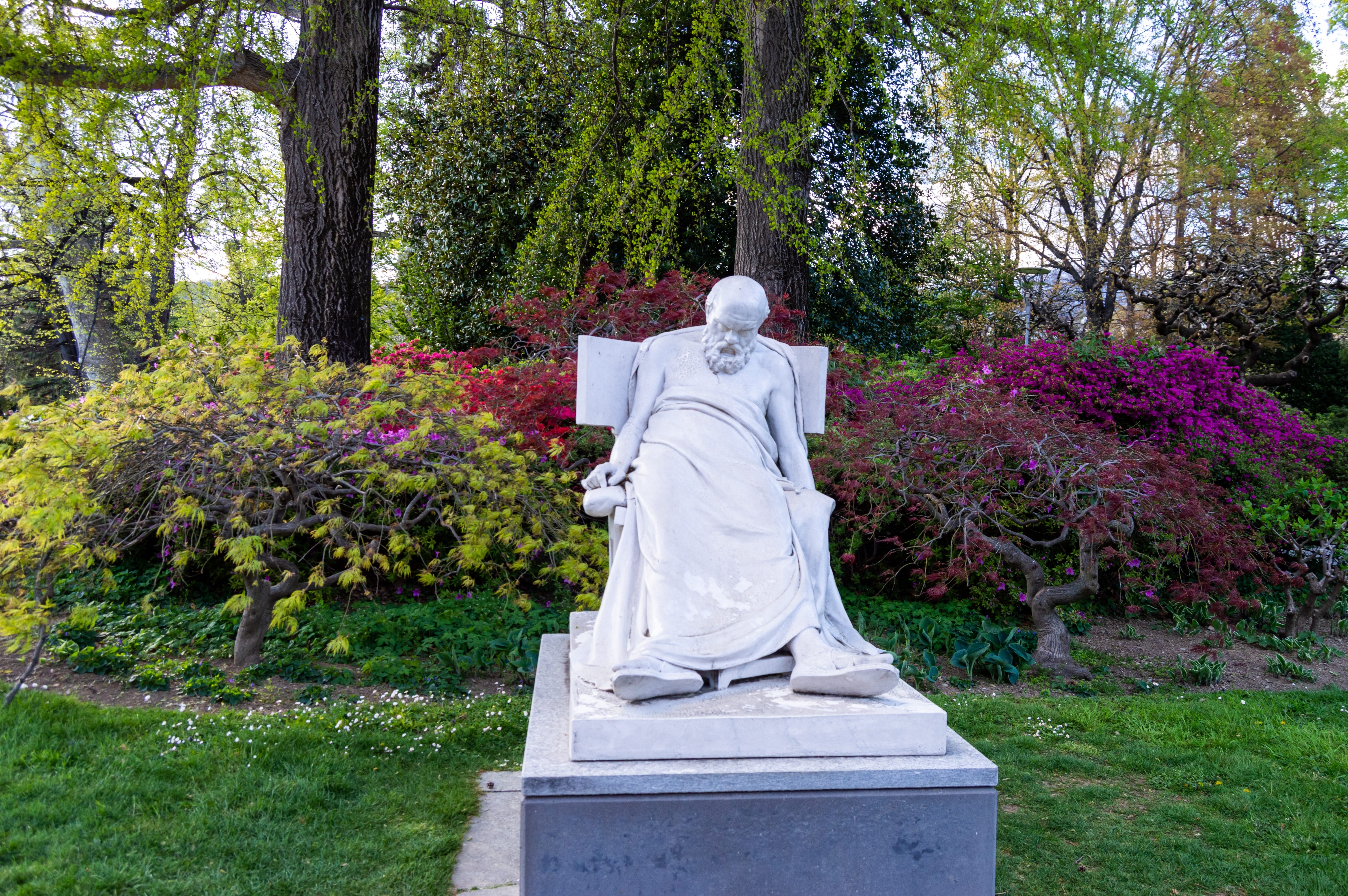
One of the accounts through which we inherit Athens ends with the city putting Socrates to death. In Plato’s Phaedo, his friends remain with him as he drinks the poison and waits for it to work. Whatever historical questions surround the dialogue’s literary construction, this is the scene the tradition has handed down: a man whose thinking outlives the judgment that condemned him.
Plato’s Apology gives us an earlier refusal: imagining an acquittal conditional on abandoning philosophy, Socrates tells the Athenians that he would continue his inquiries. In the same passage he asks why a citizen of so distinguished a city should care so much about money and reputation, and so little about wisdom and truth. The city’s greatness supplies a reason to question its priorities, rather than an instruction to stop asking.
It would be a somewhat inflationary reading of the historical record to place Socrates in the category of a contemporary liberal. But what I take from Socrates’ encounter with the hemlock is the possibility that a civilization’s judgment can be wrong about the person it has the power to silence. We inherit an obligation to examine the judgment, even when the people delivering it have excellent credentials and an impressive city behind them.
Then there is the other condemned man so frequently placed at the center of this inheritance. In John’s account, Pilate hands Jesus over for crucifixion. Mark records Jesus describing rulers who lord it over others and instructing his followers that greatness among them must take the form of service.

The Reformation makes the difficulty impossible to keep at a safe distance. German peasants drew on Luther’s language of Christian freedom and the authority of scripture in advancing their demands, only for Luther to support their violent suppression. His 1525 tract against the rebels appeared while that suppression was already underway, giving religious support to the response of the landlords rather than initiating it.
Here the emancipator and the defender of domination can be the same person. A principle that loosens one authority’s grip may threaten another authority the reformer would prefer to preserve. I find that more instructive than a procession of flawless heroes. It requires us to follow the argument beyond the point where its author becomes uncomfortable.
The resulting political settlement following the Glorious Revolution limited royal power while excluding Catholics from the throne. Across the Atlantic, the American Declaration made legitimate government depend on the consent of the governed, while slavery continued in the republic that followed. These contradictions belong in the account of the inheritance, because an honest defense of the principles requires us to notice where their supposed custodians stopped applying them.
France’s 1789 Declaration of the Rights of Man and of the Citizen declared people free and equal in rights and made public officials answerable to society. Across the Atlantic, the Haitian Revolution brought the struggle against enslavement into the revolutionary age on the initiative of the enslaved. I cannot see why a history organized around emancipation should treat those people as peripheral to the meaning of the principles being announced in Europe.
If a declaration calls its rights universal, someone outside the circle of its beneficiaries is entitled to ask what the word means. The person asking has not damaged the principle by refusing its restricted application. They have identified a debt the people celebrating it would prefer not to pay.
I am not saying that we should go about replacing a reactionary fable with a progressive one in which every rupture was liberation and every liberated person became just. The history gives us revolutionary exclusions and the restoration of slavery, alongside the declarations of freedom. A movement can overthrow a master and preserve the expectation that somebody must occupy his place.
Emancipation ought to remain a standard by which we judge a movement.
⁂
In 1963, Martin Luther King Jr. wrote from a Birmingham jail in response to clergymen criticizing the campaign. His Letter from Birmingham Jail appealed to Augustine and Aquinas while distinguishing laws that upheld human personality from laws that degraded it. The religious inheritance supplied an argument against the authority being exercised over him.
King also identified a concrete political defect: a law imposed on people who had been denied an effective part in making it could not acquire justice simply by being enacted. An official’s compliance with a procedure was insufficient when the people being governed had been excluded from its creation.
That is the part of the inheritance I intend to defend. It obliges those who exercise power to account for themselves to the people living under it, and it permits those people to bring the institution’s own promises against its conduct.
The reactionary error is to identify the inheritance with the people who happened to possess authority at some favored moment. Once you do that, later demands for inclusion can only look like damage. The woman who wants an independent life becomes a threat to the family, and the citizen who demands an account from a powerful man becomes a threat to the order he represents.
A Western civilization worth defending, in my estimation, is one where someone it excluded can understand its promises better than the people anointed to explain them. I see a civic republican hope in Jefferson’s insistence that an insufficiently informed public should be educated rather than deprived of its power.
⁂
I lack patience with liberals and leftists who hear “defending Western civilization,” turn their noses up, and immediately surrender the phrase to the people who would restore its hierarchies. If you are defending equal citizenship against inherited rank, or the right to challenge a government without becoming its enemy, there is no reason to behave as though you have wandered outside the Western tradition.
You do not magically transform into a nationalist or a cultural chauvinist by recognizing an inheritance, and you do not become a jingoist by defending its achievements.
If your response is that this excludes Eastern civilizations or Indigenous peoples, explain where the exclusion occurs. Defending an emancipatory tradition does not entail claiming that no other tradition has contributed to human freedom. Nor does recognizing the wrongs committed in the name of the West require us to abandon the principles by which we judge those wrongs. Universal dignity would be a peculiar commitment if we could defend it only after refusing to acknowledge every particular history through which people learned to articulate it.
The left-wing habit I find loathsome is the substitution of suspicion about a vocabulary for judgment about what someone is actually saying. It can make a person so anxious to avoid the appearance of exclusion that they abandon a common inheritance to the people determined to make it exclusionary. The reactionary then gets to pose as its sole defender while the people defending its most demanding commitments explain why they would prefer not to use the name.
I intend to go on arguing with that habit rather than politely accommodating it. Anyone who wants to call my position chauvinist can identify the person whose dignity I have excluded, or the abuse I have excused because of who committed it. Discomfort with the word “Western” will not do the work of either argument.
⁂
Leaving the meaning of freedom to wealthy opponents of democracy is an especially poor way to defend it. In his 2009 essay The Education of a Libertarian, Peter Thiel wrote: “I no longer believe that freedom and democracy are compatible.” He identified the growth of welfare beneficiaries and the extension of the franchise to women as developments that had made capitalist democracy, in his account, an oxymoron.
I would like the people who find this persuasive to explain what happens when the governed disagree with the governor. They may make poor choices, and they may reject a policy I think wise. But if their participation becomes intolerable whenever it produces an unwelcome outcome, what remains of their freedom depends on the continuing generosity of someone who can overrule them.
This is the old problem of freedom from arbitrary power, which cannot be answered merely by promising that the person in charge will use his discretion well. A considerate master still retains a power the person beneath him has no secure means to resist.
Being a rich motherfucker does not resolve that problem or make you the civilization. You can argue for your proposals and submit your conduct to the same scrutiny as anyone else. I see no reason wealth should purchase a different relationship to the people affected by its owner’s decisions.
This returns us to Kisin’s civilizational wager on Trump. The serious question is what a successful presidency would have to preserve, even when preservation obstructs the president’s wishes. A leader who gets his way is not necessarily restoring the freedom of the people he governs.
Suppose a president delivers a policy you wanted while undermining your ability to oppose the next one. You have received a favorable decision at the expense of your standing to contest an unfavorable decision later. I would not call that a secure inheritance, however satisfying the first announcement felt.
⁂
Nor will I pretend that history guarantees we will win this argument. The people who want domination may prevail, and the people who understand the danger may fail to organize against it. Emancipation describes work we can choose to do; it does not supply a timetable under which reality owes us a victory.
What I want from the recognition is an obligation to act. Where there is evidence of crimes, I want independent investigation and prosecution when the evidence warrants it, with guilt established through due process. Where people have defended cruelty without committing a prosecutable offense, I want public judgment and a refusal to restore their reputations merely because they have become embarrassed by their associations. Which, I think, makes me a fair bit more reasonable than my political enemies.
Those are different forms of accountability, and I mean to keep them different. A prosecutor must prove an offense under law, rather than punish a person’s place in a political story. The rest of us remain free to decide that a person who defended abuse should no longer be trusted with influence, even when no criminal charge can properly be brought.
None of this authorizes immunity for my side or the persecution of ordinary voters. People who wield power must answer for how they use it, and those who lend that power respectability should face an honest account of what they defended. My anger does not entitle me to fabricate evidence, any more than their importance entitles them to suppress it.
The French declaration that made public officials accountable also presumed the accused innocent until judged guilty. I want both commitments kept when a powerful man finally faces a court. His rights must remain intact, and his power must cease to function as an additional defense.
There is room in this inheritance for beautiful buildings. I would like the courthouse to be beautiful, and I would like the people inside it to be able to reach a verdict without considering whether the defendant knows the president. Without that freedom, the quality of the stone is a poor consolation.
The men who imagine they own Western civilization should be made to understand what I mean to preserve. If the evidence warrants their prosecution, they will be entitled to counsel and a fair hearing, and the case against them will have to survive examination. They will not be entitled to make the question disappear.
If you’re on the left and feel gross about hoisting the flag and being proud of our great history of overcoming injustice, then you’re not welcome at the celebrations when we overcome this challenge, as far as I’m concerned.
Go Deeper into the Circus
The Broken Windows of the Lost Libertarian Utopia

You can spend your whole life lecturing people about incentives and still need someone to explain why a man might cheat if it pays. Donald Trump’s teleprompter operator was betting on what Donald Trump would say.
No, We Cannot Agree to Disagree

I do not want to lower the temperature. I think the people responsible ought to feel increasing public pressure until they stop hurting people and answer for what they have done.