


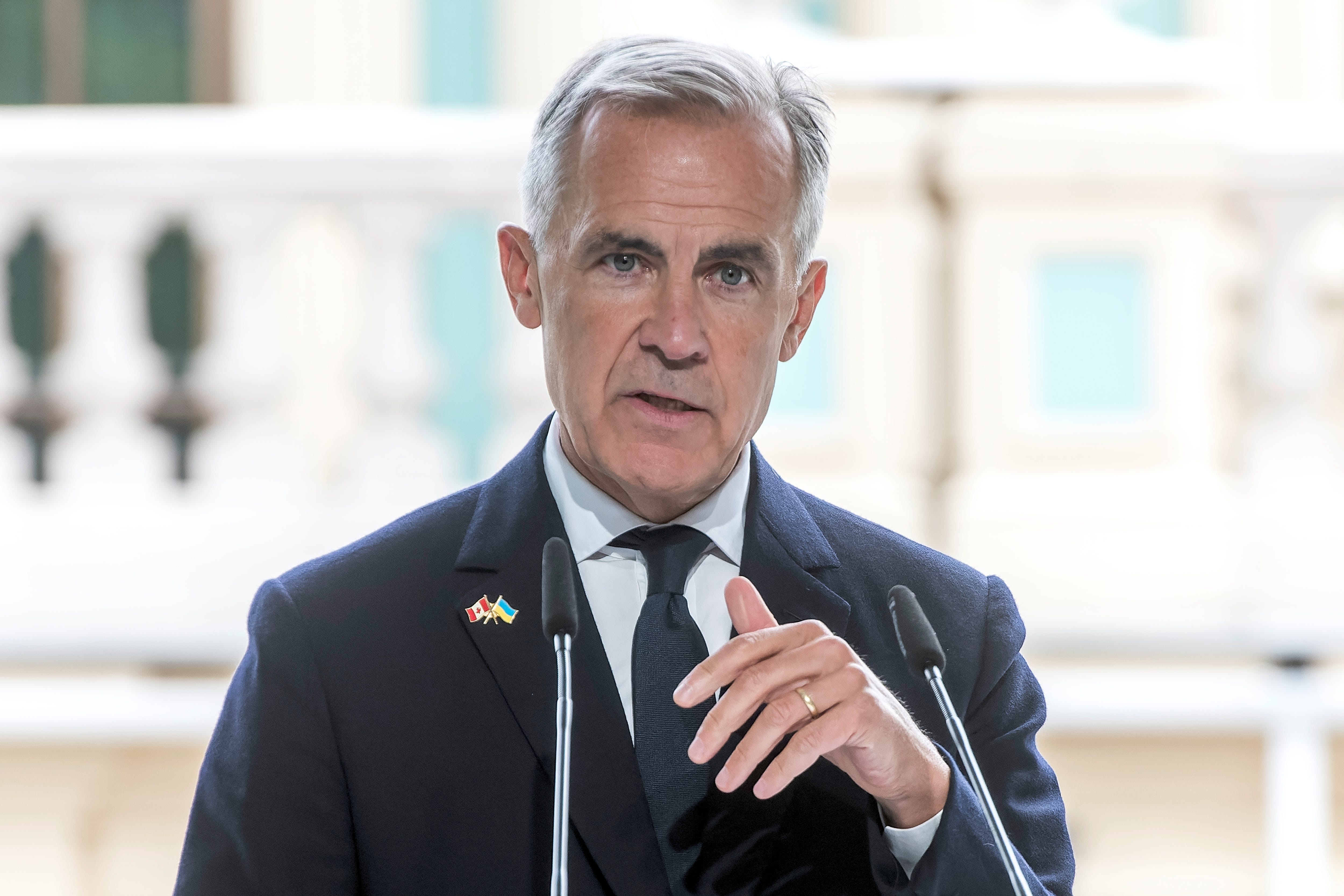
Mark Carney gave a perfectly good speech. He also gave a historically significant one. His address to the European Parliament opened with Goethe’s oak behind the barbed wire of Buchenwald, grounding the obligations of the present in a history his audience had every reason to understand. I liked that part the most. History gives people perspective and purpose, some sense of what they have inherited and what they might be responsible for losing. As a performance, I would give it a solid B+. We are not in Obama territory here, or even Jon Ossoff. Its significance lies in a Canadian prime minister asking Europe to help build the means of defending their sovereignty against coercion, rather than organizing their future around the hope that the coercion will stop (official transcript). That should be an ordinary exercise of democratic leadership. That it felt historically consequential tells us how much ground democratic leadership has surrendered.
⁂
The embarrassment for Europe is that Carney was addressing leaders whose own history supplied the warning. He could stand in Strasbourg and invoke Buchenwald because Europeans have spent generations explaining what it means to the rest of us. What should trouble them is how readily that historical understanding can coexist with a politics of waiting to see whether the next concession will satisfy the man making the threats. There are legitimate disputes to be had about the costs of resistance, the timing, the arrangements required to make it effective. But leaders are supposed to resolve those questions and persuade their publics to act. At some point, the people applauding a speech about defending democratic civilization have to accept that they are the people being asked to defend it.
What makes this especially awkward is that Carney is a centrist central banker. He is precisely the sort of person you would expect to be working out tariff exemptions while assuring everyone that the relationship remains fundamentally sound. His example makes it harder for other centrists to present accommodation as the only responsible course. The people forever urging us to focus on “kitchen table issues” ought to explain how a family is supposed to achieve economic security when its livelihood can be held hostage to another government’s demands. Carney takes that problem seriously enough to propose the shared industrial capacity, energy infrastructure, and financial arrangements that would make coercion harder. I would like his fellow centrists to explain why this should require an unusual degree of courage.
Mark Rutte is the anti-Carney. The NATO secretary general emerged from the Greenland crisis with his appetite for lavishing praise on Trump apparently undiminished. By July, he was declaring that “we should praise Donald Trump for the fact that NATO is so much stronger,” a performance that would have fit comfortably into one of Trump’s cabinet meetings. I understand the defense of this approach: keeping the United States inside the alliance may require managing the president’s vanity. But if that management requires the alliance’s secretary general to publicly celebrate a man who has threatened a member’s territory, we should at least be honest about the cost. What assurance is the threatened country supposed to take from that performance? How many times can an institution praise the source of its insecurity before its members begin to doubt what, exactly, it exists to protect?
⁂
Obviously, as an American, I owe our allies an apology for how we have failed you. But it might be useful for you to punch us in the nose a few times. I mean that in the diplomatic and economic sense: refuse the demand, make other arrangements, let Washington discover that threatening a friend can cost it something it wanted to keep. You have citizens to protect and futures to secure. You cannot make those responsibilities contingent on Americans eventually sorting ourselves out. And those of us trying to do that work here would benefit from a world that stopped rewarding our government’s worst behavior with another concession. Please do what Carney is proposing. Give us a reason to understand that your friendship involves obligations on our part, and that you have choices when we refuse to honor them.
Americans should think carefully about what happens when those choices become permanent. A government that finds another supplier, builds a different payment system, or signs a defense agreement with someone else has made an investment in needing us less. A future president will have to contend with those arrangements even if they arrive offering an apology and a promise that America is back. Why should anyone dismantle a protection they have just paid to build? Our allies would be entitled to ask how long the promise lasts, and what happens at the next election. That is the damage I fear we are doing to American leadership. We may eventually elect people worthy of trust and discover that other countries have learned to conduct their affairs without having to extend so much of it to us.
Anyways, those are just some of the thoughts I have.

Go Deeper into the Circus
The Tech Right Is Over

In April, Peter Thiel moved his family to Buenos Aires. He bought a twelve-million-dollar mansion behind wrought-iron gates and held closed-door meetings with Javier Milei and his presidential advisers. Milei’s government proposed a legislative package whose investment provisions offered foreign companies minimal taxes and thirty-year guarantees against…
The Pageant and the Program

The week after the 2024 election, I was stopped at a light in Beverly Hills. A large pickup rolled up in the lane next to me, Trump flags draped over most of its surface area, a half-dozen young men riding in the bed, and a guy hanging out of the passenger-side window making the motion for me to roll down mine. He wanted to know if I had voted for Trump…
The level of multi-generational destruction wrought by the kakistocracy our country chose is unlikely to be repaired before the climate disaster ends us. My children aren't having children and the Christo-fascists with their 13 children pods are going to have an exciting time eating each other.