


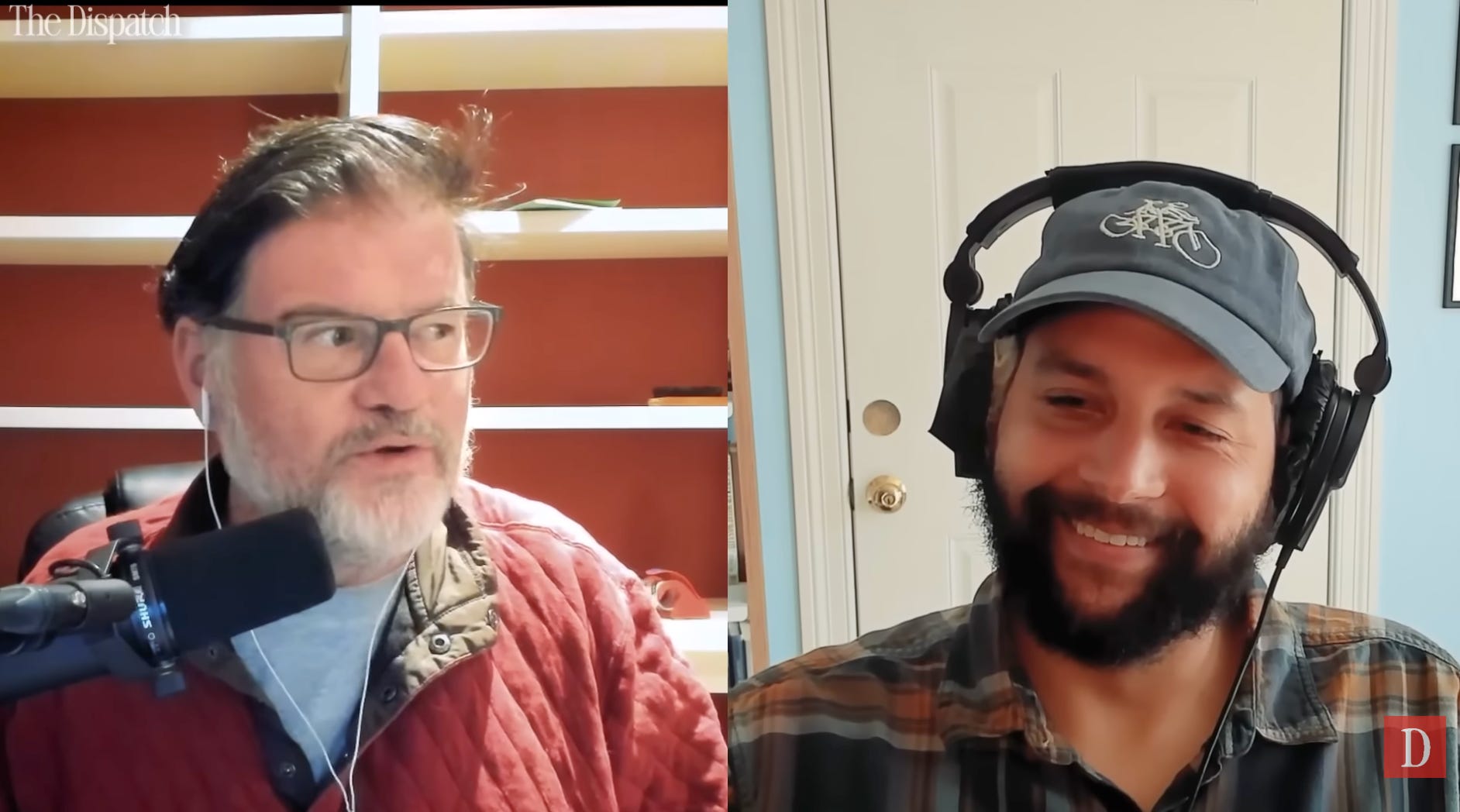
I have just spent ninety minutes listening to Jonah Goldberg and Tyler Austin Harper talk on Goldberg’s Remnant podcast, and the conversation deserves a serious response, because both of them are operating in territory I share more than I diverge from, and the divergence is interesting enough to be worth slowing down on.
Here is something worth naming at the outset. I am politically aligned with Harper more than with Goldberg. I am committed to supporting the Democrats for the foreseeable future, given the stakes to the republic, and on most policy questions Harper and I would land in the same neighborhood. And yet across this particular ninety minutes I found myself nodding furiously at Goldberg’s interventions, and especially at his critiques of Harper’s Marxism. I recognized those critiques as proper recitations of the best arguments of the liberal tradition, the tradition I am committed to, and Goldberg was making them with more precision than Harper was answering them. The distinction between political alignment and intellectual alignment is real, and the conversation produced a clean instance of the gap. I want to take it seriously because it points at something I have been working out across these pages for some time.
Goldberg is a real intellectual historian of the conservative tradition. Harper is a real left-of-center thinker who has the rare virtue of being able to articulate his own framework precisely enough that disagreement with it is possible. They had a generative conversation about Hassan Piker, the uses of Marxism, name-checking, human nature, the appeal of the Butlerian Jihad, evolution, taboos, the failures of centrism, and the question of what limits a polity should set on itself. They reached, several times, conclusions I happen to share. They reached them through methods that are more philosophically mixed than either man’s stated framework would suggest, and the mixture is itself the diagnostic.
I have written about the underlying philosophical landscape at length in The Two Materialisms: Why I’m a Liberal, where I argued that contemporary American politics has been caught between two materialist frames — the Marxist one that treats the means of production as foundational, and the neoliberal one that treats the market as foundational — both of which mistake the economic layer for the metaphysical layer and miss what classical liberalism actually was for. The positive case for liberalism, which I argued in Liberalism Is Not Oligarchy, runs through Madison and FDR and the actual American practice rather than through any of the formalisms — Kantian, Lockean, Rawlsian — that the academic tradition has tried to substitute for the practice itself. Both of these earlier essays sit underneath what I want to say about the Goldberg-Harper conversation, because the conversation is an instance of the larger argument working itself out in real time.
⁂
The most important moment in the conversation, and the one I want to slow down on, is Goldberg’s challenge to Harper about why he calls himself a Marxist at all.
Harper had just done something philosophically careful. He distinguished revolutionary or orthodox Marxism, which he explicitly rejects, from Marxist methodology, which he claims as a productive analytical lens. He said I am a Marxist in a kind of methodological sense. He uses the materialist analytical apparatus while suspending the materialist metaphysical commitment. The grade-inflation example he offered is exactly the kind of work the apparatus enables — a sharp diagnosis of a specific cultural phenomenon traced through the actual material incentives shaping it, without requiring the reader to commit to the proposition that matter is the foundational substance of reality.
Goldberg, characteristically generous, conceded that the analysis was useful. Then he asked the right question. Why signal to people your connectivity to a mode of analysis that really doesn’t depend on Marx? It’s more of a signaling thing to talk about it in a Marxian context. He suggested, gently, that Harper’s choice to wear the Marxist label might be partly aesthetic, partly tribal, and that the costume was importing baggage the analytical work did not require.
Harper’s response was the moment where the conversation produced its sharpest diagnostic. He said: I don’t actually disagree with that. And then he proceeded to defend the label anyway, on grounds that were essentially identitarian — it was a flag he occasionally hung, a marker of his intellectual community, a way of acknowledging that the analytical tradition he was drawing on had a name and that the name was Marx.
Goldberg was right. The concession was more telling than Harper realized. If the label is doing identitarian work rather than philosophical work, then the question of what label to wear is a question about something other than philosophy. And once you have suspended the metaphysical commitments and reduced Marxism to analytical apparatus that I find useful, the case for continuing to wear the label becomes harder to make on its own terms. The analytical apparatus is portable. It does not require the costume. The costume imports associations — historical materialism, dialectical reasoning about class, the prediction of capitalist crisis, the privileging of revolutionary praxis — that the suspended metaphysics has already disclaimed. Wearing the costume after disclaiming the metaphysics is wearing what Goldberg correctly identified as a tribal marker. The marker has costs. The costs are that the marker tells the audience the wearer is committed to something the wearer has just said he is not committed to.
Here is where I think the more honest description, and the one I would offer Harper if he were sitting across from me, is this. He is not a Marxist. He is a liberal who has accepted Marxist cognitive technology into the corpus of the liberal project he is committed to participating in. The cognitive technology is real and useful. The corpus that has accepted it is liberalism. The label that fits the actual position is liberal who finds Marxist analytical tools useful for specific diagnostic purposes. The label that Harper wears is Marxist, and the wearing is in tension with what he has just said his actual position is.
This is not a high-stakes definitional argument. It is a low-stakes definitional argument. Harper is not a revolutionary. He is registered Democratic. He describes himself elsewhere in the conversation as a bland Bernie-rat. The substance of his political commitments is social-democratic-liberal in the wide American sense. The substance of his intellectual commitments is, as he says himself, methodological. The label is not doing work that the substance does not already do without it. Wearing it imports baggage. Removing it would clarify rather than diminish his actual position.
What sharpens this further, and what I want to name explicitly because the mirror is striking, is that across the conversation Harper does almost exactly the philosophical and political work I was calling left-of-center thinkers to do in The Wish That Distorts, an essay I published earlier this year diagnosing the campist tendency in contemporary leftism through Beatrice Webb’s 1932 diary line about the Soviet experiment — a wish which tends to distort one’s judgment.
That essay argued that figures like Hassan Piker and Grace Blakeley are operating on a wish that distorts their judgment about the People’s Republic of China, that the wish makes them apologize for or minimize a regime that has crushed exactly the workers and democratic institutions socialism was historically supposed to liberate, and that the correct response from the careful left is to name the distortion and continue past it. The closing line was the wish distorts. Name it. Continue past it.
Harper, on the Remnant, does this. He distances himself from defending China explicitly. He says Piker’s flirty embrace of authoritarian states overseas like China I find baffling. Like I am not a pro-China leftist. I think that’s bananas. He names the camps. He names the lockup of religious minorities. He refuses the campist framing while continuing to take seriously the broader political-emergency frame that drives some leftists toward campism in the first place. He distances himself from revolutionary Marxism — I don’t militate in favor of the dictatorship of the proletariat the withering away of the state and the installation of a communist utopia of milk and honey — and locates himself inside the reformable American social-democratic tradition that the essay was defending against the campist alternative.
This is the position I was arguing for. Harper is occupying it. And he is occupying it while wearing a Marxist label that has historically been associated with the very campist figures the essay was calling out. The mirror clarifies the costume diagnosis. Harper is not just a liberal wearing a Marxist label in the abstract. He is doing the specific work the corpus has been calling for on the specific question the corpus has been engaging, while wearing a label whose historical valence is at odds with the work he is actually doing. This is what makes Goldberg’s gentle pressure on the label question land with extra force. The label is not just costume in the generic sense. It is costume that imports specific historical associations Harper himself has spent the conversation distancing himself from.
If Harper let himself name the move he is making — the same move I named in The Wish That Distorts, the move from inside the broad social-democratic-liberal tradition that refuses the campist temptation — he would find that the philosophical company he is keeping is the company of Orwell, Camus, Michnik, Havel, Kolakowski. The democratic-socialist tradition that paid in blood to understand these questions. The tradition that defended the workers when the regimes that called themselves workers’ states were crushing them. The tradition that distinguished the reformable from the unreformable not as a matter of pragmatic compromise but as a matter of categorical political philosophy. That tradition is the tradition Harper is operating inside. The tradition the Marxist label points at is, in its actual historical form, the tradition that produced the figures Harper has spent the conversation distancing himself from.
And to be clear, this is a debate over what to call things, not what to do. Harper and I would vote for the same candidates in most elections. We share most policy commitments. The disagreement is over how he describes the philosophical apparatus that grounds his commitments, not over the commitments themselves. The argument is genuinely low-stakes in the political register. It is more interesting in the philosophical register because it tells us something about what the liberal tradition is and what it can absorb without losing itself.
⁂
What it can absorb is a great deal. This is what I think both Harper and Goldberg miss in different directions, and what gives the actual liberal tradition its generative depth.
The liberal tradition is catholic enough to absorb analytical tools developed inside non-liberal frameworks without committing to the metaphysical claims those frameworks were built on. It can take Marx’s diagnostic apparatus about ideology and class without committing to historical materialism. It can take Hume’s epistemology without committing to skeptical paralysis. It can take pragmatism’s cash-value test without committing to relativism. It can take Burke’s anti-revolutionary disposition without committing to traditionalism. The tradition is the synthesizing apparatus that absorbs what works and metabolizes it into the ongoing practice of liberal self-government. This is what the tradition is for.
Harper’s methodological hedge is exactly the move the liberal tradition makes when it encounters useful analytical tools developed inside non-liberal frameworks. He has, without quite realizing it, made the canonical liberal move. The mistake is in attributing the move to the framework whose tools he is borrowing rather than to the tradition that authorized the borrowing. The borrowing is what the tradition does. Naming it a Marxist hedge gives the costume credit it does not deserve. The liberal tradition got there first and authorized the move, and Harper is operating inside the tradition while wearing the wrong jersey.
Goldberg’s challenge on the label question is itself a Burkean-prudential point about tribal signaling, and the Burkean-prudential disposition is, again, inside the liberal tradition. Goldberg is asking why import baggage the actual work does not require, when the importing has costs the wearer may not be reckoning with. This is the kind of question the liberal tradition asks itself when it is doing its work well. It is the kind of question Madison and Hamilton asked each other in the Federalist Papers, the kind of question Lincoln asked himself about the Whig tradition he was inheriting, the kind of question FDR asked about the progressive tradition he was extending. The tradition is in part the practice of asking these questions and revising the labels and commitments in light of the answers.
Harper conceded the question. He just did not let the concession do the work it deserved.
⁂
There is a separate place where the conversation produces a philosophical surprise that I want to credit, because it is where Goldberg’s actual disposition becomes clearest.
When the discussion turned to Hassan Piker and the broader question of what political-violence rhetoric is acceptable in mainstream discourse, Harper, with growing frustration, demanded consistent rules. I just want to know what the rules are. I want to feel like those rules are consistently applied. He was responding to what he saw as the selective application of standards across the political spectrum, and the asymmetry he was naming was real.
But what he reached for as the remedy was Kantian universalizability. The rules should be consistent across cases. The standards should apply evenly regardless of whose ox is being gored. The discourse fails because it does not produce the universalizable principle and apply it without favor.
Goldberg, who I had been prepared to read as the more Kantian of the two, turned out on this specific question to be doing something closer to the older tradition. He conceded Harper’s frustration. He shared the hatred of the hypocrisy-policing cycle. But when Harper reached for the consistent-rules-demand, Goldberg gently complicated it. I just do wonder sometimes whether or not the problem is trying to come up with that in politics where you’re just always in an era of nut-picking. He proposed instead that the better way might be to have politicians have an expectation that politicians can defend whatever rule they’re following.
This is the Humean-pragmatist concession. The rule is no longer derivable from reason alone. The rule is whatever the politician can defend in a register that other thoughtful people in the deliberative tradition will recognize as legitimate. Goldberg invokes Hitchens, McCain, Sasse, Daniel Patrick Moynihan as figures who had a well-thought-through way of thinking about these things. What he is naming, without naming it, is that these figures had developed phronesis — practical wisdom in the Aristotelian-Humean sense, the disposition acquired through long participation in the deliberative life of a polity. The development was not the result of consulting a rulebook. The development was the result of living politically across decades inside a tradition that produced the dispositions the figures eventually demonstrated.
Goldberg, on this question, was the Humean. Harper, on this question, was the disappointed Kantian. The assignments were not the ones I would have predicted from their stated frameworks. They were the ones the actual conversation produced.
What makes this even more interesting is that Goldberg, only minutes later, dismissed pragmatism by name. I think had a lot to do with American pragmatism which I think was not a great philosophical school. He said it as throat-clearing, in passing, without pausing. The dismissal is doing serious philosophical work that he does not seem aware of, because he has just made a recognizably pragmatist move on the rules question. The pragmatist tradition — James, Dewey, Rorty, the lineage that runs through American political philosophy from the late nineteenth century forward — is the tradition that authorized the kind of move Goldberg made. It is also the tradition Goldberg has just rejected by name while practicing it in form.
What makes the rejection more striking is that in his closing remarks Goldberg explicitly affirmed Richard Rorty as a great American. Rorty is the late-twentieth-century pragmatist who carried the Dewey-James lineage into explicitly political philosophy, who argued that liberal democracy did not need foundationalist metaphysics to ground itself. Goldberg likes Rorty. Goldberg dismisses the school Rorty belongs to. The school he is dismissing is not the school he thinks he is dismissing. He is rejecting a caricature — pragmatism as relativism, pragmatism as anti-foundationalism in the bad sense — when the actual tradition is the philosophical articulation of the disposition Goldberg admires when he points at Hitchens and McCain and Moynihan as exemplars, and the tradition that authorized the move he made when he gently corrected Harper’s Kantian rules-demand.
This is the romantic liberal Enlightenment core that propelled the American experiment into existence. The Federalist Papers are not Kantian. Madison is not Kantian. Jefferson is not Kantian. The Constitution is not the application of categorical imperatives to a blank slate. The American founding was, in significant part, a pragmatist experiment before pragmatism had been named — an experiment in the construction of a polity whose foundational commitments were held provisionally, tested in practice, revised through deliberation, and grounded in claims about what humans are like and what their flourishing requires. James and Dewey gave the experiment its philosophical apparatus a century after the fact, but they were naming what the founders had already been doing. The lineage is continuous. Goldberg is operating inside it whether he names it or not.
⁂
The deepest moment in the conversation is the human-nature exchange.
Goldberg says he is utterly confused about what the left thinks about human nature. He notices that the same intellectuals who pride themselves on their commitment to evolution become evasive or hostile when asked about the structure of the human creature that evolution produced. He notices that human-nature talk has been functionally taboo in some quarters of the left for decades. He notices that this is incoherent on its own terms.
Harper concedes the point and offers a partial answer. He says he is a human-nature leftist. He says there is a real and growing fight inside contemporary leftism between people who treat human nature as malleable and people who recognize that some features of human life require to be defended against the encroachments of technology and ideology. He says limits matter. He says Christopher Lasch was right that the dissolution of the concept of limit has been a disaster for liberal modernity.
This is good, and it is also short of where the conversation needed to go. Neither man has the metaphysical apparatus available to articulate what human nature actually is, in a register that grounds the political claims they are both reaching for. Goldberg knows there is a structure. Harper knows there are limits. Neither names what the structure is or where the limits come from, because both of them are operating downstream of the Cartesian wound — the modern philosophical injury that bifurcated mind and matter and made the question of human nature into a question about either rational principle or material substrate. Both leave out the foundational thing, which is that humans are conscious beings whose flourishing requires a specific kind of relation that is neither reducible to rational principle nor to material substrate.
The recovery move is the move beyond the Cartesian wound. It says that consciousness is not the master of matter and not the epiphenomenon of matter, that meaning is not derivable from matter and not independent of it, that the human creature is the kind of being for whom love is the foundational relational stance and the polity is the structure that allows love to be sustained at scale. This is a non-Cartesian frame. It is older than Descartes. It runs through Augustine and Aquinas and the Christian humanist tradition and the Cambridge Platonists and the secular extensions of that tradition through Whitman and James and Weil and the civil-rights movement at its religious depth. It is recoverable. It is what you get when you stop asking the post-Cartesian question and start asking the older question that the Cartesian framework was an attempt to replace.
Goldberg gets close to this through the conservative tradition’s commitment to limits, to inherited custom, to the tragic sensibility about human imperfection. The conservative tradition has been carrying fragments of the older framework forward across the past century. Goldberg knows the fragments. He cites them. Burke. Lasch. The figures who understood that the polity is more than a procedure and that human life is more than the assembly of preferences. What he has not done, and what would complete the work, is move from the fragments to the foundational claim about what humans are.
Harper gets close to this through the human-nature concession, the limits concession, the willingness to credit Lasch as a serious thinker rather than dismissing him as a reactionary. He is doing it carefully. What he has not done, and what would complete the work, is move from the methodological hedge to the foundational claim about what humans are for. The hedge is itself the canonical liberal move. Naming it as such would give him the resources to do the work the Marxist label is preventing him from claiming.
⁂
I want to step outside the Goldberg-Harper conversation for a moment, because the philosophical apparatus the piece has been working with — Hume’s guillotine, the is-ought distinction, the recognition that descriptive claims about how things are do not generate normative claims about how things should be — is the same apparatus that exposes what is actually wrong with the most aggressive contemporary alternative to the liberal tradition. I am thinking of Curtis Yarvin, against whom I debated last week in Las Vegas, and who managed in the course of that debate to whiff an elementary misreading of both Aristotle and Hume in a single sustained performance.
Yarvin’s signature move, across his entire body of work, is the slide from descriptive claims about how power actually operates to normative claims about how power should be organized. Sovereignty is conserved. This is descriptive, and it is sometimes interesting as far as it goes. Therefore the CEO-king is legitimate. This is normative, and it does not follow from the descriptive claim. Liberal democracies are actually run by an unelected priestly class. This is partly descriptive, partly tendentious, and worth arguing about on its own terms. Therefore the unelected priestly class should be replaced with a transparent monarch. This is normative, and again, it does not follow. The descriptive claims do not produce the normative conclusions. The slide between them is the entire rhetorical engine of Yarvin’s project, and the slide is exactly the move Hume named two hundred and fifty years ago as the move that cannot be made without supplying additional normative premises, premises Yarvin never supplies because supplying them would expose his actual values to the kind of scrutiny his project depends on avoiding.
In Vegas, the slide was visible in real time. Yarvin treated Magna Carta as if it were merely a contractual artifact, a feudal-era settlement between a king and his barons, and used the descriptive observation to dismiss the liberal-democratic tradition’s veneration of foundational documents as sentimental rather than serious. The descriptive observation is partly correct as far as it goes. Magna Carta was, in its specific 1215 form, a settlement between King John and his rebellious barons. The normative conclusion — that the liberal-democratic tradition’s veneration of it is therefore unfounded — does not follow. The veneration is not based on a misreading of what the document was in 1215. The veneration is based on what the document became across eight centuries of constitutional development, what it came to mean in the deliberative practice of multiple polities, what it now stands for in the actual living tradition that absorbed it. The descriptive history does not produce the normative dismissal. Yarvin slid across the guillotine. The audience that wanted to be slid across the guillotine slid with him. The audience that was paying attention noticed the move.
The Aristotle whiff was structurally similar. Yarvin treated the polis as if it were just a larger version of the oikos — the household — and used the supposed continuity to argue that political authority is structurally identical to household authority and that the liberal-democratic distinction between the two is artificial. This collapses the foundational distinction Aristotle himself drew. The whole opening of the Politics is the argument that the polis is categorically different from the oikos, that political life is constituted by a kind of rational deliberation among equals that is not present in the household, that the citizen is a different kind of being from the household member. Yarvin was not making a controversial reading of Aristotle. He was making a misreading of Aristotle, and using the misreading to support a normative conclusion that the actual Aristotle would have rejected. The slide from descriptive-misreading to normative-conclusion was performed in front of an audience that mostly did not have the philosophical equipment to notice. I had the equipment. I noticed.
What is interesting about Yarvin in the context of the Goldberg-Harper conversation is that he is the figure who is not inside the tradition Goldberg and Harper are stewarding. He is the figure who has actually abandoned the deliberative-liberal tradition in favor of a project that substitutes the descriptive-becomes-normative slide for actual deliberative argument. Goldberg, Harper, and I are arguing inside a tradition that includes Hume, Madison, the Federalist Papers, the entire architecture of constitutional self-government, the recognition that descriptive claims about power do not by themselves authorize normative conclusions about how power should be organized. Yarvin has rejected this entire apparatus. He has rejected it not by arguing against Hume’s guillotine — which would be a respectable philosophical move that the literature has actually engaged with seriously in the post-Humean tradition — but by simply ignoring it, performing the slide, and counting on his audience to want the conclusion enough that they will not examine the move. This is not philosophy. This is the rhetorical performance of philosophy, with the actual philosophical work outsourced to the audience’s prior commitments.
The contrast tells us something important about what tradition-internal argument actually looks like, and why Goldberg and Harper, despite their differences, are doing something Yarvin is not doing. Goldberg and Harper are arguing with each other under the implicit constraint that descriptive claims and normative claims are different kinds of claims, that moving from one to the other requires additional argument, that the deliberative practice of the polity is the form in which the additional argument gets worked out. Both men accept this constraint, even when neither of them names it explicitly. Yarvin does not accept the constraint. Yarvin has built his entire project on the systematic violation of the constraint. This is the deeper reason Goldberg’s challenge to Harper on the Marxist label is itself a tradition-internal challenge — both men are operating inside the constraint, and the disagreement is over how to apply it, not over whether to apply it. Yarvin would not have understood the challenge. Yarvin would not have offered it. Yarvin does not care about the apparatus that makes the challenge meaningful in the first place.
This is why I find it generative to listen to the Remnant, and why I do not find it generative to listen to Yarvin. The Remnant is the tradition working itself out. Yarvin is the tradition being abandoned in favor of an aesthetic performance that exploits the audience’s frustration with the tradition’s slowness without offering anything that could replace it except naked sovereignty. The slowness is not the tradition’s defect. The slowness is the tradition’s actual function. The deliberative practice of working out what we value, in conditions of irreducible disagreement, across generations, with the analytical apparatus to distinguish descriptive from normative claims and the practical wisdom to do the work without skipping the steps — this is what the tradition is. Goldberg and Harper are doing the work. Yarvin is performing a sophisticated-looking alternative to doing the work, and the performance is what his audience pays for.
I wrote about the debate at length in The Bell. The closing line of that piece was the man holding the bell could not read it. The rest of us can. The man holding the bell, in that piece, was Yarvin. The bell was Magna Carta. The not-reading was the slide across Hume’s guillotine. The rest of us, who can read it, are the people inside the tradition that Goldberg and Harper are arguing inside, the tradition I am inside, the tradition the Federalist Papers established and James and Dewey and Rorty articulated philosophically and the actual living polity of the United States has been working out across two and a half centuries of deliberative practice. Yarvin can be ignored. He has, as Goldberg might say, given us enough rope. The slide is there for anyone who knows what to look for. The slide is what I look for. The slide is what the corpus is, in part, for.
⁂
Here is the larger shape of the diagnosis I am making.
Both men are stewards of the same broad tradition. The actual division between them is much smaller than their tribal locations suggest. Harper is a liberal who has absorbed Marxist analytical tools while remaining liberal at the foundation. Goldberg is a liberal-conservative whose Burkean-prudential dispositions place him inside the same broad tradition Harper occupies, with stylistic emphases drawn from a different intellectual community. They argued for ninety minutes. They agreed on Burke. They agreed on Lasch. They agreed that the centrist establishment has lost the capacity to articulate substantive policy commitments. They agreed on the importance of phronesis, even if they reached for it through different vocabularies. They agreed that the contemporary moment is not as unprecedented as the discourse has been treating it.
The conversation was the tradition working itself out in the deliberative register that is the tradition’s actual life. This is what liberal democracy looks like when its better practitioners are doing their work. It is not a contest between rival traditions. It is two stewards of the same tradition arguing about emphasis, vocabulary, and tribal location, while sharing the substantive commitments that make them both members of the tradition in the first place.
This is also why I felt intellectually closer to Goldberg in the conversation despite being politically closer to Harper. Goldberg was making the proper recitations. He was asking the questions the tradition asks itself when it is doing its work. He was challenging Harper to clean up the philosophical apparatus, to name what is doing the work and what is decoration, to be more careful about what the labels he wears are committing him to. These are tradition-internal challenges. They are the kind of pressure the tradition needs to sustain itself. Harper was operating inside the tradition without quite letting himself acknowledge it, and Goldberg was, gently and generously, pointing that out.
I think Goldberg is right. I think Harper, on reflection, would find that the description liberal who finds Marxist analytical tools useful for diagnostic purposes fits his actual commitments better than Marxist in a methodological sense. The label change would not require him to give up any of the work he is doing. It would clarify what he is doing and where the work belongs in the larger architecture of contemporary American political thought. It would also, incidentally, place him in the company of most of the careful left-of-center thinkers of the last hundred years, who have been doing exactly this kind of absorption while remaining liberal at the foundation.
But this is, again, a debate over labels and emphases. The substance is shared. The political stakes are low. The intellectual stakes are about clarity rather than commitment. Both men are doing the work the tradition needs done, and the conversation between them was an instance of the work being done in real time.
⁂
What completes the picture, and what neither man got to in the run time of the conversation, is the foundational question of what humans are. The Cartesian wound is the wound. The Humean recovery is the recovery. The pragmatist tradition is the American expression of the recovery. The love-grounded liberalism is the foundation that grounds the rest of it.
Goldberg should make the move because the conservative tradition he is steward of has been preserving fragments of the older framework for two hundred years, and because the American conservative tradition specifically is downstream of the same pragmatist disposition that produced the experiment the tradition is conserving. The disposition Goldberg himself was practicing when he gently complicated Harper’s rules-demand is the pragmatist disposition. The school he dismissed is the school that named what he was doing.
Harper should make the move because the methodological commitments he holds are themselves already pragmatist commitments, the absorption he is performing is the canonical liberal absorption, and naming the absorption correctly would clarify rather than diminish his actual position. The Marxist costume has done its work. The work it has done is to import analytical tools the liberal tradition can now metabolize. The costume can come off. The tools can stay.
Both men are closer to the recovery than they yet realize. The conversation between them was already most of the work. What remains is naming it.
⁂
I enjoyed this conversation more than I have enjoyed almost any podcast exchange I have heard in the last year. Both men are serious. Both men are generous. Both men are doing public-square philosophy in the register the moment requires, which is the register where intellectuals disagree productively in front of an audience that is invited to think along with them. This is what the Remnant is for. This is part of why Goldberg has built the audience he has built. This is part of why Harper, despite my disagreement with the label he wears, is one of the more interesting figures in the contemporary commentariat.
I am politically with Harper. I am intellectually with Goldberg in this exchange. The distinction is real and worth holding on to. It tells us something about the difference between policy commitments and philosophical apparatus. It tells us something about how the liberal tradition actually works — through internal argument among its stewards rather than through external defense against rival traditions. It tells us that the actual division in American political life is not between left-liberal Marxists and right-liberal Burkeans. The division is between everyone who is operating inside the liberal tradition, in whatever stylistic register, and the materialists of left and right who have abandoned the tradition for either the means of production or the market as the foundational layer of reality.
Goldberg and Harper are both inside the tradition. The tradition is in good hands when it has stewards like them.
I am rooting for both of them. I am also, I should add, rooting for them to have this conversation again. The next iteration could go further. I think it will.
Go Deeper into the Circus
The First Domino

Spirit Airlines ceased operations last night. The final scheduled flight landed. Thirty years of business is over. Some thousands of employees lost their jobs. Some larger number of customers, holding tickets for flights that will not now happen, woke up this morning trying to figure out how to get home.
No, Government Should Not Be Pro-Business

It is entirely inappropriate for a government to be pro-business. The entire notion of a pro-business government is corrupt in the first instance. Business is a thing that happens inside government. It is the thing made possible by the laws and norms a government establishes. The purpose of a government in a republic is …
Sometimes the label is the message.
Identifying as Marxist or Socialist is in the US, important because every thing you say after that redefines what that identification means. And in the US the popular definition is the product of a century of propaganda designed to distort what those words mean.
I would not have thought it was possible to write a long form piece about Jonah Goldberg without mentioning "Liberal Fascism", but you managed to do it. And for listening to the podcast, your stomach is made of stronger stuff than mine.