


I argued against monarchy in Las Vegas on Tuesday. I debated Curtis Yarvin at a Bitcoin conference, on a stage, in front of an audience that had paid to attend, on the resolution that liberal democracy is an obsolete operating system that should be replaced by a sovereign corporation. Yarvin took the affirmative. I took the negative.
I made the case for Aristotle’s politeia, the mixed-constitutional form the founders built the American republic on. I corrected Yarvin on Aristotle, who identified six forms of government, not three — monarchy and tyranny, aristocracy and oligarchy, politeia and democracy in his technical sense — and pointed out that the form Yarvin was advocating, on his own description of it, was the form Aristotle named tyranny. I made the positive case for monarchy as the British constitutional tradition has actually practiced it, with parliamentary supremacy and the Westminster checks dating back to Magna Carta and the Glorious Revolution, in order to point out that even the strongest available case for monarchy was a case Yarvin himself was not making. I closed on the politeia, on the more perfect union of the constitutional preamble, on the idea that humans can take responsibility for themselves and build institutions to deliberate together.
Yarvin closed by attacking Magna Carta. He called it a 17th-century Puritan invention, a piece of windy beautiful abstraction concealing the ice cold political realities his project promised to address. The audience clapped. I shook his hand. I walked out into the Las Vegas evening, met some old friends, played some blackjack, ate some Chinese food.
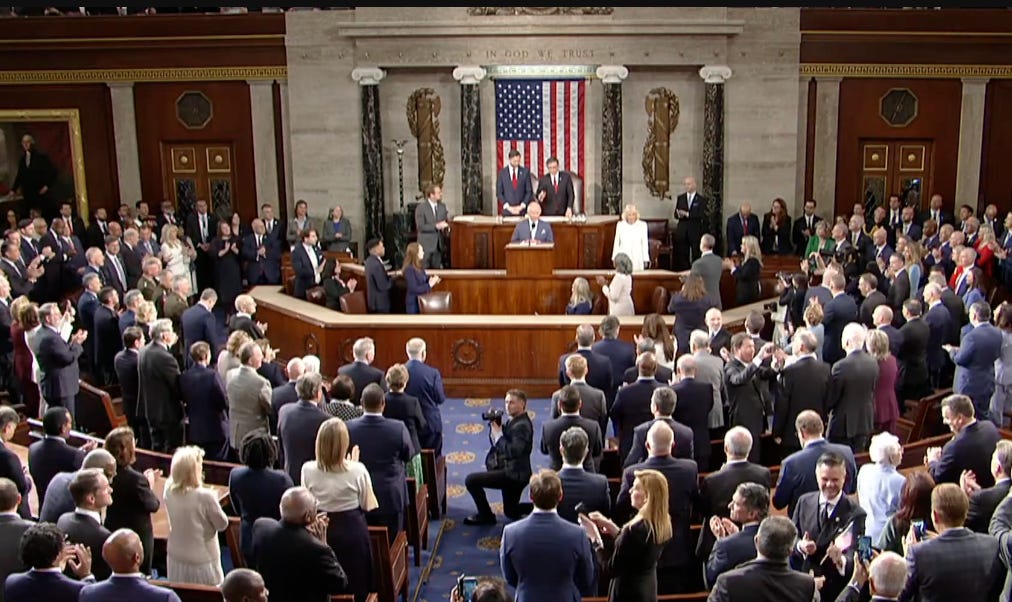
The next morning, the King of the United Kingdom landed in Washington, addressed Congress, and invoked Magna Carta.
⁂
The irony is not lost on me. I am writing a Crisis Dispatch praising a hereditary monarch the day after I argued against the philosophical framework that would put one in the Oval Office. I wonder if the irony is lost on Yarvin. The actual king of the actual monarchy Yarvin invokes when he wants the prestige of the tradition arrived at the citadel of liberal democracy and defended liberal democracy against the regime currently dismantling it from within.
He invoked Magna Carta. He invoked the 1689 Declaration of Rights. He named the founders as bold and imaginative rebels with a cause. He located the American founding inside the longer constitutional tradition, not as a rejection of his ancestors but as the continuation of what his ancestors had been forced, painfully, across centuries, to learn.
The day before he gave that speech, on a stage in Las Vegas, the man I was debating told an audience that everything Charles was about to say was propaganda. The constitutional abstractions were concealments of oligarchic interest. The tradition was a verbal fog over the reality of elite rule. Charles invoked the abstractions anyway. He invoked them in the chamber where the regime he was implicitly addressing has been operating on Yarvin’s premises.
He honored the republic, in the older difficult sense of holding it to the standard it set for itself. The man across the chamber from him did not.
Charles acknowledged the assassination attempt at the White House Correspondents’ Dinner without weaponizing it. He defended NATO and Ukraine in the chamber where the regime has been telling its own coalition that NATO is a racket and Ukraine is a graft scheme. He named climate change in the chamber where the regime has been dismantling the institutional capacity to track it. He did all of this in a courtly register that no protest could form against, because the speech was, on its face, an act of friendship.
It was also a measurement. The achievement was making the two indistinguishable.
He did the work the American president cannot do. He did it as a constitutional monarch, in front of an elected legislature, on behalf of a foreign government with every economic and strategic reason to flatter the man in the Oval Office. He chose this instead.
And before leaving, he gave Donald Trump a small bell.
⁂
A bell. A ceremonial object small enough to fit in a hand. Nothing about it hostile. Nothing about it legible as commentary in the register Trump uses to read political objects. The kind of gift a king gives, and the kind of object that does not survive translation into the transactional vocabulary of the man who received it.
The bell is a mirror. The man holding it shows what he is by how he handles it — by whether he registers, even faintly, that he was being addressed in a moral vocabulary that requires a response in kind. By whether he can sense that the small object was given with the same precision as the references to Magna Carta in the speech, and that the precision was the point.
He never could. The architecture of his political project is built on the inability to receive that kind of address. The bell goes into a display case or a drawer, and the man holding it cannot perceive that he has been measured against a standard he cannot meet, by a man who took the trouble to design the measurement in a register that protects the measurement from the recipient’s confusion about what it was.
The British press will read it. The European chanceries will read it. The American foreign service will read it and say nothing, because they cannot say anything, but they will know what they witnessed. A courtly rebuke delivered in the proper register does not depend on the recipient understanding it. It depends on history understanding it.
History will.
⁂
The American constitutional system was designed to prevent the concentration of personal authority that the figure currently in the Oval Office has been steadily building. The framers rejected the specific abuses of George III’s government and built a politeia in the technical Aristotelian sense — distributed power, periodic accountability, judicial review, rule-of-law constraint on the executive. The architecture was the answer. It was supposed to prevent exactly what is happening.
The executive treats the rule of law as an inconvenience, the legislature as ornamental, the judiciary as captureable, the demos as a base to be inflamed rather than a sovereign to be served. I alone can fix it. The constitutional architecture was designed to make that sentence structurally impossible. The architecture is being dismantled in real time by the man who occupies the office the architecture was built around.
This week, the descendant of the George whose government taxed the colonies without representing them stood in the United States Capitol and reminded Congress what the founding documents say.
The unelected hereditary monarch defended the politeia in the chamber where the elected representatives of the politeia are surrendering it.
⁂
The Yarvinite reading of this moment, because I have just heard it firsthand:
Of course Charles defended the liberal-democratic order. He is the figurehead of one of its weakest expressions. His speech was the mewling of an exhausted civilization. The fact that the British monarch had to deliver a defense of NATO and Ukraine in the United States Congress proves how spent the project is. A real sovereign would have laughed at the bell, recognized the rebuke, and humiliated the man who delivered it. Charles did courtly. Trump does power. Power wins.
The reading is wrong in a specific way. It treats the formal correctness of Charles’s address as weakness because the framework Yarvin operates in cannot conceive of an authority that draws its strength from constraint. The whole project is built on the premise that authority is most pure when most unconstrained — the sovereign-as-CEO as the highest political form, the deliberative architecture of liberal democracy as a sign of senescence.
Charles is a constitutional monarch. His authority is real precisely because it is bounded. His power is symbolic precisely because the symbolism is the power. He cannot govern, but he can speak, and his speech carries weight because the institution he speaks from has survived the English Civil War and the Glorious Revolution and the loss of the American colonies and two world wars and the dissolution of empire because it learned, painfully, across centuries, that authority without constraint destroys itself.
That is the lesson Aristotle named in Politics Book III, the lesson Yarvin’s project is built on the refusal of, the lesson the American executive is now refusing to learn.
The bell is the gesture of a man whose office has survived 350 years of testing because it has learned the difference between sovereignty and ego, between dignity and humiliation, between authority and force. He gave a small ceremonial object to a man who cannot tell the difference between any of those things, and in the giving he demonstrated which of them is going to survive the decade.
⁂
In Yarvin’s closing on Tuesday, he said Magna Carta was nothing until the Puritans reinvented it as part of a campaign of lawfare against Charles I in the 17th century. The historical claim is contestable. The framing was the move. He was naming the constitutional tradition I had been defending as a propaganda apparatus.
Twenty-four hours later, Charles III stood in the United States Capitol and invoked Magna Carta as the foundation of constitutional liberty.
The hereditary monarch defended what the philosopher of monarchy attacked. The hereditary office defended the constitutional tradition the elected office is dismantling. The carrying moved between Tuesday and Wednesday, on a 24-hour cycle, from a Las Vegas debate stage to the United States Capitol, and the move is documentable.
The carriers are not a fixed population. The office that carries the tradition is not a fixed office. When the office that was supposed to do the work refuses, the work finds another office.
This week the work was done by a constitutional monarch. That does not vindicate his office over the republic’s. It vindicates the work.
⁂
The man who received the bell will be gone — by election, by term limit, by the mortality the most aggressive personalists cannot defeat — within a few years. The institution Charles represents will outlive him. The constitutional tradition Charles invoked, in the chamber where it is being battered, will outlive him too, if the people of the United States choose to defend it.
That choice is what the speech was about.
The office of the British monarch and the office of the American president have, in 2026, traded their characteristic registers. The hereditary monarch performs constitutional restraint. The elected president performs personalist sovereignty. The descendant of George III honors 1776. The current occupant of George Washington’s office actively undermines what 1776 was for.
The man who came to Washington this week, with his measured cadence and his archaic vocabulary and his small ceremonial bell, did the job. He stood where an American president was supposed to stand and said what an American president was supposed to say.
He was a king honoring a republic.
The republic’s actual head of state was somewhere else, holding a small bell, unable to tell what he had just been given.
⁂
I argued against monarchy on Tuesday. I would make every one of those arguments again tomorrow.
The lesson of this week is not that we need a king. It is that the office we already have has stopped doing what it was built to do, and the work is happening somewhere else until the office comes back to itself, or until the polity makes it.
The man holding the bell could not read it. The rest of us can.

The Ritual

A man named Cole Allen, thirty-one years old, from Torrance, California, charged a security checkpoint at the White House Correspondents’ Dinner last night with a shotgun, a handgun, and multiple knives. He had written — and his family had been alarmed enough to send the writing to the police minutes before he acted — that he intended to target Trump ad…
Trump has become so normalized with his jabbering, his irate social posts, his vindictiveness, his narcissism, that when the King stood up and spoke before Congress, when he spoke so eloquently and sincerely, so intelligently and kindly, so warm-heartedly and friendly, it took my breath away. My head was spinning and my heart was thumping.
It made me sad to realize in a truthful and realistic manner how much influence and sway and infiltration trump has over our country—-how he chips away at pure decency right before our eyes day and night, and how I thought I was removed from it all- because I have no respect for him, dislike him immensely, and typically don’t listen to him—-still…he infiltrates every cell in my body, whether it is conscious or unconscious. And he does this relentlessly and after I see these two men, what they have to offer, how they communicate, what motivates them, they could not be any different apart from day and night. As time passes and the filth of trump continues to churn and burn, I realize that the King gave me a breath of fresh air around the fetid stench of trump where he sucks out all the oxygen in the room. I continue to feel our country is victimized by trump. Even traumatized by his violence and vindictiveness. He is a man with an iron grip on this country. Yes there is resistance, but what he is doing to the spirit, to the drive, to the beauty of America is dark, deranged and immoral. He is holding Americans hostage. The King understands his danger. He was telling Americans he understands our predicament and he will always defend the values and principle of our country. He will stand up for America while our own president is tearing it down.
Nice job Mike! I think Yarvin's done too many drugs -- or something. He is completely and utterly out of touch with American historical/constitutional reality. What a poseur! Theorist indeed! He's a joke.