


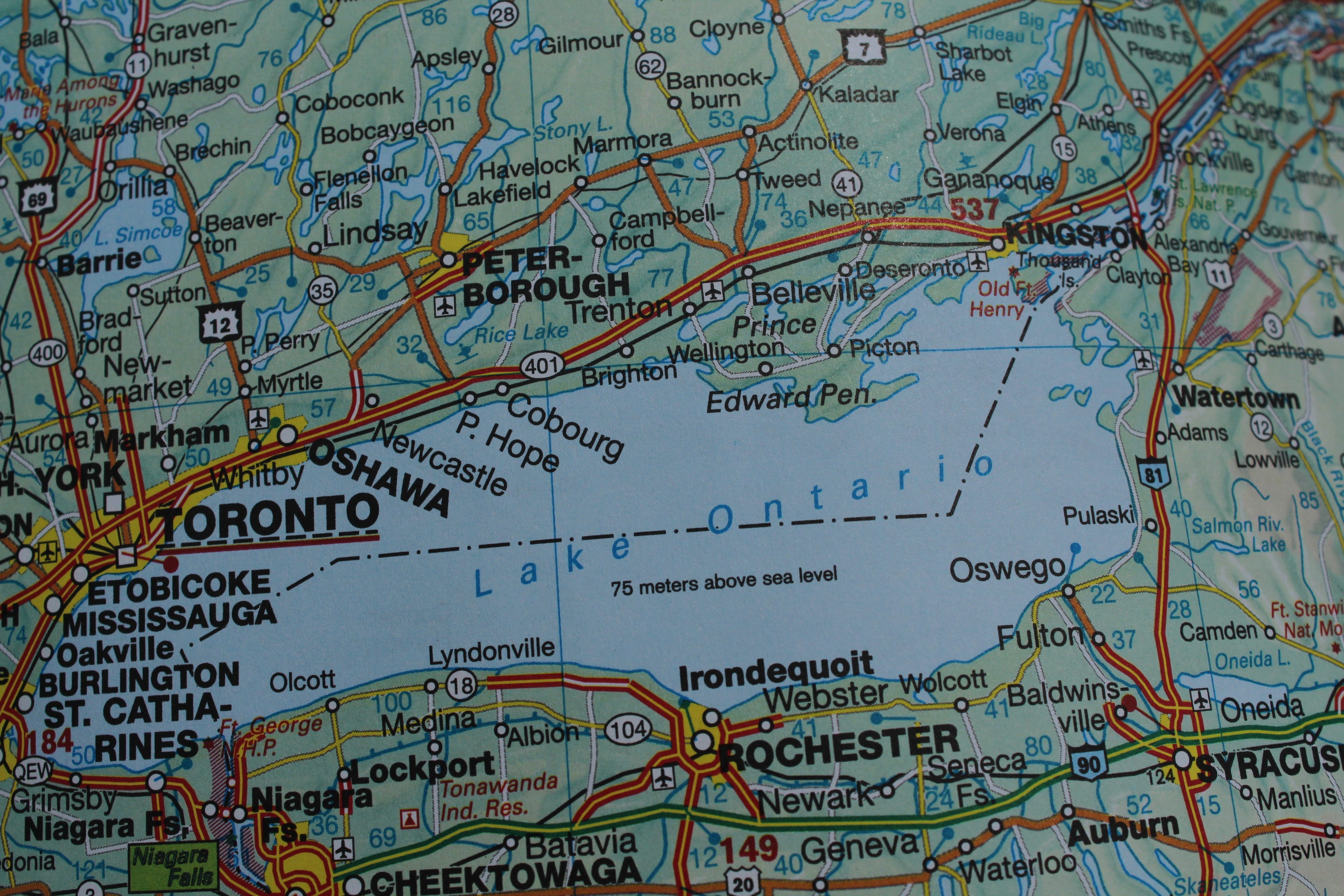
The United States Department of State apologized for deadnaming a lake this week; no one made them do it, and no one has made them stop. It happened in the universe we all live in. It is all very stupid and masks dynamics in our society that are very dangerous. Dear reader, I endeavor to explain why that is the case. The post went up on the department’s official X account, written in the borrowed courtesy of a retailer closing out a billing error, and Newsweek recorded it verbatim: “It was brought to our attention that Lake America was erroneously labeled as Lake ‘Ontario’ on our website. We have corrected this mistake and apologize for deadnaming the lake.” It ran up six figures of views.
Everyone who read it knew what it was. The post is a troll, built to be recognized as one.
The week that produced it ran four days, end to end. On Tuesday, from his own account, the president posted on Truth Social: “The United States is giving serious consideration to changing the name of Lake Ontario to Lake America in that we don’t expect to doing much business with Ontario any longer. Thank you for your attention to this matter!” On Thursday he signed the executive order, and NBC News quoted him at the signing: “This is official, effective immediately.” He had, he said, “filed all the necessary papers, documents, everything else.” From proposal to signature was two days, and from signature to apology two more. He chose the presidency’s most formal instrument of instruction and aimed it at the name of a lake. Nothing in the sequence required Canadian participation, or Canadian consent.
None of it ran on its own. Someone wrote the post. Someone senior cleared it. A web team corrected the site on instruction, and then the institutional voice of United States foreign policy published an apology to a lake. Every name in that chain had a superior, and every superior watched the post go up and let it stand. That is the complicity: a chain of custody in which every link is a person and every person chose. A troll posting from a personal account is the internet’s oldest problem. A troll posting from the State Department’s account is a decision — made once, by the person who posted it, and remade every hour the post stays up, by everyone in the chain with the custody to end it.
Hannah Arendt gave this mechanism its name: evil that needs no monster, only clerks who process the order in front of them and never ask what it does next. The lake is a small thing to test that frame on, and the frame does not need a bigger one — the worst things on record were built the same way, out of people who each did one small, defensible piece of something indefensible. Orwell knew what the name itself was worth: control the word for a thing, and the thing changes shape. A government that can rename a lake by fiat, and make its own diplomats apologize for the old name, is rehearsing a muscle it may use on something that matters more than a lake.
Permission, repeated, stops looking like permission. It reads as ordinary procedure — a website corrected, an apology posted, a tariff schedule taking effect on its effective date — and procedure has no villain, only participants. The department could pull the post at any hour and chooses otherwise. Congress could take back the powers it lent and chooses otherwise. Neither is an oversight. No one votes on the post, and no statement defends it. Interrupting would cost the interrupter, immediately and alone, so the cost goes unpaid — and the word for the stillness is cowardice. The post stays up, the tariffs stay on, and the week closes with the account in the same hands as before. Everyone with the power to alter any of it watched all of it, exactly as plainly as everyone else.
What an order renaming a lake can actually do is still an open question — and the order itself answers it.
Everyone knows the post is a troll, and everyone knows why it keeps the account: the voice on it is his. Four days earlier he used this same dry, mock-procedural register on his own account, and nobody between him and the department’s login rewrote a word of it into a different one. The tariff power is Congress’s own, and Congress voted, 213 to 211, to keep it in the president’s hands; the adults in the room watched the lake post go up from inside the building that posted it; and the people who had the power to stop all of it held still. Their still hands will not be forgotten. Call it what it is: a collective cultural pathos, and every hand in that account belongs to somebody who chose it.
⁂
The renaming order concedes its own impotence beyond federal paperwork in its operative sentence. Section 2(b) of the order gives the Secretary of the Interior thirty days, “in coordination with the Board on Geographic Names,” to “take all appropriate actions to rename as ‘Lake America’ the body of water currently named as Lake Ontario, bounded on the south and east by the State of New York, and on the north, west, and southwest by the Canadian province of Ontario.” Five bearings, and the order hands three of them to a foreign province. The instrument that renames the lake opens its own legal description of the lake by recording that most of the shoreline belongs to somebody else, and the drafters wrote that concession into the command themselves.
Every other directive in the order lands on federal property. The Secretary “shall subsequently update the Geographic Names Information System (GNIS)” and “remove all references to Lake Ontario from the GNIS,” and the Board on Geographic Names “shall provide guidance to ensure all Federal Government references... including on executive department and agency maps, contracts, and other documents and communications, shall reflect its renaming,” per the order’s text. Every object in that directive is federal property — a database the government keeps, maps it prints, contracts it signs. The order’s jurisdiction is the government’s own records, top to bottom, and within them it runs unopposed.
The order’s closing clause reads, in full: “The costs for publication of this order shall be borne by the Department of the Interior.” The boundary the order draws around itself is the one Reuters reported: it “applies to U.S. federal usage... and does not govern what Canada, international bodies or other organizations call the lake.”
Outside that boundary there is no renaming mechanism, because there is no renaming authority anywhere. “There is no single international body that determines names of international bodies of water,” the Associated Press explained. Names hold by usage, and usage is the one thing an executive order cannot instruct. “The Americans can call it whatever they want to call it,” Marc Isaacs, a Canadian maritime attorney, told NBC News. “It is Lake Ontario.” The order never reached him. Its verbs act on federal references, and where the federal references end, Lake America ends.
The agencies answered the same afternoon. Within hours of the signing, the U.S. Geological Survey had changed the name in GNIS and posted that “the base maps for GNIS are in the process of being updated,” according to the Guardian‘s live blog. USGS Director Ned Mamula announced the compliance himself, in a message the White House shared on X: “As of 4:30 pm today the U.S. Geological Survey has officially designated the former Lake Ontario to be renamed as Lake America in all official USGS electronic documents.” Printed documents would follow over several days, Newsweekreported. The order allowed thirty days; the database took hours. Mamula’s phrasing had already moved the old name into the past tense — “the former Lake Ontario” — before the first workday ended in the one jurisdiction where the order runs.
The companies answered on their own clocks; the biggest took two days to kneel. On August 29 — a day after the GNIS update, two after the order — Google announced adoption in a blog post by Claire Herrin. The Gulf of America template, set February 10, 2025, applies. Phones in Rochester now show ‘Lake America,’ phones in Toronto keep ‘Lake Ontario,’ the rest of the world gets both — description, not prediction. The order never commanded it — its verbs reach federal references, and Google is not one. Adopting was a choice, and the grammar exists to make the choice look like gravity: since “we update Google Maps to reflect name changes in official government sources,” updates “follow our long-standing policy for bodies of water with names that vary from country to country.” Nobody decides anything in those sentences. A renaming one man signed two days earlier becomes organic cross-border variance; the split shows what the grammar is for: the fake name appears where no one will punish Google, the real one where the customers who would punish it live. That is the proceduralist defense — a decision dressed as procedure, so no one has to be seen deciding — and it is cowardice.
A decade ago this industry treated which bathroom trans people use as worth economic retaliation against a state. In 2016 North Carolina passed HB 2; PayPal cancelled a four-hundred-job Charlotte operations center over a law its CEO said “perpetuates discrimination”; eighty CEOs signed a letter demanding repeal: “HB 2 is not a bill that reflects the values of our companies.” Google signed its own name — uncommanded, on stated principle. The variable is not principle but price: a state legislature could be punished for free; the White House prices retribution. Google decided to let the deadnaming stand because it fears that price — that is character. The proceduralism purchases no protection: a company that pleads the file writes the case for its own regulation, and the readers keeping books are not only in this government. Not our fight is a lie, and lies date themselves — this is a page of the company’s own history, and it will spend years trying to live it down.
This was not new behavior, and it was not only Google‘s. Google, Amazon, Meta, Microsoft, and Apple‘s Tim Cook personally each gave Trump’s 2025 inaugural fund a million dollars, and Musk, Zuckerberg, and Cook took seats at the Capitol ahead of the sitting Cabinet. That May, Sundar Pichai and Sergey Brin sat down with him at Mar-a-Lago to help settle his lawsuit over the suspended YouTube account; by September, Google had agreed to pay him $24.5 million, and steered $22 million of it straight into the trust building his White House ballroom. When the White House published that ballroom’s donor list in October, Google‘s name was on it again, beside Apple, Amazon, Meta, Microsoft, and Palantir. None of it was compelled. Every check bought protection, in installments, and Lake America is the payment coming due on the last of them.
MapQuest did not wait for official sources. “We’re not changing it,” the company posted. The longer version: “We’re not changing the name of Lake Ontario. Name it whatever you want at your leisure.” The post came with a map, and on the map, where the water’s name goes, the label read “Lake Are We Doing This Again?”
The answers the order got sort by jurisdiction. One came from inside it — an agency commanded, its director reporting compliance at 4:30. Another came from a company outside it, refusing — asking whether anyone has the energy for this. The third came from the largest mapmaker on earth — uncommanded, complying without being asked, in the grammar of no one deciding. Only the first was owed; the other two were choices — refusal was available, MapQuest took it, and Google did not. An order that runs where the government runs and stops where the government stops had, within two days, heard from everything that was ever going to answer — and the only answers it can command come from instruments it owns.
⁂
A geographic-names database is one instrument the federal government owns outright; the tariff power is Congress’s, and the president holds it on loan. “Congress holds the constitutional power over tariffs,” per the Congressional Research Service, and the president — as the Supreme Court put it in Learning Resources — “enjoys no inherent authority to impose tariffs during peacetime” and acts “only pursuant to delegated authority.” CRS’s standing report names the responsible party: “Congress is ultimately responsible for determining what tariff authorities the President should have and what limitations those authorities place on presidential discretion.” Every duty he signs is borrowed.
On July 20, 2026, President Trump signed three proclamations under Section 338 of the Tariff Act of 1930, laying an additional 50 percent duty on a scheduled list of Canadian goods — effective in thirty days, exempting energy, potash, fish, critical minerals, and anything already covered by the Section 232 metals tariffs, and applying regardless of USMCA origination, per the White House fact sheet. The record: Proclamation 11046 on alcohol (91 FR 46639, HTSUS 9903.03.12), Proclamation 11047 on dairy (91 FR 46653, HTSUS 9903.03.13), Proclamation 11048 on motor vehicles (91 FR 46663, HTSUS 9903.03.14).
What he signed was 19 U.S.C. § 1338: duties up to 50 percent ad valorem — the rate the July proclamations adopt whole — on any country he finds to be discriminating against American commerce, effective no sooner than thirty days after proclamation, extensible to third countries and escalatable past duties to outright exclusion, per White & Case and CSIS. The section demands no investigation, no notice-and-comment, no hearing, no formal findings — Morrison Foerstercatalogues the absences. The triggers are an “unreasonable charge, exaction, regulation, or limitation” and conduct that “discriminates in fact.” He defines the nouns; he makes the finding.
He reached back to 1930 because every authority enacted since came with a condition he would not meet:
Section 122 of the Trade Act of 1974 tops out at 15 percent and lapses after 150 days.
Section 301 cannot move without an investigation.
Section 232 hangs on a national-security finding.
The International Emergency Economic Powers Act, his vehicle for the earlier Canada tariffs, was a door the Supreme Court had already shut: earlier in 2026 it struck down the IEEPA tariffs as exceeding presidential authority, the Globe and Mail reported.
Section 338, per Morrison Foerster‘s comparison, asks for a unilateral presidential finding plus thirty days. It was the only door Congress had left unlocked.
The statute had waited for a hand willing to use it. In ninety-six years on the books it had been a threat and a talking point, never a tariff — White & Case records no implementing regulations, no prior presidential use, no judicial precedent — and Reuters called the July proclamations “the law’s first known usage in nearly a century.”
The people around the president said why. Peter Harrell, a former Biden White House official, told the Globe and Mail: “Trump has just been chafing at not having a more flexible tariff authority. He’s been casting about for one, and his advisers have kept coming back to this.” Canada supplied the target: “The administration has been frustrated in negotiations with Canada and they are looking for a way to increase the pressure.”
Nineteen days before the proclamations, the administration declined to renew the trade agreement Trump himself had signed. At the agreement’s scheduled July 1 joint review, U.S. Trade Representative Jamieson Greer announced: “The United States did not agree to renew the USMCA in its current form. As a result, the USMCA is not renewed... However, the Agreement remains in force pending resolution of these issues or until the Agreement’s termination.” He scheduled a third round of bilateral talks with Mexico for the week of July 20 — the week the proclamations were signed — and no equivalent Canada track. The statute predates the postwar trade system, so it contains no exception for preferential trade agreements, White & Case notes: USMCA qualification exempts nothing, and the 50 percent stacks on the duties already in place. He taxed goods under an agreement his own trade representative says remains in force.
Canada was never what the statute was built to punish. John Veroneau, a former Bush administration trade official, read the section’s paper trail: threats and discussions from the 1930s and 1940s involving France, Germany, Australia, Spain, Japan, and China, then no references to Section 338 after 1949, the Globe and Mail reports. His explanation for the silence: “The GATT eliminated the problem 338 was designed to address.” And the relationship the section had just been used against bore no resemblance to that problem: “Canada was treating the U.S. better than most of Canada’s other trading partners and the U.S. was treating Canada better than most of the U.S.’s other trading partners.”
The statute assigned one job outside the White House. Its text charges the International Trade Commission with monitoring foreign discrimination and reporting it to the president; no ITC process appears in the proclamations, and some analysts argue the section has been implicitly repealed across the decades it sat unused, CSIS notes. He skipped the one piece of machinery the statute put outside his office.
The loan is a choice Congress keeps making. Section 338 sits in the president’s hand because Congress leaves it there; what Congress wrote, Congress can repeal. Someone had already filed the repeal. On March 27, 2025, Rep. Brad Schneider of Illinois introduced H.R. 2464, the Repealing Outdated and Unilateral Tariff Authorities Act — one operative sentence repealing Section 338 of the Tariff Act of 1930. The House referred it to Ways and Means the day it was introduced and has not moved it since. The bill to kill the statute sat in committee for the sixteen months before the statute’s first use.
Two days after the proclamations, on July 22, 2026, Sen. Ron Wyden introduced the Congressional Trade Powers Reform Act, which would repeal Sections 122 and 338 and require congressional approval for tariffs under Sections 301, 201, and 232 — a bill CNBC described as facing long odds. No vote has been scheduled.
When the House has moved on the tariff power, it has moved in the other direction. On September 16, 2025, the chamber voted 213 to 211 to adopt a rule blocking members from bringing resolutions to disapprove the president’s tariff declarations — a roll call held open more than half an hour while Republican whips flipped initial holdouts, Politico reported. Only three Republicans — Kevin Kiley, Thomas Massie, and Victoria Spartz — joined the Democrats. Kiley’s objection fit in one sentence: “I think this is a misuse of what rules are for.” The block was later extended through the end of January 2026.
Speaker Mike Johnson, on deferring Congress’s tariff authority: “We’ll exercise it when appropriate.”
Nobody scoped this policy, and nobody in the majority asked anyone to. What the finding taxed is written down: three proclamations signed July 20, each carrying an annex of tariff lines, each line a product somebody chose. The lists need no decoding. They are the evidence that the scoping never happened.
Reuters listed the covered goods: “wine, cement, ice hockey gear, dairy products, swimming pools, furniture, fishing rods, seeds, clothing, wigs,” and hockey sticks. Morrison Foerster‘s reading of the annexes adds cement, furniture, fishing rods, seeds, clothing, and hockey equipment; the Globe and Mail headlined its roundup “From wine to whey to wigs.” That is the roster. Every line on it has an author. Each proclamation announces a grievance, and its annex is the grievance’s answer.
The motor-vehicle proclamation is the largest: 439 tariff subheadings covering $19.3 billion in 2024 imports, per White & Case. The grievance behind it was Canada’s United States Surtax Order (Motor Vehicles 2025), which imposes twenty-five percent on U.S.-origin vehicles only, and the harm was real as far as it went — American vehicle exports to Canada fell about 22 percent, from roughly $25.9 billion to $20.3 billion, as Morrison Foerster documents. Then CSIS read the proclamation’s own product list. The automotive schedule excludes autos and auto parts, making an exception only for motorcycles. The finding invoked Canada’s treatment of American vehicles; the annex reaches no vehicle with four wheels.
The dairy proclamation is the small one, and the weakest. White & Case counts fifty-two subheadings aimed at $97.2 million of 2024 imports — against the vehicle schedule’s $19.3 billion, about half of one percent of the combined coverage. The finding rests on Canada’s supply-management quotas, and specifically, per Morrison Foerster, on the detail that Canadian retailers can use the quota Canada granted Europe under CETA but not the one Canada granted the United States under the USMCA. The discrimination claim is weak on its face, CSIS notes: American dairy exports fall far below the quota thresholds at issue. The quota the finding complains about is one American exporters were not filling. Fifty-two tariff lines, trained on ninety-seven million dollars of trade.
Between them sits the alcohol proclamation — 63 subheadings and roughly $1 billion in 2024 imports, the same White & Case count. Here the grievance at least occurred: after Ontario’s LCBO and Quebec’s SAQ pulled American bottles from their shelves, U.S. alcohol exports to Canada fell about 81 percent, from roughly $718 million to $137 million, as Morrison Foerster records. The administration’s own trade ambassador supplied the sequence. “Canada, unlike other partners and allies, continues to retaliate against the United States for its efforts to rebalance trade and protect U.S. industry in national-security sensitive sectors,” Ambassador Greer said, per Reuters. Retaliate. The word is his.
The sequence is the legal problem. The attack runs two ways, the Globe and Mail reports: that the delegation is narrow and does not support this use, and that the statute addresses unilateral foreign action rather than retaliation-for-retaliation. The findings describe the second one — the vehicle surtax and the liquor delistings were Canadian answers to American tariffs, and the one grievance that predates the fight is the weakest of the three. The administration turned a statute written for the country that starts something against the country that answered. One trade lawyer gave Politico the phrase for the whole approach: “a cornucopia of caprice.”
Nobody costed the policy either — before the signing or after it. Reuters put the covered trade at nearly $20 billion, about 5.2 percent of the $382 billion in goods the United States imported from Canada in 2025; CSIS put it at $20.2 billion, 4.9 percent, on 2024 values; Canada’s finance department counted $27.6 billion; CBC counted $28 billion. The counts were never reconciled. Nobody in the majority asked. An eight-billion-dollar spread between the lowest number and the highest is what a government produces when it signs first and measures never. RBC Economics put the affected products at up to 0.4 percent of Canada’s GDP and jobs, per Politico.
One line in the annexes says it for all of them. In its later reporting, Reuters singled out the wooden ice hockey sticks, noting they are rarely used anymore. The flagship product of a fifty-percent tariff on an ally is equipment its own game has moved past.
On August 24 the threat widened to every car and truck Canada sends south. Patrick Anderson, chief executive of the Anderson Economic Group, drew the distinction for CNN: “Sweaters, honey and hockey sticks are not a trade war. What the president just threatened this morning is a trade war.”
⁂
Hockey sticks are not a trade war. The president started one against the second-largest trade relationship the United States has. The two countries did an estimated $872.3 billion in goods and services trade in 2025, down 4.6 percent — $42.1 billion gone before the new duties collected a dollar. Carney answered with the exposure Washington chose not to count: Canada supplies 99 percent of U.S. natural gas imports, 85 percent of electricity imports, and 60 percent of crude imports; it is the largest customer of twenty-six states; Americans sold Canadians more than $1.6 billion in goods and services a day. He was reading the meter, not pleading for mercy.
Start with the auto file, where the fight started, because the numbers indict the purpose. In the first half of 2026, CNN reported, the United States imported $24.5 billion in Canadian vehicles and parts while Canada imported $30.4 billion in American ones — a U.S. surplus of nearly a billion dollars a month in the sector the tariffs claim to protect. More than 500,000 American supplier workers feed Canadian-built cars. The people the tariff claims to defend said so on the record. Flavio Volpe, who heads Canada’s Automotive Parts Manufacturers’ Association, told Reuters that a U.S. tariff on Canadian parts “will be paid by (the) US auto assembly,” and that without those parts “auto assembly throughout the U.S. would halt.” UAW president Shawn Fain, breaking with Trump, said tariffs should rise, if anywhere, “on countries where automakers continue to offshore jobs because they can pay workers $3 an hour, force them to work in unsafe conditions, and crack down on independent unions.” That country is not Canada. Washington taxed it anyway.
A deal nearly happened anyway. On Tuesday night Trump posted that Canada and the United States, “subject to the finalization of documents, have a DEAL!” Three days of talks between Dominic LeBlanc and Jamieson Greer ended with Greer announcing no deal less than an hour before midnight Friday; the 50 percent duties took effect just after midnight Saturday, August 22, and no further talks were scheduled. He announced a victory and let it die at midnight.
What broke it depends on who is talking. Canada said the last-minute asks touched “the French language,” “our culture,” and Canada’s ability to enter third-party trade deals; asked whether he could accept them, Carney answered, “’No,’ is the short answer.” At the podium he said “these issues were never on the table, even though the United States tried until the very last minute,” and he later specified the asks concerned Quebec’s French-content streaming rules and bilingual labelling under Bill 96, which the U.S. National Trade Estimate report lists, per ABC News. Trump, quoted at length by the same outlet: “I have never even thought of doing such a stupid thing. This lie was made up by a weak and ineffective Prime Minister in an attempt to gain political support, which he has totally lost, from the people of Quebec. I love French Canadians!” Greer called it a “funny fake story.” Whatever was asked was asked in the final hours of a private negotiation; the accusation and the denial are equally beyond checking.
The Monday after the collapse, the larger threat got its date: 50 percent on all Canadian cars and trucks, effective January 1, 2027. Auto executives noted, anonymously, that January 2027 falls after the midterms, so the threat may be aimed at restarting talks — the people with the most to lose would not attach their names to the warning.
The majority’s answer to $42.1 billion in damage arrived from one senator. Susan Collins of Maine, a Republican, said: “Imposing new tariffs on Canada is a mistake.” That sentence is the whole of the congressional majority’s response. The statutory power over the tariffs sits in Congress, and in September 2025 the House voted 213 to 211 to wall off challenges to the tariff declarations. Eleven months later the duties took effect. The chamber that could have stopped them had already voted not to.
Ottawa answered with tariff lines, not sentences. On August 25 it announced counter-tariffs dollar for dollar, rate for rate: 15, 25, and 50 percent on $27.6 billion of American imports, more than 700 products, steel and aluminum doubled to 50, the list drawn to pressure particular U.S. states Mélanie Joly declined to name. Three in four Canadians told the Angus Reid Institute they approved of Carney walking away. Asked whether the two countries were at war, Carney answered, “You’re at war when you get attacked. We got attacked.“ (CBC heard the last line as “Because we were attacked.”) The counter-tariffs take effect September 8. Canada is using the power it holds; the people in Washington who hold the statutory power have used none of it.
⁂
In the middle of a trade war, a man whose recitals argue about icebreakers deleted the continent’s oldest name. On August 27, 2026, the president signed an order titled “Honoring the American History of the Great Lakes and Renaming Lake Ontario as Lake America,” and the precedent it names is Executive Order 14172 of January 20, 2025, “Restoring Names That Honor American Greatness.” The title makes a promise — that there is an American history of the Great Lakes to honor, and that the renaming honors it. The order breaks the promise.
The recitals remember everything except the name. They remember the fort at Oswego as the first U.S. port of call from the St. Lawrence Seaway, and the shipbuilding at Sackets Harbor during the War of 1812. The United States, they say, is “the greatest protector of the Great Lakes,” having invested “nearly $4 billion” over the last decade “while Canada has invested far less.” About the name Ontario itself — where it came from, how long it has been on the water — the recitals say nothing.
The name was on the water before either country existed. “The name Lake Ontario comes from the Wendat word Ontari’io, which, appropriately, means ‘the lake is beautiful, the lake is big,’” Mark Carney wrote on X, adding that the name “is more than 400 years old, predating both the Confederation of Canada and the Declaration of Independence of the United States of America.” And: “We know that America is changing. Their trading relationships, their foreign policies, their national monuments, their hydronyms.” To the BBC he put it in one line: “things must be called by their name, and this lake is called Lake Ontario - today and forever.” By the measure the order itself announced, the name it deletes is the oldest American thing on the map — older than the country renaming it, older than the War of 1812 the recitals remember. The order erases the American history it claims to honor.
The other official answers were the same answer at different lengths: Industry Minister Mélanie Joly said on camera that “we’ll always call it Lake Ontario,” a line The Hill renders with an appended “Period”; Ontario Premier Doug Ford told the Associated Press “It’s Lake Ontario to Canadians and the rest of the world. Now and forever”; and New York Governor Kathy Hochul, in the same report, said “New York won’t be calling it that,” while the Guardian‘s live blogcarried her update to the old acronym: HOMES had become SHAME.
One man from the president’s own party said no, and the lake does not even touch his state. “This is petty and disappointing,” said Phil Scott, the Republican governor of Vermont: “We should be at the negotiating table, finding a path forward that strengthens both the U.S. and Canadian economies.” Every other name in the refusal column is a Canadian or a Democrat. Nothing required Scott to say anything, and he is running for reelection this fall.
The only answer with power behind it came from outside the system. The Seneca Nation, a member nation of the Haudenosaunee confederacy, did not promise to keep saying the old name. Its president, J. Conrad Seneca, demanded the order be rescinded — the only answer that week framed as a legal claim, the only one that cited an instrument, a date, and signatures. “The President cannot assert ownership over our culture or erase it through irresponsible political action,” he said, calling the order “blatant disrespect” and arguing that it violates the 1794 Treaty of Canandaigua, signed by George Washington and the Haudenosaunee confederacy 232 years ago.
As Seneca frames it, the order breaches an instrument the United States executed in 1794 — and that kind of claim does not expire when the news cycle moves on. A duty can be answered with a counter-duty, a position with another position. A claim of breach has to be answered on its own terms, or not answered. The Canadians are defending a name. The Seneca Nation is holding the republic to a signature George Washington gave the Haudenosaunee before the name on the lake had a rival.
The order’s own argument for itself lives in those recitals. The Coast Guard, they note, “supplies 9 of the 11 ice breaking vessels on the Great Lakes, securing commercial shipping lanes free of charge.” And: “With the deepest parts of the Lake’s waters lying within United States territory, the United States claims most of the Lake’s volume.” Boats and the deepest water, against a name four centuries old and George Washington’s signature. The only power that answered was the Seneca Nation’s. Everyone with statutory power used none of it.
⁂
The recitals have a native habitat. An ownership argument assembled from water volume and icebreaker counts is a Truth Social post in federal dress, and that same week the department took the dress off: the @StateDept account posted an apology “for deadnaming the lake” — deadnaming being the term for using a trans person’s discarded name. German-language RT recorded “extensive mockery” in the replies; no major outlet wrote up the reception at all.
The shade was aimed at the trans community. The word belongs to trans people, and the people who run the department’s account knew it — knowing is what the joke runs on. The whole thing was a display of the worst people reveling in the chaos and cruelty of it, staged in the department’s official voice, and the aim is documented: the department had spent the previous nineteen months writing it into policy.
On January 20, 2025, hours into the new term, the president signed Executive Order 14168, “Defending Women From Gender Ideology Extremism and Restoring Biological Truth to the Federal Government,” whose Section 3(d) directs the Secretaries of State and Homeland Security to require that government-issued identification — passports, visas, Global Entry cards — “accurately reflect the holder’s sex.” Within days, the Guardian reported, Marco Rubio had directed the department to suspend all passport applications seeking a sex-marker change or an “X marker,” with instructions that “sex, and not gender, shall be used” on official documents, per ABC News. February guidance left passports already carrying the “X marker” valid until replaced or expired, while pending applications were converted to M or F “based on a review of supporting evidence.” A federal judge in Massachusetts enjoined the policy that June, in Orr v. Trump, and on November 6 the Supreme Court, by a 6-3 vote, stayed the injunction and let the policy run while the challenge proceeds; the order came down as Trump v. Orr.
The department’s passport guidance, live today, reads: “we are only issuing passports reflecting sex at birth and will not honor attestations requesting a preferred sex marker.” The department that apologized for deadnaming a body of water refuses, on that live page, to honor the names of actual people — and both postures belong to the same Secretary, whose passport directive went out within days of the inauguration and whose department defended it to a 6-3 Supreme Court stay nine months before the lake post. The joke and the policy share an author.
The culture war is the only language the machine still speaks fluently, and it now speaks it to allies. In the same post-cycle, CNN catalogued the rest of the output: Canada as “easily the most difficult and unreasonable” of the countries he deals with; “They feel entitled, but they are not a State, and will be entitled no longer!”; Doug Ford waved off as “the less charismatic, intelligent, and overall unimpressive brother of the late, great, Rob Ford”; “Someone should get these clowns to ‘fall in line’ or, the consequences for Canada will be far WORSE!”
The renaming map showed “Lake Ontario” crossed out and “Lake America” lettered larger, in a gold-colored font beneath an American flag — ABC News carried the image. An AI-generated Lego version posted by the White House put Washington, D.C. “somewhere south of Virginia Beach” and left out Maryland, and the White House never took it down or commented.
The Daily Beast attributes the renaming and the gold-font map to Trump himself, in a feud in which aide Natalie Harp figures; Rep. Debbie Dingell’s answer was “Let’s just call it Lake Natalie so we know you’ll start protecting our Great Lakes.”
None of it arrived without warning. At the signing he looked out at the rest of the map — “If you think about it, we have a gulf and we have a lake, now all we need is an ocean.” Asked about the renaming the day before, he had answered, “maybe I wasn’t kidding.”
Ottawa settled its policy on the whole output months before the lake. “We’ve decided as a federal government months ago not to respond to sort of the daily social media posts,” Dominic LeBlanc, the minister charged with the trade file, told CNN. The cruelty requires no response; the people who could give one have decided they never will.
⁂
A government whose output requires no response leaves the response to be imagined, and the imagination settled on Marco Rubio. Rubio answered it months ago, on tape, with another man’s name. The country went ahead and cast him anyway. In June the Western Conservative Summit’s straw poll gave him 57 percent, thirty-six points ahead of JD Vance; AtlasIntel put him at 45.4 percent, a “commanding lead” over the vice president; on Kalshi he passed Vance as the favorite to win the presidency in 2028, a “surprise front-runner” in the betting. A betting market prices appetite, not foresight. The Washington Post headlined the appetite “Marcomentum” on May 7, in a piece noting that Rubio and the White House were swearing off 2028 talk even as it swept the internet. What the appetite wants is “grown-ups in the room,” and it wants the Secretary of State first — the man whose department wrote the apology, whose file is not the trade file, and who has declined the role out loud. He directs the passport policy named a section ago.
The casting call has a resume. White House insiders told Politico in April about his “savvy handling of foreign conflicts and his ability to avoid political land mines”. CNBC recorded that his odds jumped “surrounding the initiation of military operations”, and NBC set the mechanism in a headline: “Iran war elevates Marco Rubio in Trump’s 2028 succession jockeying”. USA Today supplied the electability case in so many words: “Rubio is the stronger candidate for the 2028 general election”. A war, and the talent for walking out of it unharmed.
Marco Rubio is the still hands made flesh.
On Canada, the record runs the other way. In March 2025, flying to the G7 foreign ministers’ meeting at Charlevoix, Rubio stopped to refuel in Ireland and, before his plane had touched Canadian soil, delivered the reassurance the trip was understood to require: the gathering “is not a meeting about how we’re going to take over Canada”. What followed was the man: “I think it is quite possible that we could do these things and at the same time deal in a constructive way with our allies and friends and partners on all the other issues that we work together on”. These things and the constructive way, carried in one breath — the takeover talk and the partnership, compatible, simultaneous.
Then his plane landed, and he did worse. After the summit, standing on the soil of the country in question, he folded its annexation into the ordinary traffic of politics: “There’s a disagreement between the president’s position and the position of the Canadian government,” he told reporters. A disagreement. Two positions. The program’s most extreme claim, your country absorbed into his, filed as a difference of opinion between neighbors. The man the fantasy casts as the brake stood on Canadian ground and priced the brake pedal. That is what stillness looks like, said out loud.
Mélanie Joly answered him in both official languages. “Canada’s sovereignty is not up to debate, period,” Canada’s foreign minister said. “There’s no argument, there’s no conversation about it, there’s no need to talk about it” — and then, in French: “Vous arrivez dans notre pays, vous respectez notre souveraineté.” You come into our country, you respect our sovereignty. She said it because the man she had called a “good interlocutor” a few weeks earlier had made it necessary, on her own soil. At her closing press conference she mentioned that her European counterparts had initially taken Trump’s annexation threats for “a joke”. Rubio’s contribution to the file was to make the threats legible as one side of a disagreement.
Then came August 20, 2026 — roughly thirty-four hours before the trade talks collapsed at the midnight deadline, nine days before his department apologized for deadnaming the lake. The department’s public schedule carried a single Canada item: “1:30 p.m. Secretary Rubio meets with Canadian Foreign Minister Anita Anand at the White House.” The venue was the president’s house; the substance, per the official readout, was “continued partnership with Canada on the Standing Group of Partners in Haiti” and emergency earthquake response, and Canada’s readout matched. Rubio’s own post on Xdescribed strengthening “U.S.-Canada coordination on shared security and economic priorities in our hemisphere.”
It was a Haiti-and-earthquake meeting. That is the point. The Canada file’s deadline was two days out, and the file belonged that week to somebody else: Dominic LeBlanc and Jamieson Greer at USTR, with Anand’s office framing her trip around “continental security and other global priorities” while LeBlanc returned to Washington to see Greer about the deal. The office Rubio holds enters the lake’s record exactly once in those nine days, with the apology. The timeline is the receipt. On the Section 338 tariffs and on the renaming itself, the record contains no statement from Marco Rubio.
He has declined the rescue in his own voice, more than once, with the other man’s name. Asked about the succession by Lara Trump on Fox News, he said: “I think JD Vance would be a great nominee if he decides he wants to do that”. Privately, per Politico‘s reporting last November — before any of the numbers above — he has been “quite explicit that JD will be the Republican nominee,” a line also carried by Newsmax. The president, on Pod Force One in June, mused that a Vance-Rubio ticket “would be unbeatable” — “I like them both” — Vance on top, Rubio in the second slot. The odds climbed anyway, and kept climbing after the public endorsement of the other man. Neither a straw poll nor a betting market interviews its winner. The fantasy does not require its object’s participation, and it never had it.
⁂
The renaming reached the government’s own records and stopped at the water’s edge. Its operative sentence is one line: “I am directing that the Lake officially be renamed as Lake America.” The names database answered that same afternoon. The agency maps and contracts followed. Every office that was instructed complied — and the largest mapmaker on earth, instructed by no one, followed two days later. The shoreline never moved. Federal paperwork is the only jurisdiction the order ever had.
The tariff power was never his. The Constitution assigns it to Congress, and a president holds it only where Congress has handed it over. Every duty in this war runs on that loan: Section 338 of the Tariff Act of 1930, ninety-six years old, never used by any president before this one, reached for because every newer authority carried a condition it does not. A loan can be called back on any day the lender chooses. The lender has chosen, more than once, to leave it where it is.
The shade was aimed — the department that apologized for deadnaming a lake won at the Supreme Court for the right to keep trans Americans’ names off their passports. The rescue being priced in the straw polls and the betting markets waits on the man who runs that department, and Marco Rubio has already endorsed JD Vance for the nomination.
None of it was hidden, and none of it needed belief — only the acquiescence of the people positioned to interrupt it. Every step of it ran in the open. The file is dated, signed, and public, every page of it.
Everyone knows the post is a troll, and everyone knows why it keeps the account: the voice on it is his. Four days earlier he used this same dry, mock-procedural register on his own account, and nobody between him and the department’s login rewrote a word of it into a different one. The tariff power is Congress’s own, and Congress voted, 213 to 211, to keep it in the president’s hands; the adults in the room watched the lake post go up from inside the building that posted it; and the people who had the power to stop all of it held still. Their still hands will not be forgotten. Call it what it is: a collective cultural pathos, and every hand in that account belongs to somebody who chose it.
“Who controls the past,” Orwell wrote, “controls the future.” The old name was in the past tense within hours of the signing.
Go Deeper into the Circus
The Human Printer

The operation’s first visible defensive move of the week was a photograph. It was taken on Thursday, August 20, in the Rose Garden, where Melania Trump ended thirty-two days offstage — she had last been seen beside her husband on July 19, at the FIFA World Cup final in New Jersey — by stepping to a podium at an event built around a
The Framework Needs the Enemy

Sam Harris published an episode of his podcast on Thursday. It is called More From Sam: The Iran Deal, College in the AI Age, Mamdani’s DSA, and More. In it, discussing the fact that Zohran Mamdani has begun endorsing Democratic Socialists of America-aligned candidates and that some voters find them credible, Harris says the following:
Posting whatever Trump sys without comment simply encourages him to do more. Personally, I would only post those items that are truthful. That should limit the items we read from Trump to about zero. Of course that requires research and confirmation, something your article does well. It's a lot of work and most people won't do the hard work to make things clear to themselves. Thanks for doing the hard work.
Thanks, as always, for this thorough working through the history and the sequence of events and the characters who maneuver it into being. Strength to the Canadians and, importantly to our survival, to you having the dedication that keeps you there putting it all together, not letting it escape notice or be misinterpreted. Every day I realize more and more that knowing is vital as the pieces come together.