


The word has been ruined by the people who use it most. Loyalty, in the contemporary American political vocabulary, has come to mean the operative’s willingness to serve a principal — a candidate, a faction, a party, a movement — without regard to the cost the service imposes on anyone else, including the country. This is loyalty as the mob understands it. This is omertà. This is the loyalty Donald Trump demands of his attorneys general and the loyalty he is currently extracting from Pam Bondi and Kash Patel and J.D. Vance and the rest of the people on that July 17 speakerphone.
But the word had another meaning once, an older meaning, the meaning it carries in the constitutional oath. The oath is to the Constitution. Not to the man who appointed you. Not to the party that elevated you. Not to the movement that credentialed you. To the Constitution. Loyalty, in the oath’s sense, is fidelity to a structure that exists prior to any particular officeholder and that will exist after every particular officeholder is gone. It is the discipline of placing the country’s continuing form above the immediate interests of the faction one happens to belong to.
These two meanings of loyalty are not compatible. A person can occupy one or the other. The people who try to occupy both end up, inevitably, occupying the first while talking about the second. They end up, that is, where Sarah Isgur is.
⁂
I have written about Sarah Isgur before. That piece described the structural answer to the question of who she works for — the conservative legal movement that produced her career, the doctrines that movement constructed, the audience the movement cultivated. The piece treated her with care. It declined to call her the villain. It named her as the diagnostic case for what the Never Trump conservative position requires of its most articulate practitioners.
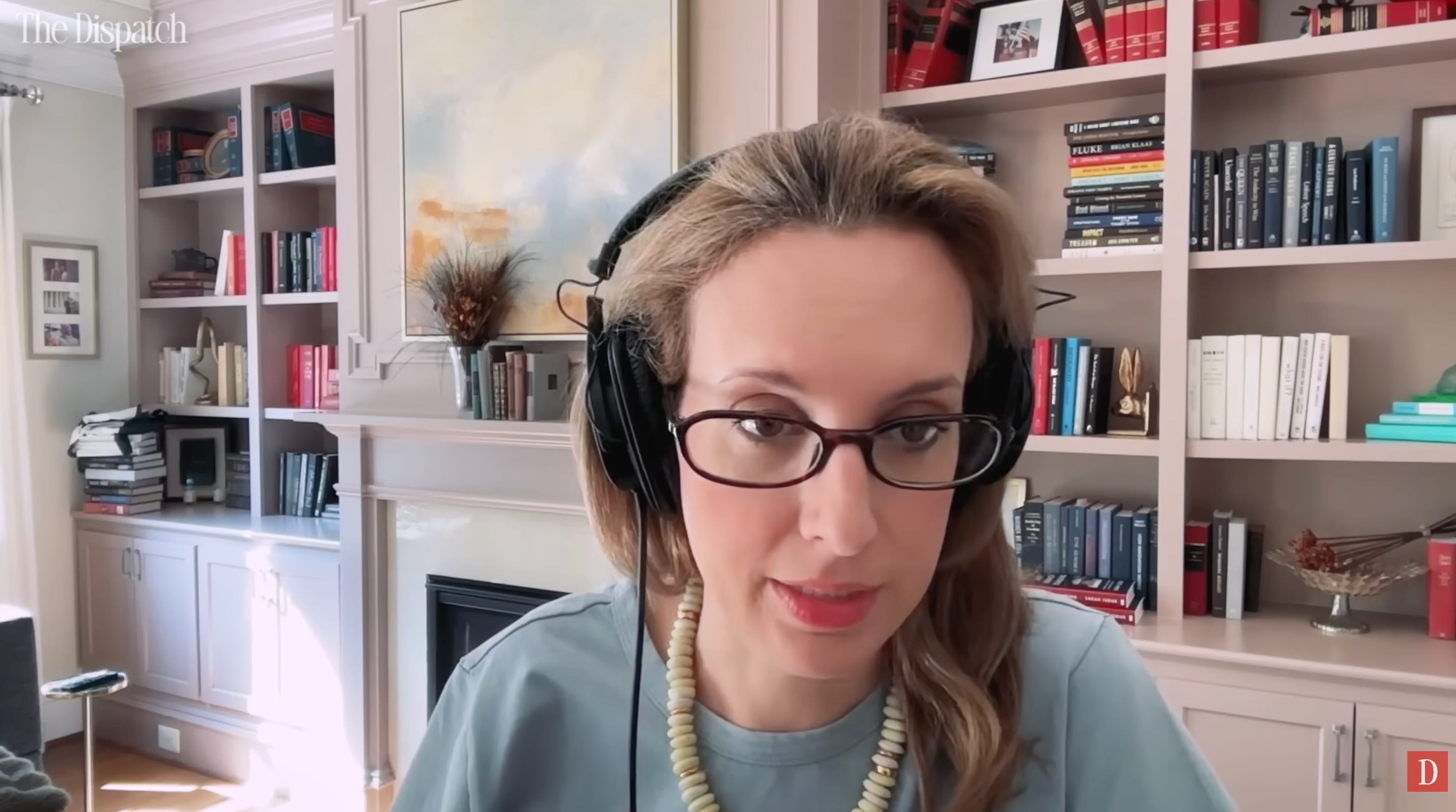
This piece is harder. This piece is about what happened on the Dispatch Podcast on Friday, June 12, 2026, when Stephen Hayes and Michael Warren and Kevin Williamson and Sarah Isgur sat down to discuss the Epstein-files cover-up that the New York Times Magazine documented two days earlier and that I wrote about as the orbit-fracture the day after the excerpt dropped. The episode is called How the Epstein Files Stumped the White House. The title is wrong. The files did not stump the White House. The White House suppressed the files. There is a difference.
Isgur, on that podcast, spent forty minutes performing a particular cognitive operation in real time, in front of three colleagues who became visibly more confused as the operation proceeded. The operation was to convert the specific question — did Bondi and Patel suppress evidence at Vance’s direction — into a general question. The general question was: wouldn’t any administration, faced with the same fact pattern, do exactly the same thing? The general question has no answer. That is why she chose it.
This is the move. Watch it carefully because it is the load-bearing structural element of everything she does. The specific question implicates specific people in specific acts. The general question dissolves the specific people into a structural claim about how anyone in their position would behave. The specific question demands accountability. The general question forecloses it. The specific question is what journalism is for. The general question is what operatives say when journalism is closing in.
Hayes was confused. Warren was confused. Williamson was confused. They were still trying to discuss what Bondi and Patel had actually done. Isgur had already moved on to what Bondi and Patel were structurally compelled to do. They were in different conversations. Hers was the conversation in which no one is responsible because everyone would have done the same thing.
⁂
I want to be careful about what I am claiming. I am not claiming Sarah Isgur is lying. I am not even claiming she is being cynical. I am claiming something stranger and, I think, sadder.
I am claiming she cannot afford to know.
There is a third position between she believes it and she is lying about it, and the third position is where most of the operative class lives. The third position is that she has constructed, over fifteen years of professional life, a cognitive architecture that routes around a particular question. The question is whether the institutions she has worked inside — the Department of Justice under Sessions and Rosenstein, the Republican political infrastructure that selected and credentialed her, the Federalist Society pipeline that placed her in those positions, the conservative legal movement that built the doctrines she now performs as professional analysis — function, in their actual operational behavior, the way she presents them as functioning.
The question, asked plainly, is whether the apparatus she has spent her career inside is a constitutional apparatus serving the country or a partisan apparatus serving a faction. The cheap version of the question lets her off because it admits of degree. The serious version of the question does not. The serious version asks whether the apparatus she has served has, at the load-bearing moments, served the Constitution or the party. The answer determines whether her professional life has been what she says it has been.
She cannot answer the question. So she has built a life in which the question never comes up. The Friday podcast is what it looks like when the question comes up anyway and the architecture strains against it.
⁂
There is a specific episode in Sarah Isgur’s career that the larger architecture exists, in part, to keep submerged. The episode is the Lisa Page leak.
In December 2017, Sarah Isgur was Director of the Office of Public Affairs at the Department of Justice and Senior Counsel to Deputy Attorney General Rod Rosenstein. The Russia investigation was active. Rosenstein was scheduled to testify before the House Judiciary Committee. The night before the testimony, a selected set of text messages between FBI lawyer Lisa Page and FBI agent Peter Strzok — cherry-picked from a larger corpus, decontextualized, the most damaging-looking ones isolated — were provided to a handful of Trump-aligned reporters. The reporters were called into the DOJ that night. The story broke the next morning. Rosenstein testified into a media environment that the leak had reframed.
The leaker was Sarah Isgur. We know this because Lisa Page eventually said so, in print, in her own account of what happened to her. Page wrote, in The Daily Beast, that Isgur was the person who selected the texts, decided which to release, and convened the reporters. Isgur has, to my knowledge, never publicly contested Page’s account.
The leak was not a freelance act. The leak was, at minimum, sanctioned by the political leadership of the Department. It was timed, it was targeted, and it was strategic. It damaged Page personally — her marriage, her career, her life — and it damaged the Russia investigation institutionally, which is the thing it was intended to do. It worked as designed.
This is the documentary case. This is what loyalty looks like when loyalty means to the party. The leak did not serve the Constitution. The leak served a particular political project — the project of damaging the institutional credibility of the FBI’s Russia investigation in order to make the Mueller probe survivable for the people the probe was investigating. The project was a Republican Party project. The leak was a Republican Party act, conducted from inside the Department of Justice, by an official whose oath was to the Constitution and whose paycheck was signed by the United States.
The Lisa Page episode is not a footnote. It is the load-bearing fact. It is the documentary instance of the pattern the entire subsequent career has been arranged to avoid asking about. The Advisory Opinions register, the Dispatch legal-craft polish, the SCOTUSblog editorship, the ABC News analyst chair, the National Security Institute affiliation — all of it is the architecture that holds the Lisa Page question at bay. Each new credential is one more reason not to look back. Each new platform is one more incentive structure that rewards her for not asking. Each new appearance is another performance of the persona that the unasked question makes possible.
⁂
The Friday podcast is what it looks like when the architecture meets a fact pattern that exactly recapitulates the Lisa Page pattern.
July 17, 2025, Situation Room. J.D. Vance in the chair. Pam Bondi on the speakerphone. Kash Patel on the speakerphone. Susie Wiles in the room. Documents on the table that implicate the President and his political network in the Epstein matter. A decision made about what to release, what to withhold, what to release in a form that would damage selected enemies, what to release in a form that would protect selected friends. The Department of Justice, the Federal Bureau of Investigation, the political leadership of the Executive Branch, working together to determine how the documentary record would be presented in order to serve the political interests of the people in the room.
This is the Lisa Page pattern. The names are different. The party in power is the same. The institutional behavior is identical. The Department of Justice is being used, again, by a particular partisan project, to manage a documentary record in service of the project’s survival.
Sarah Isgur, asked to analyze this on Friday, could not analyze it. She could not analyze it because the analysis would require her to recognize the pattern. The pattern is the pattern she was part of in 2017. To name it now would be to name it then. To name it then would be to dismantle the professional identity she has spent the intervening nine years constructing.
So she didn’t name it. She moved instead to the counterfactual. Wouldn’t any administration do this? The counterfactual abstracts the question into structural territory where no answer can be given. The counterfactual is the cognitive route around the specific case. The counterfactual is what loyalty to the party looks like when loyalty to the party has to be performed in a venue that ostensibly demands loyalty to the country.
Her co-hosts could not follow her because they were operating, in that moment, in good faith on the specific case. She was operating, in that moment, in the structural register that the architecture of her career requires her to inhabit. The confusion on the podcast was the gap between the two registers. The gap is what she has spent her career working to keep invisible. On Friday, for forty minutes, the gap was visible.
⁂
This is what I mean when I say her loyalty is to the party and not to the country.
I do not mean that she signed a piece of paper somewhere committing to the Republican Party against the Constitution. No one does that. The operative class does not work by explicit commitments. It works by selecting for, and then incentivizing, a particular cognitive architecture in which the partisan project’s interests and the country’s interests are routinely confused, in which the confusion is rewarded with credentials and platforms and book contracts and analyst chairs, and in which the recipient of the rewards comes, over time, to experience the confusion as clarity.
When Sarah Isgur converts the specific question into the general counterfactual, she is not lying. She is performing the cognitive operation that her career has trained her to perform. The performance is sincere. The performance is also what loyalty to the party, as opposed to the country, structurally looks like in someone of her credentialing and her platform and her self-presentation. The country, in her cognitive architecture, is the structure inside which the party operates. The party is the agent. The country is the field. Her loyalty is to the agent and her professional identity is to the field, and she has not noticed, because the architecture is designed to prevent her from noticing, that the agent and the field have different interests, and that the agent’s interests have been, at the load-bearing moments of her career, served at the field’s expense.
This is the structural meaning of loyalty in the operative class. It is not a choice. It is a shape. The shape is what the position is. The people inside the shape experience the shape as principle. The people outside the shape see it for what it is.
⁂
There is a question that Sarah Isgur could ask herself, and it is a simple question, and the entire architecture of her career has been arranged to prevent her from asking it.
The question is: In every load-bearing moment of my professional life, when the interests of the Republican Party and the interests of the constitutional order have diverged, which one have I actually served?
In 2017, at the Department of Justice, when the choice was between protecting a sitting Republican president from a legitimate counterintelligence investigation and protecting the institutional integrity of the investigation, she chose the President. She conducted the Lisa Page leak. She participated in the broader Sessions-Rosenstein-era project of managing the Mueller investigation’s institutional damage. She left the Department only when Sessions was fired, not before, not in protest of any particular act. She left because her principal left.
In 2019, when she pivoted to media, she pivoted to a venue — first CNN, then ABC, then The Dispatch — that allowed her to continue performing legal-craft authority while bracketing the structural questions her DOJ tenure had raised. She did not write the memoir that named what she had done. She did not testify, except where compelled. She did not say, in any venue I have been able to find, what we did to Lisa Page was wrong and I did it. The Lisa Page episode was managed, by her and by the broader operative network around her, as a survivable embarrassment rather than a defining act.
In 2025 and 2026, on Advisory Opinions and on the Dispatch Podcast, when the Trump administration’s behavior has produced a sequence of constitutional crises that exactly recapitulate the patterns of the 2017-2018 period, she has performed, again, the conversion of specific questions into general counterfactuals. She has performed the conversion in the register of legal sobriety. She has been rewarded for the performance with platforms and credentials and the Last Branch Standing book contract and the SCOTUSblog editorship and the ABC analyst chair.
At every load-bearing moment, the choice has been the same choice. The choice has been the party. The country has been the language she has used to describe the choice.
⁂
This is the diagnostic case the publication has been building, piece by piece, across the past two years. It is the same diagnostic the publication ran in Economic Royalists for the donor class and in Business Ought Never Be Politics for the executive class and in The Conspiracy Is The Cover Story for the operative class and in The Orbit Is Fracturing for the inner ring around the President. The diagnostic, in each case, is that there is a class of people whose professional identity is constructed on the load-bearing claim that they serve a structure larger than the faction that credentialed them, and whose actual operational behavior, examined at the load-bearing moments, reveals that the faction is the structure they actually serve.
Sarah Isgur is the cleanest case of this in the credentialed knowledge class because her career runs almost entirely through institutions whose ostensible commitment is to a structure prior to the party — the Department of Justice, the federal judiciary, the legal academy, the legal-analyst function on cable news and on podcasts. Each of these institutions exists, in its self-presentation, to serve the constitutional structure. Each of these institutions, in Sarah Isgur’s actual operational behavior inside it, has served the Republican Party at the load-bearing moments. The pattern is not deniable. The pattern is, in fact, what the architecture of her career is for.
The cost of the architecture is that the country gets, in moments of constitutional emergency, an operative-class legal-analyst function that converts every specific question of accountability into a general counterfactual about how anyone in the position would behave. The country gets, that is, a class of professionals who cannot, by virtue of their own structural position, do the work the moment requires. The work of the moment is the specific question. The structural position can only do the general counterfactual. The country waits and the moment passes and the specific question does not get answered, and the people who should have answered it appear, in the meantime, on the podcasts and on the cable shows, performing the legal-analyst function with all the appropriate polish.
⁂
I do not write this with hostility. I write it because the diagnostic is the diagnostic and the moment requires it. Sarah Isgur is not, in the moral universe of this publication, the worst person in Washington. She is, structurally, more honest than most of the people occupying similar positions, because the Never Trump posture has at least required her to articulate, repeatedly and publicly, where the contemporary right has gone wrong. That is more than the partisans of the right have done. That is more than many of the partisans of the left have done about their own apparatus.
But the Never Trump posture has a limit, and the limit is what this piece is about. The limit is that the posture cannot reach the structural question about its own apparatus. The posture can name the Trumpist insurgency. The posture cannot name the forty-year project that produced the conditions inside which the Trumpist insurgency became possible, because the people performing the posture are the products and the practitioners of the project. The project produced their credentials, their networks, their professional identities, their entire cognitive architecture. To name the project is to dismantle the identity. The identity, in their experience, is the principle. They cannot do it.
So they continue, sincerely, to perform the analysis the project requires of them. They continue, sincerely, to convert specific questions into general counterfactuals. They continue, sincerely, to occupy the legal-analyst function on the podcasts and the cable shows and the analyst chairs. They continue, sincerely, to write the books and edit the blogs and host the shows. The architecture of their career continues to reward them for the performance. The country continues to get, at the load-bearing moments, the counterfactual instead of the answer.
This is what loyalty to the party, rather than the country, looks like in the credentialed knowledge class in 2026. It does not look like a confession of loyalty. It looks like the calm professional analysis on the Friday podcast, in which the specific question about Bondi and Patel and Vance and the suppressed Epstein documents is dissolved, by a person of high professional polish and visible sincerity, into a general structural claim about how any administration would behave under the same conditions. Her co-hosts are confused because they are still in the specific question. She is in the structural one. The structural one has no answer. That is why she is in it.
⁂
The question I would put to Sarah Isgur, if I had her ear, is a simple one, and it is the question the entire architecture of her career has been arranged to prevent her from being asked.
The question is: Whose interests have you actually served, at the load-bearing moments?
The answer is in the documentary record. The Lisa Page leak is in the record. The Sessions confirmation prep is in the record. The Rosenstein-era management of the Mueller investigation is in the record. The pivot to media that bracketed the structural question is in the record. The Friday podcast counterfactual is in the record. The pattern is the pattern.
The country, by virtue of its constitutional structure, has the right to ask the people occupying its load-bearing positions whether they have been serving it or serving something else. The asking has gone out of fashion. The asking is part of what these pages have been for.
Sarah Isgur is the diagnostic case. The diagnostic case is, with appropriate substitution of names and credentials, also the case for most of the rest of the credentialed knowledge class. The asking has to happen, in public, in the venues that have not been captured by the requirement to bracket it. The asking is the first move of the work the moment requires.
That is all I came to say.

Go Deeper into the Circus
The Orbit is Fracturing

Maggie Haberman and Jonathan Swan have a book coming out. The book is called Time Change, and Simon & Schuster has put substantial weight behind it, and the New York Times Magazine has run the set-piece excerpt this morning. The piece is framed, with the careful gentleness of the trade, as an inside look at the White House freakout over the Epstein file…
Donald Trump is Evil

The word is old and it is precise. It has fallen out of fashion in the commentariat because the commentariat is in the business of euphemism, and euphemism is the dialect of people who have something to lose. Authoritarian. Illiberal. Norm-breaking. Anti-democratic. Each of these words is a step backward from the thing itself. Each of them buys the spea…
“It is difficult to get a man to understand something, when his salary depends on his not understanding it.”
~Upton Sinclair
Excellent. We need more knowledge and principle like this.