


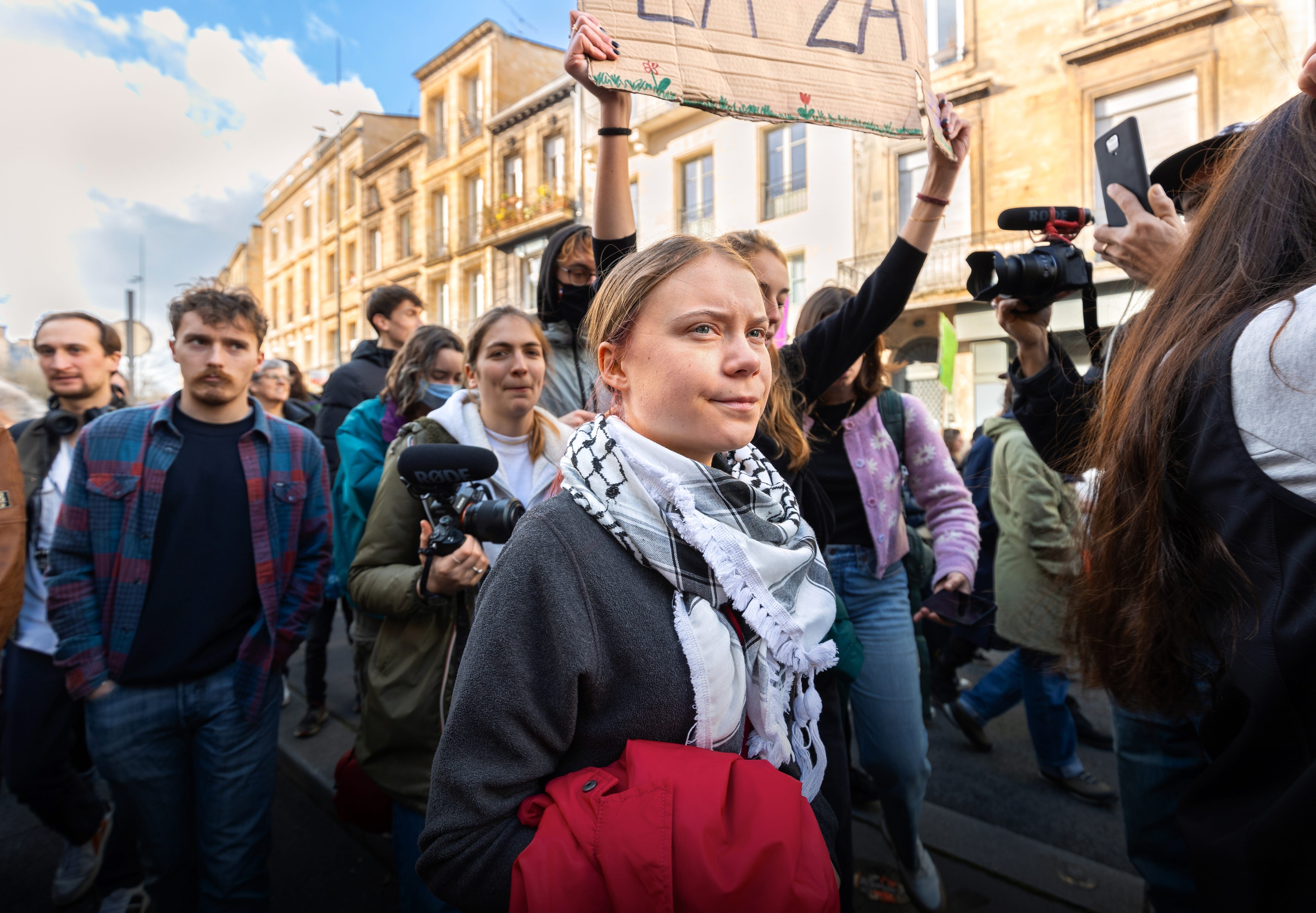
I have been thinking about Greta Thunberg.
This may seem like a strange place to find oneself in the middle of a war, a blockade, a constitutional crisis, a papal feud, and a consumer sentiment index at an all-time low. And yet here I am. I went into a meditative state this afternoon and found myself contemplating what I can only describe as a ridiculous object. Not ridiculous in the sense of absurd, though there is absurdity in it. Ridiculous in the original sense — something that invites examination precisely because of the disproportion between the thing itself and the reaction it produces.
The object is this: a fifteen-year-old girl who was afraid.
⁂
In 2018, a fifteen-year-old Swedish girl with Asperger’s syndrome read the science on climate change and understood it. Not in the way that people sometimes understand things — abstractly, at a distance, as a position to be held — but in the way that serious, literal minds sometimes understand things: completely, concretely, with full apprehension of the implications. She understood that the trajectory of carbon emissions, continued, meant a future that was categorically different from the present. She understood that the people responsible for that trajectory were not acting as if they understood it. She understood that she was fifteen years old and the future being discussed was, specifically, hers.
She was afraid. This is a reasonable response to the information she had processed.
She did what frightened, serious people sometimes do: she acted with what was available to her. She made a sign. She sat outside the Swedish parliament on school days. She spoke in the flat, precise language of someone who has not yet acquired the social training that teaches you to disguise what you mean behind the appropriate performance of uncertainty.
“Our house is on fire,” she said. She meant it literally. She was describing the situation as she understood it.
⁂
What followed is the part I find myself unable to stop examining.
The most powerful people on earth decided she was the enemy.
Not the fossil fuel companies that suppressed their own climate research for decades. Not the governments that received that research and chose inaction. Not the executives who knew — who specifically and documentably knew — and decided that the quarterly returns were more pressing than the trajectory. Not the political operatives who built the infrastructure of climate denial, who funded the think tanks, who produced the talking points, who turned a scientific consensus into a culture war.
The fifteen-year-old girl with the sign.
She was mocked by world leaders. She was the target of coordinated social media harassment campaigns. She was diagnosed, by people who had never met her, with every pathology available. She was accused of being a puppet, a plant, a pawn, a tool of globalist elites — by, among others, the actual globalist elites who found her inconvenient.
And now she has grown into a woman, and the hatred has matured with her, and she is regarded by a significant portion of the global right as something approaching an Antichrist figure. The precociousness that was laughed down when she was fifteen has become, in their telling, evidence of sinister influence. The fear that animated her has become, in their framing, ideology. The sign outside the Swedish parliament has become, in the mythology they have constructed, the opening act of a totalitarian project to destroy civilization in the name of saving it.
⁂
Thiel — the German-Kiwi-American of white South African descent, the man who has publicly called for an end to democracy, the man who bought New Zealand citizenship as a personal hedge against civilizational collapse — has, in leaked recordings of a four-part lecture series, described the modern Antichrist as a “Luddite who wants to stop all science” and said: “It’s someone like Greta.” He has called people like her “legionnaires of the Antichrist.” He has argued that climate activism and calls for global cooperation foreshadow the rise of a one-world government that will suppress dissent and freeze innovation.
The man who has positioned himself, with considerable financial ingenuity, to survive the catastrophe has named the woman who has spent her adult life trying to prevent it as a figure of the Antichrist. He has built the bunker. She has been trying to prevent the need for it. In the moral universe he has constructed — and that a significant portion of the global right has adopted — this makes her the villain.
Fortune asked the obvious question at the end of its report on Thiel’s lectures: “Who is the real Antichrist?”
It is a good question. I will not answer it in the theological register. But in the political and moral register, the answer is not complicated. The person who accepted the reality of the trajectory, made private arrangements for his own survival, and proceeded to fund the political projects that accelerated the conditions he was hedging against — that person is not the one trying to save the house.
⁂
There is a deeper structure to this that I want to name — one that requires me to tell you something about my own recent reading.
I came to the Gospels as an adult, for the first time, with fresh eyes and no institutional instructions for how to proceed. I wrote about what I found in The Kingdom Within. What I found was not what Christopher Hitchens had prepared me to find, and not what the Church prepares anyone to find. It was a wisdom tradition of extraordinary density and coherence, pointing — insistently, from almost every direction — toward the same thing: the kingdom is within you, the last shall be first, the excluded are the included, the meek shall inherit the earth. A radical inversion of every institutional hierarchy. A figure whose entire ministry was oriented toward exactly the kind of people that every institutional hierarchy, then and now, has declared unclean.
I also recently sat through Jordan Peterson’s interview with Peter Thiel, having done that careful reading of the Gospels. I watched with careful attention Thiel’s preferred interpretive doctrines — including the moment he took Peterson to task on whether Jesus saw virtue in self-sacrifice. The exchange seemed to confuse Peterson, which, given Peterson’s weirdnesses, still reflected excessive charity toward Thiel’s position.
Thiel is a student of René Girard. Girard argued, with genuine sophistication, that the Gospels expose and reject the scapegoating mechanism — the way societies create unity by sacrificing victims. In this reading, Jesus’s death is not a glorification of sacrifice but an indictment of the system that produces it. Thiel uses this framework to argue that self-sacrifice is not a Christian virtue, that the heroic-suffering reading Peterson has built his career on misreads of the text.
This is a sophisticated argument. It has some textual basis. I do not dismiss it entirely.
But watch what Thiel does with it.
He keeps the Girardian critique of scapegoating — very useful for a man who has positioned himself as a victim of establishment persecution, a martyr to the progressive forces that seek to suppress technological innovation. He discards everything else. The neighbor-love. The care for the excluded. The Sermon on the Mount. The money changers in the temple. The lepers and the tax collectors and the Samaritans. The itinerant teacher who ate with outcasts. The line that stopped me completely when I read it: The kingdom of God is within you. Not above you, not administered by a priest or a hierarchy, not accessed through the correct performance of institutional ritual. Within.
Thiel uses a legitimate theological argument as a scalpel to excise from Christianity precisely the elements that make it incompatible with the project of accumulation, power, and survival-of-the-prepared. He performs theological surgery and leaves a Christianity with no obligation to anyone outside the bunker.
The Pharisees are the recurring villains of the Synoptic Gospels. Their crime is not irreligion. They believe. Their crime is that they have institutionalized belief — turned it into a mechanism of social status, a hierarchical system for sorting the righteous from the unclean, a performance of virtue in the service of power. They use the sacred vocabulary to defend the arrangement. They name as unclean precisely the people Jesus keeps stopping for.
Thiel calls Greta Thunberg a legionnaire of the Antichrist. He does this using the vocabulary of a tradition whose founding documents — read carefully, without the institution’s instructions — describe the Antichrist profile in terms that fit the powerful defending the arrangement against the disruptive claims of the living. Not the girl with the sign. The people who built the mechanism she is trying to stop.
I am not a Christian. I came to this text as a mythologist of sorts. But I know what I found in those pages. And what I found does not describe Greta Thunberg as the enemy.
It describes her as the one Jesus would have stopped for.
⁂
Here is the thing I cannot stop turning over in my mind.
The people who hate Greta Thunberg — and I mean this as a description, not a provocation, because I know some of them personally — have come to genuinely believe that she is a performance. A prop. The visible face of a vast conspiracy of scientists and researchers around the world, coordinated to convince us of a lie: that putting carbon dioxide into the atmosphere in the quantities we are will lead to human suffering in the future. A lie motivated, in their telling, by a pernicious ideology that will stop at nothing to smash capitalism, to end freedom, to impose a one-world government under the cover of environmental emergency.
They believe this. Sincerely. Not as a cynical rhetorical position. As a description of reality.
And it does not go without saying — though it should — that the oligarchical interests which seek to break the democratic game and displace liberalism as a public morality invest enormous sums of money in the infrastructure that produces this belief. The influencers. The think tanks. The lobbyists. The political campaigns. The lecture series in which a billionaire who has bought himself a New Zealand citizenship as a personal apocalypse hedge names the girl who is trying to prevent the apocalypse as a legionnaire of the Antichrist.
The money flows in one direction. The belief flows in another. The people who cannot afford a New Zealand citizenship come to believe, sincerely, that the fifteen-year-old girl with the sign is the threat.
This is not an accident. It is the arrangement’s most refined product: a population that has been persuaded to direct its fear and anger at the person most clearly naming the arrangement’s consequences, rather than at the arrangement itself.
In this insane, captured, upside-down world — Greta Thunberg is the evil one.
She was fifteen years old and she was afraid and she was right. That is the whole story. Everything else is the reaction to it.

Go Deeper into the Circus
The Boiling Point

There is a concept in the sciences known as a phase transition. It describes the threshold at which an otherwise stable system suddenly rearranges itself into a completely different stable pattern. Water freezes. Not gradually — at a precise threshold, the molecular structure reorganizes and something categorically differ…
Garbage In, Garbage Out: DoorDash Edition

On Monday morning, oil hit $104 a barrel. The Hormuz blockade went into effect at 10am Eastern. The Pope said he had no fear of the Trump administration. Hungary confirmed a TISZA supermajority. The President defended a deleted AI-generated image of himself as Jesus Christ.
Thunberg is our gift. (By which I mean she’s been gifted to us.)
Agree with every word - Greta will be noted by history as stating only the obvious truth.