

In January I wrote about Tim Cook and the hollowing of Apple. The thesis was simple, and I will not rehearse it at length here. Cook had built a company so structurally dependent on authoritarian favor — Beijing’s and Washington’s in equal measure — that it had lost the organic capacity to say no. That he had mistaken optimization for leadership, efficiency for freedom, and the management of contradictions for the resolution of them. That the man who wore Martin Luther King Jr.’s words in his Twitter bio had attended a private screening of a vanity documentary about the First Lady on the night a nurse was shot ten times in the back in Minneapolis.
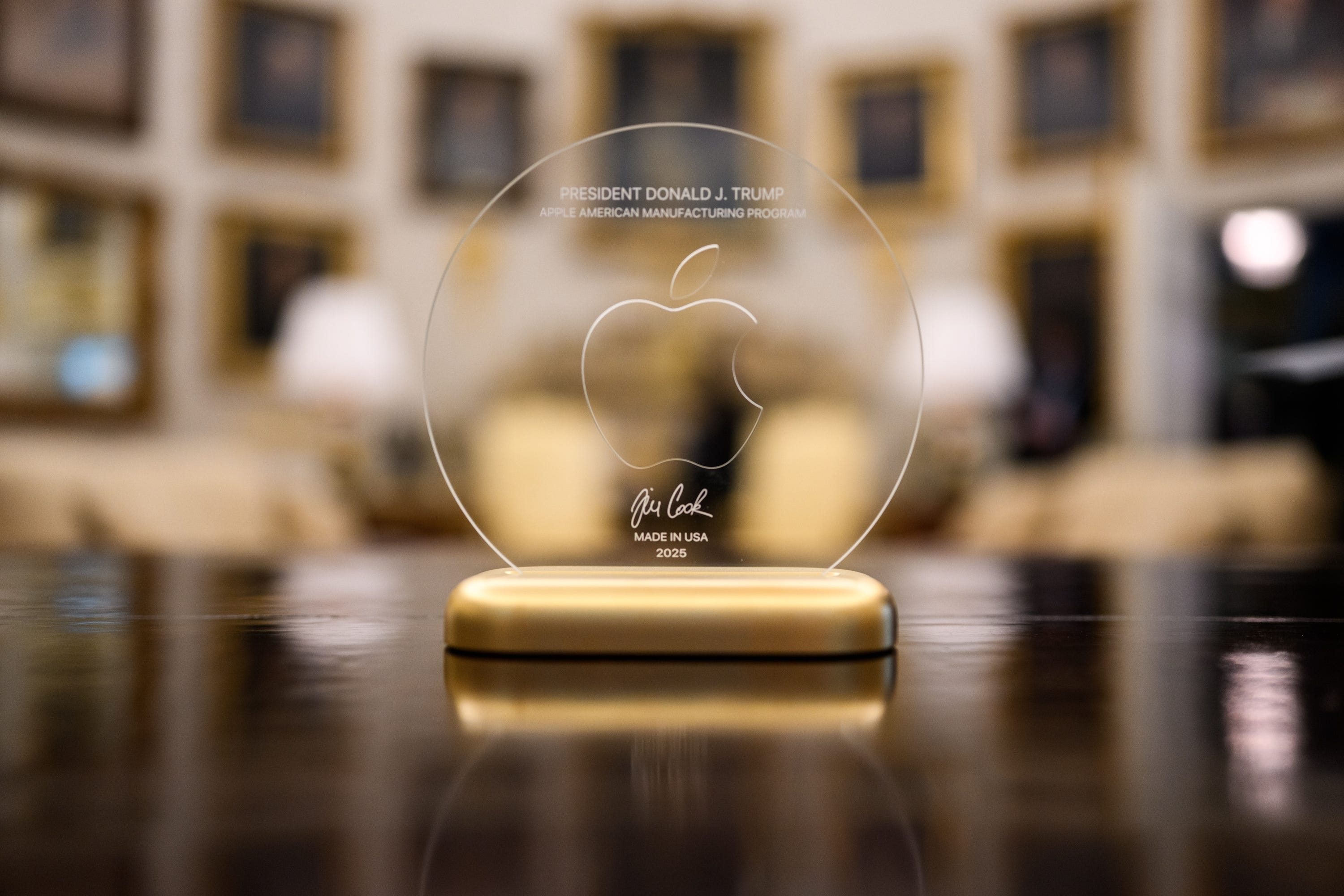
Last October, Tim Cook walked into the Oval Office of the United States, stood before the cameras, and presented the President of the United States with a golden plaque bearing his name. It was not a quiet transaction. It was a ceremony. A deliberate, public, photographed act of tribute.
I noted it then, as I note most things from that world — the world I left, the world that came to find my presence within it toxic, because I refused to pretend that any of this was okay.
I am writing about it now, in March, not from surprise but from reflection. From the distance that time and departure allow. From the particular clarity of a man who watched this industry from the inside for long enough to understand what it was, and who has spent the intervening years trying to say so plainly.
⁂
The object in the photograph is a circular plaque, laser-etched with the Apple logo, mounted on a base of 24-karat gold. It bears the inscription: President Donald J. Trump — Apple American Manufacturing Program. It was presented by Tim Cook to the President of the United States in exchange for tariff relief. It now sits on the Resolute Desk.
I want to be precise about what this object is.
It is not a gift in any meaningful sense. Gifts are given freely, without expectation of return, between parties of roughly equal standing or from a position of genuine affection. This is not that. This is a tribute. It is the physical instantiation of a transaction — favorable regulatory treatment rendered in exchange for a golden idol bearing the sovereign’s name. It is the vocabulary of court, not commerce. It is what you present when you need something from someone who has power over you and who wants, above all else, to be told that he is great.
Tim Cook, who runs the most valuable company in the history of human civilization, made a golden idol for Donald Trump.
Sit with that for a moment.
I said in January that Jobs had an aversion, deep in his soul, to being anyone’s bitch. That his stubbornness, his tyranny, his refusal to accommodate were not merely personality defects but structural features of a man who understood that moral freedom requires operational freedom. That you cannot act on your values if you have made yourself dependent on people who do not share them.
Jobs told the record labels to accept his terms or get nothing. He pulled Flash from the iPhone while advertisers screamed. He refused to put ports and buttons on devices because he thought they were ugly. He made choices that cost money, lost partnerships, and alienated people — because the alternative was making something he didn’t believe in.
He would never have made this plaque. Not because he was a saint — he was not — but because sucking up to power was simply not on his menu. His stubbornness was the point. His refusal was the feature.
The plaque is the proof that Cook has completed a transformation Jobs would have found incomprehensible. Not the transformation from creator to manager — Jobs understood that Cook was a manager, which is why he hired him to manage. The transformation from a company that used leverage to a company that submits to it. From a company that said no to a company that says yes. To anyone. For anything. As long as the supply chain requires it.
⁂
The prostration has an address. It is from the House of Jobs to the House of Trump.
These are not equivalent houses. One was built on the proposition that technology could be beautiful, humane, and built for people rather than against them. That the things we make reflect who we are. That how we make them matters. That design is not decoration but moral statement — the insistence, rendered in aluminum and glass, that the person holding the object deserves something that respects their intelligence and their time.
The other is built on the proposition that power is its own justification, that loyalty is the highest virtue, that the measure of a relationship is what you can extract from it, and that flattery — the golden plaque, the competitive superlatives of Miller and Patel in Memphis, the trophy room of signed memorabilia and corporate tribute — is the appropriate language of politics.
Cook has chosen to conduct his business in the second language. He did not have to learn it from scratch — he had been practicing it in Beijing for twenty years. The grammar is the same. Only the sovereign has changed.
⁂
There is a version of the defense of Cook that goes like this: he is doing what he must. Apple operates in the real world, not in a philosophical seminar. The tariff relief is worth tens of billions of dollars. The alternative — confrontation, moral posturing, the kind of defiance that plays well in essays and poorly in earnings calls — would harm shareholders, employees, suppliers, and the millions of people whose livelihoods depend on Apple‘s continued functioning. Cook is being responsible. He is being adult. He is doing what leaders of large institutions must do.
I want to take this argument seriously, because it is not entirely without merit, and because dismissing it too quickly is its own form of intellectual dishonesty.
It is true that Apple operates in the real world. It is true that the tariff relief matters. It is true that the alternative to accommodation is not without cost.
But here is what the argument elides: the trap was not inevitable. Cook built it. The China dependency that makes him unable to say no to Beijing — he constructed that over twenty years of operational decisions that prioritized efficiency over leverage. The financial structure that makes him unable to say no to Washington — he built that by optimizing for margin rather than maintaining the kind of diversified independence that Jobs always preserved. The prison is real. But Cook built the prison. And he built it in full knowledge of what he was building, and called it genius while he did.
You cannot plead the constraints of a cage you designed.
⁂
The gold base of the plaque is the detail that lodges.
Not the Apple logo. Not the president’s name. The gold base. The 24-karat gold base, which serves no functional purpose, which communicates nothing about the product or the company or the manufacturing program it supposedly commemorates, which exists for one reason only: to signal expenditure. To say, in the language of the House of Trump, that this tribute was costly. That the supplicant paid. That the deference is real.
This is the aesthetic of Mar-a-Lago applied to Silicon Valley. The gold that says I take you seriously to a man who measures seriousness in gold. The visual vocabulary of a relationship that both parties understand and neither will name.
Jobs built Apple on the proposition that restraint was a form of respect — that the most powerful statement a designer could make was the decision to leave something out. That the empty space on the screen, the absence of the button, the removal of the port — these were not deprivations but gifts. That less, done with intention, was more.
The gold base is the opposite of that proposition. It is more, done without intention, in service of nothing except the performance of submission.
Steve would have looked at it and felt physically ill.
⁂
I am not naive about what I am asking when I ask Cook to do otherwise. I am not suggesting that defiance is free, or that principle is costless, or that the structural constraints Cook operates under are imaginary. I argued in January, and I argue now, that he built those constraints himself over decades of choices that compounded into dependency. But I am aware that the constraints are real, that unwinding them is not a matter of a single brave gesture, and that the world does not always reward the kind of moral clarity I am describing.
What I am suggesting is narrower than that. I am suggesting that the plaque was a choice. Not a structural necessity. Not an operational requirement. A choice. Nobody forced Cook to commission a 24-karat gold base. Nobody required the presidential inscription. Nobody demanded the gesture. The tariff relief could have been accepted with a handshake and a press release, as such things have been accepted by corporate leaders throughout American history without the production of a golden idol.
Cook chose the idol. Cook chose the gold. Cook chose to speak in the language of tribute because he has spent twenty years learning that language, and it now comes naturally.
That is the moral of the object on the Resolute Desk.
⁂
I ended the January essay with a line I want to return to.
Efficiency, once chosen over freedom, never chooses back.
The plaque is the proof. Cook had everything he needed to be good. He had the resources, the leverage, the institutional prestige, the cultural authority of the most recognized brand in the world. He had more runway to say no than any executive in American business.
He said yes. In gold. With the president’s name on it.
This is what the hollowing looks like when it completes itself. Not a dramatic collapse. Not a scandal. Not a moment of obvious betrayal. Just a plaque on a desk, in a room where power is performed, bearing the name of a man who demanded it and the logo of a company that once stood for something else.
⁂
I know that the bite in the Apple logo was not designed as a reference to the Book of Genesis. I know this. The story goes that it was simply a design choice — to make the apple legible at small sizes, to distinguish it from a cherry or a tomato. There is no intended theological symbolism. Rob Janoff, who designed it, has said as much.
And yet.
I cannot look at that logo — on the plaque, on the gold base, bearing the president’s name — and not see it. The bitten apple. The fruit of the Tree of Knowledge. The object around which the oldest story in the Western tradition turns.
The myth is not really about sin. That is the Sunday school reading, the one that has done the most damage. The myth is about knowledge and its conditions. It is about what it costs to know — to truly know, to be conscious, to be awake to the world and its suffering and its beauty and its moral weight. The bite is not a transgression. It is the price of admission to the human condition.
And the condition is this: with knowledge comes responsibility. If you take the bite — if you eat of the fruit, if you open your eyes, if you wake up to what the world actually is — you own the consequences. You cannot unknow what you know. You cannot unsee what you have seen. You cannot retreat into the comfortable pretense that you didn’t understand, that the complexity was too great, that you were just managing the supply chain.
This is what it means to live in what I have called the tragic dimension. Not tragic in the sense of sad, though it is often that. Tragic in the ancient sense: the condition in which knowing fully and acting fully are the same obligation, in which consciousness and responsibility are not separable, in which the bite and its consequences arrive together and cannot be refused individually.
It is also — and this is the part that gets lost — the condition that makes love possible. You cannot love what you do not know. You cannot be in genuine relation with a world you have refused to see clearly. The bite is the price of love as much as the price of sorrow. This is why the myth is not a tragedy in the diminished sense. It is the beginning of the human story, not its end.
And if we are to live — truly live, in the full weight of that word — there must be justice and truth. Not as abstract ideals. As conditions of existence. Because a world without justice is a world in which the bite meant nothing. A world without truth is a world in which the knowledge purchased at such cost was squandered.
Tim Cook’s company has that bitten apple on everything it makes. On every device, on every storefront, on every piece of packaging that reaches a billion human hands.
He took the bite. He built the knowledge. He understood, as clearly as any person in American business has ever understood, what Apple was and what it meant and what it was capable of.
And then he put it on a golden plaque and set it on the desk of a man who is burning the world down.
Tim — you let us all down.
Say hello to your Chinese friends.
⁂
Steve Jobs built Apple to be the most powerful no in American business.
Tim Cook has made it into a very expensive yes.
Go Deeper into the Circus
On Moral Imagination
Shadi Hamid asked me a fair question on X this morning. I had said that the world should simply impose a solution on the Middle East — that the time for managed conflict had passed and the time for managed peace had arrived. He asked, reasonably: imposed by whom, and how exactly?
The Crisis, No. 5

I never met Steve Jobs. But I know him—or I know him as well as anyone can know a man through the historical record. I have read every book written about him. I have read everything the man said publicly. I have spoken to people who knew him, who worked with him, who loved him and were hurt by him.
Welcome to the resistance!
That so many friends can’t understand or can’t see shows the power of the structure we live under.
Oh wow. The bite from the apple. That is a lovely metaphor. Well done.