


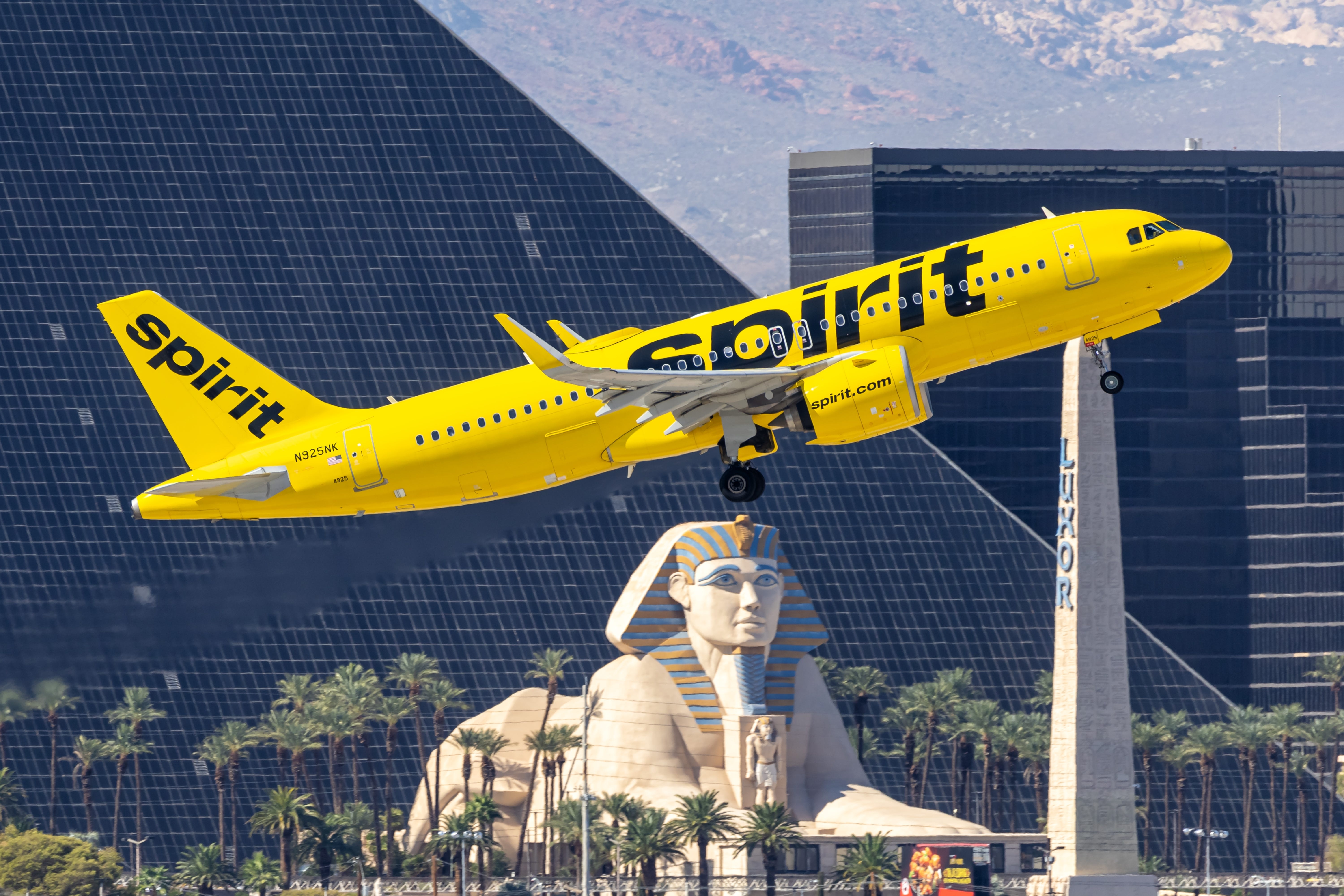
Spirit Airlines ceased operations last night. The final scheduled flight landed. Thirty years of business is over. Some thousands of employees lost their jobs. Some larger number of customers, holding tickets for flights that will not now happen, woke up this morning trying to figure out how to get home.
The CEO, Dave Davis, named the cause of the failure in plain language. “Everybody burning cash — we just had a smaller pile to start with.” The cash burn is from the doubling of jet fuel prices. The doubling of jet fuel prices is from the global supply contraction that followed the closure of the Strait of Hormuz. The closure of the Strait of Hormuz is from the war Donald Trump started against Iran without congressional authorization, in violation of the War Powers Act, in violation of the Constitution, against the advice of his own military leadership, and which he has now apparently lost, at the cost of American blood and treasure and the cost of American leadership in a region the United States has spent eighty years stabilizing.
Spirit was the first airline to fall. Davis was explicit about the rest. “They’re not that far behind us in the race.” The other low-cost carriers are now standing in the same fuel-price line Spirit was standing in. They have larger piles of cash. The piles are still finite. The fuel prices are still doubled. The math does what math does.
That is the chain. The chain is documentable. The chain runs from the executive’s unconstitutional war through a regional crisis through global commodity markets to the bottom line of an American airline whose final flight landed last night.
The libertarians and market fundamentalists, watching this happen in real time, have decided the proximate cause was Lina Khan.
The story they are telling: Khan’s FTC blocked the JetBlue-Spirit merger in 2024. The merger would have rescued Spirit by absorbing it into a stronger competitor. Khan, in her “anti-business” zeal, prevented the consolidation. Therefore Khan killed Spirit. Therefore Khan’s antitrust enforcement is responsible for the airline’s collapse. Therefore the lesson of Spirit is that we need to free the merger and acquisition market from the regulatory state’s interference, and the next time a struggling carrier wants to be absorbed by a larger one, the polity should get out of the way.
This is what the libertarian frame produces when it encounters the failure of Spirit Airlines. It produces a story in which the entrepreneur is the foundational actor, the regulator is the obstacle, and the failure of the entrepreneur is necessarily the regulator’s fault, because in the libertarian frame the regulator is the only available source of failure outside the entrepreneur themselves, and the entrepreneur cannot have failed on their own merits because that would mean the market does not always know best.
The story is wrong on the facts and wrong in its philosophical structure, and the two failures are related.
The factual problem first. Spirit filed for bankruptcy twice in the year before the JetBlue merger was blocked. The bankruptcy filings were not Khan’s doing. They were the airline’s response to a business model that was already failing under conditions of normal jet fuel prices. The post-COVID recovery in passenger demand had partially obscured the structural problems for a few quarters, but the structural problems were real and they were getting worse. Sean Duffy, the Trump administration’s Transportation Secretary, said as much yesterday. “Their model wasn’t working. They couldn’t get to fiscal health.” Duffy is not a friend of mine and I do not say this often, but on this specific empirical claim he is correct. Spirit was in trouble before the war. The war was the proximate cause of the final collapse. The model’s underlying problems were the distal cause.
The libertarians want both of these to be Khan’s fault, and the wanting is the move. They want the model’s underlying problems to be Khan’s fault because Khan blocked the merger that would have transferred those problems to JetBlue. And they want the proximate cause to be Khan’s fault because if Spirit had been merged in 2024, it would have been operating under JetBlue‘s larger cash reserves when the war started, and the larger cash reserves would have absorbed the fuel price shock long enough for the airline to survive. Both claims require the Iran war to be treated as background noise — as if the war were weather rather than policy, an act of God rather than an act of the executive who is currently denying the war has anything to do with it.
This is the philosophical structure of the failure. The libertarian frame cannot accommodate the war as a causal factor because the war was an action of the framework — the polity, the executive, the sovereign authority above the entrepreneur — and the libertarian frame is committed to the proposition that the entrepreneur is the foundational actor and the framework is either neutral background or hostile interference. The war does not fit either category. The war is the framework actively producing the conditions under which the entrepreneur fails. Acknowledging this would require acknowledging the case I made yesterday in No, Government Should Not Be Pro-Business: that the polity is logically prior to the markets that operate within it, and that pro-business government is a category error that mistakes the framework for one of its contents.
The libertarians cannot acknowledge this because the acknowledgment dismantles the foundational commitment of their position. So they cannot see the war. The war is the largest causal factor in the airline’s failure and the libertarian frame is constitutively unable to see it. They look at the failure and reach for the only enemy their frame has the apparatus to identify. The enemy is Khan. The enemy is always Khan, or somebody like Khan, because the frame produces only that enemy.
⁂
There is a deeper irony here that I want to slow down on, because the corpus has already named one half of it and the other half just arrived in the form of grounded airplanes.
In April I published The Supply Crisis, a piece about Trump’s clinical need for narcissistic supply. The piece worked through the literature on pathological narcissism — Durvasula, Vaknin, Malkin, Frank George — and the central claim was that the structure operates on the same neurological pathways as drug addiction. The self, in this configuration, has no stable internal foundation. It exists only in the reflection coming back from the outside world. When the reflection fails, the subject seeks novel supply sources to replace the failing ones. The piece predicted that as the existing supply sources contradicted the self-image, the instinct would be to find a new supply source large enough to drown out the contradiction. I named the Iran deadline as already operating in this register. “The civilizational stakes, the deadline, the dramatic save.” I wrote that the question was what would come next when this supply source also degraded.
What came next was the war itself. The deadline became the strikes. The strikes became the regional crisis. The regional crisis became the closure of the Strait of Hormuz. The closure of the Strait of Hormuz produced a global jet fuel supply contraction. The supply contraction killed Spirit Airlines.
The pursuit of narcissistic supply produced a literal commodity supply crisis. The president who needed admiration to keep his self-organized started a war to get it, lost the war, and the lost war is now producing the conditions under which the American airline industry begins to fall. The two meanings of “supply” — the psychological and the material — meet in the same causal chain. The chain runs through the same man.
This is the structural irony the corpus has been building toward without knowing what it was building toward. The Supply Crisis in April named the psychological pattern. The Victory Tax later named the economic costs being levied on Americans by the gap between Trump’s declared reality and the actual one. The Walls Are Closing In described the simultaneous failure of his supply sources. The Vance Accretion documented the parallel power structure being built around him while his own power degraded. The pattern was clinical. The pattern was political. The pattern is now industrial. Spirit Airlines is the pattern arriving at the level of grounded planes and unemployed pilots.
The libertarians cannot see this either, because the libertarian frame cannot connect a clinical psychological condition in the executive to a global commodity market through a regional war. The frame does not have the apparatus for that kind of connection. The frame can produce only the entrepreneur and the regulator. It cannot produce the executive whose pursuit of psychological supply destabilized the global supply chain that the entrepreneur depended on. So the frame produces Khan. Khan is the only villain the frame has the equipment to name.
⁂
The Trump administration’s response to the Spirit failure deserves separate attention because it is the apologist apparatus operating at the official level of the executive branch.
Duffy went on Fox News and denied that the fuel cost surge was the “impetus” for Spirit‘s collapse. He said, correctly, that Spirit‘s model was failing before the war. He used the correct factual claim to do the apologetic work — to deflect from the connection between the war he serves in the cabinet of and the airline failure he is being asked about. The factual claim is true. The deployment of the factual claim is dishonest, because the question Duffy is being asked is not whether Spirit had pre-existing problems. The question is whether the war doubled jet fuel prices and whether the doubling was the proximate cause of an airline that was already in trouble being pushed over the edge it had been approaching for a year. That question’s answer is yes. Davis answered it. Davis runs the airline. Davis was sitting on the cash pile he was watching get burned. He knows what burned it. He said so.
The Trump administration would prefer the question not be asked, because answering the question requires connecting the war to specific economic harms inflicted on Americans. The connection is what the apologist apparatus is built to prevent. Duffy’s “their model wasn’t working” is the same move as Shapiro’s “that’s priced in” from the Dispatch I published last week, The Most Articulate Apologist. Both moves acknowledge the bundle of harms while refusing to acknowledge the relationship between the bundle’s elements and the conduct of the administration whose policies produced the bundle. The pre-existing problems are real. The administration’s war is also real. The administration would prefer that the analysis stop at the pre-existing problems, because moving past them and into the proximate causes leads to the war, and the war leads to the executive, and the executive is the man Duffy serves.
So the apologetics performs the move it has been performing for ten years. Acknowledge enough of the truth to maintain plausibility. Deflect attention from the connections that would require accountability. Let the bundle of harms be priced in by the public over time, until the priced-in harms become the new background and the administration’s role in producing them is forgotten in the noise.
It is a working strategy. It has been working for a decade. It is working today on Fox News while Spirit‘s furloughed employees figure out their next jobs and Spirit‘s stranded passengers figure out their next flights.
⁂
The Spirit failure is the case study that demonstrates why the libertarian position cannot be defended on its own terms.
The libertarian wants the polity to be pro-business. The libertarian wants the framework to remove obstacles to business activity, secure property rights, enforce contracts, and otherwise stay out of the way. In Spirit‘s case, the libertarian wants the polity to have permitted the JetBlue-Spirit merger so that the consolidated entity could weather the storm. The libertarian frame is consistent on this. The merger should have happened. The market should have been allowed to consolidate. Khan’s interference prevented the consolidation. Therefore Khan is to blame.
But the storm the libertarian wants the consolidated entity to have weathered is a storm produced by the framework. The doubling of jet fuel prices was not a market phenomenon. It was the consequence of an executive decision to start a war. The executive decision originated in the layer above business — the layer of sovereign authority, the layer of the polity, the layer the libertarian wants to constrain to staying out of the way of business. The libertarian frame, applied consistently, would say that the executive should have stayed out of the way of the global jet fuel market. The libertarian frame, applied consistently, would say that the war was an unwarranted intervention by the framework into the conditions under which markets operate.
The libertarians who are blaming Khan for Spirit‘s collapse are not applying their frame consistently. They are applying their frame to one part of the causal chain — the part where Khan blocked the merger — and ignoring the much larger part where Trump’s war restructured global commodity prices in a way that no merger would have absorbed. The selectivity is the diagnostic. The libertarian frame cannot consistently object to Trump’s war while objecting to Khan’s antitrust enforcement, because both are the framework acting. The selective objection — Khan bad, Trump war fine — reveals that the libertarian frame was never about constraining the framework. It was about constraining specific exercises of framework authority that protected the public from corporate consolidation, while permitting other exercises of framework authority that served other ends the libertarian wanted served.
This is what pro-business government actually means in practice. It does not mean a polity that stays out of the way of business. It means a polity whose framework choices are made in business’s favor regardless of whether the choices stay out of the way or actively intervene. The polity should have permitted the merger because the merger served business. The polity’s war is fine because the war does not, in the libertarian frame, count as the same kind of intervention. The war is the executive doing executive things. The merger block is the regulator doing anti-business things. The two are not commensurable in the libertarian frame even though they are exactly commensurable in the actual causal chain that ended Spirit Airlines.
The framework matters. The framework always matters. The libertarian who wants to deny that the framework matters is denying it selectively, in the cases where the framework’s intervention serves interests they oppose, while accepting it silently in the cases where the framework’s intervention serves interests they support. The selective denial is the apologetic apparatus of the libertarian position. It is what makes the libertarian position incoherent on its own terms. It is what makes the libertarians who deploy it not actually liberals in any serious sense, because actual liberals understand that the framework is what the polity is and that the polity’s choices about how to exercise its authority are the substantive content of political life.
⁂
The lesson of Spirit Airlines, properly understood, is that businesses fail when the framework that makes them possible is operated by people who are willing to break it. Trump broke it. He started a war the country did not authorize, in a region the war was certain to destabilize, with consequences for global commodity markets that anyone competent could have predicted. The consequences arrived. The first major American business casualty arrived this weekend. The other low-cost carriers are in the line behind it.
The libertarians and market fundamentalists who are pointing at Khan are doing the same thing the Trump administration is doing in Duffy’s denial. They are deflecting attention from the connections that would require accountability. The connection from the war to the fuel prices to the airline failure is direct and visible. The connection from Khan to the airline failure runs through a counterfactual that requires ignoring the war entirely. The libertarians and market fundamentalists prefer the counterfactual because the counterfactual lets them keep the frame they have committed to. The frame is more important to them than the truth. The frame is more important to them than the airline. The frame is more important to them than the people who lost their jobs last night and the people who could not get home.
These are not serious people. They are people maintaining a brand. The brand requires Khan to be the villain because Khan is the only villain the brand has the apparatus to produce. The brand cannot produce Trump as a villain because the brand’s audience would not tolerate it, because the brand’s audience has built its identity around the proposition that figures like Trump are allies in the project of freeing business from constraint. The fact that Trump’s war just killed an airline that all the supposed constraint of the FTC could not save is a fact the brand cannot metabolize. So the brand performs the substitution. Khan is the cause. The war is background. The model was failing anyway. The fuel prices are ambient weather. Move along.
I will not move along.
⁂
Spirit Airlines failed because Donald Trump started a war he was incompetent to win, in a region he was incompetent to manage, with economic consequences he was either unable or unwilling to anticipate. The consequences are not abstract. They have first names and last names. The pilots who will not be flying the routes they had flown for decades. The flight attendants who will not be working the jobs they trained for. The maintenance crews. The gate agents. The customer-service representatives. The thousands of people whose paychecks ended last night and who will be looking for other work in an aviation industry where the other carriers are now in the same fuel-price line their employer was in.
The political project that produced these consequences is the political project the libertarians and market fundamentalists have been supporting. They supported it when it was rolling back the regulatory apparatus. They supported it when it was cutting taxes on capital. They supported it when it was restructuring the federal bureaucracy in service of executive consolidation. They are now performing the contortion required to avoid noticing that the project they supported produced the airline collapse they are upset about, because the contortion is the price of maintaining the brand, and the brand has not yet been priced too high to maintain.
It will be. The next airline will fail. The one after that. The fuel prices are not coming down. The Strait of Hormuz is not reopening on a timeline that helps the carriers waiting in line. The administration is not going to admit the war was a mistake, because admitting the war was a mistake would require admitting that the executive who started it is responsible for the consequences, and the apologetic apparatus is built to prevent exactly that admission.
The framework is what determines whether business is possible. The framework is the polity. The polity is the people. The people, this week, are losing their jobs because their president started a war he could not finish, and the libertarians who have spent ten years insisting the framework is the problem are now demonstrating, in real time, that they cannot diagnose a framework failure when the failure is caused by the executive they helped install.
The man whose pursuit of psychological supply produced the commodity supply crisis is now watching the commodity supply crisis produce the first major business casualty of his administration. The casualties will not stop with Spirit. The man at the center of the chain has not yet acknowledged the chain exists. He will not acknowledge it, because the apologetic apparatus is built to prevent the acknowledgment, and because acknowledging it would require him to face the connection between his own clinical condition and the economic destruction it has produced.
These are not serious people. The brand is not a serious philosophy. The libertarian who blames Khan for Spirit‘s collapse has shown the public, on the record, what their frame is actually for and what their frame cannot see. The frame is for protecting business from the parts of the framework they oppose. The frame cannot see the parts of the framework they support, even when those parts are in the act of dismantling the conditions that make business possible.
The framework matters. The framework always matters. Spirit Airlines is the framework speaking, in the language of bankruptcy filings and grounded planes and unemployed workers, about what happens when the people in charge of the framework do not understand what the framework is for.
The first domino has fallen. The rest are waiting in line.
Go Deeper into the Circus
No, Government Should Not Be Pro-Business

It is entirely inappropriate for a government to be pro-business. The entire notion of a pro-business government is corrupt in the first instance. Business is a thing that happens inside government. It is the thing made possible by the laws and norms a government establishes. The purpose of a government in a republic is …
The Bell

I argued against monarchy in Las Vegas on Tuesday. I debated Curtis Yarvin at a Bitcoin conference, on a stage, in front of an audience that had paid to attend, on the resolution that liberal democracy is an obsolete operating system that should be replaced by a sovereign corporation
I really like what you do in these posts as they help the reader to connect a lot of the sub-surface mechanisms and infrastructure that informs what is happening to us and why. However, I do wonder why you repeatedly use the phrase, “These are not serious people” as your conclusory judgement. I really don’t think it lands as powerfully as apparently you do.
Whenever you declare this I immediately think, “Are you kidding me? These people are about as serious as we’ve encountered domestically in more than a century. They are serious about crushing and, as far as possible, erasing all evidence of the existence of liberalism, including rolling back the egalitarian gains of The New Deal, the a suffragists, The Great Society, The civil Rights Movement, etc., etc., and creating and cementing in place the law and order of white Christian nationalism and related thuggish and plutocratic elements of a hemispheric criminal syndicate.” Yes, I think all of that and more in about half a second.
These people are damned — and even demonically — serious. And it is perhaps only because Trump and his consiglieri have become so obnoxiously brazen and intoxicated (as you so adeptly describe) in their hubris and mania for treasure, tribute and territory, that even some of the most Foxified Americans are beginning to wonder what has possessed these people.
All of which is to say that I think you might want to consider a way to characterize these seriously, dangerous people and their epically apocryphal agenda.
I believe there is a larger message behind all of what we are seeing. And I have said this before and for some years. Trump is acting like a Russian operative. He is intent on destroying the United States of America. He is a puppet of Vladimir Putin. He should be impeached and then tried for treason.
All of this nonsense with Comey is such bullshit, and it's amazing to me that the mainstream news media doesn't understand what the expression "86" means. It was used in places like bars, perhaps restaurants, where a customer was unruly and you wanted him thrown out of the establishment. It perfectly fits Trump because it means "throw the bum out." So what is behind all of this is that we put a bum into a position of power and he's acting perfectly the way he always has acted. He comes first, and his admiration of all of the fascist leaders of the world vie with that focus. Trump admires perpetual demagogues like Hitler, Stalin, Mussolini, and currently Putin, as well as his love affair with North Korea's Kim.
It is a harsh reality for the American public to realize how stupid or ignorant they have been and how derelict they have been regarding paying attention to who they put into office. Although I give the lion's share, like 95% of the blame to the Republicans and the Republican Party, I also find the Democratic Party to be seriously at fault in not dealing with these issues when they were in power. They were terrible and not addressing the Epstein files when they were in charge of the Congress and the presidency. They were derelict in not doing something with intelligent immigration legislation when they had the chance. They did not do away with gerrymandering and the filibuster when they had the chance. They did nothing to ensure that the Supreme Court would always have some balance when they had the chance.
What we have right now in the US is a shitstorm. It is the decline of democracy and perhaps the death of democracy because of an ignorant electorate. This is the bottom line. A turd like Trump could never have risen to the surface if it were not for the ignorance of the citizens of this country. So shame on us.
And one last jab to the mainstream media. When Trump talks about the price of gasoline getting better, all you've got to do, media, is remind them what Trump said about COVID: "It will go away when the weather gets warmer." How can intelligent newscasters be so fucking ignorant regarding the blatancy of what Trump says and does. Why aren't more mainstream media spokespersons just calling it what it is? "Bullshit."Just say it. Trump insults the American citizenry with his nonstop bullshit. He needs to be removed from office. He should be 86'd from his position as POTUS. All of America that feels this way should be out wearing t-shirts or sweatshirts that say 86 Trump. And it doesn't freaking mean kill someone, it means just throw the bum out.