


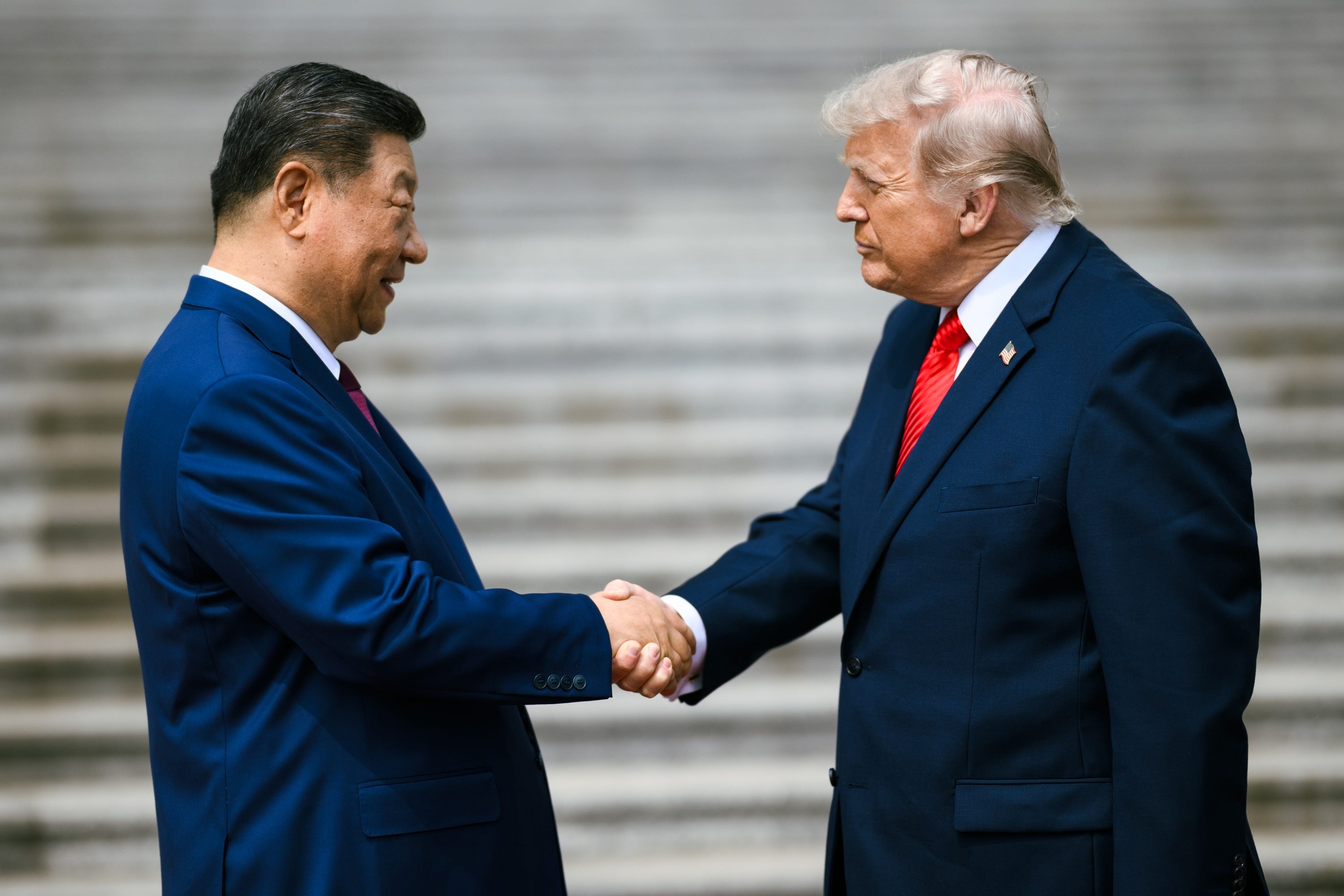
There is a dinner in Washington tonight I find myself holding in pathos, which surprises me, because the facts of it mostly deserve anger. Xi Jinping is at the White House for a state dinner, his first visit here in eleven years, greeted at the steps of his own plane by a president who reserves that courtesy for very few. Three news organizations had to obtain a midnight court order this morning for the right to report on the occasion. A Republican senator, Roger Wicker, spent the week hoping aloud that the president would remember, in every minute of dialogue, that his guest is a brutal, unelected and oppressive dictator. All of that is true and all of it matters, and yet what keeps rising in me, looking at the setup, is not contempt. It is something closer to the way you feel watching an old man insist, at eighty, that he can still drive.
Because look at the scene from a little distance, the distance the eventual audience will have. In a few decades all of this is a photograph in a chapter with a small font. The silver will be in storage or in a museum case. The toast will be a quoted sentence with a footnote. And the two principals, who tonight feel themselves to be at the center of history, will have gone the way everyone at every state dinner always goes. Shelley put the machinery of this view in place two centuries ago. A traveler comes back from an antique land with a description: a broken statue, an empty desert, and on a pedestal the inscription addressed to every powerful person who would ever read it: Look on my works, ye Mighty, and despair. The despair runs in both directions. Despair at the scale of the empire while it stands; despair at the certainty of what it becomes — the colossal wreck, the lone and level sands. Shelley wrote that about a living king, from the far side of an ending that had not happened yet. The vantage is not to gesture toward the prophetic. But towards a tension. Power has only one declension, and everyone at tonight’s table is declining.
That is where the pathos enters, uninvited and, I think, earned. The emperor’s-new-clothes story is usually told as a story about a liar and a brave child. But consider the clothes themselves. They fade. The fabric of courts is mortal on a schedule that flattery cannot move, and every man at tonight’s dinner knows it at some level below the one where the toasts are composed. Both principals are very old men, governing the world’s two largest economies from inside bodies that keep their own schedule, non-negotiable and silent. The flatterers around them are paid to behave as though none of that is visible, and the flattery is, when you look at it plainly, a form of staging against the grave. Seen plainly, the groveling donor, the vice president telling jokes to the press pool about banned outlets, the guest who presides over the hundred-and-seventy-eighth-ranked press environment on earth out of a hundred and eighty: each of them is standing in a light that will not hold, pretending for one more evening that it will. They are the emperors of dirt — dirt not as an insult but as an address, the substrate under the carpet, the dust that the silverware will join.
⁂
The reason to keep this vantage close is not that it absolves. It still took a lawsuit filed on Monday and a signature just after midnight; a judge’s signature is not a poem, and the men in the room are still doing their harm in real time. The vantage does something quieter. It removes the dinner’s actual product from circulation, at least for the reader willing to hold it. Because what a state banquet manufactures is not the trade truce — that was agreed in advance — but a feeling it wants to install in everyone watching from outside: smallness, and luck to be permitted the view. Every element of the staging, from the planeside greeting down to the curated press pool, is the instruction to look up. The vantage is the refusal to look up, not from defiance but from a better sense of where the horizon actually is. Look level instead and the whole evening resolves into what it is: mortal men at a catered table, very powerful for a while, rehearsing permanence in a room that has hosted a hundred such rehearsals and forgotten nearly all of them.
There is, in the end, something almost tender available here if you want it. The same country that hosts the banquet is the one where the banned reporters sued on Monday and won by Thursday, where the senator’s letter lands in the record and the president’s less favored allies are already quietly sanding his name off their websites six weeks before an election; the arrangement frays and persists, frays and persists. Emperors keep their calendars in months and they are running out of them; the institutions they strain against work in longer units, and the dirt is patient with everything. So hold the dinner in pathos. Watch the old men clink glasses under the chandeliers one more time, in clothes that are already fading, in a photograph already aging, and let the anger keep working where it needs to while the pity does its slower work underneath. The desert gets every pedestal in the end. It does not hurry, and neither should we.
Go Deeper into the Circus
Nobody Left to Talk To

This is, after all, a philosophy blog. And Pluribus, in which most of humanity becomes a seemingly happy collective consciousness, has given us a very old philosophical problem wearing a smile. I think the show can be read as the inverse of the ur-myth in the
The Believers

Donald Trump stood on the stage at the Bitcoin Conference in Nashville in July 2024 and told the audience that Bitcoin stood for “freedom, sovereignty and independence from government coercion and control.” Later in the same speech, he promised that “the rules will be written by people who love your industry, not hate your industry.” There was the propo…
No one gets out of here alive...