


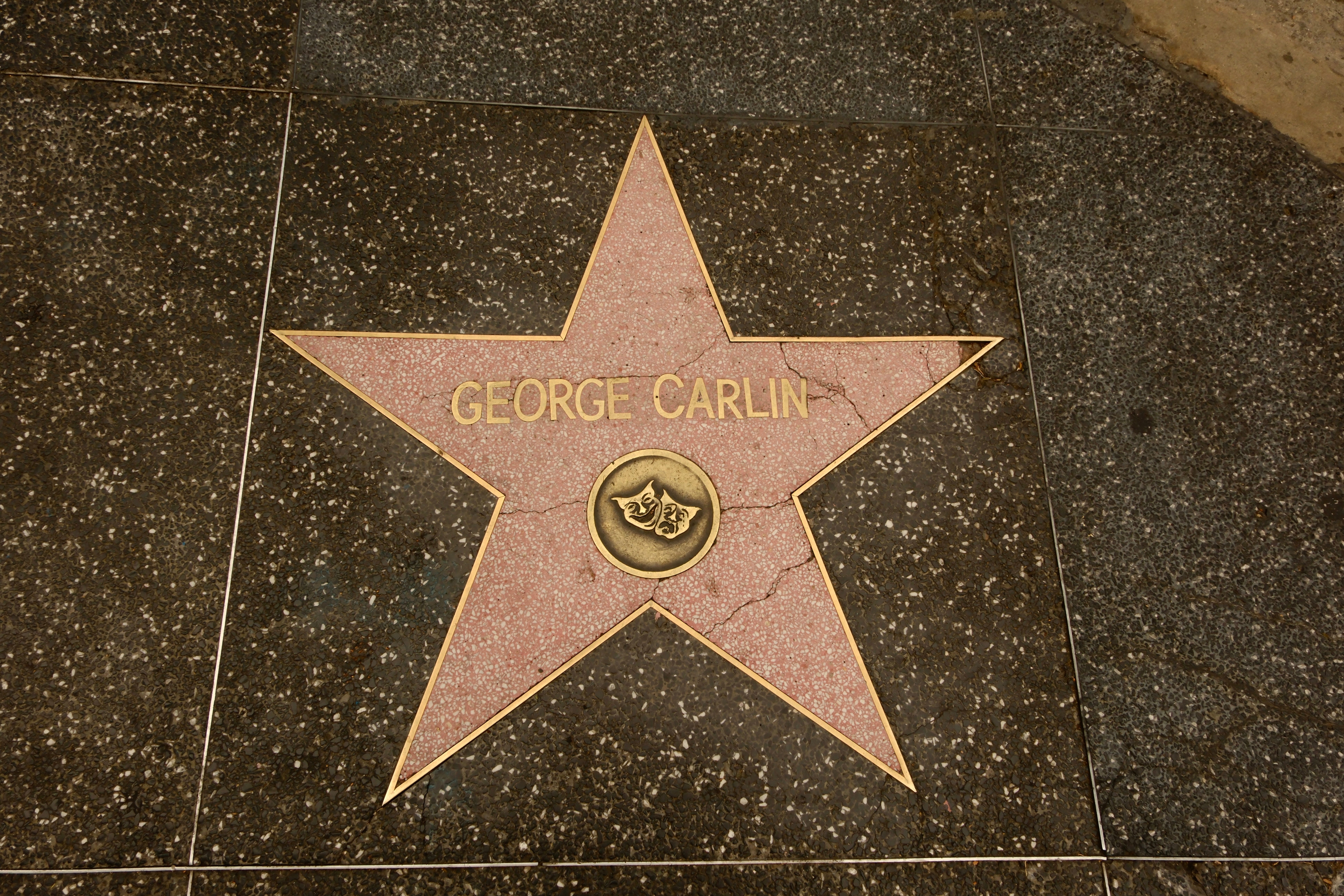
I loved George Carlin growing up. I discovered him in my father’s vinyl album collection. It was his fourth stand-up album, Class Clown. Track one, “Seven Words You Can Never Say on Television.” It is a monologue I must have listened to dozens of times as a child. With my friends. It was very naughty and inappropriate for children.
And the memory of this got me thinking.
⁂
I did not know, at ten years old, that I was receiving moral philosophy. I thought I was getting away with something. The thrill was transgression—forbidden words, adult territory, the delicious knowledge that my parents would not approve. My friends and I played that record the way children have always played with forbidden things: as adventure, as rebellion, as proof that we were brave enough to hear what we were not supposed to hear.
But Carlin was not interested in the words. He said so, many times, in many ways. The words were the door. What was behind the door was a question: who decides? Who decides which words are forbidden? Who decides which truths can be spoken and which must be dressed up in euphemism? Who decides what you are allowed to think, and what happens to you when you think it anyway?
That is not comedy. That is political philosophy. That is epistemology. That is a man standing on a stage asking the most dangerous question any citizen can ask: why should I believe you?
⁂
Carlin spent forty years asking that question. He asked it about religion. He asked it about politics. He asked it about consumer culture, about the military, about the education system, about the American dream itself. He stripped away the comfortable stories Americans tell themselves—the pretense of democracy while oligarchs run the show, the pretense of freedom while consumer culture colonizes every private space, the pretense of moral seriousness while nobody does the work.
He attended to what was real and reported it faithfully. He refused consolation. He refused to let his audience feel good about themselves. He held up the mirror and said: look. This is what you are. This is what you accept. This is what you pretend not to see.
The conventional reading of Carlin is that he became a nihilist. That he gave up on the species. “I have no stake in the outcome,” he said. “I’m just here for the show.” People cite this as evidence that he stopped caring. That the diagnosis consumed the doctor. That he withdrew into spectation and called his withdrawal wisdom.
I don’t believe it. What people call nihilism in Carlin was his refusal to offer false comfort. The audience wanted the diagnosis and the reassurance. They wanted to be told that things were broken and that it would be okay. Carlin would not do that. He would not tell you the patient was fine when the patient was dying. He would not pretend that laughter was medicine when laughter was the only anesthetic the culture would accept.
He was not a nihilist. He was a prophet in the Old Testament sense—a man who loved his people enough to refuse their self-flattery. Who told Israel what Israel did not want to hear. Not because he had given up on them. Because he had not.
⁂
But here is what I cannot stop thinking about.
The most morally serious public intellectual of his generation had to frame everything as a joke.
Carlin was doing philosophy. He was doing political theory. He was attending to the structures of power and reporting what he found with more precision than most academics and more courage than most journalists. And the only way American culture could metabolize it was as entertainment.
You had to buy a ticket. There was a two-drink minimum. The truth came with a cover charge and a laugh track. You sat in a dark room with strangers and you heard things that should have changed your life, and then you went home and changed nothing. Because it was comedy. Because the format told you it didn’t count. Because the stage and the microphone and the timing of the punchlines all said: this is not real. This is a show. You are the audience. You are not required to act.
The court jester is allowed to speak truth to power precisely because the jester’s role guarantees that truth is received as performance rather than demand. The king laughs. The courtiers laugh. Everyone agrees the fool is very clever. The kingdom does not change.
This is what happened to Carlin. Not that he gave up. That we neutralized him. American culture developed a mechanism for receiving moral seriousness without letting it change anything. The truth gets spoken and defused in the same gesture. The prophet speaks and the congregation applauds and everyone goes home and the temple remains as corrupt as it was before he opened his mouth.
⁂
Carlin was not the only one caught in this trap. He was the most gifted. But the trap is everywhere.
Punditry is the same mechanism. An industry of “hot takes” and “analysis” that lets people feel informed without being obligated. You read the thread. You share the article. You know what’s happening. Knowing becomes a substitute for doing. The information enters and produces not action but the feeling of action—the sense that you have participated, that you are engaged, that you are one of the people who understands.
Social media is the most efficient version yet. You feel the moral emotion. You express it publicly. You are seen expressing it. Others validate the expression. The emotion was real. Nothing happened.
I wrote in Crisis No. 4 about The Fifth Column podcast and its function as a permission structure. I called it “a machine for generating reasons not to act.” I want to return to that now, because I understand it better than I did in January.
The Fifth Column is the Carlin trap run in reverse.
Carlin held the mirror up and the audience neutralized the reflection by calling it comedy. The Fifth Column holds the mirror up and the hosts neutralize the reflection by calling it nuance. The mechanism is different. The result is identical. Nobody acts.
Michael Moynihan sat in a studio and explained, at considerable length, why we cannot call what is happening fascism. Why the Gestapo analogy is imprecise. Why Jonathan Rauch was wrong. Why the people sounding alarms are being hysterical. He was concerned—genuinely concerned, I believe—about the hypothetical future violence that might result from people taking the comparison too seriously.
The actual bodies were less concerning than the theoretical bodies. The violence of the state right now was less alarming than the violence of those who might resist it.
I called this a tell. I want to name it more precisely now. It is moral unseriousness. Not the absence of moral feeling—Moynihan has moral feelings. Not the absence of intelligence—these are smart people. It is the refusal to let what you see change what you do. It is the deployment of sophistication in the service of paralysis. It is the use of education, rhetorical training, and access to information—gifts that could illuminate—to construct an ever more elaborate shelter from the demands of the moment.
Carlin used his gifts to strip away shelter. The Fifth Column uses identical gifts to build it. That is the difference between moral seriousness and its opposite. Not what you see. What you do with the seeing.
⁂
There is a version of this on the left, and I must be honest about it, because the crisis we are in was not created by one side alone.
I said in my Substack Live yesterday that there is a strain on the American left that dismisses sacrifice. That treats the history of the republic as nothing but a record of powerful men being terrible. That cannot say the word “soldier” without flinching, that cannot honor the dead without appending a disclaimer, that treats patriotism as a costume worn by fools and fascists.
I understand where this comes from. The history is bloody. The founders were slaveholders. The wars were imperial. The flag has been used to bludgeon. Every critique has a foundation in truth.
But there is a difference between holding complexity and refusing to hold anything at all. Jefferson was a slaveholder who wrote the words that made abolition possible. The soldiers at Normandy fought under a segregated military for a nation that denied its own principles—and they died so that those principles could survive to be fulfilled. The moral tradition of this republic is not pure. It was never going to be pure. Moral progress comes through flawed people or it does not come at all.
The left’s refusal to hold this complexity is its own form of moral unseriousness. Not because the critiques are wrong—they are not wrong. Because the critiques become a mechanism for avoiding the debt. If the founders were nothing but villains, you owe them nothing. If the soldiers were nothing but instruments of empire, their sacrifice places no claim on you. If the whole tradition is rotten, you are free to stand outside it, commenting on its failures, bearing no responsibility for its repair.
This is comfortable. It is also how you lose a republic.
⁂
I wrote in Crisis No. 11 that memory is what the universe is. I meant it literally—it is the argument of my philosophical work—but I also meant it politically.
A republic is its memory. The principles encoded in its founding documents. The precedents established by its courts. The sacrifices made by its citizens. The stories it tells itself about who it is and what it owes to those who came before. All of this is memory. All of it is the accumulated record of choices made by people who are no longer here but whose choices shaped the world we inhabit.
When the regime seizes ballots in Georgia, it is attacking memory. When it occupies Minneapolis, it is overriding the memory of democratic choice. When it arrests journalists, it is criminalizing the creation of new memory. I have documented this across eleven pamphlets.
But the regime’s assault on memory was made possible by a prior failure. A failure on our side. A decade of teaching people that American memory was nothing but a record of oppression. That the founding was a fraud. That the sacrifices were meaningless. That the tradition was irredeemable.
You cannot defend what you have been taught to despise. You cannot fight for what you have been told was never worth having. The left’s moral unseriousness—its performance of critique without commitment to repair—systematically dismantled the memory structures that would have inoculated the republic against exactly this kind of assault.
The regime did not have to destroy the republic’s memory. The opposition had already done much of the work.
⁂
Let me be precise about what I mean by moral seriousness, because I do not mean severity. I do not mean grimness. I do not mean the pose of concern that replaces actual concern.
Carlin was morally serious and he was funny. These are not in tension. The laughter was a byproduct of precision—of seeing clearly and describing what you see without flinching. The funniest moments in Carlin are the moments of sharpest sight. The audience laughs because it recognizes truth, and recognition is delightful even when the truth is terrible.
Moral seriousness is not a mood. It is a practice. It is the quality of attention you bring to what is in front of you. It is attending before acting. Understanding before judging. It is the willingness to let what you see change what you do—to accept the demands that reality places on you, even when those demands are costly.
What the regime does is the opposite of this. It refuses to attend at all. It replaces the record with fabrication. It installs false memory in place of real memory. That is active corruption—the deliberate destruction of the attractor landscape, to use the language of my philosophical work.
What the performative left does is a subtler opposite. It attends selectively. It sees the parts of the record that confirm its narrative and refuses to see the rest. It performs moral positions without inhabiting them. It signals without attending. It condemns without understanding. It invokes justice without accepting costs.
What The Fifth Column does is subtler still. It attends brilliantly—sees everything, understands everything—and then deploys that understanding in the service of inaction. The seminar that replaces action. The taxonomy that replaces witness. The sophistication that becomes the shelter.
Three flavors of the same refusal. Three ways of not being serious. And they feed each other. The left’s unseriousness creates the opening. The regime’s unseriousness fills it. The commentariat’s unseriousness provides the soundtrack—the reasonable voices explaining why alarm is premature while the building burns.
⁂
I keep returning to that kid listening to his father’s records.
The vinyl was a physical object. My father bought that album. He made a choice, and that choice shaped who I became. I did not ask for it. I found it. The pattern was already there, waiting to be discovered. That is inheritance. That is memory. That is the contingency of every human life—we are shaped by choices made by people we never consulted, and we owe them something for it, whether we acknowledge the debt or not.
Carlin’s voice reached me across that gap. A man I never met, speaking words recorded before I was born, playing on a machine my father owned in a house where I grew up. The chain of transmission is specific and material. Someone made the record. Someone bought it. Someone’s child found it. The voice persisted because the medium persisted. The truth survived because someone bothered to preserve it.
That is what memory is. Not an abstraction. A practice. A chain of choices, each one preserving something for the next person who might need it. The soldier who dies. The archivist who catalogs. The teacher who teaches. The father who keeps his records where his son can find them.
Moral seriousness is the willingness to be a link in that chain. To receive the inheritance and pass it forward. To accept that you owe something to the dead and something to the unborn and that the debt is not discharged by critique alone.
⁂
I said in that Live session that the revolution we need is a revolution of patience and gentle sustained attention. I want to end with what I mean by that.
The regime wants you enraged. Rage is useful to power. It burns hot and burns out. It makes mistakes. It gives the regime the enemies it needs—the violent protesters, the hysterical commentators, the people who confirm the narrative that the opposition is as dangerous as the state.
The commentariat wants you calm. Calm is useful to the commentariat. It sustains the subscription. It keeps the seminar going. It ensures there is always another episode, another thread, another reason to wait and see.
The performative left wants you righteous. Righteousness is useful to the performance. It generates content. It keeps the critique machine running without ever engaging the gears of repair.
Moral seriousness is none of these. It is what Carlin was doing at his best—before the audience turned it into a show. Attending. Seeing clearly. Reporting faithfully. And then—this is the part Carlin’s format could never accommodate, the part the two-drink minimum structurally prevented—acting on what you see.
Gentle is not a feeling. It is a discipline. It is the discipline of paying attention long enough to understand, and then acting from understanding rather than from rage or righteousness or the performance of either. It is what the grand jurors did when they refused to indict Democratic lawmakers—ordinary citizens, attending to the evidence, refusing to let the justice system become an instrument of false memory. It is what the protesters in Minneapolis did when they stood in subzero temperatures, not because they were enraged but because they understood what was happening and could not look away.
It is what this republic needs now. Not more commentary. Not more critique. Not more sophisticated reasons for sophisticated paralysis. Moral seriousness. The willingness to see, and to let the seeing cost you something.
Carlin tried to give us this. We took it as a show.
It is time to stop applauding and start acting on what we heard.
⁂
A ten-year-old boy, cross-legged on the carpet, listening to a dead man’s voice on his father’s turntable. He doesn’t know it yet, but he is being formed. The voice is reaching him. The pattern is being laid down. It will take decades to understand what he received that afternoon—that a man he never met gave him the tools to see clearly in a time that had not yet arrived.
That is inheritance. That is memory. That is what the universe does.
The question is whether we are serious enough to deserve it.
Go Deeper into the Circus

The Crisis, No. 5

I never met Steve Jobs. But I know him—or I know him as well as anyone can know a man through the historical record. I have read every book written about him. I have read everything the man said publicly. I have spoken to people who knew him, who worked with him, who loved him and were hurt by him.
“But there is a difference between holding complexity and refusing to hold anything at all. Jefferson was a slaveholder who wrote the words that made abolition possible.” Not just complexity, but paradox. When you simplify something complex, you get a caricature, a crude cartoon. When you ignore or are blind to the paradox, you eviscerate the inner dynamic that powers movement and hence the possibility of creative change—in other words, evolution. The process that Hegel called the dialectic.
Thank you for this insightful essay. I love George Carlin, too, but I never considered that his observations were a call to action. I am a leftist. There is an old folk song called “Love Me, I’m a Liberal” by Phil Ochs that also criticizes the left (particularly the comfortable, middle class left) for its criticisms without action. Your insight is really rich and I’ll read this again for deeper understanding. Yes, we owe a debt to our brothers and sisters who sacrificed. I came of age in the sixties and seventies and it was a transformative time when action got results particularly in civil rights, anti war, and environmental awareness. I believe that this regime will not last for long but it will not go down easy. My concern is that there is no vision of what comes next. A return to the “normal” republican/democrat, us or them system will only perpetuate the system Carlin criticized. We have to grow from here. We have to renovate the system. Our voting system sucks. Gerrymandering is corrupt. Citizens United is corrupt. The two party duopoly is corrupt. Much renovation could be achieved without constitutional amendments, but amendments may be required. We are a million miles from the civil cooperation necessary for deep system change. George Carlin showed us the problems. The question remains, is it even possible for Americans to see them and respond effectively?