


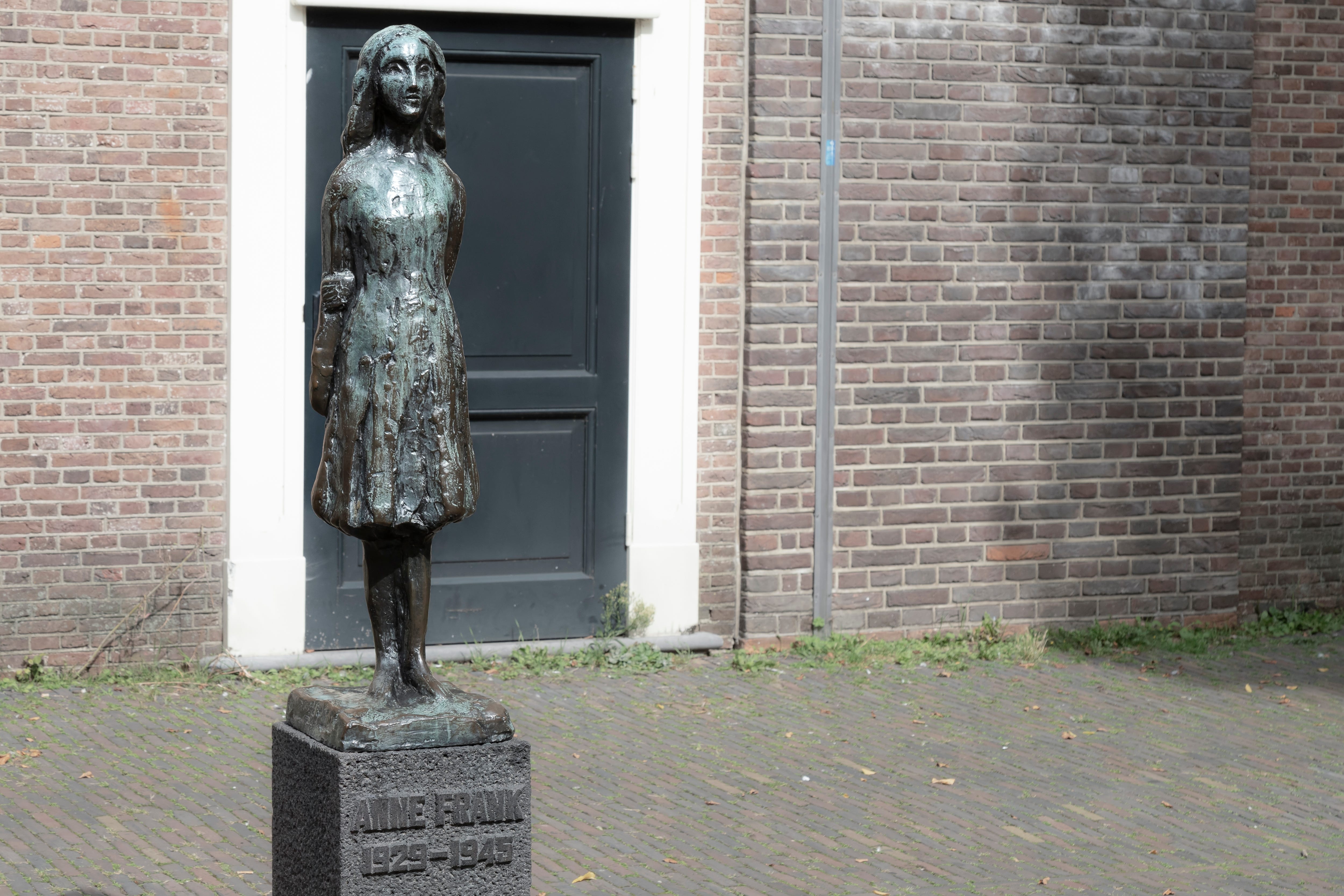
Governor Tim Walz said there are children hiding at home in Minnesota, just like Anne Frank in Amsterdam.
The United States Holocaust Memorial Museum issued a statement in response: “Anne Frank was targeted and murdered solely because she was Jewish. Leaders making false equivalencies to her experience for political purposes is never acceptable. Despite tensions in Minneapolis, exploiting the Holocaust is deeply offensive.”
What is Holocaust education for, if not this?
⁂
I have read the Diary of Anne Frank multiple times. The first was in middle school, where I wrote an essay on my impression of this girl’s thoughts while she was in hiding from the Nazis. I have returned to it since, as an adult, with different eyes but the same essential response: awe at her clarity, grief at her fate, and gratitude that her words survived even though she did not.
What strikes me most about Anne Frank’s diary is its universalism. She did not write as a political theorist. She did not write to document the specific mechanisms of Nazi persecution. She wrote as a child—a human being—experiencing fear, boredom, hope, love, and the constant knowledge that powerful men wanted her dead for reasons she had not chosen and could not change.
The diary endures because it is not merely a Jewish document, though it is that. It endures because it is a human document. It speaks to anyone who has ever been hunted. Anyone who has hidden. Anyone who has lived with the knowledge that the knock on the door could come at any moment.
That is why we teach it to children. That is why it sits in middle school curricula across America. Not so students can memorize the specific history of Nazi Germany—though that matters—but so they can recognize the patterns. So they can feel, in their bones, what it means when a state decides that a category of people are outside the protection of law. So they understand that this can happen anywhere, to anyone, and that they have a responsibility to prevent it.
If that is not what the diary is for, then what is it for? A museum piece? A historical curiosity? A tragedy safely contained in the past, invoked only to remember and never to warn?
⁂
The Holocaust Museum’s statement performs a kind of protective custody over Anne Frank’s memory. It says: she was targeted because she was Jewish. Her experience belongs to Jewish history. You may not borrow it for other purposes.
The Holocaust has been cheapened by careless comparisons. Every inconvenience is “literally Hitler.” Every policy dispute becomes Kristallnacht. There is a real danger in overuse—the boy who cried wolf, the analogy that loses all meaning.
But there is also a danger in underuse. In building such a high wall around the Holocaust that its lessons become inaccessible. In declaring that the only valid invocation is the exact repetition—same victims, same perpetrators, same mechanisms, same outcome.
Governor Walz did not say that ICE agents are Nazis. He did not say that the children of immigrants will be sent to gas chambers. He said there are children hiding at home in Minnesota, afraid of men with guns who want to take their parents away. And he said that their fear—the fear of a child in hiding—is something we have seen before.
Is this so offensive? Is this so beyond the pale?
The children hiding in Minnesota are not Jewish. The agents hunting their parents are not members of the SS. The endpoint, we pray, will not be extermination. But the experience—the terror of the knock on the door, the necessity of hiding, the knowledge that your family is not safe in your own home—that experience is not unique to Jewish history. It is a human experience. Anne Frank documented it with such clarity and power that her words have become the universal language for that particular kind of fear.
To say that this language cannot be used—that these children’s fear is categorically incomparable, that their hiding is a different species of hiding—is to betray the universalist legacy of the diary itself.
⁂
I struggle to believe that Anne Frank would be offended by Governor Walz’s invocation.
I say this knowing it is presumptuous. I cannot know what Anne Frank would think. She was murdered at fifteen, and she left us only her words—words that have been interpreted and contested and claimed by countless people in the eight decades since.
But I have read those words. I have sat with them. What I find in them is not a narrow particularism—not a claim that her suffering was unique and incomparable—but an expansive humanity. A girl who saw clearly that what was happening to her was wrong. Who believed that people were fundamentally good. Who hoped that her words might matter to someone, someday.
Would that girl—that girl with her innocent morality, her desperate hope, her clear eyes—would she look at children hiding from ICE in Minneapolis and say: your fear is nothing like mine? Would she say: do not invoke my name, because your suffering is lesser, your terror less valid, your hiding less real?
She would not. She would recognize them. She would see herself in them. Because she understood—as only someone who has been hunted can understand—that the particular reasons for persecution matter less than the fact of persecution itself. That a child’s fear is a child’s fear. That hiding is hiding. That the knock on the door sounds the same in every language.
⁂
The Holocaust Museum speaks of “tensions in Minneapolis.”
Let me tell you about the tensions in Minneapolis.
Federal agents have killed two people in less than three weeks. Renee Good was shot through the windshield of her car, point-blank, in the face, while trying to drive away. Alex Pretti, an ICU nurse who cared for veterans at the VA hospital, was shot ten times in the back while trying to protect a woman that agents had pushed to the ground. His phone was in his right hand. His other hand was raised above his head.
Three thousand federal agents occupy the city. They wear masks. They operate without meaningful oversight. They deploy tear gas on crowds, including children. When local police try to secure crime scenes, they are ordered away. When courts rule against them, they arrest the same people the next morning.
The Attorney General of the United States has sent a letter to Minnesota officials: ICE will leave if the state turns over its voter database.
These are not “tensions.” This is an occupation. This is state violence deployed against an American city to extract political concessions. This is the thing that Anne Frank’s diary is supposed to help us recognize.
And the Holocaust Museum’s response is to police the language of the governor who is trying to protect his people.
⁂
There is a certain kind of intellectual who believes that analogies to the Holocaust are almost never appropriate. That the Holocaust was so unique, so unprecedented, so categorically different from all other atrocities, that comparison is itself a form of desecration.
We have been listening to these intellectuals. We have been listening to them explain why we cannot call this fascism. Why we cannot invoke the Gestapo. Why Anne Frank’s name must not be spoken in connection with children hiding from ICE.
Their arguments are sophisticated. They invoke the specific history of Nazi Germany—the ideology of racial purity, the mechanized death camps, the six million. They note, correctly, that America in 2026 is not Germany in 1942. The camps are not built. The gas chambers do not exist. The endpoint, as yet, is not extermination.
And therefore, they conclude, the comparison is invalid. The invocation is offensive. The analogy cheapens the memory of the dead.
What this framework does in practice: it makes warning impossible. We cannot call it fascism until the fascism is complete. We cannot invoke the Gestapo until the camps are built. We cannot compare to Anne Frank until children are being loaded onto trains.
By the time the analogy is permitted, it is no longer an analogy. It is simply a description of what has already happened. The warning function—the entire purpose of remembering—has been disabled. The lesson of the Holocaust becomes: we will recognize the next Holocaust only after it has occurred. And then we will build museums to it, and we will say “never again,” and we will wait for the next one.
This is not sophistication. This is not moral seriousness. This is a machine for generating reasons not to act.
⁂
On the most recent episode of The Fifth Column, Michael Moynihan argues that the problem with invoking Nazis is that it empowers people to “punch Nazis.” And when you broaden the definition of Nazi, you open the door to violence against people who merely have “shitty ideas.”
This is his concern. This is what keeps him up at night. Not the federal agents killing people in Minneapolis. The hypothetical future violence that might be committed by people who take the Nazi comparison too seriously.
Moynihan is not worried about the violence being done by the state right now. He is not worried about Renee Good shot through her windshield. He is not worried about Alex Pretti shot ten times in the back. He is worried about the hypothetical future violence that might be done by people who take the Nazi comparison too seriously.
The actual bodies are less concerning than the theoretical bodies. The violence of the state is less alarming than the violence of those who might resist it.
This is the tell. This is how you know the concern is not really about protecting the memory of the Holocaust. It is about protecting the comfort of people who do not want to be implicated. Who do not want to face the possibility that they are living through something that demands more of them than commentary.
⁂
We have also been told that we should criticize the administration’s tactics without reaching for historical analogies. Call it “authoritarian.” Call it “police state tactics.” But do not invoke the specific history of fascism, because that history is contested and complicated and we might get the taxonomy wrong.
But notice: when someone calls the administration’s tactics “Chavista” or “KGB-like,” there is no outcry. When someone invokes Orbán or Erdoğan, the Holocaust Museum does not issue a statement. It is only the Nazi comparison—the one with the most moral weight, the one that most clearly demands action—that must be policed with such vigor.
This is not about historical accuracy. This is about moral deflection. The insistence on finding the exactly correct authoritarian analogy is a way of not reckoning with what is happening. It transforms an emergency into a seminar. It replaces action with taxonomy.
The house is on fire, and they are arguing about the chemical composition of the accelerant.
⁂
I want to talk about The Fifth Column podcast.
This is a show hosted by Kmele Foster, Matt Welch, and Michael Moynihan—journalists and commentators who position themselves as heterodox thinkers, skeptical of both left and right, committed to reason and nuance in an age of hysteria. They are, by their own account, the adults in the room.
I have listened to their recent episode on Minneapolis. I have listened to Moynihan scold Governor Walz for the Anne Frank comparison. I have listened to him explain, at considerable length, why we cannot call this fascism, why the Gestapo analogy is offensive, why Jonathan Rauch—a writer they claim to greatly respect—is wrong in his Atlantic piece arguing that yes, it is time to use the word.
And I have listened to them pivot, almost seamlessly, from policing the language of resistance to criticizing Walz for not having a “productive conversation” with Trump sooner. As if the problem in Minneapolis is insufficient diplomacy. As if two people died because the Governor didn’t pick up the phone.
I was told, some time ago, that I was considered “too confrontational” to be a guest on The Fifth Column. I found this interesting. Not because I was offended—I was not—but because it revealed something about the show’s function in the epistemic ecosystem.
The Fifth Column is a permission structure.
It gives its audience—educated, politically engaged, generally center-to-libertarian—permission to not take sides. Permission to see “both sides” as equally captured by hysteria. Permission to believe that the real danger is overreaction, not the thing being reacted to. Permission to feel sophisticated while doing nothing.
When Trumpistan does something monstrous, The Fifth Column finds the nuance. They interview historians about the precise definition of fascism. They debate whether the correct analogy is Mussolini or Chávez or Orbán. They express concerns, raise questions, and ultimately conclude that the people sounding alarms are being hysterical.
When the left does something the hosts find distasteful—a protest that gets out of hand, a university speech code, a clumsy statement by a progressive politician—the show focuses in. The nuance disappears. The judgment is clear.
The detachment is just so glaring. The inability to step out of this frame of false neutrality.
The show exists to make a certain kind of person feel good about their disengagement. It tells them: you are not ignoring an emergency. You are refusing to be manipulated by those who cry wolf. You are the reasonable one. The hysterics are the problem.
I am “too confrontational” for this show because I refuse to participate in the permission structure. I insist on naming what is happening. I decline to treat the occupation of Minneapolis as an occasion for seminars on comparative authoritarianism. When federal agents shoot a VA nurse ten times in the back, the correct response is not to ask whether the analogy to historical fascism is precisely calibrated.
Moynihan constructs his moral framework around capacity rather than intention. We cannot call it fascism, he argues, because the full apparatus of fascism has not yet been constructed. The camps are not built. The courts still sometimes restrain. Therefore the comparison is premature.
If one cannot deploy apt historical analogy as a cautionary tale of where things might lead if certain actions are not taken, because it risks evoking an emotional response in the public, then what even is the point of learning history? You cannot warn about a fire until the house has burned down. You cannot invoke the patterns of history until history has fully repeated. The lesson of the Holocaust becomes: we will know it when we see the camps. And not a moment before.
One could be mistaken for seeing this as apologetics. I do not think Moynihan sees himself as an apologist. He sees himself as a rigorous thinker, holding the line against rhetorical excess, refusing to let emotion cloud analysis.
The problem is that this rigor is selectively applied. The same show that demands precise historical taxonomy before we may call something fascism does not demand the same precision before calling campus protesters “woke mobs.” The same hosts who police the invocation of Anne Frank do not police the invocation of “cancel culture” or “left-wing authoritarianism.”
The rigor points one direction. The skepticism flows one way. And the effect—whatever the intention—is to provide cover for the side that is actually killing people.
That is the role The Fifth Column plays in the epistemic ecosystem. Not as propagandists—they are too smart for that, too genuinely committed to their self-image as independent thinkers. But as the reasonable voice that tells you the alarmists are wrong. As the sophisticated take that lets you feel good about not taking to the streets. As the permission structure for inaction, dressed up in the language of nuance.
I am too confrontational for their show. I will accept that as a compliment.
⁂
The memory of the Holocaust belongs to everyone. Not because everyone suffered it—they did not—but because the lesson is universal. The lesson is: this is what happens when a state decides that a category of people are outside the protection of law. This is what happens when good people do nothing. This is what happens when we wait too long to name the thing.
Anne Frank’s diary is taught in middle schools because we want children to recognize the patterns. To understand that the particular identity of the victim does not diminish the crime. To feel, in their bones, what it means to be hunted—so that when they see hunting, they will not look away.
Children are hiding in Minnesota right now. Not from the SS. From ICE. Not because they are Jewish. Because their parents came from somewhere else. The reasons are different. The fear is the same.
Governor Walz was right to invoke Anne Frank. Not because the situations are identical—they are not—but because the situations rhyme. Because the pattern is visible. Because the lesson of the diary is precisely that we must see ourselves in the hunted, whoever they are, and act before it is too late.
The Holocaust Museum’s statement, whatever its intentions, functions as a permission slip for inaction. It tells people: this is not that. You do not need to be alarmed. The strong language is offensive, not the atrocity it describes.
The intellectuals who police these comparisons—who insist that we cannot call it fascism, cannot invoke the Gestapo, cannot speak of Anne Frank—are performing a kind of moral sophistication that is, in practice, indistinguishable from complicity. They are building a wall around the lessons of history so high that those lessons become unusable. They are ensuring that “never again” means only “never again to those specific people in that specific way”—and therefore, functionally, means nothing at all.
⁂
Anne Frank died at Bergen-Belsen in February 1945. She was fifteen years old. The camp was liberated by British soldiers a few weeks later.
She did not live to see her diary published. She did not live to see it become one of the most widely read books in the world. She did not live to see generations of schoolchildren write essays about her, as I once did, trying to understand what it felt like to be hunted.
But she hoped for it. In her diary, she wrote about wanting to be a writer. About wanting her words to live on. About believing that what she was experiencing mattered—not just to her, not just to Jewish history, but to the human record.
She gave us a gift. The gift of her witness. The gift of her clarity. The gift of knowing, through her words, what it feels like to be a child hiding from men who want to kill her.
We honor that gift not by locking it away. Not by building walls around it. Not by declaring that it belongs to one people and one history and cannot be shared.
We honor it by using it. By letting it illuminate the present. By recognizing, when we see children hiding, that we have seen this before. That we know what it means. That we know what it demands of us.
Anne Frank cannot speak for herself. She was silenced at fifteen, in a camp in Germany, surrounded by death.
But her words speak. They have never stopped speaking. And what they say, to anyone with ears to hear, is: see me. See what happened to me. And when you see it happening again—to anyone, anywhere, for any reason—do not look away.
⁂
There are children hiding in Minnesota.
Their crime is being the children of immigrants. Their punishment is fear. Their fate is not yet written.
We know what this is. We have been taught to recognize it. We have read the diary. We have visited the museums. We have said the words: never again.
Now we will find out if we meant them.
Go Deeper into the Circus
Ten Shots

Alex Jeffrey Pretti was an ICU nurse at the Minneapolis VA hospital. He spent his days caring for American veterans—the men and women who served this country and came home broken in body or mind. He wanted to make a difference in this world. That is what his parents said, in a statement released hours after federal agents killed him on an American stree…
The Crisis, No. 3

When we take power—and we will take power—we are going to have to do some uncomfortable things.
Keep doing what you're doing Mike. The pointy heads who disagree with you don't comprehend the stark line between right and wrong. The systematic elimination of Native Americans was wrong, slavery was wrong, Jim Crow was wrong, The Holocaust was wrong, fascism is wrong, the genocide happening in Gaza is wrong, and I could go on and on. Anyone who tries to spin any of these wrongs as anything else is just saying they don't see it as wrong. There are gray areas in life, but things like this are black and white.
See it. Name it. Fight it. So glad the smug cowards find you too confrontational.