


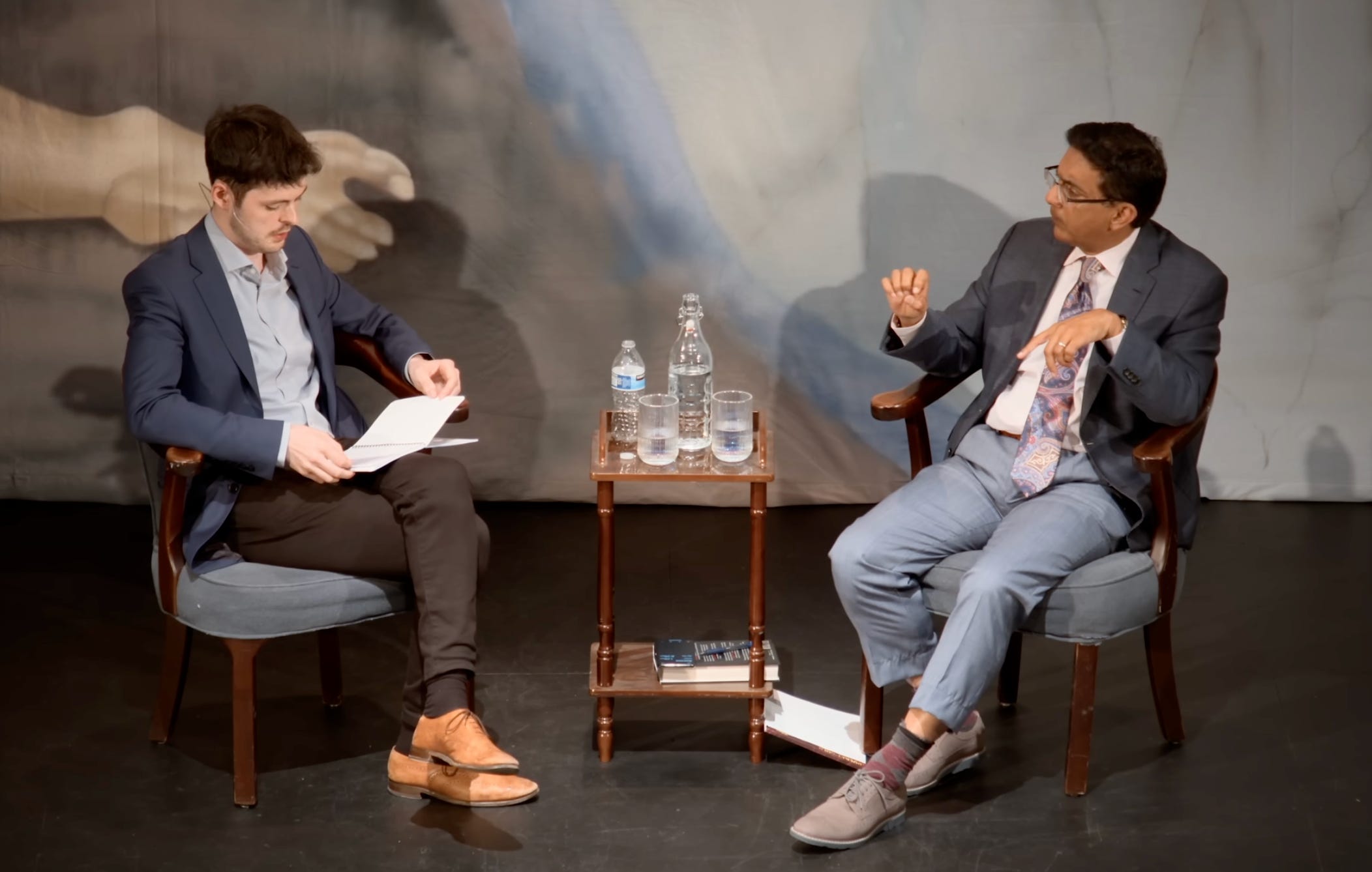
On June 1, 2024, Dinesh D’Souza debated Alex O’Connor in the Bronx on the question “Is the Bible true?” During an exchange about whether Genesis anticipated modern science, O’Connor pointed out that its creation account puts the earth before the sun; D’Souza asked to be shown the passage and said he had never noticed the problem. A man defending the scientific insight of Genesis had arrived unprepared for an objection from its opening chapter. Even the Catholic apologist Joe Heschmeyer’s response appeared under the heading Dinesh’s Debate Flop.
⁂
During the same debate, D’Souza appealed to the New Testament’s spirit of forgiveness when pressed about the biblical slaughter of the Amalekites. O’Connor objected that invoking Jesus could not somehow undo the immorality of the earlier slaughter. An appeal to moral progress leaves the apologist having to explain why the conduct being surpassed was attributed to God in the first place.
In Matthew’s Gospel, Jesus tells his listeners to love their enemies and pray for those who persecute them. That teaching gives me a Christian reason to reject the defense of slaughter. An apologist who invokes Jesus as the measure of moral progress has supplied a standard against which his own defense can be judged.
O’Connor has spoken of taking inspiration from Jesus, specifically the teaching to love one’s enemies. He need not believe in God to hold a Christian apologist to the standard of the Gospels.
⁂
New Atheism did face serious philosophical opponents: Daniel Dennett debated Alvin Plantinga in 2009, an encounter expanded into Science and Religion: Are They Compatible?. O’Connor nevertheless criticizes the movement’s “failure to seriously engage with the best philosophical depictions“ of God. He includes his own earlier work in that criticism, recalling a response to an argument by William Lane Craig that “completely misunderstands the argument”. An atheist can recognize a bad argument against God without acquiring a good argument for God.
A stage with a materialist on one side and a theologian on the other still leaves out the person who rejects both positions. That person may agree with the atheist’s criticism of religion while finding the atheist’s account of consciousness inadequate.
⁂
In the opening chapter of The God Delusion, Richard Dawkins describes an atheist “in this sense of philosophical naturalist” as someone who believes “there is nothing beyond the natural, physical world.” He also writes that human thoughts and emotions “emerge from exceedingly complex interconnections” of physical entities within the brain.
Dawkins is describing a particular kind of atheist. His account of mind requires an argument beyond the rejection of a supernatural creator.
Materialism holds that reality is wholly physical, including consciousness. Atheism concerns the existence of gods. If materialism fails, a theologian still has to make the case for God; if the theologian fails, the materialist still owes us an account of mind.
Consciousness could belong entirely to nature without nature being exhausted by what physics describes. Calling it “natural” leaves that possibility open.
⁂
Schopenhauer was an atheist whose philosophy treated mind and body as aspects of the same nature, neither reducible to the other. His account of the world’s inner character as “will” did not require a divine intelligence: he understood that will as blind and unconscious.
Bertrand Russell’s neutral monism explored a different possibility: mind and matter might both be understood through something more basic than either. In The Analysis of Mind, published in 1921, he described that basis as “neither mental nor material.”
Thomas Nagel, explaining Mind and Cosmos, rejected theism while seeking a “naturalistic, though non-materialist, alternative,” arguing that subjective experience requires an expanded understanding of nature. Showing that D’Souza mishandles Genesis would leave Nagel’s argument untouched.
Nagarjuna’s account of dependent origination challenges the idea that things possess an independent, fixed nature at all. His concept of “emptiness” means the absence of that independent existence, rather than a hidden substance beneath the world. We lose his argument if we make it audition as either an anticipation of materialism or a disguised theology.
⁂
The Discovery Institute’s Wedge document names the defeat of “scientific materialism” as a governing goal, alongside replacing materialistic explanations with “the theistic understanding that nature and human beings are created by God.” A non-materialist atheist can dispute the first position without granting the conclusion the document seeks.
The same person is inconvenient to an atheist who treats physicalism as the price of admission to rational inquiry. Their objection cannot be answered by exposing a contradiction in scripture, because scripture supplied none of their premises.
If the audience accepts that every challenge to materialism belongs to religion, the apologist can claim a constituency much larger than the argument warrants. The materialist can answer that constituency through its weakest spokesman, leaving the atheist objections to materialism unanswered.
⁂
I began as a strong atheist and am now philosophically agnostic about God, while believing that materialism cannot be true. Those judgments concern different questions, and neither obliges me to defend a creation story.
When I see someone and hear them speak, the sight and sound belong to one experience for me. I want to know how an account of physical activity explains that togetherness.
Saying that reality has physical and mental aspects leaves me with questions about their relationship. If a materialist can explain experience without that distinction, I want to understand how the explanation works. I have no reason to accept it because an apologist could not account for the first page of his Bible.

Go Deeper into the Circus
Complete the Way a Crossword Is Complete

In 1800, William Herschel put thermometers into the colors of sunlight separated by a prism. He wanted to measure their heat. The temperature rose toward the red end of the spectrum, but when he placed a thermometer just beyond the red, where he could see no light, it registered a still higher temperature. He had
An Argument in Three Costumes

In June, Geremie Barmé’s China Heritage ran The Longest Relay in its Seeds of Fire series, forty years on from the original volume of Chinese voices of conscience, on the anniversary of June Fourth. The series name is the diagnosis: the Substrate and the Longest Relay
The sequence of human beliefs over time started with magical thinking, leading to religious thinking and we are now at scientific thinking - a reductionism of being to components.
We will never comprehend how time has put the human existential machine together through the ages, the epochs, the periods, the eras and the eons from a single common ancestor.
We are foolish creatures indeed trying to explain why we are here - just accept the fact that you are a part and not the whole of everything.
I think it was Voltaire who said, of religion, that “doubt is indeed a disagreeable state, but certainty is a ridiculous one.” Thus I am in the camp of agnostics. I do have a question, though. If homo sapiens has been around for approx 300,000 years, what sort of a god would allow 298,000 years of humankind to languish without the hope of salvation Christianity claims to offer?