


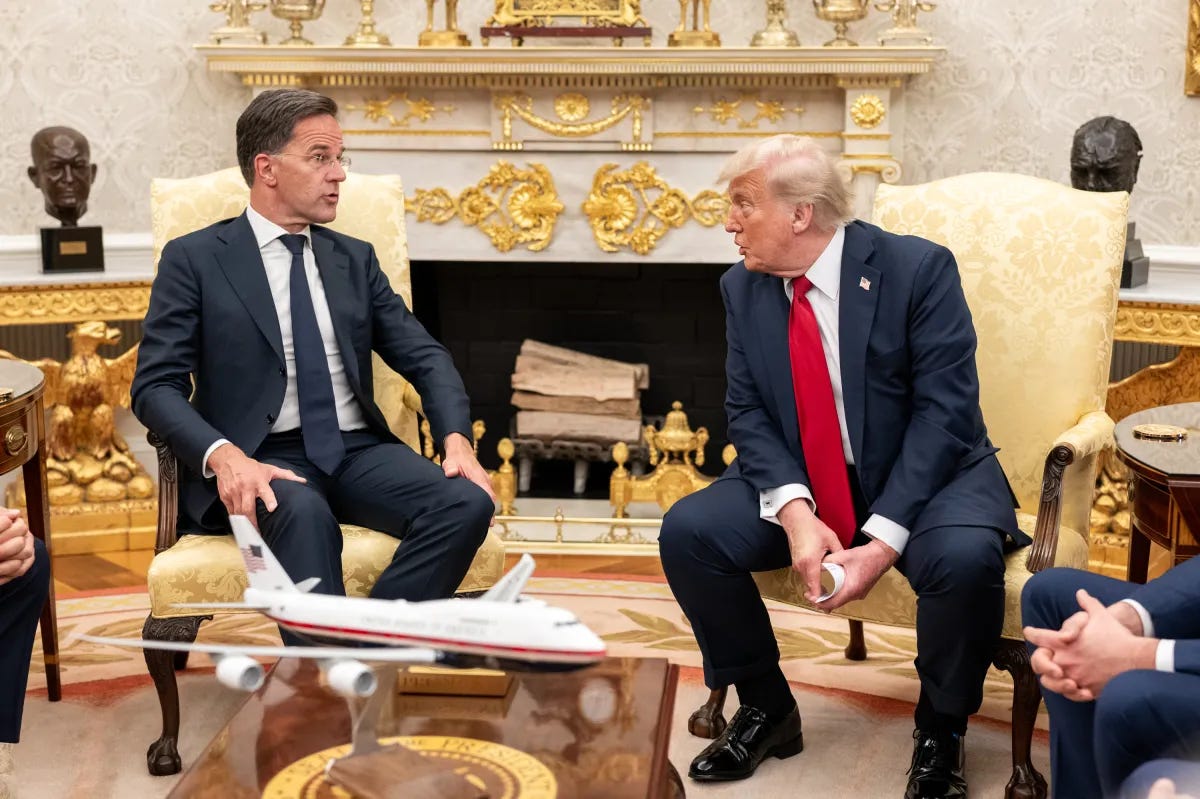
There is a video you should watch.
It is a man in a suit, in the Oval Office of the White House, arranging posters on easels. The man is Mark Rutte, the Secretary General of the North Atlantic Treaty Organization. The posters are charts. The charts have been prepared for the President of the United States. The President of the United States is sitting in the room. The Secretary General of NATO is walking him through the charts the way a substitute teacher walks a class through the parts of a sentence, with the patience of a person who has accepted that the audience requires this particular form of address. On one chart there is a phrase. The phrase is the Trump Trillion. The Secretary General of NATO is pointing at it. He is explaining, to the President of the United States, why the President of the United States should not be angry.
Watch the video. Watch it now. Watch the way the man with the posters has positioned them, the way he gestures at the numbers, the way the President’s defense secretary stands in the corner of the frame. Watch the room. Watch what the room is. Watch the carpet. Watch the desk. Watch the portraits on the walls. Watch a man arrive in that room with posters because the room now requires posters.
Then ask yourself what you felt while you were watching it.
⁂
The honest answer for almost everyone who has watched the video, including for me, is some version of not enough. Some version of of course. Some version of a tired half-smile, a comment about how diplomacy works now, an observation about Rutte’s tactical skill, a note about the daddy episode last year and how this is the next installment. Some version of the registration that this is, on the spectrum of degradations now available daily, not the worst. There were worse degradations earlier in the week. There will be worse ones next week. This one we file under the new normal, we move on, we click to the next tab, we open the email, we go on with our lives.
I want to say something difficult about that response. I want to say it as plainly as I can. The response is the problem. The response is, in the strict sense, the disease. The video is not the problem. The video is the symptom. The fact that the video does not produce in us, in 2026, the response that it would have produced in 1996 or 1976 or 1956 — the fact that we can watch the Secretary General of the alliance that has kept Europe from major war for three quarters of a century arrive at the White House with posters, and feel only a tired registration that this is how things go now — is the actual emergency. The video is footage of a degradation. The flatness is footage of the conditions that allow the degradation to continue.
Stop and feel it.
I am asking you, as a reader, to do something specific. I am asking you to refuse the reflex that has been trained into you over the past ten years. The reflex is the protective cynicism, the of course, the what did you expect, the rolling of the eyes, the dry meta-commentary, the we live in unserious times posture that has been so widely adopted that it has become its own form of seriousness — the seriousness of accepting that nothing is serious, deployed precisely so that nothing has to be felt. The reflex protects you. The reflex prevents you from feeling what the situation actually warrants. The reflex is also the thing that is killing the country.
Feel it.
Feel what an adult is supposed to feel watching the man whose job is to represent thirty-two democratic nations explaining, with posters, to the head of the alliance’s largest member, that the man is not being adequately credited for the spending increases the alliance has undertaken in response to a Russian war the alliance is supposed to be deterring. Feel the room. Feel the desk. Feel the office that Roosevelt sat in. Feel the chair that Kennedy sat in to face down a nuclear standoff. Feel the carpet that Eisenhower stood on when he addressed the country about the military-industrial complex. Feel the room across which Truman first authorized the alliance Rutte is now humiliating himself to preserve. Feel the eighty years of seriousness that built the institutions Rutte is reduced to flattering. Feel, in the same instant, that this is not a metaphor and not an exaggeration. The man brought posters. The posters were necessary. The man who needed the posters is the President of the United States. The Secretary General of NATO is doing the only thing available to him to keep the alliance from being detonated by a mood.
Feel it. Feel that this is what we have become. Feel that we are the country whose allies have to manage us the way a family manages an unstable elder relative. Feel that the institutions we built to lead the world are now being held together by foreign leaders’ willingness to publicly indulge our degradation. Feel that the videos we are watching are not isolated incidents. They are the texture of what we have become. They are the constant transmission, clip by clip, of what it now means to be a citizen of the country whose name is on the building Rutte walked into with his easels.
Feel the grief. The grief is the correct response. The grief is what you would feel if it were a parent. The grief is what you would feel if it were an institution you loved. The grief is the early warning. The grief is the body politic still able to register that something has gone wrong. The grief is the thing that is being eroded, clip by clip, by the protective reflex that converts grief into a tired half-smile and a click to the next tab.
⁂
The reflex has a history. It did not arrive on its own. It was cultivated, deliberately, by the political project that has been the subject of these pages for years. The cultivation is not a conspiracy theory; it is documented in the texts of the people who did it. The flooding of the zone. The deliberate production of so many outrages, so quickly, so consistently, that no single outrage can be held long enough to produce the response it warrants. The strategy is now textbook. Steve Bannon described it explicitly. The point is not to win any individual argument. The point is to exhaust the public’s capacity for response, so that the response, when it would normally arrive, no longer arrives, and the actions that would normally produce response can proceed without it.
The strategy has worked. The strategy has worked on me. The strategy has worked on you. The strategy has worked on the country. We can recognize the strategy and still be subject to it, because the strategy operates at a level below the cognitive level. The strategy operates on the body. The body cannot sustain the response that each new outrage warrants. The body adapts. The adaptation is the flatness. The flatness is not a failure of moral character; it is a physiological accommodation to an unsustainable level of stimulus. The body has done what bodies do. It has gone quiet, so that the organism can continue functioning.
The cost of the quiet is that the organism continues functioning while the conditions that should have triggered its response continue worsening. The organism cannot tell that it is dying. The organism only knows that the response system has gone quiet, and the quiet feels, from inside, like equanimity. The equanimity is the disease presenting as health. The composure with which we are absorbing the Rutte video is not composure. It is the symptom of an immune system that has been trained, by deliberate effort, to stop responding to the antigens it was built to respond to.
This is the situation.
It is bad. It is much worse than the daily texture of our consumption of it suggests. The discrepancy between the actual severity of the situation and the felt severity inside the population that is living through it is the central political fact of our moment. It is the thing that makes everything else possible. Without the discrepancy, the Rutte video would produce the response the video warrants, the response would translate into pressure, the pressure would translate into political consequence, and the conditions that produced the video would change. The discrepancy is what allows the conditions to continue. The discrepancy is the medium in which the operation runs.
Closing the discrepancy is the work. Not closing it once, in a moment of inspired response, but closing it as a daily discipline, by deliberately refusing the protective reflex, by allowing yourself to feel what the situation actually warrants, by maintaining the capacity for response that the strategy has been designed to anesthetize. The discipline is not pleasant. The discipline costs energy. The discipline produces, in the people who undertake it, a chronic low-grade exhaustion that is not the exhaustion of doing too much but the exhaustion of feeling at full strength what most of the population around you is no longer feeling. The exhaustion is the price of remaining responsive. The price is high. The alternative is higher.
⁂
I want to ask you to do a specific thing.
Watch the Rutte video. Watch it again. Watch it three times. Watch it with the sound on. Watch it slowly. Notice the room. Notice the posters. Notice the words the Trump Trillion and how the man pronouncing them is the Secretary General of the North Atlantic Treaty Organization. Notice that the room is the Oval Office. Notice who is sitting at the desk. Notice, as you watch, the impulse to deflect — the impulse to smile, to make a joke, to recall the daddy incident, to note Rutte’s tactical skill, to admire his diplomatic adaptation, to do any of the things the protective reflex offers you as alternatives to feeling what the video actually contains.
Refuse the impulse. Sit with the video. Let it work on you. Let yourself feel that this is the country you live in. Let yourself feel that this is what it has come to. Let yourself feel that the institutions you grew up understanding as the load-bearing structure of the world’s stability are being held together by one foreign politician’s willingness to publicly humiliate himself on their behalf. Let yourself feel that the man at the desk is the man whose hand is on the alliance. Let yourself feel the grief.
The grief is not weakness. The grief is not catastrophism. The grief is not partisanship or hysteria or any of the other dismissive labels the protective reflex offers to make the grief go away. The grief is the response a healthy political body produces to a degradation of this magnitude. The grief is what an immune system that has not been compromised does in the presence of an antigen this large. The fact that you may have trouble accessing the grief is a measure of the immune compromise. The work is to access the grief anyway.
This is the intervention. This is the only intervention available to a writer in 2026 who can see what is happening and who has to address an audience that has been trained, deliberately and successfully, to not see it. The intervention is not analysis. The intervention is not a new framework or a more precise account of what has gone wrong. The intervention is the demand that you feel. Feel it. Feel what your body is for. Feel what the body politic is for. Feel that the reflex to not feel is itself the most dangerous thing happening in the country right now, because it is the reflex that makes everything else possible.
The Rutte video is not the worst thing that has happened this month. It will not be the worst thing that happens next month. The worst things are not the individual events; the worst things are the events you do not respond to because you have been trained not to. The intervention is to be the person, in your circle, who does respond. Who watches the video and lets the grief arrive. Who says, out loud, this is not normal, I refuse the protective reflex, I am going to feel this in proportion to what it is. Not as performance. Not as social signaling. As an act of preservation — of the response system, of the moral immune system, of the capacity to register that something has happened, that this is not how things should be, that the institutions you love are being humiliated and that the humiliation should hurt.
Let it hurt.
The hurting is the beginning. Nothing else is available until the hurting starts. The strategy that has been deployed against the country is a strategy of preventing the hurting. The counter-strategy is the recovery of the hurting. The recovery is yours to undertake. No one else can undertake it for you. The institutions cannot save themselves; their survival depends on a population that can still feel their degradation. The population is you. The feeling is the work.
⁂
Watch the video.
Feel what your grandparents would have felt if you had shown it to them. Feel what your parents would have felt if you had shown it to them twenty years ago. Feel what you yourself would have felt if it had been shown to you in a different decade, before the strategy had done its work on you. Feel the gap between what you feel now and what you would have felt then. The gap is the measure of what has happened to you. The gap is the diagnosis.
Close the gap.
Not by pretending to feel more than you do. Not by performing outrage. By sitting with the video for the time it takes for the body to do what the body is for, which is to respond to what the eye is seeing. The response is slow because the response has been trained out of you. Let the training fail. Let the response come. Let the grief arrive on its own time, in its own form, with the weight that the situation actually carries.
This is the country. This is what it has come to. This is the room and the posters and the man and the easels and the alliance held together by one Dutch politician’s willingness to be undignified in public for our sake. This is the news. This is the texture. This is the daily life of a civilization in decline that has been trained not to notice that it is in decline.
Notice.
Feel.
The feeling is the resistance. There is no other resistance available. Everything else follows from this one.
Watch the video.
Let it hurt.
Go Deeper into the Circus
They Confirmed Her

The story that broke on Sunday in The Washington Post is being read as a story about a cult. It is not a story about a cult. It is a story about the United States Senate.
Friendship

There is a question that comes to most people in middle life, and it comes quietly, usually late at night, usually after a stretch of work that has required the person to be more than they were before. The question is: how many true friends have I actually had?
When I saw this video, I burned with anger. My father lost some of his hearing from being bunked next to the engine room on a troop ship that took him to the island of Tinian. He was there when the Enola Gay took off for its fateful mission to drop the atomic bomb. Dad’s brother, my uncle, was at the Bulge. That meeting was revolting, as disgusting to me as the one where Zelenskyy was humiliated by those fascist Putin-loving goons.
I've been grieving for this country since that fuckhead rode down the escalator.