


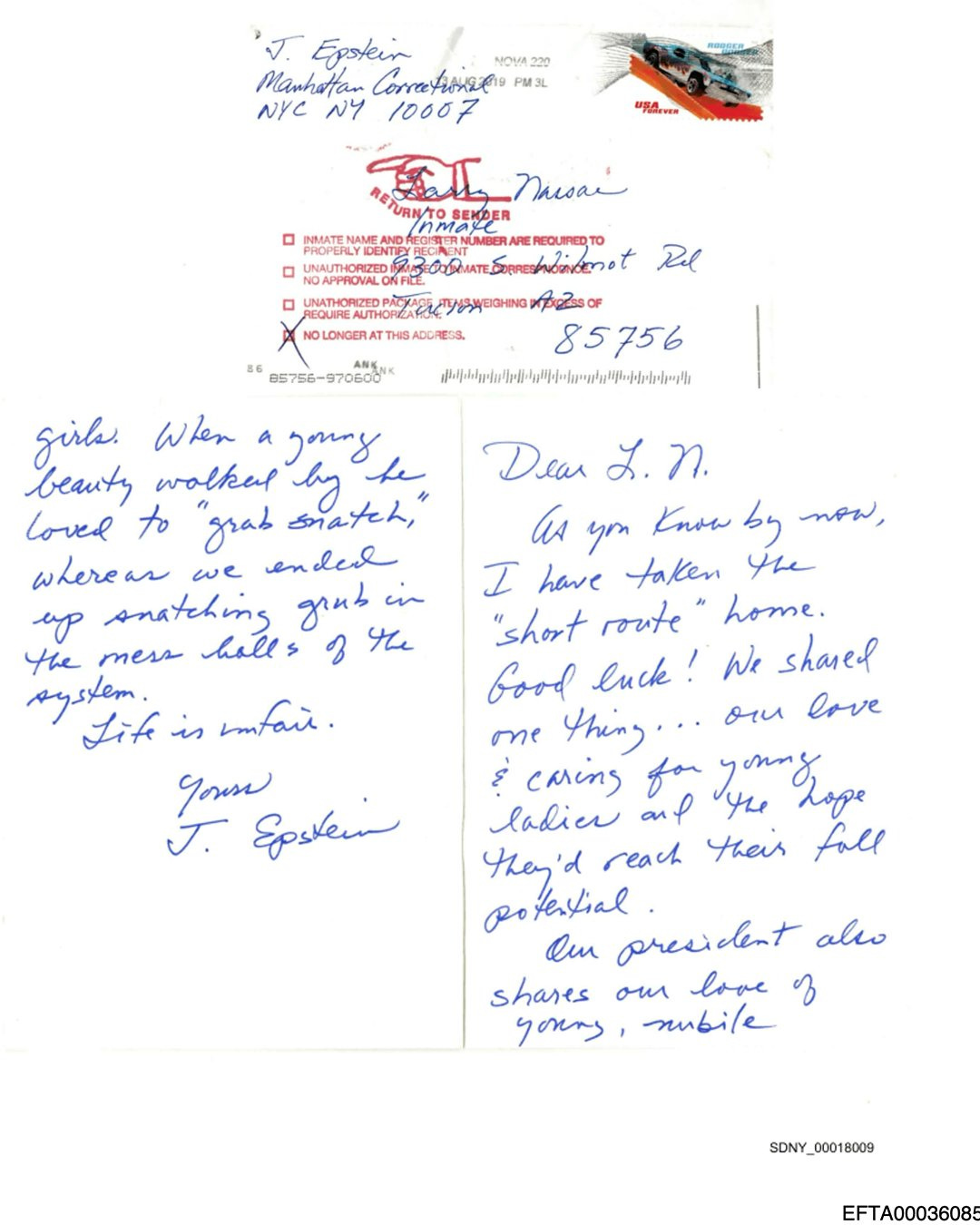
Well. After seeing the farewell letter allegedly written by Jeffrey Epstein to Larry Nassar—a letter that was briefly included in the DOJ’s Epstein files release before being pulled, now circulating widely on social media—I’m forced to advance a theory.
Let me be clear about what this is: informed speculation based on suspicious patterns, not proven fact. But the patterns are suspicious enough that the speculation deserves to be stated plainly.
The letter, if genuine, was postmarked days after Epstein’s reported death in August 2019. It references taking “the short route home.” It explicitly mentions “our president” who shares “our love of young, nubile girls” and loves to “grab snatch.” It was sent to another convicted sex offender, returned to sender, and submitted by investigators for handwriting analysis—though no conclusion has been made public about authenticity.
Here’s what I think happened, and I’ll tell you why:
I think Jeffrey Epstein tried to negotiate protection from Donald Trump. I think that negotiation failed. And I think Trump—or those acting on his behalf—gave Epstein a choice: do it yourself, or we’ll do it for you.
Why I think this:
Epstein had leverage. He had information about powerful people, including potentially about Trump. When you have that kind of leverage and you’re facing life in prison, you use it. You negotiate. You say: I can talk, or I can stay silent. What’s it worth to you?
Trump had motive. Epstein alive and talking represented enormous exposure risk. Epstein is dead, and the files are controllable, representing closure. The calculus isn’t complicated.
The death circumstances were suspicious. Guards not checking. Cameras malfunctioning. Timing convenient. This has been known for years. What’s new is the context: documents about these circumstances exist and are being withheld through statutory violation.
The letter, if genuine, reads like insurance or farewell. “Our president shares our love”—that’s Epstein saying: I can implicate you. The Trump “grab snatch” reference uses Trump’s own language. This isn’t subtle. This is: I have receipts, I will use them.
The bitterness in the letter is notable. “Life is unfair.” Not the words of someone who got the deal they wanted. The words of someone who got told: no protection, but here’s how it ends.
What I’m not claiming:
I’m not claiming I can prove this. I’m not claiming the letter is definitely authentic. I’m not claiming I know exactly what negotiation occurred or what Trump personally ordered.
I’m saying: this is my best guess about what the pattern suggests. And I’m saying it because the alternative—that all of this is a coincidence, that Epstein just happened to die under suspicious circumstances while holding leverage over powerful people, that files about his death just happen to be withheld through statutory violation—strains credulity.
Why this matters now:
The administration is violating congressional statute to withhold Epstein files. Attorney General Pam Bondi has released victim names while protecting perpetrator names. Documents that raise questions about the circumstances of death were briefly posted, then pulled.
The pattern of protection isn’t just about who visited an island. It’s about protecting information regarding the circumstances of death, the extent of the conspiracy, and potentially Trump’s involvement in whatever happened in those final days.
When Massie and Khanna demand full file release, when they prepare contempt proceedings against Bondi, they’re not just seeking gossip about wealthy men. They’re seeking answers about what happened to Jeffrey Epstein and who made it happen.
The responsible position:
Maybe I’m wrong. Maybe Epstein simply killed himself with no negotiation, no deal, no coordination. Maybe the suspicious circumstances are all a coincidence. Maybe the extreme file protection is just about embarrassment rather than criminality.
But I’ve looked at the pattern—the leverage Epstein had, the motive Trump had, the suspicious death, the letter referencing Trump and “short route home,” the illegal file protection, the documents being hidden—and my best guess is: something happened between them. Some negotiation occurred. And it ended with Epstein dead and files being protected through lawbreaking five years later.
I could be wrong. But the people who could prove me wrong—the administration officials withholding files in violation of statute—won’t release the information that would answer these questions.
So I’m stating my theory plainly: I think Trump was involved in the circumstances of Epstein’s death. I think Epstein tried to leverage his information for protection. I think he was told no deal, but given the option to end it himself. And I think the files being protected illegally contain evidence of this.
Prove me wrong. Release the files. Show the handwriting analysis. Explain the postmark date. Account for the suspicious death circumstances. Answer the survivors’ questions about who raped them and why those men stay protected.
Until then, I’m operating on the pattern in front of me. And the pattern says: powerful people did something they’re breaking the law to hide.
That’s not a conspiracy theory. That’s pattern recognition based on documented facts and suspicious circumstances. The difference matters.
Go Deeper into the Circus
Bari Weiss is Not on the Level

On Saturday, Bari Weiss—CBS News’s editor-in-chief—killed a 60 Minutes story about men deported to El Salvador’s CECOT mega-prison. The segment, reported by correspondent Sharyn Alfonsi, had been promoted publicly on Friday. It had been screened five times. Legal counsel cleared it. Standards and Practices cleared it. The story was factually correct.
A Conspiracy of Capital

Yesterday I published an essay diagnosing Balaji Srinivasan’s Network State vision as spiritually empty dissolution of civilization—governance as consumer choice, democracy as thing you shop for, exit replacing democratic constraint.
What I find darkly amusing about the whole thing is that Qanon was ‘right’ about the pedophile ring, but it wasn’t operating out of a pizza parlor, it was operating in the halls of governments around the world for three decades.
The analysis rings true because Ghislaine Maxwell has successfully employed the same playbook once her high visibility rendered her impossible to "be suicided."