


The funny thing about the Graham Platner is a Nazi strategy is that the more attention the anti-anti-Trump self-described libertarian commentariat puts on him, the more people get a clear look at him.
And what they see is not a Nazi. They see a likable, intelligent man with humane views.
The strategy requires the target to stay abstract, you see. But the target keeps showing up on camera. It’s very annoying for them. They don’t know what to do about it.
⁂
This is the problem with the strategy, structurally. It was designed for a target who would not, or could not, defend himself. It was designed for the political opponent who hides, who refuses interviews, who sends out only sanitized campaign communications, who stays at the safe distance from which the accusation can do its work without being contradicted by the accused. The accusation of Nazism is a high-yield weapon when deployed at distance. It produces immediate revulsion in the audience and the audience never has to encounter the human being against whom the revulsion is being directed. The human being is, by design, kept off-screen.
Mr. Platner refuses to stay off-screen. He sat for Pod Save America. He sat for Jon Stewart. He sits for local press in Maine. He sits for any podcast or video format that asks him to come on. He answers the questions. Including the hard ones. Including the ones about the tattoo. He is patient, articulate, visibly thoughtful, visibly exhausted in the way that working people are visibly exhausted, visibly the kind of person who knows what oysters cost and what the price of diesel does to a fishing boat’s margins. The audience encounters him. The encountering is the problem for the people who need him to remain abstract.
I have been thinking about why this commentariat ecosystem cannot course-correct as the encountering accumulates. The Reddit posts get litigated, the Pod Save America episode airs, the Stewart conversation airs, the long-form interviews stack up — and the Platner is a Nazi discourse, instead of softening as the evidence comes in, hardens. The hardening is not a bug. It is a feature of the ecosystem’s incentive structure. The anti-anti-Trump self-described libertarian commentariat is a brand identity, not an analytical framework. Brand identities cannot update against evidence because the brand is the asset. To update would be to admit that the previous position was wrong, which would damage the brand, which is the only thing the commentariat has built. So the position cannot be revised. The evidence has to be discounted, reframed, or ignored. The commentariat is not free to update. It is captured by its own brand.
⁂
This is what I want to name precisely. The commentariat I am talking about — the Fifth Column hosts, the Greenwald-Taibbi axis on Substack, the Walter Kirn register at County Highway, parts of The Free Press, the broader ecosystem of figures who have built audiences on the proposition that the people opposing Trump are worse than Trump — does not actually function as a libertarian intellectual tradition. It functions as a reactive contrarianism dressed in the costume of libertarianism. The actual libertarian intellectual tradition — the one that produced Nozick and Hayek and the careful arguments about distributed knowledge and the limits of state coercion — is engaged with serious questions and produces serious, falsifiable claims. This commentariat does none of that. It produces takes calibrated to provoke the audience that follows it, and the takes are calibrated by the audience’s hostility to the conventional left rather than by any positive intellectual commitment.
When you look at the actual content of what this commentariat produces, the libertarianism turns out to be aesthetic rather than substantive. Greenwald is happy to launder Hungarian Orbánism through anti-globalist framing. Taibbi is happy to platform Russian state-aligned narratives. The Fifth Column hosts are happy to laugh along with whatever the day’s contrarian frame happens to be. None of this is libertarian in any tradition I recognize. It is anti-anti-Trump, which is something else, which is a distinct political project with its own distinct logic, which the libertarian-aesthetic costume conceals.
The costume is the giveaway. Anyone who has actually read Hayek knows that The Road to Serfdom is, among other things, a sustained argument against the precise kind of charismatic-authoritarian populism Donald Trump represents. A genuine libertarian in 2026 would be the most consistent and forceful critic of the Trump administration in American public life. The fact that the self-described libertarian commentariat is instead the most consistent and forceful critic of Trump’s critics is the diagnostic. The label has come unmoored from the content. The content is anti-anti-Trump. The label is whatever the speaker can claim with a straight face.
⁂
So back to Platner. Why does he, specifically, break the strategy.
He breaks the strategy because he is the kind of person the strategy cannot survive contact with. He is a Marine. He is an oyster farmer. He is articulate without being slick. He is angry in the way that working people are angry — at the actual conditions of working people’s lives — rather than in the performative way that professional commentators are angry. He cannot be made into the figure the Platner is a Nazi discourse needs him to be, because the discourse needs him to be a creepy outsider with a hidden agenda and he is, transparently, a guy who has been working for a living in Maine and decided to run for Senate because he watched billionaires take more and more of what working people make.
The strategy needed an abstract Nazi-coded figure to project the accusation onto. What it got was Graham Platner. The mismatch is the strategy’s structural failure.
This is the larger pattern worth noting. The anti-anti-Trump commentariat has been, for a decade, building its brand on the claim that the people opposing Trump are hysterical, illiberal, prone to crying wolf about fascism, captured by a moralistic discourse that cannot recognize legitimate political opposition. The brand requires a steady supply of examples. Each example has to be deployed in a way that lets the audience confirm the prior — that the anti-Trump coalition is unhinged, that the fascism accusations are unserious, that the people calling things Nazi are the actual problem.
But the brand cannot survive the inverse case. The brand cannot survive a candidate who is being called a Nazi by a billionaire-funded ad campaign and who is, on inspection, obviously not a Nazi but also obviously a left-populist Democrat who threatens the donor class for entirely substantive reasons. To engage with the Platner case honestly would require admitting that sometimes the Nazi accusation is being deployed in bad faith by their own side, by the funded discourse the commentariat is structurally aligned with even when it claims independence. That admission would damage the brand. So the admission cannot be made. So the discourse has to keep insisting Platner is a Nazi, even as Platner keeps showing up on camera and making the insistence visibly absurd.
This exact same formation of forces would be talking about cancel culture or reciting the importance of free speech if Graham Platner were an actual fascist running in service of the Republican Party. Bari Weiss would be working with Tony Dokoupil on a feel-good human interest story for the CBS Evening News on Platner’s time as harbor master, while attacking the illiberals of the left who want to cancel him and deprive him of his First Amendment rights. That’s what would happen. Because that’s what these people are.
⁂
What is happening in real time, then, is the public exposure of a structural feature of this ecosystem. The audience that has been told for a decade that the anti-Trump coalition cries wolf about fascism is now watching that same coalition’s commentariat-adjacent ecosystem cry Nazi about a Democratic Senate candidate from Maine. The contradiction is visible. The audience is not stupid. Some portion of the audience is going to notice. Some portion is going to ask, quietly, why the people who told me the Nazi accusations were always overblown are now pushing the Nazi accusation themselves, and against a guy who is patently not a Nazi.
This is why the strategy is, in the longer arc, going to fail. Not because the commentariat will course-correct — they cannot, for the reasons named above — but because the audience will. Some part of the audience will register the contradiction and walk away. Brand identities decay when the brand starts to embarrass the people who bought into it. The Platner is a Nazi discourse is the kind of public embarrassment that, if Platner wins in November, will be remembered as the moment the anti-anti-Trump commentariat showed itself to be exactly what its critics had always said it was: not a serious intellectual project, not a libertarian tradition, but a brand calibrated to a market, willing to deploy any accusation the market would buy.
The target keeps showing up on camera. The commentariat keeps insisting on the abstract Nazi. The audience is watching both. The audience will draw its own conclusions.
They will conclude that they have been lied to by the people they trusted to tell them the truth.
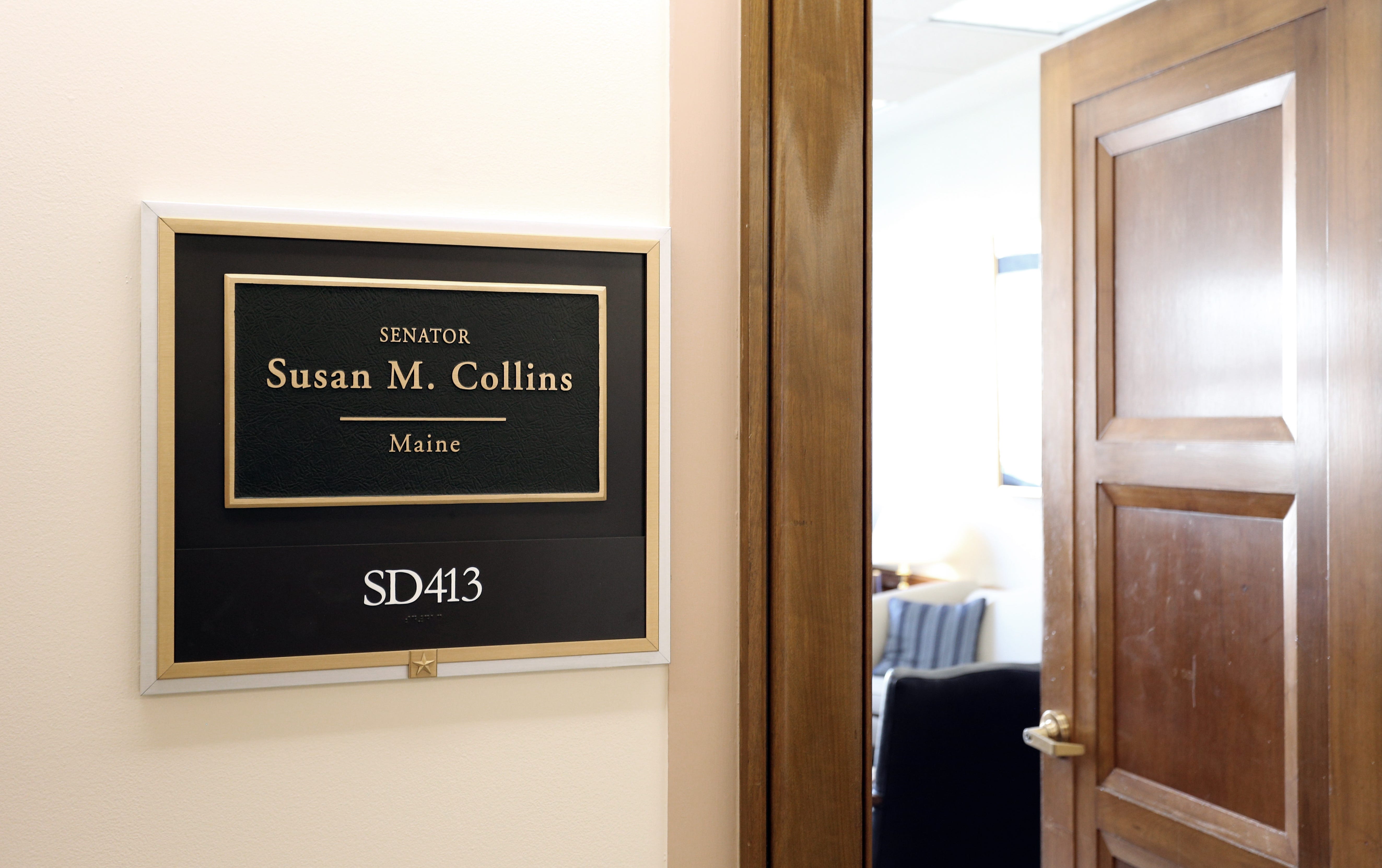
One thing they do seem to know now, is they have to do everything they can to keep Susan Collins in her seat. And boy are they going to spend money towards that end.
Ms. Collins has been in the Senate for thirty years. She has built her brand, with the assistance of a credulous press corps, on the proposition that she is a moderate Republican who is troubled, gravely troubled, by whatever the latest indignity her own party is inflicting on the republic happens to be. The trouble never quite reaches the point of action. It reaches the point of statement. She is troubled by Brett Kavanaugh’s temperament during the confirmation hearings, troubled enough to vote for him anyway, troubled later by the overturning of Roe that any honest reading of his record predicted. She is troubled by Donald Trump’s conduct in office, troubled enough to vote to acquit him in the first impeachment, troubled later when he did exactly what the impeachment had alleged. She is troubled by the conduct of the second Trump administration on every front from immigration to executive overreach to the termination of legal status for hundreds of thousands of Americans, troubled enough to issue concerned statements, troubled never enough to use the institutional power her position actually grants her. The troubling is the brand. The voting is the substance. The two have not aligned in three decades and there is no reason to believe they will align in a sixth term.
She is, in my judgment, the most consistently dishonest member of the Senate Republican caucus. Not the most extreme. Not the most ideological. The most dishonest — because the entire performance is structured around the gap between what she says and what she does, and the gap is sustained by a press corps that keeps reporting on her concern as though concern were the same as conscience. It is not the same. It has never been the same. The funded discourse going up against Mr. Platner knows exactly what it is buying. It is buying another six years of the gap.
⁂
I for one, endorse Graham Platner for United States Senate. I hope my fellow citizens in the great state of Maine will deliver him to Washington and bring an end to our long winter of unresolved concerns.

Go Deeper into the Circus
Graham Platner is Not a Nazi

Graham Platner is not a Nazi. I have met Graham Platner. I have talked to Graham Platner. About his tattoo, in fact. And I have serious people in my life that think I am somehow brainwashed as to not see Platner as a Nazi. And I realize some of these people really believe what they’re saying, and they think I’m really deluded to not see that Platner is …
The Industry’s Court in a Stolen Republic

On April 18, 2026, the New York Times published the most consequential breach of Supreme Court confidentiality since the Dobbs draft leak — and, I would argue, a more consequential one. Adam Liptak and Jodi Kantor obtained internal memos that the justices wrote to one another during the five days in February 2016 when the Court was deciding whether to b…
Fact check: Senator Collins is running for her sixth term, not fourth.
Also, I've seen it noted that the main reason Collins keeps winning is that she shows up to everything in Maine. People there know her, and they like her, and they're comfortable with having her as a Senator.
If anything, Platner's ability to rebuff the Nazi allegations is a side effect of his pursuing a similar strategy: show up everywhere, get to know people, convince them to vote for him by making a personal connection.
It seems to me the best advertising for Graham Platner are the people calling him a Nazi. In the entries for "dumbest thing done when young" getting a stupid tattoo (which seems to be his offense, speaking factually rather than mind reading) comes very low on the list. Personally I could beat it several times over.