



I honestly cannot understand how anybody cannot see that The Free Press is not merely an anti-left-wing rag, but an operation whose mission is to make people who have somewhat of a heart, and money and influence in the greater social strata of the elite classes, vote for right-wing power as the lesser evil. It is, in fact, very clear that this is the editorial goal of The Free Press. For people who worry capitalism will be eliminated by revolutionary Marxists on the far fringes of the left-flank of the Democratic Party, but recognize how evil the Republican Party has become, they provide just enough justification fuel to hold their nose and vote Republican anyway.
Let me be clear from the start: I’m not saying that pro-Palestinian campus protests aren’t newsworthy. Or that a lot of the leftist excess they document isn’t excess—it often is. But the whole enterprise is playing a salience game, one that is whitewashing the facade of the Republican Party that is what FDR would have recognized as now being beholden to a vanguard of economic royalists. Bari Weiss’s mission here, not disconnected from her pro-Israel views, is to talk to the person who feels guilty about voting for someone like Donald Trump—because he’s a liar, a thief, a tyrant—and give them a permission structure that says: “yes, but he’s the lesser evil. Look at all this scary left-wing insanity over here.”
The Architecture of Distraction
The Free Press doesn’t lie, exactly. That’s what makes it so effective. They document real things. Campus protests that do cross lines. Progressive activists who do say indefensible things. DEI initiatives that do sometimes produce absurd outcomes. Woke excess that does sometimes exist.
But journalism isn’t just about what you cover—it’s about what you emphasize. What you place on the front page versus what you bury. What becomes a multi-part investigation versus what gets a brief mention. What frame you use to interpret events. What patterns you construct from the noise of daily occurrence.
This is the salience game. Not lying about facts, but manipulating what facts feel important. Creating a distorted sense of threat through editorial curation rather than through fabrication
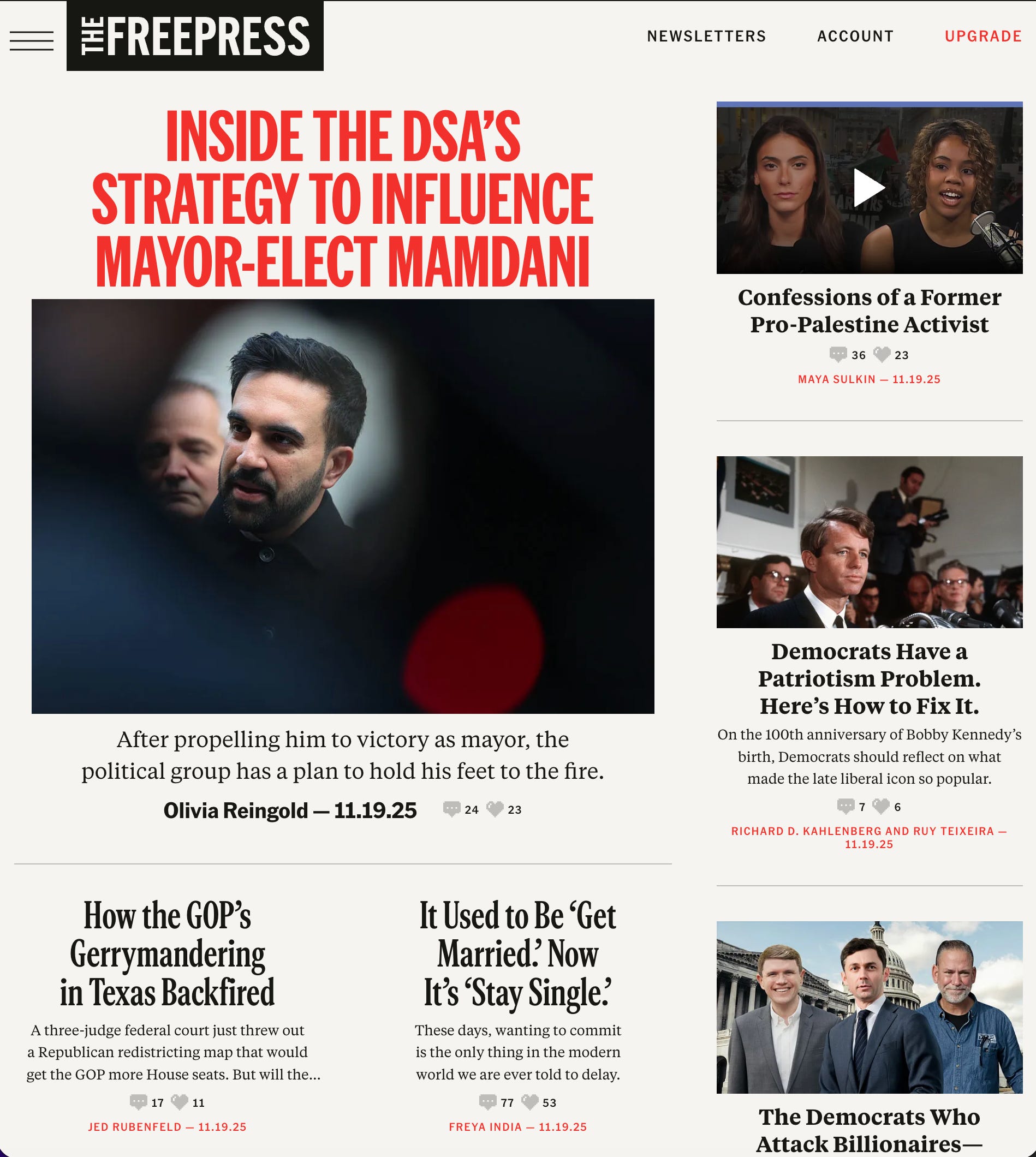
Look at The Free Press homepage on any given day. You’ll find detailed coverage of campus protests against Israel, trans activists demanding accommodation, progressive prosecutors who won’t prosecute certain crimes, teachers unions resisting education reform, DEI consultants making corporations do embarrassing things, Democratic Socialists winning local elections, and “cancel culture” claiming another victim.
What you won’t find—or will find buried, minimized, framed as unfortunate but understandable—is coverage of economic elites systematically capturing regulatory agencies, Republican officials openly discussing plans to dismantle democratic institutions, corporate consolidation eliminating competition across industries, wealth inequality reaching levels that make democratic crisis worse, climate policy being written by fossil fuel executives, immigration enforcement killing people in custody under suspicious circumstances, or algorithmic censorship by the richest man on earth who now has government power.
The pattern is consistent: threats to elite economic interests are presented as existential. Threats to democracy are presented as unfortunate side effects of fighting the real enemy.
The Target Audience
The Free Press knows exactly who they’re talking to. They’re not speaking to MAGA Republicans who don’t need permission to vote for Trump. They’re not speaking to committed progressives who won’t be convinced.
They’re speaking to a very specific demographic: educated, wealthy liberals who are uncomfortable with Republican cruelty but more uncomfortable with anything that might threaten their economic position.
These are people who live in coastal cities and send their kids to private schools, who work in finance, tech, law, consulting, or medicine. They consider themselves thoughtful and heterodox. They read longform journalism and listen to podcasts. They are genuinely disturbed by Trump’s behavior—but are more disturbed by the possibility of wealth taxes or healthcare reform. They feel guilty about their own privilege and need intellectual justification for protecting it. They want to think of themselves as reasonable moderates, not selfish elites.
For these people, The Free Press provides an essential service: it gives them permission to vote their economic interests while maintaining their self-image as principled truth-seekers standing up to authoritarianism (the campus kind, not the government kind).
The Permission Structure
Here’s how the permission structure works:
Step 1: Establish credibility through heterodoxy.
The Free Press positions itself as willing to say what the mainstream media won’t. They platform voices that have been “canceled.” They publish pieces critical of progressive orthodoxy. They frame themselves as brave truth-tellers risking their reputations to speak uncomfortable facts.
This is crucial. If The Free Press were just obviously right-wing, it wouldn’t work. They need to feel independent, heterodox, intellectually serious. They need to make readers feel smart and brave for reading them.
Step 2: Document real left-wing excesses.
This is where honesty becomes the tool of manipulation. The Free Press doesn’t need to fabricate stories about campus activists or progressive prosecutors because real examples exist. Some protests do cross lines. Some activists do say indefensible things. Some progressive policies do produce bad outcomes.
By documenting real excesses, The Free Press builds credibility. Readers think: “See, they’re not just making this up. This really is happening.”
Step 3: Present these excesses as existential threats.
This is where the salience game becomes manipulation. Yes, there’s a bad DEI training at some corporation. But is this a threat to Western civilization? Is this more dangerous than wealth concentration that makes democracy impossible? Is a college protest more threatening than billionaires capturing regulatory agencies?
The Free Press answers: yes. Through volume of coverage, through framing, through the emotional intensity they bring to these stories, they create the impression that campus radicalism is the most pressing threat facing America.
Step 4: Frame Republican authoritarianism as regrettable response.
When The Free Press does cover Republican overreach—and they do, occasionally, to maintain credibility—it’s framed as an understandable if unfortunate reaction to left-wing excess. Trump is bad, they acknowledge, but he emerged because of political correctness run amok. DeSantis’s authoritarian legislation is concerning, they note, but understandable given how woke institutions have become.
The implicit message: if the left hadn’t gone so crazy, none of this would be necessary.
Step 5: Tell readers they’re brave for seeing the truth.
Finally, The Free Press assures readers that recognizing the left as the real threat requires courage. You’re not being selfish by voting to protect your wealth—you’re being realistic about where the real danger lies. You’re not rationalizing support for authoritarianism—you’re making hard choices in difficult times. You’re not fooling yourself—everyone else is fooled by mainstream narratives.
This is the genius of it. The Free Press makes people feel heroic for doing what serves their material interests.
Economic Royalists Redux
Franklin Delano Roosevelt used a term in his 1936 speech accepting the Democratic nomination that perfectly describes what we’re witnessing: economic royalists.
“For out of this modern civilization economic royalists carved new dynasties. New kingdoms were built upon concentration of control over material things. Through new uses of corporations, banks and securities, new machinery of industry and agriculture, of labor and capital—all undreamed of by the Fathers—the whole structure of modern life was impressed into this royal service... It was natural and perhaps human that the privileged princes of these new economic dynasties, thirsting for power, reached out for control over Government itself. They created a new despotism and wrapped it in the robes of legal sanction... And as a result the average man once more confronts the problem that faced the Minute Man.”
Roosevelt understood what The Free Press obscures: that the greatest threat to democracy comes not from revolutionary leftists but from concentrated economic power that seeks to escape democratic constraint.
The economic royalists of Roosevelt’s time used fear of communism to prevent regulation and redistribution. The economic royalists of our time use fear of “woke” leftism to accomplish the same goal. The tactics evolve but the strategy remains constant: make people more afraid of economic reform than of oligarchy.
This is what The Free Press serves. Not truth. Not heterodoxy. But the interests of economic royalists who need the educated elite to tolerate authoritarianism rather than risk meaningful redistribution.
The Israel Connection
It’s not coincidental that Bari Weiss, The Free Press’s founder, comes out of pro-Israel advocacy. Much of what The Free Press frames as dangerous left-wing radicalism involves Israel-Palestine activism. Campus protests, activist rhetoric, progressive criticism of Israeli policy—these are presented not as legitimate political disagreement but as antisemitic extremism threatening Jewish safety.
I’m not arguing that antisemitism doesn’t exist on the left or that all criticism of The Free Press is fair. But look at the pattern: The Free Press gives extraordinary coverage to campus protests over Gaza while giving minimal coverage to, say, Republican officials openly discussing plans to dismantle civil service protections.
Why? Because their target audience—educated, wealthy, often Jewish liberals—is genuinely disturbed by some pro-Palestinian rhetoric. The Free Press speaks to their real fears and real discomfort. And then uses those real feelings to construct a narrative where the primary threat to America comes from college students with signs rather than from billionaires with government power.
The message is clear: yes, Trump is bad, but at least he won’t abandon Israel to campus radicals who want to destroy it. Yes, Republicans are authoritarian, but at least they won’t side with Hamas. Yes, you’re voting for someone you find morally repugnant, but you’re doing it to protect something you genuinely care about.
This is sophisticated manipulation because it starts with real emotions, real concerns, real values. And then redirects them toward political outcomes that serve entirely different interests.
What Actually Matters
On August 5th, 2025, Chaofeng Ge died in ICE custody in Pennsylvania. The official story: suicide by hanging. The autopsy report: he was found hog-tied with bedsheets binding his hands and feet behind his back.
The family’s attorney asked the obvious question: “It is truly mystifying how any detention facility can let someone leave their room, create three nooses and then hang themselves without anyone knowing.”
DHS offered boilerplate about taking deaths seriously and investigating thoroughly. No answers to how someone commits suicide while hog-tied. No emergency oversight. No congressional investigation. Just another death in custody filed away and forgotten.
This happened in August. Most Americans are learning about it now, in November. By tomorrow it will be memory-holed completely while we argue about whatever outrage is trending.
Did The Free Press cover this? Did they frame a man dying under physically impossible circumstances in government custody as a threat to constitutional governance? Did they investigate how American institutions have degraded to the point where such deaths occur and are simply accepted?
No. Because that’s not the threat their audience needs to worry about.
But a pro-Palestinian protest that gets heated? Front page coverage for days. Analysis pieces about the death of liberalism. Investigations into who funded the activism. Think pieces about whether American Jews are safe on campus.
This is the salience game in its purest form. A man dying hog-tied in government custody is less important than college students making Jewish students uncomfortable. State violence is less concerning than activist rhetoric. Actual authoritarianism is less threatening than woke excess.
The Lesser Evil Argument
Here’s the core con: The Free Press frames American politics as a choice between revolutionary Marxists who want to eliminate capitalism versus Republicans who are maybe a bit rough but at least respect property rights and won’t tax you into oblivion.
Never mind that the “revolutionary Marxists” have no meaningful power. The DSA has a handful of local elected officials. Bernie Sanders and AOC are Social Democrats proposing policies that would be center-left in most European countries. There is no serious movement with any possibility of seizing the means of production or eliminating private property.
Meanwhile, the Republican Party is actively dismantling democratic institutions. Not hypothetically. Not in the future. Right now. They’re purging civil servants who might resist illegal orders. They’re installing proprietary AI systems in government agencies. They’re conducting warrantless mass detentions. They’re giving billionaires direct government power. They’re openly discussing plans to end the independence of regulatory agencies.
But The Free Press says: worry about the college students. They’re the real threat.
This works because The Free Press’s audience has genuine wealth to protect. They’re not billionaires, mostly, but they’re comfortable. They have retirement accounts and real estate and children in expensive schools. They benefit from the system as it exists.
And The Free Press tells them: you’re not being selfish for wanting to protect what you’ve built. You’re being realistic. The left really would redistribute your wealth if they could. The campus radicals really do want to tear down everything you value. Your anxiety about economic reform isn’t greed—it’s rational concern about dangerous extremism.
This is permission structure in its purest form. It transforms “I’m voting to protect my tax rate” into “I’m defending civilization from revolutionary chaos.”
The Sophistication of the Con
What makes The Free Press particularly effective is how sophisticated the operation is. This isn’t crude propaganda. It’s not Fox News screaming about caravans. It’s thoughtful, well-written, intellectually serious-seeming content that makes readers feel smart rather than manipulated.
They platform interesting writers. They publish genuinely heterodox perspectives sometimes. They break real stories occasionally. They maintain enough independence to criticize Republicans when it’s safe to do so.
This is necessary. If The Free Press were obviously just Republican propaganda, it wouldn’t work for their target audience. These are people who pride themselves on being thoughtful and independent. They need to feel like they’re thinking for themselves, not being told what to think.
So The Free Press gives them the experience of independent thought while systematically directing their attention toward threats that justify voting against their stated values.
It’s the same game National Review played for an earlier generation—giving educated conservatives intellectual cover for positions they were going to take anyway for material reasons. William F. Buckley made it acceptable for smart people to oppose civil rights. Bari Weiss makes it acceptable for smart people to tolerate authoritarianism.
The tactics have evolved but the function remains the same: manufacture consent among the educated elite to preserve existing power arrangements against democratic challenge.
Why It Works
The Free Press works because it tells people what they want to hear: that their self-interest aligns with principle. That voting to protect their wealth is actually a courageous stand against authoritarianism (the campus kind, not the government kind). That they’re not being selfish—they’re being realistic about threats.
It works because the excesses they document are real. Some campus protests do go too far. Some progressive activists do say indefensible things. Some DEI initiatives do produce absurd outcomes. These aren’t fabrications.
But journalism isn’t just about reporting facts. It’s about constructing narratives from facts, deciding which facts matter, creating frameworks for understanding what you’re seeing. And The Free Press constructs a narrative where college students are more dangerous than oligarchs, where activist rhetoric is more threatening than concentrated power, where woke excess justifies tolerating fascism.
It works because their audience has real anxieties that deserve acknowledgment. People who have built comfortable lives through hard work do worry about instability. Jewish liberals do feel uncomfortable with some pro-Palestinian rhetoric. Parents do worry about their children’s education. These feelings are real and legitimate.
The con is in how these legitimate concerns get redirected. Your anxiety about campus radicalism is real—but is that really the biggest threat you face? Your discomfort with activist rhetoric is understandable—but should that determine how you vote when democracy itself is at stake?
The Free Press says yes. And they make it feel brave to say yes. They make it feel like clear-eyed realism rather than rationalization. They make it feel like you’re standing up to authoritarianism rather than enabling it.
The Revealed Preference
When you look at what The Free Press covers versus what it ignores, the editorial mission becomes undeniable.
A socialist wins a city council seat: crisis requiring multiple essays about the death of liberal values, investigations into the candidate’s views, hand-wringing about whether Democrats have lost their mind, speculation about whether this represents a broader trend.
A man dies hog-tied in government custody: silence.
A campus protest over Gaza: front page coverage for days, interviews with students who felt threatened, analysis of whether universities are doing enough to protect Jewish students, investigations into who funded the protests.
Elon Musk algorithmically suppressing substantive political critique on the platform he owns while holding government power: nothing, or briefly mentioned as an unfortunate side effect of the platform’s general chaos.
Progressive prosecutor declines to prosecute some low-level offenses: major investigation into whether this represents a breakdown of law and order, interviews with victims, analysis of crime statistics, speculation about broader implications.
ICE conducting warrantless mass detentions: not mentioned, or framed as necessary border security.
This isn’t balance. This isn’t heterodox thinking. This is serving a very specific class interest while pretending to be brave truth-tellers.
The preference is revealed: threats to elite economic interests are existential. Threats to democracy are unfortunate side effects of fighting the real enemy.
What FDR Would Recognize
Roosevelt would recognize this immediately. He faced the same forces, using the same tactics, with the same goal.
The economic royalists of the 1930s used fear of communism to resist regulation. They said: yes, there are problems with capitalism, but the alternative is Soviet totalitarianism. Yes, there’s suffering, but government intervention will make it worse. Yes, there’s inequality, but redistribution will destroy prosperity.
They were wrong then. The New Deal didn’t destroy capitalism—it saved it by making it sustainable. Regulation didn’t end prosperity—it created the greatest middle class expansion in history. Democratic constraint on economic power didn’t produce tyranny—it prevented it.
But they almost succeeded in preventing reform because they convinced enough educated elites that the real threat came from below rather than from concentrated power.
That’s what’s happening now. The Free Press and similar operations are convincing educated elites that the real threat comes from campus radicals and progressive prosecutors rather than from billionaires systematically capturing democratic institutions.
And it’s working. People who know Trump is a tyrant vote for him anyway because they’ve been convinced that college students are more dangerous than oligarchs. People who recognize Republican authoritarianism tolerate it because they’ve been convinced that the alternative is revolutionary chaos.
The Stakes
This isn’t just about media criticism. It’s about whether American democracy survives.
We face genuine threats. Climate change that requires coordinated response. Wealth concentration that makes democracy mathematically impossible. Technological change that could eliminate meaningful work. Authoritarian movements that would replace democratic deliberation with algorithmic governance.
None of these threats can be addressed while we’re arguing about campus protests and DEI initiatives. None of these challenges can be met while educated elites are convinced that the greatest danger comes from the left rather than from concentrated power.
The Free Press isn’t just distraction—it’s systematic misdirection at precisely the moment when clear vision is most necessary. It’s sophisticated propaganda designed to prevent the educated elite from recognizing who their real enemies are.
And it’s working. Which is why it needs to be named.
The Choice
I’m not saying The Free Press should be banned or censored. I’m not even saying they shouldn’t cover campus protests or progressive excess.
I’m saying we should recognize what they are: not heterodox truth-tellers but sophisticated manufacturers of permission for educated elites to abandon democratic principles rather than risk economic redistribution.
I’m saying we should understand the salience game they’re playing: not lying about individual facts but distorting what matters through editorial emphasis.
I’m saying we should see through the permission structure they provide: making people feel brave for voting their material interests against their stated values.
I’m saying we should remember what FDR understood: that the greatest threat to democracy comes from economic royalists, not from campus radicals.
The choice isn’t between revolutionary Marxism and tolerating authoritarianism. It’s between democracy that constrains power and oligarchy that calls itself freedom.
The Free Press is trying to convince you that college students are more dangerous than the people murdering detainees in custody. That activist rhetoric is more threatening than algorithmic censorship by billionaires with government power. That woke excess justifies voting for tyrants.
It’s a lie. Not in the individual facts they report, but in the pattern of emphasis they create. Not in what they say, but in what they make you care about.
And if we don’t see through it, we’ll wake up one day in the world the economic royalists are building: one where democracy exists in name only, where power is concentrated in the hands of those who claim competence justifies their rule, where dissent is algorithmically disappeared, and where people die in government custody under impossible circumstances while we argue about campus speech codes.
The circus continues. The tent burns. And The Free Press hands out programs explaining why the real problem is the people trying to put out the fire.
Go Deeper into the Circus
They Don’t Understand Orwell. At All.

How charming it must be to invoke George Orwell while cheering the richest man on the planet as he systematically buries dissent on the platform he purchased with the explicit promise of “free speech absolutism.” How delightfully convenient to wave Nineteen Eighty-Four
On Seeing Clearly Without Losing Your Mind

I put out a meditation yesterday, and it elicited concern from some people who know me. I am both surprised and existentially amused by this. But the discussions the piece caused have made me want to dig deeper here into the philosophical question that hides behind the mythopoetry. Why it’s not empty sentiment. Why it attach…
"People who recognize Republican authoritarianism tolerate it because they’ve been convinced that the alternative is revolutionary chaos."
The really disturbing and sad truth is that the longer the publishers, writers, and readers of "The Free Press" continue to tolerate authoritarianism, the more likely that they will eventually be confronted by revolutionary chaos, and lose everything that they are trying so desperately to protect.
You really nailed it! Many thanks for your words and thoughts.