


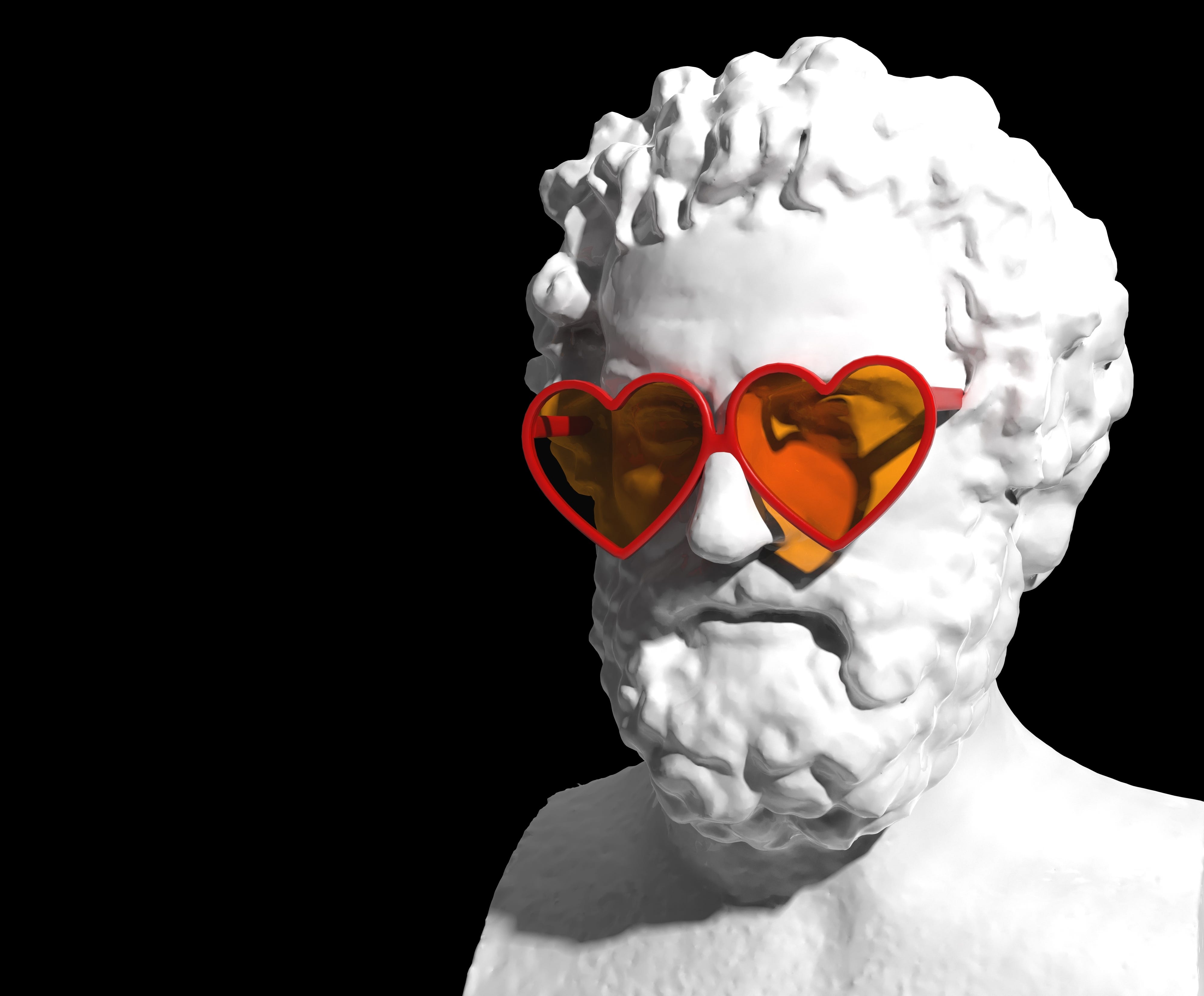
We teach children that Western civilization began with Greece. We show them the Parthenon. We mention democracy. We tell them that a man named Socrates asked a lot of questions and was executed for it, and that this was unfortunate, and that his student Plato wrote it all down, and that this is why we have philosophy departments.
This is one of the greatest failures of pedagogy in human history.
Because what actually happened in Athens in 399 BC was not a philosophical footnote. It was the founding act of everything we call Western civilization. And the man who performed it was not merely a great thinker. He was, by any serious application of Aristotelian virtue ethics — courage measured against cost, principle measured against consequence, commitment measured against the available alternatives — the greatest hero in the history of the human species.
⁂
Before Socrates, political change was a matter of power. Who had the army. Who had the gold. Who could build the coalition of aristocrats necessary to take or hold the city. The mechanisms of political transformation were entirely material. You changed the regime by changing who controlled the instruments of force. This was true in Egypt. In Persia. In every civilization that preceded Athens. Power justified itself by existing. The king was the king because he was the king. The arrangement of authority was not answerable to anything outside itself.
Socrates introduced a different mechanism entirely. He proposed that the legitimacy of power was answerable to reason. That the man with the sword was obligated — not just by custom or by the gods, but by the structure of argument itself — to justify his authority. That the question “by what right do you rule?” was not sedition. It was the most important question a citizen could ask.
He did not write this down. He walked into the marketplace and asked it. He asked it of generals and politicians and poets and craftsmen. He asked it with the relentless, cheerful, maddening precision of a man who genuinely wanted to know the answer — and who understood, better than anyone around him, that the powerful never had one.
High society found him irritating. This is always how it goes with the genuinely revolutionary. They are not recognized as revolutionary in the moment. They are recognized as annoying. As destabilizing. As the kind of person who makes important people uncomfortable at dinner parties by asking why they believe what they believe.
The jury of five hundred Athenians voted to execute him for impiety and corrupting the youth. What they meant was: he would not stop asking the question.
And here is where the heroism becomes precise.
His friends arranged his escape. The dialogue Crito records the offer — the boat was ready, the plan was in place, exile was available. Socrates could have lived. He was seventy years old. He could have gone to another city, continued his conversations, died in his bed.
He declined. He drank the hemlock. On purpose. In public. With the calm of a man who had settled a question.
The question he settled was this: you can kill the man, but you cannot kill the argument. That the argument is more durable than the power that tries to silence it. That dying for the principle is the most powerful demonstration of the principle that has ever been devised.
By choosing the hemlock over exile, Socrates did something no one had done before in the history of human civilization. He made the argument immortal by refusing to outlive it.
Before Socrates, the sword was always ahead of the word. Power preceded argument. Force preceded reason. The blade determined what could be said and by whom and for how long. After him — through this gift, this one voluntary act on a morning in Athens — the word precedes the blade. The argument outlasts the execution. The question survives the silencing. This is not a metaphor. It is the operating principle of every free institution the Western world has ever built.
⁂
What happened next is the proof.
His students — Plato, Phaedo, Crito, and the others who loved him and were young and did not want him to die — wrote it down. They wrote down the arguments. They wrote down the dialogues. They copied them and taught them and founded schools to preserve them. Not because they were commanded to. Because a man they loved had shown them, by the manner of his death, that the argument was worth preserving at any cost.
Those ideas traveled. They reached Rome, where the Stoics built on them — Epictetus, Marcus Aurelius, Cicero — adding the insight that the Socratic commitment to reason and virtue was not just a philosophical position but a way of living, a daily practice available to every human being regardless of their station. The slave Epictetus and the emperor Marcus Aurelius were both Stoics. The tradition had already begun its work of distributing dignity more widely than power had ever distributed it.
Those ideas traveled further. They entered the bloodstream of the Enlightenment. They became the philosophical foundation on which Jefferson built the argument that all men are created equal — that dignity is not granted by kings but inherent in the capacity for reason that every human being possesses. The Declaration of Independence is a Socratic document. It asks power to justify itself. It insists that it cannot.
Every political revolution in the liberal tradition — the English Civil War, the American founding, the French Revolution, the abolitionist movement, the suffrage movement, the civil rights movement — begins with the same move. Someone stands up and says: the existing arrangement of power cannot justify itself by the standards that power itself has implicitly acknowledged. You claimed legitimacy. We are here to ask you to demonstrate it.
That move was invented in Athens, in the marketplace, by a short ugly man with no money and no army who spent his days asking embarrassing questions and his evenings drinking wine with young men who loved him.
And it was sealed — transmitted into permanence — by his choice to drink the hemlock rather than abandon it.
This is what we should tell children. Not that Socrates was an important philosopher. That he was the first political revolutionary in human history. That every free institution we have ever built rests, at its foundation, on the act of courage he performed on a morning in 399 BC. That we are his heirs. That the tradition he founded is our inheritance. That it is worth defending.
That it demands defending. Right now. Today.
But there is a second story inside this one, and it is the story of how we lost the thread.
Socrates did not just found the political tradition. He held, in the act of his questioning, a particular understanding of what a human being is. The questioner is not separate from the question. The observer is not separate from what is observed. The man in the marketplace asking “what is justice?” is not a detached scientific instrument measuring an external phenomenon. He is inside the question. His life is at stake in the answer. The inquiry and the inquirer are one thing.
This is the middle position. And for two thousand years, it held.
Then Descartes made his cut.
In 1637, René Descartes sat down to establish what could be known with certainty, and concluded that the only thing he could not doubt was the fact of his own doubting — cogito ergo sum, I think therefore I am. This seems modest. It was not. What Descartes actually did was split the universe in two. On one side: the thinking thing, the res cogitans, the mind. On the other: everything else, the res extensa, the material world that the mind observes but does not belong to.
This was a revolution in philosophy. It made modern science possible. It also severed the connection between the observer and the observed that Socrates had taken for granted — that every serious philosophical and spiritual tradition, East and West, had taken for granted — and it has never quite been reattached.
The Copernican principle finished the job. The methodological commitment to treating the human observer as nothing special — as one object among objects, as epistemically average, as a bias to be corrected for rather than a perspective to be inhabited — migrated from astronomy, where it belonged, to epistemology, to pedagogy, to ethics. It became the operating assumption of educated Western thought: that any account of human experience that treats humans as significant is a form of self-flattery. That the properly detached scientific view is the true one. That meaning is what you add to the facts, not what the facts contain.
The result is a civilization that can build anything and cannot tell its children why any of it matters. A history curriculum that teaches dates and causes and power structures and says nothing about what it means that a man chose death over silence — and that choice echoes forward through every free institution we have ever built.
⁂
But the Cartesian pathology did not remain in the philosophy departments. It migrated. It found, in our own time, its most ambitious and most dangerous political expression. And to understand what is happening to the republic right now, you have to see it as the latest chapter in this very old story.
Here is the move, stated plainly. If you take the Cartesian cut seriously — if you accept that the observer is separate from the observed, that the subject is separate from the object, that the human community is separate from the forces that govern it — then you will eventually arrive at the conclusion that the best governance is governance without deliberation. That the best money is money without politics. That the best rules are rules that cannot be argued with, because they are not human rules at all. They are mathematical ones.
This is Bitcoin. Not as a technology — the technology is real and the engineering is genuine. But as an ideology. As the political project that has been constructed around it and that now sits, with the full backing of the American executive branch, at the center of a proposed Strategic Bitcoin Reserve.
Follow the genealogy. In 1997, James Dale Davidson and William Rees-Mogg published The Sovereign Individual, a book that became required reading among Silicon Valley elites. Its thesis: digital technology would allow wealthy individuals to escape the nation-state entirely. To become sovereign. To exit. To take their capital beyond the reach of democratic communities, democratic taxation, democratic deliberation. The nation-state was legacy technology. The sovereign individual was the upgrade.
That book shaped a generation of Silicon Valley thinking. It runs directly through Peter Thiel, who funded the Founders Fund on its premises. Through Curtis Yarvin, whose neoreactionary philosophy elaborated the Sovereign Individual’s political implications — that democracy is, in his words, “a shortcut to tyranny,” that what is needed is a competent executive unencumbered by the legislative process, that Retire All Government Employees is not a joke but a program. Through Balaji Srinivasan, whose Network State provided the infrastructure vision: digital communities governed by code, bound by cryptocurrency, sovereign to themselves, answerable to no democratic body.
I traced this network in detail in The Plot Against America. The architecture is visible to anyone willing to look. A network of tech oligarchs who believe democracy is obsolete technology. Who see the American government as legacy code to be disrupted. Whose vision for the future is a world made safe for stateless capital — free from democratic regulation of markets, trade, and labor. Yarvin’s RAGE doctrine — Retire All Government Employees — is being implemented in real time. Srinivasan’s network state is being wired into Treasury payment systems. The sovereign individual is no longer a thought experiment. He is in the building.
And Bitcoin is his reserve currency.

This is the Cartesian cut applied to money. Before Bitcoin, money was a convention — a social agreement, constituted by the community, answerable through democratic institutions to the community’s evolving needs and values. This is what David Hume understood: money is not natural. It is a human artifact, like property, like law, like the republic itself. It is downstream of the community that constitutes it. The word — the democratic deliberation of a self-governing people — precedes the blade.
Bitcoin’s founding claim is the precise inversion of this. The 21 million cap is not a political decision. It is mathematics. The algorithm cannot be argued with. The protocol does not deliberate. The community of users cannot vote to change the supply, cannot adjust the rules in response to human need, cannot exercise the sovereign judgment that democratic communities have always exercised over their monetary arrangements. The blade — the hard mathematical rule, fixed by a pseudonymous founder who has vanished — precedes the word. Forever. By design.
This is not liberation from corrupt institutions. It is the elimination of the institutional capacity for democratic deliberation over value itself. It is the Sovereign Individual’s exit from the community made monetary. It is the empire of exit with a blockchain underneath it.
And the men who built this project and are now installing it at the center of American monetary policy — these are not neutral technologists. They are the ideological descendants of a tradition that has been, since the beginning, a counter-revolution against the Socratic gift. Against the principle that power must justify itself to reason. Against the claim that the word precedes the blade. They have dressed the blade in mathematics and called it freedom. They have dressed the exit from democratic community in the language of liberation. And they have gotten further than anyone thought possible, because the Cartesian pathology had already done their work for them — had already persuaded the educated classes that objectivity requires the elimination of perspective, that the neutral view is the true view, that the human community’s claim on its own governance is a form of bias to be corrected.
Name them plainly. Peter Thiel, who has funded the post-democratic project for thirty years and whose fingerprints are on every institution that has been erected to replace democratic governance with algorithmic governance. Curtis Yarvin, whose philosophy is being implemented in real time by the people he mentored. Balaji Srinivasan, whose network state requires Bitcoin as its monetary infrastructure and who has spent a decade arguing that the nation-state should be disrupted the way Uber disrupted taxis — without asking the cities involved whether they consented. Elon Musk, who announced from his digital throne that Vox Populi, Vox Dei — the voice of the people is the voice of God — while building the tools to replace that voice with an algorithm. These are the villains of this chapter of the story. Not cartoon villains. Intelligent men. Serious men. Men who have thought carefully about what they want and have been strategically brilliant in pursuing it. But villains nonetheless — in the precise sense that they have devoted their considerable resources and intelligence to putting the blade back in front of the word. To reversing the Socratic gift. To building a world in which the question “by what right do you rule?” has no purchase, because the rulers are not people but protocols, and protocols do not answer to reason.
⁂
And yet.
The gates did not hold.
A year ago, I ended The Plot Against America with a warning. The oligarchs were whispering Vox Populi, Vox Dei as they locked the gates. They used the people’s voice as a mask while they silenced it. They built the network state on the premise that democratic deliberation was obsolete — and then used democratic elections to get into position to implement it.
But the plot required obscurity to function. It required the public to believe that DOGE was about efficiency, that the tech oligarchs were patriotic innovators, that the disruption of government was reform rather than demolition. That cover is gone. The ideology has been shown to the people. The Sovereign Individual has been named. The empire of exit has been mapped. The network state has been explained to ordinary citizens who did not sign up to have their republic replaced by a protocol. And they are not impressed.
Because the Socratic tradition is not dead. It went underground, as it always has when the powerful found it inconvenient. It was preserved by people who loved the argument more than they loved safety. It was transmitted person to person, candle to candle, in every generation that faced the same pressure to abandon it. And it is alive now, in the people who are reading the oath and meaning it, in the judges who are issuing the orders, in the citizens who are asking — in the marketplace, in the streets, in the comment sections and the letters to Congress and the protests on the Capitol steps — the oldest and most dangerous question a citizen can ask:
By what right do you rule?
They have no answer. They never did. That is why they needed the blade to precede the word. That is why they needed the mathematics to replace the deliberation. That is why they needed the algorithm to speak for the people rather than the people speaking for themselves.
The Socratic tradition survived the hemlock. It survived the Inquisition. It survived every empire that decided the question was too dangerous to permit. It will survive this.
Vox Populi, Vox Dei.
They are no longer whispering.
⁂
The Eastern traditions never made this mistake. They never split the observer from the observed so completely that the observer became irrelevant. The Buddhist understanding that consciousness is primary. The Taoist insistence that the Tao cannot be named but must be lived. The Vedantic claim that the self and the cosmos are not separate categories. These are not pre-scientific superstitions. They are sophisticated attempts to hold the middle position — that the interior life of the observer is not a contaminant to be controlled for but a fundamental feature of reality to be understood.
Two figures in the Western tradition fought hardest to recover this position after Descartes had lost it.
The first was Baruch Spinoza. He took the Cartesian framework — the one that split mind from matter, observer from observed, God from nature — and collapsed it from the inside. One substance, he said. Not mind and matter as separate categories but two aspects of a single reality. God and nature are not two things. They are one thing described in two ways. The observer is not separate from what is observed. The interior is not separate from the exterior. He used Descartes’ own tools to dismantle the Cartesian cut.
They excommunicated him for it. At twenty-three. The most severe excommunication in the history of the Amsterdam Jewish community — the cherem that named him and condemned him and cut him off from every person he had ever known. Because what he was saying was more threatening than atheism. He was saying that the middle position was not just defensible but true. That God was not a being separate from the world who could be mediated by an institution. That the divine and the natural were one substance, and that amor dei intellectualis — the love of God through the love of understanding — was available to any human being willing to think clearly.
He went home and ground his lenses. He worked alone. He died at forty-four of lung disease, probably from the glass dust. He left behind the most rigorous philosophical defense of the middle position the Western tradition has ever produced.
The second was Alan Watts. He came from the other direction — from Zen, from Vedanta, from Taoism — and brought the middle position back into Western language. He was a translator in the deepest sense. Not just between Eastern and Western vocabulary but between the pre-Cartesian intuition and the post-Cartesian world that had forgotten it. He made the position speakable again in English, in the twentieth century, to people who had been educated out of the capacity to hear it.
Spinoza proved it. Watts transmitted it.
And the position they were both recovering is the position Socrates never abandoned — that the human being is not an object among objects, not a bias to be corrected for, not a detached observer measuring an external world from a safe distance. That the questioner is inside the question. That the inquiry and the life are one thing. That how we live cannot be separated from what we know, because knowing is itself a form of living.

This is what we should teach children.
Not the Copernican principle as the final word on human significance. Not the detached scientific view as the only serious view. Not history as a sequence of impersonal forces in which individual human beings are, at most, products of their circumstances.
We should teach them that a man in Athens, 2400 years ago, was offered a boat and chose hemlock instead. That this choice — this specific, voluntary, costly, unnecessary act of commitment to the argument over the life — echoed forward through every free institution we have ever built. That they are his heirs. That the tradition is real and it is theirs and it is worth carrying.
We should teach them that the question “by what right do you rule?” is not sedition. It is the most important question a citizen can ask. That Socrates asked it first. That it has been asked in every generation since by people who understood what was at stake. That it is being asked right now, in this country, in this moment, by people who have read the oath and mean it.
We should teach them that they are not objects among objects. That they are participants in the oldest and most serious tradition in human history. That the tradition is not a museum piece. It is alive. It is the thing the tent is holding. It is the thing the little girl carries when she holds the candle steady.
By any serious application of Aristotelian virtue ethics — courage measured against cost, principle measured against consequence, commitment measured against the available alternatives — Socrates is the greatest hero in the history of the human species.
He was offered the boat.
He drank the hemlock.
Everything we call civilization followed from that choice.
We owe him our thanks. And we owe him the continued work of the argument he made immortal.
The argument continues. The wire still holds if we choose to walk it. The first movement was the only movement. And we may contribute a verse.
We quite literally live inside of Socrates’ question. And we are living his answer. To him, I extend my love across the distance of historical memory. Thank you.
It is the Song of Civilization.
Hallelujah.
Go Deeper into the Circus
Conservative Legal Theories and Their Authoritarian Roots

There is a principle that runs through the conservative legal tradition like a load-bearing beam. It goes by several names — executive deference, the presumption of constitutionality, the unitary executive theory — but its core claim is consistent across all of its formulations: when the executive acts, the burden of proof falls on those who would restr…

Mike, I love that you are here, that you exist, that you are a force, that you are compelled, that you think, write and share.
Thank you. I am moved and enlightened by your contribution to my education. 😊♥️🙏🏻♥️