

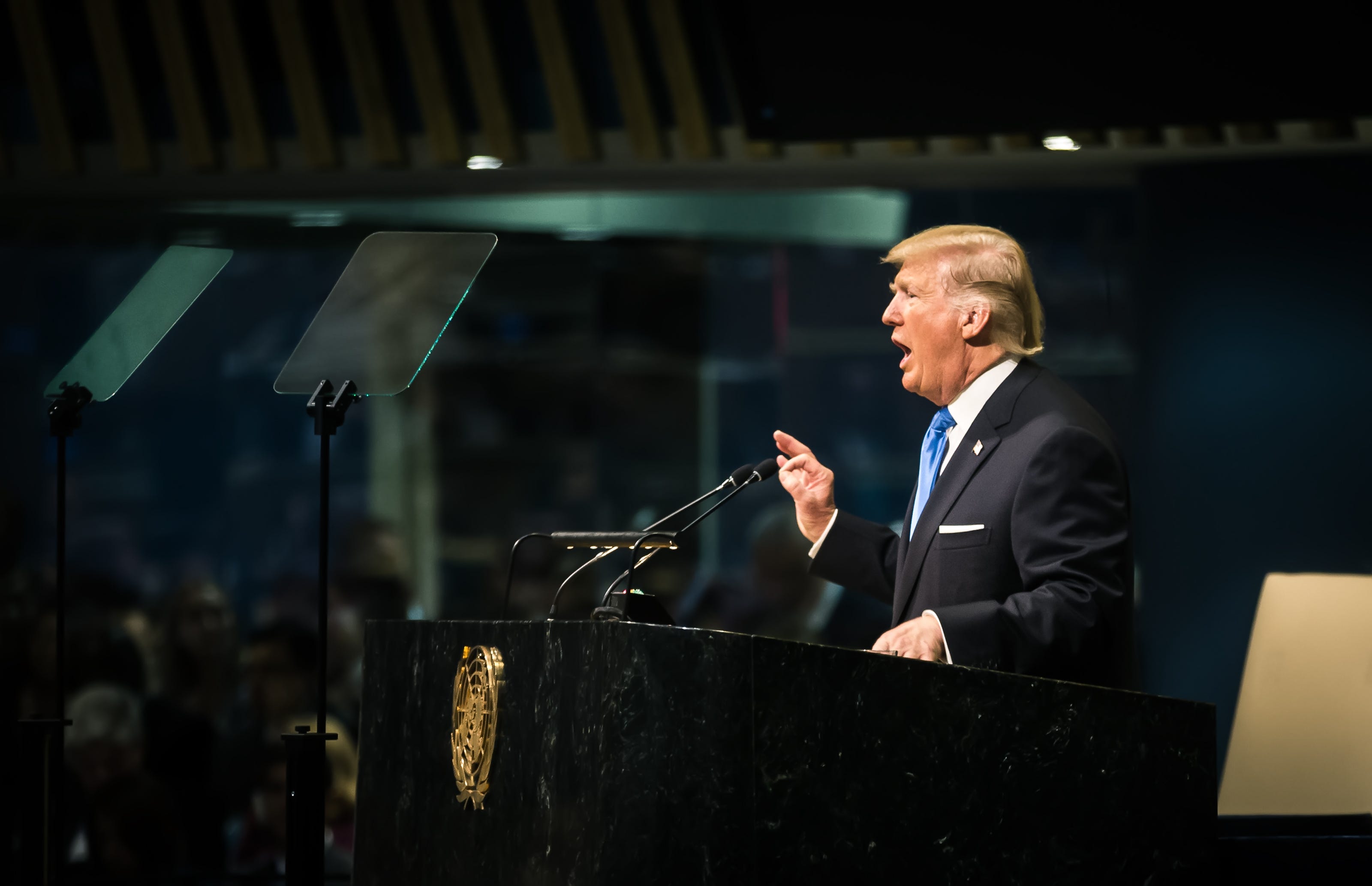
Donald Trump is evil. I mean this literally. I am not saying it to exaggerate. I am, in fact, prepared to defend the idea, the claim, and the implications that flow forth from such a conferral of status, that Donald Trump, the 47th President of the United States, is, in fact, an evil man.
Let me be precise about what I mean. Evil, as I use the term here, is the systematic use of power to dissolve the constraints that protect human dignity and law, while demanding deference to the very crimes being committed. It is not merely selfishness, incompetence, or even cruelty. It is the deliberate subordination of other human beings to one’s own will, coupled with the insistence that this subordination is right and proper, that resistance to it is illegitimate, that the victims deserve what they receive.
By this definition, observe: A president who pardons those who attacked the Capitol on his behalf, while prosecuting those who investigated him. A president who defies court orders and dares the judiciary to stop him. A president who treats foreign policy as a vehicle for personal enrichment and grudge-settling—threatening war over Greenland, blockading Venezuela, inviting Vladimir Putin to advise on Middle East peace. A president who is 30 days late on releasing court-ordered documents and responds to the deadline by releasing one percent of the files. This is not a policy disagreement. This is the methodical dissolution of the constraints that make lawful government possible, conducted by a man who believes he is owed obedience.
The country’s founding documents do include procedures for dealing with an evil man occupying the office of the President. However, Donald Trump has successfully rendered the Republican Party, which controls Congress, supplicant. It is not even clear to me that there remains a distinction between the Trump family business and the RNC, and now apparently, the entire Article II branch of the federal government. Mike Johnson, John Thune, and dare I say Hakeem Jeffries and Chuck Schumer continue to undersign the notion that this is a regular constitutional government, in form adequate to any reasonable understanding of lawful government within the confines of said laws and constitution.
This is an absolute emergency. And the failure of leadership here constitutes a catastrophic abdication of constitutional duty.
So yes: Congress should act. But we do not get to treat Congress as an entity separate from ourselves. Congress responds to pressure. Pressure is us. I will return to this.
First, let us address those who made this moment possible.
The anti-anti-Trump intellectuals. The contrarians and self-appointed heterodox thinkers who could not bring themselves to support Trump, but who found the alarm of his critics unseemly. The real threat, they insisted, was the overreaction itself. They positioned themselves as the adults in the room while the rest of us succumbed to panic.
Here is what I maintained for years, and what I will now state plainly: the obsessive fixation on leftist excess functioned as a form of cognitive capture. It rendered an entire class of otherwise intelligent people incapable of perceiving threats originating in their own ideological vicinity. They became so convinced that the republic faced imminent danger from campus speech codes and diversity initiatives that they looked upon an actual authoritarian—a man who had already attempted to overturn an election—and concluded he represented the lesser evil.
This is the precise error made by German conservatives in the early 1930s, who persuaded themselves that the Austrian corporal was a manageable risk compared to the Bolshevik menace. I do not make this comparison for rhetorical effect. I make it because the structural logic is identical.
The financial class, which assured us that Trump represented the superior outcome for capitalism and markets. They were explicitly and repeatedly warned that this man was unstable, authoritarian, and constitutionally incapable of the restraint that global economic leadership requires. And they made their calculation: yes, but the regulatory burden. Yes, but the tax implications. Now the dollar weakens, treasury yields spike, and serious analysts discuss whether the prudent move is to “sell America” as an investment thesis. In their desperation to save capitalism from the indignity of democratic regulation, they have handed its critics the most potent propaganda tool in modern history. They did not save capitalism from the left. They discredited it utterly.
The technocratic establishment—the consultant class, the pollsters, the professional Democrats who have made careers of cautious positioning. They have no theory of the moment. They have tactics designed for a political context that no longer exists. They are preparing for an election in 2026 as though elections, conducted fairly and counted honestly, remain a reliable mechanism for the transfer of power. What would adequate leadership look like? It would look like treating this as the emergency it is—Capitol steps press conferences every single day, procedural warfare, telling the truth plainly and repeatedly. Instead, we get calibration. We get the infinite hedging of people who are more afraid of being called hysterical than they are of losing the republic. They are finished. The era that produced them is over. They simply haven’t realized it yet.
Corporate America, sitting in silence. You have made your calculation. You believe you can wait this out. Keep your heads down, issue no statements, offend no one in power, and emerge on the other side with your market share intact. But the populist backlash that is coming—from left and right alike—will not spare you for your silence. You had more power to constrain this administration than the Democratic minority in Congress. And you chose to do nothing. You wanted to stay out of politics. Politics is about to come for you regardless.
And now to the point.
To the Citizen—and I use that word with the weight it deserves—I hope you understand that this falls to you now.
The institutions have failed. I have just spent considerable effort documenting the various ways in which people who should have known better did not act as though they knew better. The cavalry is not coming. There is no adult in the room who will fix this while you go about your life. The room is full of adults, and they have failed.
Which means the republic is counting on you to keep her.
You must take responsibility for the shape of your world before the world around you shapes you. You may not consider yourself the sort of person who protests. You may never have attended a rally or called a congressional office. Politics, you may feel, is something that happens elsewhere, conducted by professionals, and your role is simply to vote every few years and hope for the best.
I am here to tell you that this posture is a trap. And it is a trap designed specifically for you.
The self-entitled elites who have driven this country to the brink—the ones I have been addressing throughout this essay—they want you to think about politics this way. They want you to believe that your role is to choose between the options they present, to select between the candidates they anoint, and otherwise to leave the business of governance to your betters. They want you to outsource your politics to them.
This arrangement has worked very well for them. It has not worked particularly well for you.
So I might suggest: show them what you think about that. You have First Amendment rights that exist precisely for moments like this one. The right to assemble. The right to speak. The right to petition your government for redress of grievances. These are not abstract principles taught in civics class and then forgotten. They are tools. They are yours. And this is the moment to use them.
The people in the streets of Minneapolis understood this. They did not wait for permission. They did not wait for the consultants to craft messaging. They saw what was happening, and they acted. And in acting, they demonstrated something that authoritarians and their enablers desperately do not want you to know: that collective action works. That power does not only flow downward. That citizens who refuse to be spectators can change the calculus of what is possible.
You are not powerless. You have been told you are powerless by people who benefit from your believing it. This is a lie. It has always been a lie. And the proof is in every historical moment when ordinary people decided they would no longer accept what was being done in their name.
We have an evil man in the White House and an empty Congress that will not confront him. That is the situation. It is not a drill. It is not hyperbole. It is a constitutional emergency unfolding in real time, while those charged with responding to it check polling data and workshop talking points.
The question is not whether someone will save the republic. The question is whether you will.
This is such a moment. What will you do with it?
Go Deeper into the Circus
The Dictators’ Miscalculation: How Undermining American Democracy Created Their Worst Nightmare

In October I asked: What time is it?
This is one of your best pieces of work, Mike.
I've often said that if American politics were a Hollywood movie, everyone would clearly recognize the behavior of the Republicans as the villains. The fact that tens of millions of Americans want the villains to win is discouraging, but we will persevere.
This is spot on. As someone involved in political activism for a very long time, I can attest that I was called hyperbolic for predicting LESS than what he is actually doing.
"The anti-anti-Trump intellectuals. The contrarians and self-appointed heterodox thinkers who could not bring themselves to support Trump, but who found the alarm of his critics unseemly. The real threat, they insisted, was the overreaction itself. They positioned themselves as the adults in the room while the rest of us succumbed to panic.
Here is what I maintained for years, and what I will now state plainly: the obsessive fixation on leftist excess functioned as a form of cognitive capture. It rendered an entire class of otherwise intelligent people incapable of perceiving threats originating in their own ideological vicinity. They became so convinced that the republic faced imminent danger from campus speech codes and diversity initiatives that they looked upon an actual authoritarian—a man who had already attempted to overturn an election—and concluded he represented the lesser evil."