

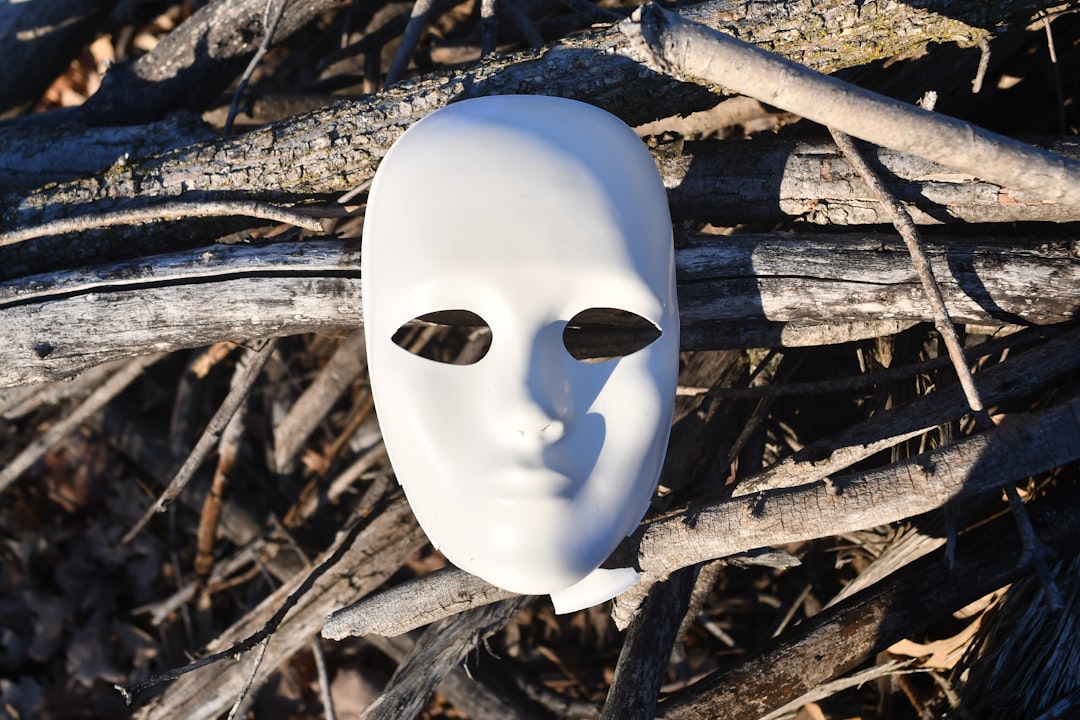
The way you know that social media is not a serious place to discuss the course of human civilization is this: most of the people discussing it will not put their name on what they say.
I want to sit with that for a moment, because I think it is more diagnostic than it first appears.
⁂
There is a position — advanced with genuine conviction by the libertarian community, the cypherpunk community, the assorted philosophical heirs of the early internet — that anonymity online is not a bug but a feature. That there is virtue in the separation of identity from argument. That the words should stand on their own. That what matters is the idea, not the person behind it. That stripping the speaker from the speech purifies it — leaves only the logic, clean and uncontaminated by the biases and interests of its source.
This is a strange intuition. And as something of a philosopher on the question of meaning, I puzzle over it.
Because the position contains a real insight, buried inside a category error.
The real insight: the validity of certain kinds of claims does exist independently of who is making them. A mathematical proof is true or false regardless of the character of the mathematician. An empirical observation about shared reality does not become more or less accurate depending on the observer’s biography. Necessary truths, relational truths — the philosophically literate among us will recognize the terrain. The genetic fallacy exists for a reason. You cannot dismiss an argument simply by attacking its source.
The category error: political speech is not that kind of claim.
⁂
When we argue about how to share space together — about the rules under which we will coexist, the distributions of power and resource and obligation we will accept, the future we will build or allow to be built — we are not doing mathematics. We are not making empirical observations about a fixed external reality. We are making normative claims about how things ought to be, advanced by people who stand somewhere specific in the world, who have particular interests and communities and things to lose or gain, and whose standing to make those claims is itself part of what is being evaluated.
In this register, the identity of the speaker is not incidental metadata. It is constitutive of the speech itself.
A person arguing for a policy that would enrich them at your expense is making a different argument than a person arguing for the same policy at their own expense. The words may be identical. The speech acts are not. Who is speaking, why they are speaking, what they stand to gain — these are not biases to be filtered out in the name of pure reason. They are the substance of the political claim. They are what the rest of us need to evaluate in order to decide whether to be governed by it.
Anonymity does not purify political speech. It amputates the part that makes political speech meaningful.
⁂
I want to say something about privacy here, because I do not want to be misread.
Privacy is important. I value it. It serves a genuine and irreplaceable social good. It allows us to exist in spaces of life without judgment, without surveillance, without the prying eyes of those who would use our private selves against us. The right to be who you are without performing it for an audience is not a minor thing. We all cherish it and we should.
But there is a distinction that the anonymity doctrine collapses, and the collapse is not innocent.
Privacy is the right to exist in your own space without intrusion. It is the right to be unobserved in the rooms of your own life. It is not, and has never been, a right to enter the commons masked and demand that the rest of us reorganize ourselves according to your preferences while you remain unaccountable for the demand.
When you walk out of your private space and into the shared space — when you raise your voice in the commons and say the rules should change, and here is how they should change — you have done something that is by definition not private. You have made a claim that, if accepted, will govern people who did not ask to be governed by you. You have proposed to alter the conditions of other people’s lives.
Those people have a right to know who is asking.
Not because your argument is invalid if you won’t give your name. But because political speech is a social act, and social acts carry social obligations. The person willing to put their name on a position is making a bet — with their reputation, their relationships, their standing in the community they are asking to change. That bet is the skin in the game that makes the speech worth taking seriously. It is the collateral that distinguishes a genuine political actor from a drive-by.
An anonymous account is making no such bet. The costlessness of the speech is precisely what makes it worthless as political currency.
⁂
This is also, I should note, a thermodynamic argument.
Anonymous political speech is a system that produces signal at zero cost. And as any engineer who has thought carefully about open systems rather than closed ones will tell you — zero cost inputs produce infinite noise. When the cost of speech collapses to zero, the volume of speech increases without limit and the signal-to-noise ratio collapses toward zero with it. This is not a temporary condition to be engineered around. It is the destination.
The cypherpunk dream of an internet where pure ideas compete in a frictionless marketplace of reason has produced the comment section. It has produced the reply guy. It has produced the coordinated anonymous harassment campaign. It has produced a political discourse so saturated with costless noise that the people willing to pay the actual price of public accountability — their name, their face, their reputation — are increasingly indistinguishable from the noise around them.
The friction was not the enemy of good political speech. The friction was the mechanism by which good political speech was distinguished from bad.
⁂
I am not naive about the risks of putting your name on things. There are people — dissidents, whistleblowers, targets of authoritarian regimes — for whom anonymity is not a philosophical preference but a survival requirement. This is real and it matters and it is not what I am talking about.
I am talking about the healthy adult citizen of a functioning democracy who has opinions about how the republic should be governed and who has decided that those opinions should circulate without attribution. Not because they fear a dictator. Because they fear being disagreed with. Because they want the influence without the accountability. Because they want the power to shape the discourse without the obligation to stand inside it.
That is not a philosophical principle. That is cowardice dressed in the language of epistemology.
⁂
Our traditions of justice give us the right to face our accusers. This is not an accident of legal history. It is a recognition that the identity of the person making a claim against you is inseparable from the claim itself — that you cannot evaluate an accusation without knowing who is making it, what they stand to gain, what their relationship is to you and to the facts. Anonymity in a courtroom is not a purification of the process. It is a corruption of it.
The same principle applies to the commons.
When you step into public debate and propose that we change the rules under which we all live, you are making a claim that affects every person who will be governed by those rules. We are entitled to know who is asking. Not because your argument is automatically invalid without attribution. But because we cannot evaluate what you are asking without understanding why you are asking it — what stake you have, what community you belong to, what you stand to gain or lose. This is not an invasion of your privacy. It is the minimum condition of a serious political conversation.
You want to change the rules for everyone. The least you can do is tell us your name.
⁂
I want to be direct about what I have observed, because I think the philosophical argument deserves a political conclusion.
The people who hide behind pseudonyms in political debate — who advance positions about how the rest of us should live while remaining unaccountable for the consequences — are not, in the main, dissidents protecting themselves from authoritarian retaliation. They are citizens of free and democratic countries who have decided that the influence of public speech is something they are entitled to without the obligations that public speech carries.
I have watched these people operate. I have seen them make confident pronouncements about the future of human civilization, watched those pronouncements prove catastrophically wrong, and watched them face zero consequences for the wrongness — because there was no name attached, no reputation at stake, no face to which the error could be attributed. I have seen them coordinate harassment campaigns from behind handles. I have seen them claim the mantle of free speech while denying their targets the basic dignity of knowing who is coming for them.
This is not a civil rights matter. The cypherpunk community, the crypto community, the terminally-online political philosophers who treat their pseudonymity as a principled stand — they have constructed an elaborate ideological architecture to justify what is, at its foundation, a simple thing: they want power without accountability. They want to shape the discourse without standing inside it.
I find this contemptible. Not the privacy. The cowardice.
Show your face. Say your name. Stand where you stand and let the rest of us decide what to make of it.
That is what it means to be a citizen.


We are living in a world where your government can track you and end your way of life based on what you say. That’s enough motivation for anonymity for anyone, especially those who never have been in the public limelight before. Think about all the countless lives ruined by Facebook posts, deservedly or not.
I am not monetizing my participation here. Nor am I judging anyone who wants to stay anonymous if they choose to.
But are we "citizen(s) of a functioning democracy "? I question the functional part for all of us at this point and has it ever been a true democracy for people of color, women, the queer and disabled?
I started out naively on Facebook sharing content in 2015, (mostly standing up for gradualism and against the radical agenda of MAGA) under my own name, then came the disgusting threats and rampant sexism, some of the worst of it from members my own MAGA family. I quit FB in 2017 familial relationships forever frayed by the digital gang bang that I experienced as a liberal woman there.
So I built my Twitter profile where I fled with a pseudonym. I identified at first as a woman and my comment section was often enough crashed by mansplaining, harassment and the occasionally stalking by RW trolls, so I stripped my gender and because my basic profile, profession and often my voice skews male I was able to freely navigate in the social media world. I have never shared photos of humans or other identifiable data, a fact that I've been very glad about after the onset of data mining. After quitting Twitter when Musk stunk it up, I did the same profile masking on Bluesky. It seems only prudent now.
I tend to agree with you in the main but it's not so simple for people that are not as equal as others given the dangers that are inherent on social media. I think that should change once people monetize their feeds. FWIW.