


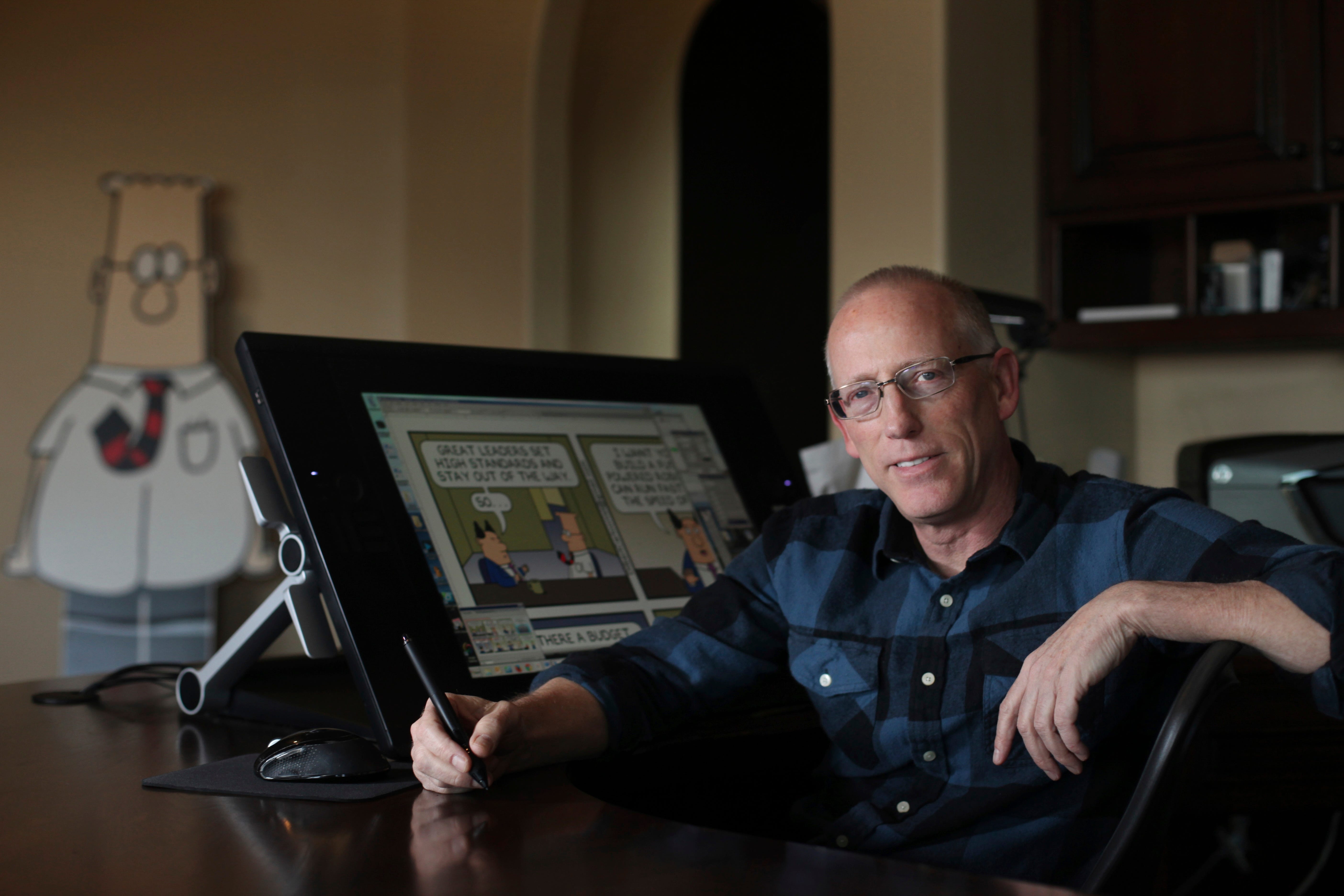
I would like to take the time to mark the passing of Scott Adams. Today he died. It is worth acknowledging this point. His Dilbert comic is a piece of American culture. But one does not earn a free hagiography bonus in death. One must consider their legacy before their dying breath.
People will accuse me of dancing on his grave. But I’m not. I am deeply sad for Scott’s loved ones. But I must note that the man caused us great harm. And that was demonstrated by the death of another great American citizen, a woman shot by ICE in Minneapolis this week.
Scott Adams created Dilbert in 1989. For decades, it was genuinely funny. It captured something real about American corporate life - the absurdity of middle management, the meaningless meetings, the Kafkaesque bureaucracy that consumes workers’ souls. Millions of people saw themselves in those cubicles. That matters. That’s a legitimate cultural contribution.
But that’s not the complete legacy. That’s not the full accounting.
Scott Adams spent the last years of his life using the platform and credibility he built from Dilbert to promote dangerous nonsense. He defended Trump. He minimized January 6th. He spread conspiracy theories. He used his influence to normalize authoritarianism and undermine democratic institutions.
And when ICE shot a woman in Minneapolis this week—when federal agents killed an American citizen in the streets—Scott Adams’s legacy is part of the ecosystem that made that possible.
Not directly. I’m not claiming he ordered the shooting. But he was part of the cultural and political apparatus that normalized lawless federal power. That defended unconstitutional executive action. That treated critics of regime violence as hysterical while treating regime violence as necessary.
He was part of the machinery that made this moment possible.
I know what people will say. “Have some respect. The man just died. His family is grieving. You’re dancing on his grave.”
Death doesn’t erase what someone did in life. It doesn’t sanitize the record. It doesn’t transform bad choices into good ones. It doesn’t make harm disappear.
Scott Adams made choices. He used his platform in specific ways. He defended specific people and policies. Those choices had consequences. Those consequences include the political emergency we’re living through right now.
I wish his family peace. I genuinely do. Losing someone is devastating. Grief is real and deserves respect.
But respecting grief doesn’t require lying about the deceased. It doesn’t require pretending his choices were something other than what they were. It doesn’t require giving him a “free hagiography bonus” just because he died.
The woman killed in Minneapolis had a name. She had a family who loved her. She had a life that was ended by federal agents operating under a regime that Scott Adams defended and normalized.
Her death is part of his legacy, too.
Not because he pulled the trigger. But because he was part of the ecosystem that made pulling the trigger acceptable. Part of the machinery that defends lawless executive power. Part of the apparatus that treated critics as hysterical and regime violence as necessary.
You don’t get to separate those things. You don’t get to claim credit for Dilbert while disclaiming responsibility for defending the regime that kills citizens.
That’s the complete legacy. That’s the full accounting.
I’m not celebrating Scott Adams’s death. I take no joy in it. Death is sad. For his family, for the people who loved him, this is a moment of genuine grief. I respect that.
But I will not participate in the process where death erases accountability. Where we’re supposed to pretend that a person’s choices and their consequences disappear the moment they die. Where “don’t speak ill of the dead” becomes a shield against historical truth.
Scott Adams created Dilbert. That’s part of his legacy.
Scott Adams defended Trump and normalized authoritarianism. That’s part of his legacy.
Scott Adams contributed to the ecosystem that made our current political emergency possible. That’s part of his legacy.
A woman was killed by ICE in Minneapolis this week. That’s part of his legacy, too.
All of it matters. All of it goes in the historical record. All of it must be remembered when we ask: how did we get here? Who helped create this moment? Who defended the regime when it mattered to resist?
This isn’t about revenge. This isn’t about dancing on graves. This isn’t about expressing joy at suffering.
This is about documentation. About preserving the historical record. About refusing to let death sanitize what needs to be remembered.
Scott Adams made choices. Those choices had consequences. Those consequences are still unfolding. People are dying because of the political emergency that he helped normalize.
That’s not speculation. That’s documentation.
And documentation doesn’t pause for grief. It doesn’t stop because someone died. It doesn’t grant amnesty to those whose choices caused harm.
So I mark the passing of Scott Adams. I acknowledge his cultural contribution through Dilbert. I express genuine sympathy for his family’s grief.
And I document his role in the political emergency that killed a woman in Minneapolis this week.
All of it is true. All of it matters. All of it must be remembered.
That’s not dancing on his grave. That’s keeping the candle burning. That’s refusing to let death erase what must be preserved for posterity.
May Scott Adams rest in peace. May his family find comfort in their grief.
And may we remember the complete truth about what he did in life. For the sake of those still living. For the sake of those who died because of the regime he defended. For the sake of future generations who need to understand how we arrived at this moment.
The woman killed in Minneapolis deserves that much. We all do.
Go Deeper into the Circus
We Are Sliding Into Historic Territory

We are sliding into historic territory. You may want to sit down while you read this, because what I am about to tell you is the complete truth. It is not exaggerated. I am, in fact, calm as I write this. I’m drinking tea right now, looking outside at the beautiful Southern California sunshine, and here’s what I have to tel…
As the Sun Sets on Sand Hill Road, Andreessen Awaits His Caesar

The sun is setting on Sand Hill Road. Not literally—the venture capital still flows, the returns still compound, the pitch decks still promise to change the world. But the light has changed. The Valley that once claimed to serve humanity now funds its surveillance. The republic that constrained power through democratic process now bends to oligarchs who…
.
Thoughtful, fair piece. Death often stirs remembrance, grief and, in the case of public figures, at least, some degree of legitimate accountability needs to be part of that reckoning of a life. RIP
I appreciate your perspective; gently worded yet impactful. Our actions (or inactions) today are indeed forming our personal legacies.