


Shadi Hamid asked me a fair question on X this morning. I had said that the world should simply impose a solution on the Middle East — that the time for managed conflict had passed and the time for managed peace had arrived. He asked, reasonably: imposed by whom, and how exactly?
It is a good question. It is the question that has historically been used to end conversations like this one before they begin. The realist’s deflection: you cannot specify the mechanism, therefore the vision is naive, therefore we return to the present arrangement, which is also a mechanism, also a choice, also imposed — but by the powerful, for the powerful, without the consent of most of the people living inside it.
I want to answer the question seriously. Not because I have a complete blueprint — I do not — but because the absence of a complete blueprint is not the same as the absence of a direction. And direction, right now, is what we most desperately lack.
So. Here is where my moral imagination takes me. Here is what I would do, if I were in charge, which I am not, and if I could wave something close enough to a magic wand, which no one can. I offer this not as policy but as orientation. Not as a plan but as a proof that the present arrangement is not the only possible one.
⁂
The first move is the most dramatic, and I want to be honest about why it is necessary.
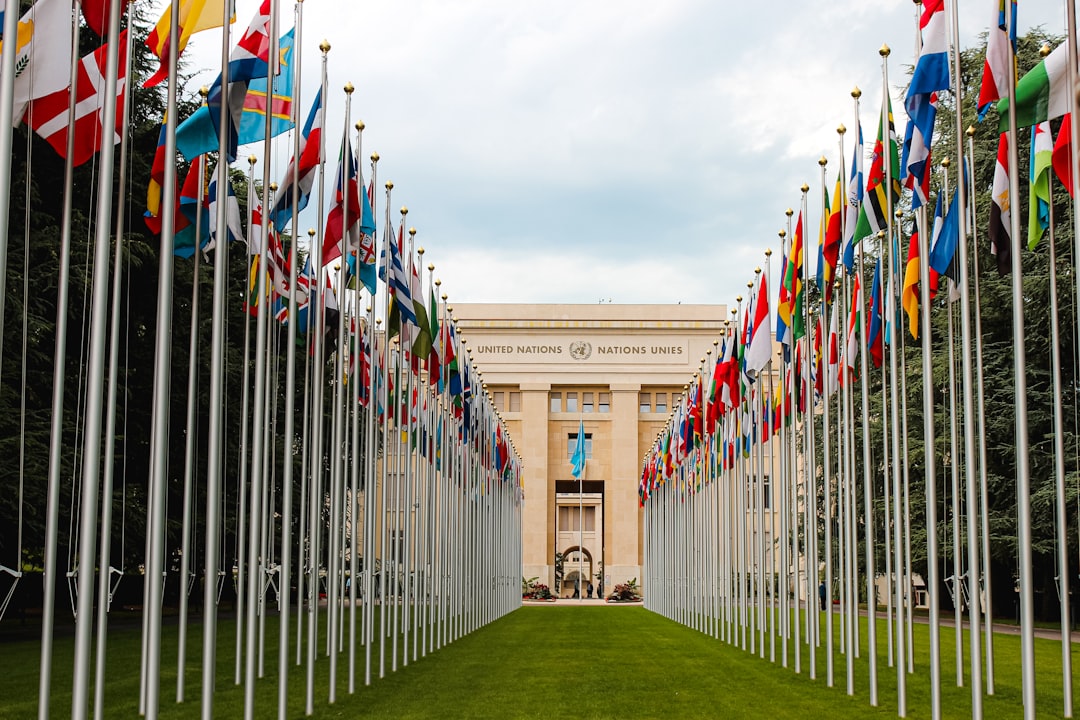
The United States should resign its permanent seat on the United Nations Security Council.
I know how that sounds. I know the objections. I will address them. But let me first say what it would mean and why it matters.
The Security Council, as currently constituted, is a museum piece. It was designed in 1945 to reflect the power arrangements of a world that no longer exists, by men who understood — and this is the part that gets lost — that what they were building was a transitional structure, not a permanent one. Roosevelt’s vision, which Eleanor did as much as anyone to articulate and extend, was the democratization of international order. The Security Council veto was a concession to the realities of 1945, not a statement of principle. It was the price of getting the institution built.
The price has compounded into a prison.
The veto has been used, systematically and repeatedly, to protect the crimes of the powerful from accountability. Russia vetoes resolutions on Ukraine. The United States vetoes resolutions on Gaza. China vetoes resolutions on Tibet and the Uyghurs. The Security Council, which was supposed to be the world’s instrument for collective security, has become the instrument by which the powerful guarantee their own impunity.
Resigning the seat is not an act of weakness. It is an act of moral leadership of a kind the world has not seen from the United States in a very long time. It is the United States saying: we believe in democratic legitimacy, and we are willing to submit to it ourselves. We are stepping out of the arrangement that protects our unilateral power and inviting the world to build something better.
The objection — that Russia and China keep their seats, and the asymmetry is dangerous — is real. I do not dismiss it. But it rests on the assumption that the current arrangement is preferable to the uncertainty of change. I no longer believe that assumption holds. The current arrangement has produced Gaza, Ukraine, the Iran war, and the closed Strait of Hormuz. The current arrangement is the catastrophe we are trying to escape. We cannot escape it by defending it.
The second move follows directly from the first.
Having resigned the Security Council seat, the United States goes to the General Assembly and makes a proposal. Not a demand. A proposal.
The proposal is this: one nation, one vote. No vetoes. The General Assembly, the body that actually represents the breadth of humanity, becomes the decision-making authority for questions of international peace and security. And the United States calls on the community of democracies to form a coalition within that body — a democratic caucus that acts collectively, that holds each other to basic standards of free elections and civil liberties, and that uses its collective weight to build the institutional capacity for what comes next.
I am aware of the objection here too. The General Assembly includes China, Russia, Saudi Arabia, Iran, North Korea — governments that do not represent their people and whose votes in any democratic caucus would be a travesty of the word. This is true. It is also true of every democratic institution in its early stages. The United States, at its founding, excluded women, enslaved people, and those without property from the democratic process. The imperfection of an institution in its early form is not an argument against the institution. It is an argument for improving it over time, which is only possible if you build it.
The democratic caucus begins with the democracies that exist. It invites others to join by meeting standards that are clear, measurable, and not set by the United States alone. It grows. It builds legitimacy. It becomes, over time, what the Security Council was supposed to be and never was: an instrument of collective human security that derives its authority from something other than the barrel of the great powers’ guns.
⁂
The third move is the one that will generate the most controversy, and I want to state it plainly because I think it is right.
The United States should formally assert Taiwan’s democratic self-determination.
Not as a provocation. Not as a military commitment. As a moral statement of principle that applies universally, including to the 1.4 billion people on the Chinese mainland who are governed without their consent.
The Taiwan question has been managed for fifty years as a great power negotiation — a question of American strategic interests versus Chinese territorial claims, in which the Taiwanese people themselves are treated as pieces on a board rather than as human beings with the right to determine their own future. This is the realist frame. It is also morally bankrupt.
The democratic self-determination of Taiwan is not a special case. It is the application of a universal principle. And that universal principle, applied honestly, extends to everyone. The people of mainland China are not less deserving of democratic dignity than the people of Taiwan. The people of Hong Kong are not less deserving of the freedoms they had until recently. The Uyghurs are not less deserving of the most basic protections of human life and cultural integrity.
To assert Taiwan’s self-determination is to assert a principle. To assert a principle is to be bound by it. To be bound by it is to accept that the United States, which has supported authoritarian regimes when it was convenient, is placing itself under the same standard it is asking others to meet.
That is not weakness. That is the only kind of moral leadership that has ever actually moved the world.
⁂
I want to say something about the Middle East specifically, because it is where this conversation began and because the suffering there is the most immediate and the most visible.
The conflicts of the Middle East are ancient in their grievances and modern in their weapons. People are killing each other over questions of land, prophecy, and historical wrong that no living person caused and no living person can fully resolve. I do not minimize the reality of those grievances. I do not pretend that the history can be unknotted by an act of will.
But I also do not accept that the present catastrophe is the inevitable expression of that history. The present catastrophe is the expression of a failure of international governance — the failure to build institutions with the legitimacy and capacity to say, simply and with force: enough. The killing stops here. Not because one side has won. Not because the grievances have been resolved. But because the rest of humanity, which did not cause this conflict and is now being dragged into its consequences, reserves the right to impose a peace.
A democratic peace. One that protects the people — all of them, Palestinian and Israeli and Iranian and everyone else caught in the machinery of other people’s ancient quarrels — from the violence being done in their names and against their interests.
This requires a peacekeeping force of genuine international character, not the projection of American or Israeli or Iranian power, but the expression of the collective will of a humanity that is tired of watching its children die for flags and prophecies and real estate disputes that have been running since before any living person was born.
Is this achievable tomorrow? No. Does the mechanism exist yet? Not fully. Does the absence of the mechanism mean the vision is worthless? Only if you believe that institutions are discovered rather than built. Only if you believe that the present arrangement, which is also a mechanism, which is also a choice, is the natural order of things rather than a set of decisions made by people who are now dead, in circumstances that no longer exist, for reasons that no longer apply.
I do not believe that.
⁂
There is a word for what I am doing here. Shadi Hamid correctly intuited it in his question, and I said it in my reply, in capital letters, because I wanted to own it rather than apologize for it.
Moral imagination.
The capacity to see, clearly and without flinching, what the world actually is — and to hold simultaneously, in the same mind, a vision of what it could be. Not as fantasy. Not as naivety. As the only form of political seriousness that has ever produced anything worth having.
The people who built the institutions we are now relying on — the UN, the Geneva Conventions, the Universal Declaration of Human Rights — were not realists. They were people who had just watched the world burn in the most catastrophic war in human history, who understood exactly how bad things could get, who had no guarantee that what they were building would survive, and who built it anyway. They built it because the alternative was to accept that the world that produced two world wars in thirty years was the best humanity could do.
Eleanor Roosevelt, who did more than almost anyone to make the Universal Declaration of Human Rights a reality, was not naive about power. She had spent decades watching power operate from close range. She knew exactly what she was up against. She built it anyway.
Thomas Paine did not know that the American Revolution would succeed when he wrote Common Sense. He wrote it because the moment required someone to say plainly what needed to be said, to name the direction even before the mechanism was fully clear, to make the vision legible so that the people who were going to have to build the mechanism could see what they were building toward.
That is what moral imagination is for.
It is not a substitute for mechanism. It is the precondition for it. You cannot build what you cannot imagine. And the present arrangement — the Security Council vetoes, the managed conflicts, the great power competitions conducted over the bodies of people who did not choose to be caught in them — will not be replaced by a better one until enough people can hold the better one clearly enough in mind to make it real.
⁂
I am one person. I am not in charge. I am talking into a microphone in Los Angeles, in the 249th year of a republic that is currently on fire, trying to do what I believe needs doing, which is to narrate what is real and to point toward what could be real, and to refuse — as stubbornly and as publicly as I know how — the counsel of those who tell me that the present catastrophe is the best we can do.
It is not the best we can do.
We can do better. We have done better, in fragments and imperfectly, in moments when enough people decided that the cost of the present arrangement was higher than the risk of changing it.
This is one of those moments. The Strait of Hormuz is closed. The world economy is absorbing a shock it did not choose. The children of Gaza and Ukraine and Tehran are paying for decisions made by people who will never be held accountable under the current arrangement.
The current arrangement has to change.
The direction of that change is not, in the end, so mysterious. It runs toward democracy, toward accountability, toward the genuine representation of the people who are affected by decisions in the making of those decisions. It runs away from the veto, away from the great power carve-up, away from the management of human suffering as a strategic resource.
It runs, in short, toward what Roosevelt imagined and Eleanor built the first imperfect version of, eighty years ago, in the wreckage of the last catastrophe.
We have the blueprint. We built it once already.
It is time to build it again. Better this time. With the lessons of what went wrong. With the moral seriousness that the moment demands.
And with the imagination to see that it is possible, even now, even here, even in the middle of the fire.
Go Deeper into the Circus
Captain Ahab Has Caught His Whale

There is a particular quality to watching someone get exactly what they wanted and discover, in the moment of getting it, that the wanting was the thing that was going to destroy them.
The Plaque

In January I wrote about Tim Cook and the hollowing of Apple. The thesis was simple, and I will not rehearse it at length here. Cook had built a company so structurally dependent on authoritarian favor — Beijing’s and Washington’s in equal measure — that it had lost the organic capacity to say no. That he had mistaken optimization for…
Agree with the general direction. Quibbles: (a) 1 vote per nation in the UN doesn't represent population, so would be as bad as 2 senate seats per state in the US (which sucks). (b) China only has one legitimate government, which currently sits it Taipei.
It's time we stop recognizing the legitimacy of any government which is not democratically elected. Start with the Saudis, who per the NY Times are giving Trump orders in the war on Iran, and who many suspect orchestrated 9/11. Trump's closeness to them is as treasonous as his with the Russians.
I couldn't agree more with this essay. The entire UN has been corrupted into a way to launder the crimes of the powerful. I will raise you one, Mike. I am adamant that the next president push for us to join the ICC so that these criminals running things are held to account. It is clear our own courts will do nothing and the world needs to see we are serious about fixing the mess the international order has become. We will need to earn back a lot of trust.