


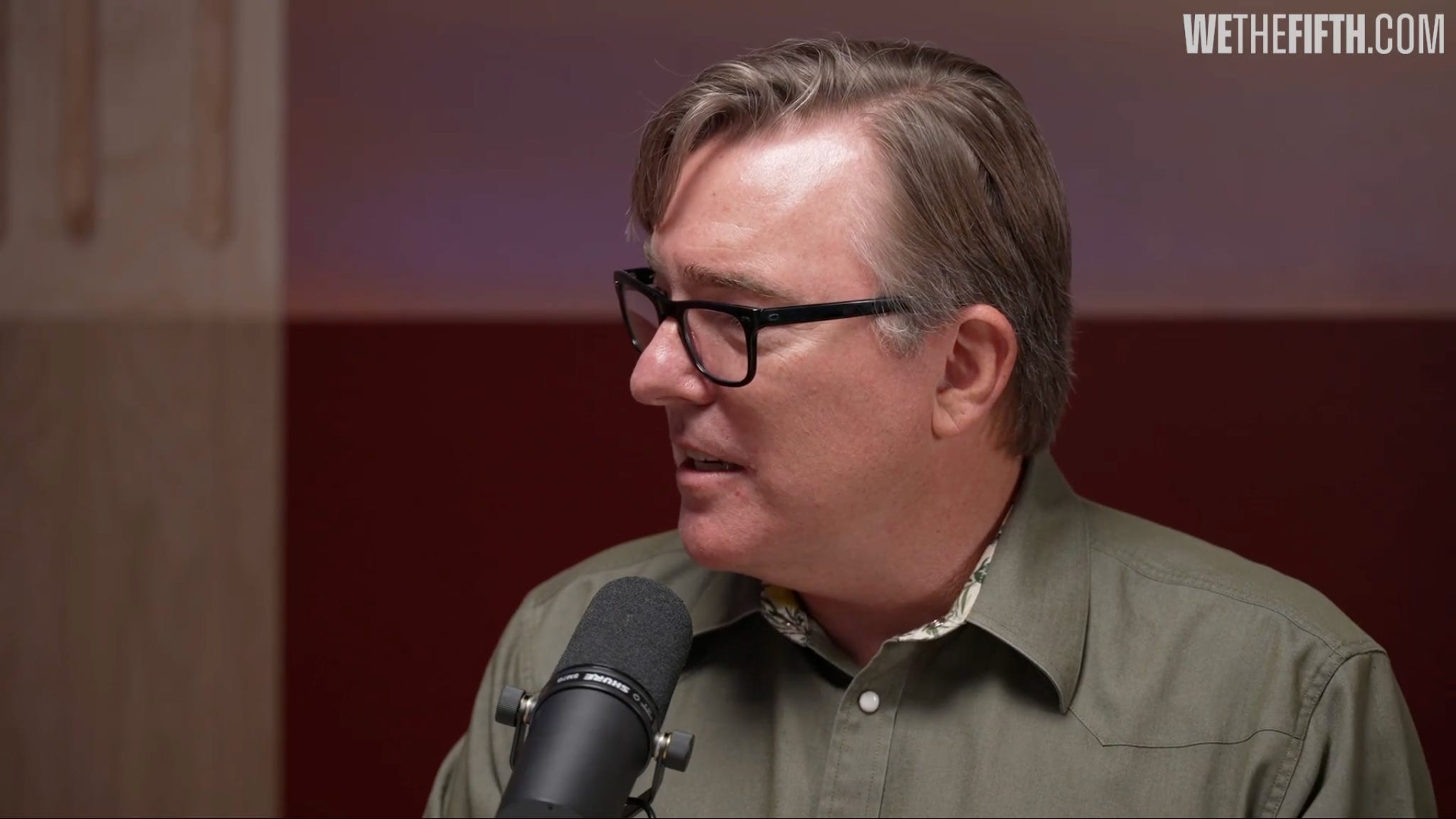
Matt Welch once told me at a party that he was a romantic. I don’t believe him.
That he would take offense that the answer would be rejected, that the question of an opponent of this defacing of the American experiment would be seen as evidence of moral corruption, has instead said a lot more about Mr. Welch than it has of the good-natured humans who would insist that violence is never the answer. The good-natured humans are clichéd, and the cliché is real, and the cliché is one of the structural problems of contemporary liberal discourse, and naming the cliché is fair game. What is not fair game is the move Welch and his colleagues made on The Fifth Column the day after the White House Correspondents’ Dinner shooting, which was to take the existence of the cliché as evidence that the people deploying it are secretly closer to the shooter than they let on. Violence is never the answer suggests that maybe dude has the right motive, Welch said. Dude’s onto something. He’s asking the right questions. He’s just got one wrong answer.
This is not the move of a romantic. This is the move of a man whose brand requires the move, performed in the register the brand has trained him to perform it in, on the day the move was structurally indefensible.
⁂
The hosts open by mocking the shooter’s manifesto. The mockery is sustained for several minutes. The manifesto is, in their account, badly written, insufficiently crazy, kind of conventionally crazy, lacking the flights of almost everybody in this genre, missing the commitment a real radical would bring. The mockery has a specific structural function. It establishes that the shooter is unserious, which establishes that the shooter cannot be analyzed as a political phenomenon, which establishes that the rhetorical climate that produced him cannot be the subject of the episode. The mockery clears the ground.
The hosts then run a compilation of public figures saying violence is never the answer — Ro Khanna, Pramila Jayapal, Hakeem Jeffries, Pedro Sánchez, David Axelrod, Cenk Uygur, Ted Lieu, Steve Schmidt. The compilation is presented as evidence of liberal cliché, which it partly is. The compilation then becomes the basis for the move I quoted above. Why do we hear that formulation? Welch asks. The implication, made explicit several beats later, is that the formulation reveals something about the speakers — that they are working hard to deny something they secretly suspect, that the shooter has a point, that he’s asking the right questions.
This is the most consequential move of the episode and it is worth pausing on for more than a moment. The move takes the genuine analytical observation that violence is never the answer is a ritualized formulation — which is exactly the observation I made in the Crisis Dispatch I published two days ago — and inverts it into a diagnosis of the speakers’ hidden sympathies. The inversion is rhetorically clever. It is also substantively dishonest, because the actual reason the formulation is unsatisfying is not that the speakers secretly think the shooter has a point. The actual reason is that the speakers have been disciplined, over a decade of asymmetric ritual demand, into performing condemnation as the price of being permitted to speak about anything else. The ritual prevents the analytical work the moment requires. Welch knows this, or should know it. He chose the inversion anyway. The inversion serves the brand. The brand requires it.
The hosts then do what the brand has trained them to do for a decade. They spend the bulk of the remaining episode adjudicating the cultural left. Hassan Piker is mentioned by name eight times. Mahdani — Zohran Mamdani — comes up. Linda Fiorentino’s Vulture interview comes up. Andreas Malm comes up. The New Yorker and the New York Times come up as venues that have published the wrong people. The discussion of Trump’s actual rhetorical record over the past decade — the vermin, the enemy within, the day of love, the threats against governors and members of Congress, the explicit incitement at rallies, the pardoning of January 6 attackers — is brief, ritualistic, and immediately followed by a pivot back to whatever the cultural left is currently doing wrong. The pivot is the structure. The pivot is what the brand has been selling for years.
The empirical argument the episode rests on is worth examining because it does not survive the examination.
Welch makes the claim, near the middle of the episode, that the United States needs a sober conversation about the political left’s in this country’s unique proximity to political violence. This is the load-bearing factual claim. The whole apparatus of the episode is in service of it. The case for the claim is the recent Trump assassination attempts, the Mangione case, and the Wall Street Journal statistic Welch himself partially cites — ten left-coded acts of political violence this year against five last year.
The case is weak, on the data Welch himself acknowledges. Ten this year against five last year is a small absolute number against a long historical record in which right-coded political violence has operated at much higher base rates and with much higher casualty counts. The murders at the Charleston AME church. The Tree of Life shooting in Pittsburgh. The El Paso Walmart. The Buffalo Tops Friendly Market. The Christchurch attack performed by an American-radicalized shooter. The Oklahoma City bombing, which is in living memory and which killed 168 people. The murders of Heather Heyer at Charlottesville and George Tiller in Wichita and the Sikh worshippers in Oak Creek and the Jewish worshippers in Poway and the Black shoppers in Jacksonville and the Walmart shoppers in El Paso and the children at Sandy Hook and Marjory Stoneman Douglas at the hands of shooters whose manifestos cited the same online radicalization ecosystems that produce most American political violence in this century. The base rate is what it is. Welch acknowledges it in passing and proceeds as if his thesis were settled in the direction the brand requires.
Welch also acknowledges, in passing, the recent murders of Jews in the United States that have not received the coverage he thinks they deserve. He is right that they have not received adequate coverage. The murders should be covered. Antisemitism in America is real and rising and worth naming with the precision the moment requires. The argument from the existence of these murders to the conclusion that the political left has unique proximity to political violence is, however, not sound, because the actual perpetrators of antisemitic violence in the United States in the last decade have been overwhelmingly drawn from far-right movements, with a smaller share from Islamist radicalization, and a still smaller share from anything resembling the cultural left Welch spends the episode adjudicating. The Pittsburgh shooter cited the Jews are bringing in invaders who kill our people — language indistinguishable from the white-replacement rhetoric Tucker Carlson was producing nightly on the largest cable news show in America at the time. The Poway shooter wrote a manifesto citing Christian-nationalist sources. The Buffalo shooter wrote 180 pages of explicit white-replacement theory. To name the pattern of antisemitic violence in America without naming the political coalition whose rhetorical climate has been producing it for a decade is to misdescribe the phenomenon at the level of basic factual accuracy. Welch knows the data. He chose to deploy the murders as evidence for an asymmetric argument the data does not support.
⁂
The deepest moment of the episode comes near the end. Welch says, half to himself, half to his cohosts:
I’m actually beginning to develop your level of contempt for the whole thing. We could talk about that another time. I’m not sure I’m like a libertarian anymore at this stage.
Then he immediately changes the subject to hockey betting.
This is the diagnostic moment. The host, in real time, half-acknowledges that the frame he has been operating in for a decade is breaking down. He does not pursue the acknowledgment. He cannot pursue it because pursuing it would require him to confront what the brand has been doing, what the brand has been calibrated to, what the brand has cost him in the way of the moral apparatus that produces serious public thought in serious public moments. The pivot to hockey is the apparatus protecting itself. The frame is broken. The frame cannot be admitted to be broken. The show must go on.
The romantic Welch claimed to be at a party some year ago would have pursued the acknowledgment. The romantic would have said, on his own podcast, in front of his cohosts and his audience: Wait. Stop. The frame I have been operating in for ten years is failing. The episode I am recording is a symptom of the failure. Let me think about this in real time, with you, and see if I can find the ground I was standing on when I built the brand. This is what a romantic does. A romantic is not a person who feels things prettily. A romantic is a person whose apparatus is alive enough that when the apparatus breaks, the breakage registers, and the registering produces a different kind of attention than the apparatus was producing before.
Welch did not produce the different kind of attention. He pivoted to hockey. The pivot is the answer to the question of whether he is a romantic. He is not.
⁂
I want to be careful here, because the personal-acquaintance framing of this Dispatch is unusual for me and I want it to do specific work rather than read as the airing of a private grievance.
The reason the personal frame matters is that Welch made the claim about himself, to me, at a party, in a register that asked to be taken seriously. People do this at parties. They make claims about themselves that they want their interlocutor to credit. The claims are part of how a public figure constructs the persona that lets them do their public work. I am a romantic is a particular claim. It announces an interior. It asks the interlocutor to read the public work in the light of the announced interior. It says: whatever I am doing on the podcast, whatever the brand looks like from the outside, the inside is a person responsive to what is at stake.
The claim is testable. The test is whether the public work, when it encounters a moment that requires the romantic apparatus, produces the romantic response. The episode of The Fifth Column I am writing about is the test. The shooting happened. A man with a shotgun and a manifesto charged the security checkpoint at the press dinner because he believed, rightly or wrongly, that the administration he was targeting had committed crimes the polity was failing to address. The hosts of the Fifth Column spent two hours on the event. The two hours did not produce a single sustained moment of moral attention to what the climate that produced this man might be, beyond the perfunctory acknowledgments that bracket the long passages of cultural-left adjudication. The two hours produced the brand. The brand is what the hosts produce. The hosts do not deviate from the brand even when the moment specifically demands deviation. The brand has eaten the moral apparatus the hosts may once have had access to.
This is the deeper claim and it is worth stating plainly. Welch is not a man who lacks the equipment for serious moral thought. He has the equipment. He demonstrated it in earlier phases of his career. He is sharp, he is well-read, he can construct an argument. The equipment is not the problem. The problem is what the equipment has been spent on for the past decade. The equipment has been spent on the construction and maintenance of a brand whose central commitment is the framing of the cultural left as the principal civic problem of our era. The framing was always partly defensible and is now substantially indefensible, and the equipment is increasingly being spent on the defense of a framing that the empirical record does not support, which produces the cognitive distortions visible in the episode I am writing about.
A romantic does not spend their equipment this way. A romantic preserves the equipment for the moments when the equipment is needed. The moments when the equipment is needed include moments like the one The Fifth Column episode was about. Welch did not preserve the equipment for the moment. He spent it on the brand. The episode is the receipt.
⁂
There is a broader cultural-psychological observation here that is worth naming because it travels beyond Welch and beyond The Fifth Column.
The late-stage anti-woke libertarian register, of which The Fifth Column is a representative product, has been running for about a decade now. The register was built on a set of premises about the principal civic threats of the post-2014 era, premises that included the centrality of campus-left excess, the dangerousness of the cancel-culture phenomenon, the threat of progressive overreach in cultural institutions, and the ridiculousness of the various rhetorical tics — violence is never the answer, speech is violence, the language of trauma applied to political disagreement — that the cultural left was producing. Some of these observations were accurate. Some were exaggerated. All of them were sustained, by the people who made them their brand, beyond the point at which the empirical record continued to support the centrality the framing required.
The framing’s defenders are now in the position of either updating, which would mean abandoning the brand, or continuing, which means producing increasingly visible cognitive distortion in encounter with events the framing cannot accommodate. The Fifth Column episode is a case study in the second option. The brand is preserved. The cost of preserving it is the moral apparatus that would be required to respond to the event the brand is, ostensibly, responding to.
The pattern is recognizable elsewhere. Andrew Sullivan in his Trump-curious lulls. Glenn Greenwald across the past several years. Bari Weiss and the Free Press circle most of the time. Nellie Bowles. Jesse Singal. The various figures who built brands on cultural-left adjudication during the 2014–2020 window and who have not updated the framing for the post-2020 reality in which the principal civic threat has visibly relocated. They are all, in different registers, producing the same cognitive product. The product is the maintenance of the framing against an empirical record that no longer supports it. The maintenance produces specific distortions. The distortions are increasingly visible. The distortions do not produce framing collapse because the brand cannot afford framing collapse.
The romantic Welch claimed to be at a party would, if the claim were true, be able to look at his own brand from outside and ask whether the brand was still doing the work the brand was supposed to do, or whether the brand had become the work, with the original moral commitments displaced by the requirements of brand maintenance. This is the question the romantic’s apparatus is for. The apparatus does not produce the answer the brand wants. That is part of why the apparatus is a romantic’s apparatus and not a brand-builder’s apparatus. They are different instruments oriented to different work.
Welch’s instrument, on the evidence of the episode I am writing about, is not the romantic’s. It is the brand-builder’s. The instrument has been calibrated, over years, to produce the content the brand requires. The content the brand required on the day after the WHCD shooting was the content Welch produced. The content was the manifesto mockery, the violence is never the answer inversion, the long cultural-left adjudication, the unsupported empirical claim about unique proximity, the half-acknowledged frame collapse pivoted into hockey betting. The content is the brand. The brand is the work. There is no room left for the romantic’s apparatus to operate, because the apparatus has been replaced by the brand-maintenance apparatus, and the two apparatuses cannot coexist in the same person operating at the same time.
I do not believe Welch is a romantic because Welch is, on the evidence available, no longer the kind of person whose apparatus would let him be one. He may have been a romantic once. He told me he was. The telling was not false in the moment. It was true in the way that announcements at parties are true — as descriptions of a self-image the speaker holds and wants the interlocutor to credit. The self-image and the working apparatus have, in his case, diverged. The divergence is what the episode reveals. The divergence is what makes the claim, repeated at a party, no longer survivable as a description of the person making it.
⁂
A final word, because this Dispatch is sharp and the sharpness should be defended.
I am not writing this because Welch personally annoyed me at a party. The party, as best I recall, was fine. He was fine. The romantic claim was the kind of claim people make at parties and the kind of thing one notes and moves on from. I am writing this because the framing the Fifth Column episode demonstrates is doing real political work in our current moment, and the work is bad, and the badness of the work is one of the structural reasons the political moment is what it is. People who consume the Fifth Column and similar products are being trained, every week, to direct their moral attention away from the principal threats of the era and toward the exhausting cultural-left adjudication that the brand has chosen as its territory. The training has consequences. The consequences include, among other things, the climate in which the violence the episode was ostensibly about could not be analyzed as a political phenomenon by hosts who had two hours to do so on a podcast specifically devoted to political analysis.
This is what brand-maintenance costs at scale. The cost is the analytical capacity of the consumer, multiplied by the audience, accumulated over years. Welch is one figure in this ecosystem. The ecosystem is the diagnostic. The episode is the receipt for what the ecosystem produces when it is asked to do its ostensible work in a moment that demands the work be done.
Matt Welch told me at a party that he was a romantic. I don’t believe him. The instrument that would have made him one has been spent on the brand, the brand is what produces the episodes like the one I am writing about, and the moments that would have been the romantic’s moments to demonstrate the apparatus are met instead with the brand’s content. The romantic, if he was ever there, has been displaced. What is left is the brand. The brand is what we got on the day after the shooting. The brand is what the brand will keep producing.
The romantic, in any sense the word actually carries, would have been ashamed of the episode. Welch was not. That is the answer to the question of what he is.
Go Deeper into the Circus
The Ritual

A man named Cole Allen, thirty-one years old, from Torrance, California, charged a security checkpoint at the White House Correspondents’ Dinner last night with a shotgun, a handgun, and multiple knives. He had written — and his family had been alarmed enough to send the writing to the police minutes before he acted — that he intended to target Trump ad…
The Most Articulate Apologist

Ben Shapiro went on Sam Harris’ podcast this week and gave the most clarifying interview I have read in a year. Not clarifying about Donald Trump, who has been clarified for some time. Clarifying about Ben Shapiro, and about the specific kind of figure that has been keeping the Republican coalition welded together while it converts itse…
Has anyone told you that you misquoted Matt for something Kmele Foster said? It was even part of the cold open.
You know who Matt Welch is, you have the image as a thumbnail for this article… but do you know Kmele? He is subscribed to you.
Maybe check your references and make a correction?
“People who consume the Fifth Column and similar products are being trained, every week, to direct their moral attention away from the principal threats of the era and toward the exhausting cultural-left adjudication that the brand has chosen as its territory.”
Really? I’ve been listening every week for the past, I dunno, seven years, and I have found myself increasingly alarmed by the principal threats coming out of the current administration thanks in part to their coverage of it. They either suck at their job or you’re selectively assessing their work in order to fit what at least appears to be your prefab conclusion.