


On Monday morning, oil hit $104 a barrel. The Hormuz blockade went into effect at 10am Eastern. The Pope said he had no fear of the Trump administration. Hungary confirmed a TISZA supermajority. The President defended a deleted AI-generated image of himself as Jesus Christ.
And DoorDash staged a press event at the White House.
⁂
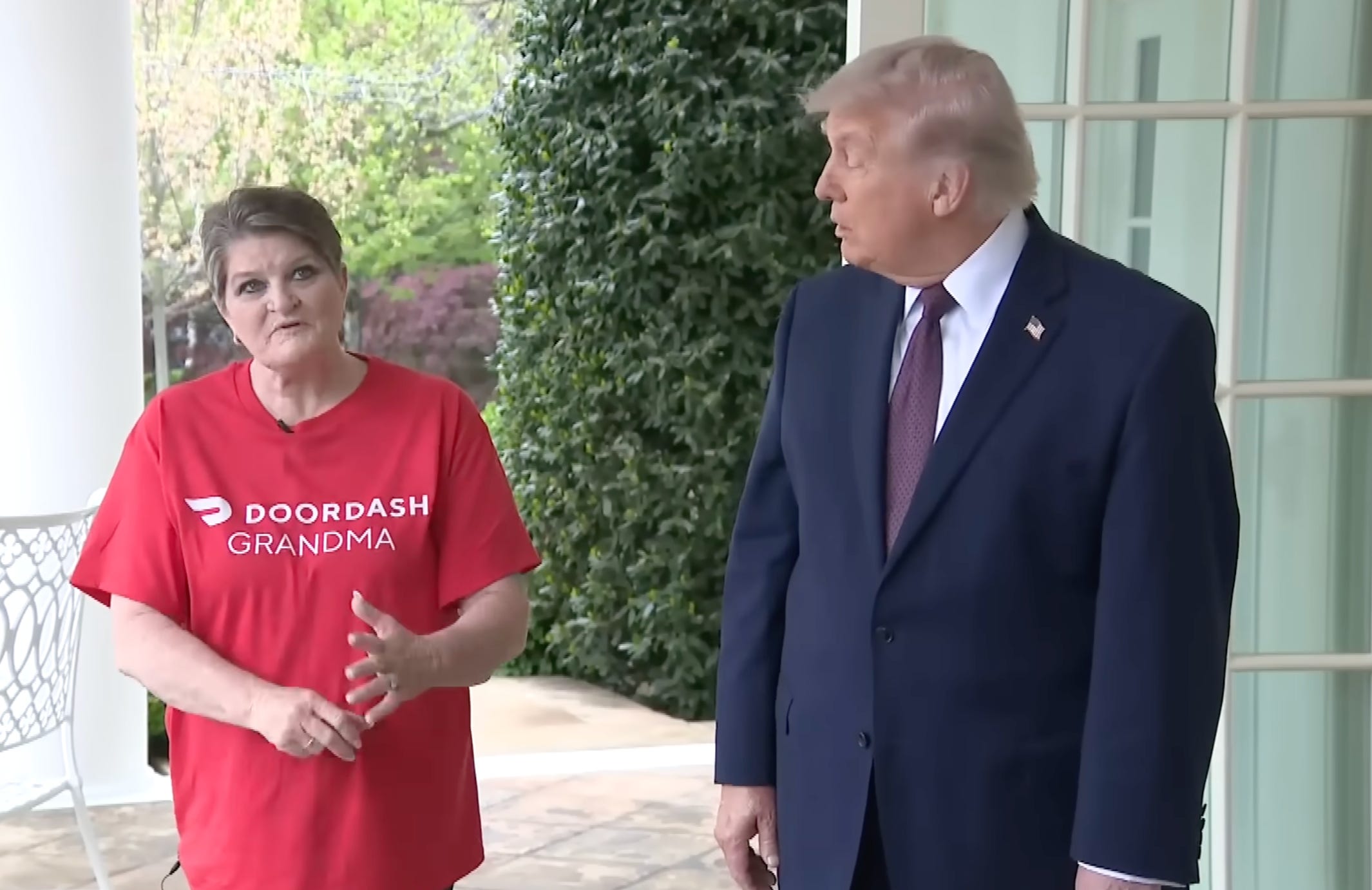
A grandmother named Sharon Simmons drove to the White House in a custom “DoorDash Grandma” t-shirt and knocked on the exterior door of the Oval Office with two bags of McDonald’s. The President opened the door and said: “This doesn’t look staged, does it?”
It was staged. Gaining access to the White House grounds requires prior authorization and passing through security. The AP noted this, as if it required noting.
Sharon Simmons has made 14,000 deliveries since 2022. She is a grandmother of ten. Her husband has cancer. The savings from the No Tax on Tips legislation — $11,000 last year — help cover his treatment. She works because the bills pile up and the tips are what keeps the arithmetic from collapsing entirely.
DoorDash‘s Global Head of Public Policy called this “real impact to so many hardworking people and their families.”
He is not wrong that it is real impact. He is not wrong that Sharon Simmons’s $11,000 matters enormously to Sharon Simmons and her husband and their family. He is not wrong that she is a hardworking person.
What he is wrong about — what the entire event is wrong about — is the frame. The frame says: this is a feel-good story. A grandmother, a president, a policy that helped her. Look at this. Isn’t this good?
⁂
The press conference went sideways almost immediately, because Sharon Simmons refused to perform the rest of the script.
Trump asked if she voted for him. She said: “Um, maybe.”
Trump asked if she believed men should compete in women’s sports. She said: “I really don’t have an opinion on that.”
Trump, apparently confused about why she was there, said: “Pizza?”
She corrected him: “No. Tax on tips.”
He awkwardly patted her on the back and said: “Okay.”
A reporter asked if the White House were good tippers. She said: “Uh, potentially.” Trump pulled $100 from his pocket. She revised: “Yes, very.”
Sharon Simmons came to talk about the $11,000 in tax-free tips that is helping her keep her husband alive. She was asked about transgender athletes, her voting history, and invited to a UFC fight at the White House on June 14. She held her ground throughout. She is the most dignified person in the room in every frame of the footage.
She is also, without knowing it or intending it, the most devastating critic of the event she was recruited to celebrate. Because her refusal to perform the script — her flat, tired, specific humanity in the face of the spectacle — is the entire thesis of The Fire Next Time made visible in a single press conference.
⁂
The DoorDash event is not a distraction strategy. I want to be clear about this because the sanewashing instinct will reach for that frame immediately. It is supply theater — the production of a controlled environment where everyone performs their assigned role: the grateful gig worker, the generous president, the beneficial policy, the feel-good moment. The McDonald’s bags are the prop. The $100 bill is the performance. The camera is the supply source.
He said so himself: “This doesn’t look staged, does it?”
He always knows. The performance is not concealing something else. The performance is the point. The supply hit comes from the performance itself — the image of the powerful man answering the door for the grandmother, the image of the $100 bill, the image of himself as the author of her $11,000. It does not matter that oil is at $104. It does not matter that the blockade went into effect at 10am. The camera is on him and he is being generous and it is working in the only register that matters to him.
⁂
Now let me tell you about DoorDash.
The same week that DoorDash staged this White House event to celebrate a tax break for gig workers, DoorDash co-founder Andy Fang was funding a primary challenge against Ro Khanna — the congressman from Silicon Valley who co-authored the Epstein files disclosure push, endorsed a billionaires’ wealth tax, and broke with the tech donor class that originally funded his career. Garry Tan, CEO of Y Combinator, said Khanna had “abandoned his responsibility to his district.” Chamath Palihapitiya joined the effort.
The motte: DoorDash celebrates a tax break that saved a grandmother $11,000 while her husband battles cancer.
The bailey: DoorDash‘s leadership is spending to remove a congressman who wants to tax the billionaire class that DoorDash’s founders belong to.
Sharon Simmons is not the beneficiary of DoorDash‘s political activity. She is its prop. The $11,000 she saved is the motte. The primary challenge against Khanna is the bailey. The feel-good event at the White House is the vehicle by which the motte is performed for the cameras while the bailey proceeds unobserved.
This is what I described in The Fire Next Time: the system’s immune response to challengers is more vigorous than its response to its own failures. Sharon Simmons saved $11,000. Her husband still has cancer. The bills still pile up. She still makes deliveries because the arithmetic still doesn’t work without the tips. And the people celebrating her savings are the same people spending to prevent the congressman who wants to restructure that arithmetic from keeping his seat.
⁂
I want to say something about what DoorDash‘s marketing team apparently believes.
They believe this is a feel-good story. They believe that in a week when oil hit $104, when the Strait of Hormuz went under blockade, when a grandmother is working gig deliveries to cover her husband’s cancer treatment because the arithmetic of their life requires it, the image of that grandmother at the Oval Office door with McDonald’s bags is — good. Affirming. The kind of thing that makes people feel warmly toward DoorDash and toward the policies DoorDash is promoting.
They are not evil people. They are people who cannot read the room.
The room, in this case, is the country. The country in which Sharon Simmons exists — a grandmother of ten, 14,000 deliveries, husband with cancer, $11,000 that matters so much it brought her to the White House — is not a feel-good story about gig work and tip tax cuts. It is an indictment of an economic arrangement in which a grandmother has to make 14,000 deliveries to cover the cost of keeping her husband alive, and the help she gets from the political system is a tax cut on the tips that make the arithmetic barely work.
The inability to see this — to hold the McDonald’s bags and the cancer bills and the $100 tip and the DoorDash co-founder’s primary challenge against Khanna all in the same frame simultaneously — is the blindness I wrote about in The Fire Next Time.
They will understand it when it arrives. That will be too late.
⁂
Sharon Simmons corrected the President of the United States on camera when he forgot why she was there.
“No. Tax on tips.”
She knows exactly what she came for. She knows what matters. She held her ground in a room full of performance and spectacle and managed, through the sheer force of her specific, tired, real humanity, to make the entire apparatus briefly visible for what it is.
I hope her husband recovers. I hope the tips keep coming. I hope the arithmetic works out.
And I hope someone in Silicon Valley eventually reads the room. For their sake, anyways.
Go Deeper into the Circus
He Has Never Been Playing Chess

This Crisis Dispatch series has been a somewhat exhausting effort. Not because of the volume of writing — I have written more in worse conditions. But because of the pervasive, grinding sense that society at large simply does not accept the obvious thing staring it in the face.

"The frame says: this is a feel-good story. A grandmother, a president, a policy that helped her. Look at this. Isn’t this good?"
This story made me feel absolutely horrible. Supposedly, we're the greatest, richest country on Earth...and we have a grandmother working DoorDash to pay for her husband's cancer treatments, while Trump puts forth a $1.5 trillion dollar budget for the Department of War, and his party and the media defend that figure. I'm no mathematician, but that's roughly $5000 per resident of the United States. This says everything about what kind of people we have elected to public office, and what kind of people we are, and it is not just "not good", it's downright evil, horrible, and horrifying.
When I was a kid (so long ago), my mother had a bumper sticker that said, "What if schools got all the money they needed and the military had to hold a bake sale to build a bomber?"
21st century America disgusts me.
Going through radiation treatment 1.5 years ago, the billed rate per treatment was $7000. Multiply that by 30. Even removing tax on tips won’t make a dent.