


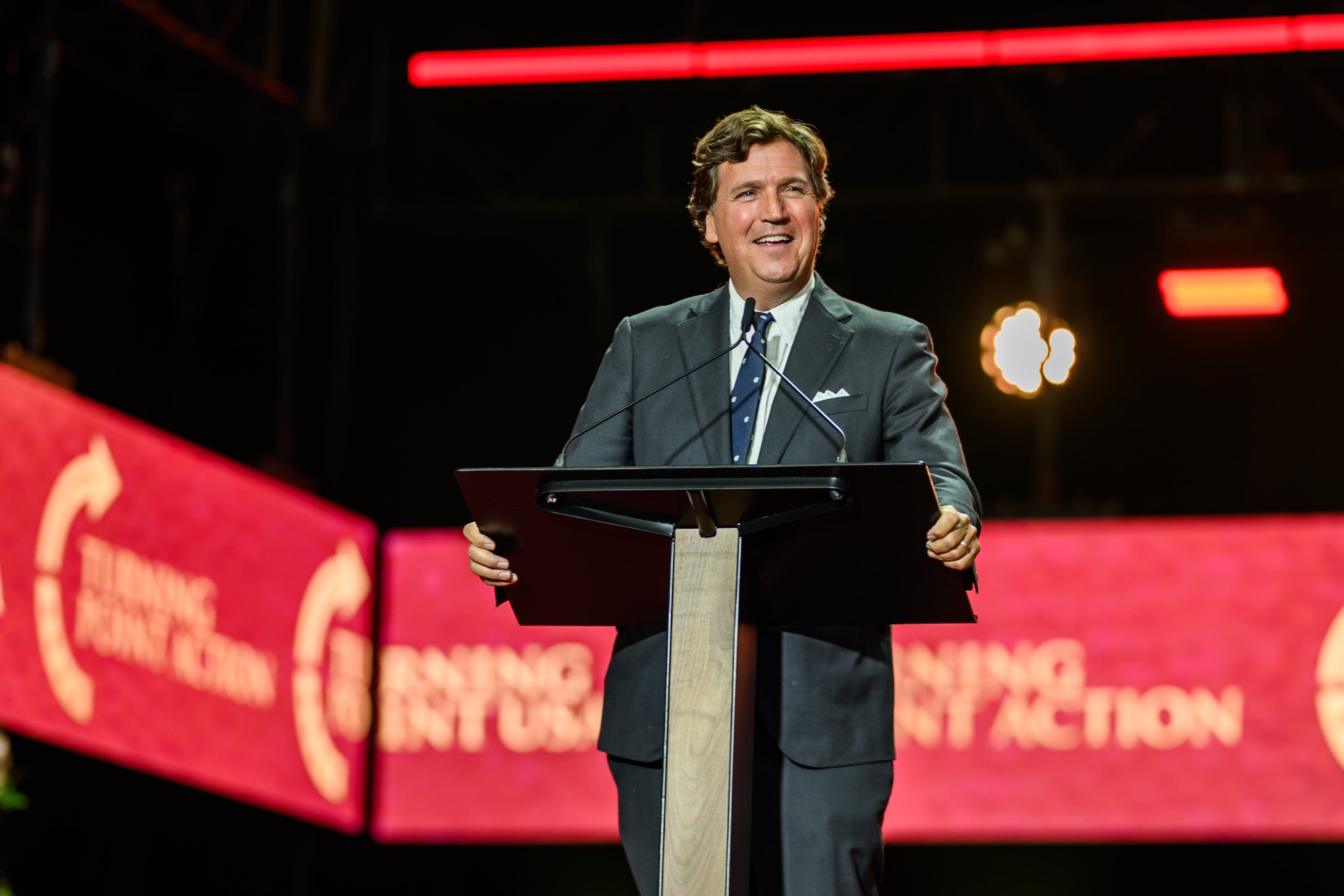
On April 20, 2026, on his own podcast, sitting across from his brother Buckley, Tucker Carlson said this: “I want to say I’m sorry for misleading people. It was not intentional. That’s all I’ll say.”
Yes, you were misleading people, Mr. Carlson. And contra your characterization, it was very much intentional. We have the receipts of the intentionality that you deny. I will now go through those receipts because I think the record deserves a full accounting of your lies. Because, it turns out, you are lying even now.
The word misleading is doing the entire work, and the word is a lie. Tucker Carlson did not mislead his audience. He lied to them. He lied to them knowing the things he was saying were false, said so explicitly in writing at the time he was saying them publicly, and continued saying them anyway because the alternative — telling the truth — threatened his business and his employer’s stock price. The record of this is not contested. It was produced, under oath, through discovery, in a defamation case his employer settled for $787.5 million rather than allow to reach trial. Every significant claim in what follows is drawn from text messages and emails that Tucker Carlson himself wrote, that Fox News was compelled to turn over, and that are now part of the public record of the United States.
⁂
Exhibit one. On November 5, 2020, two days after the election, while Fox News was beginning to report on Trump’s early attempts to contest the results, you texted your producer Alex Pfeiffer about Trump: “We worked really hard to build what we have. Those fuckers are destroying our credibility. It enrages me.” You added: “What [Trump’s] good at is destroying things. He’s the undisputed world champion of that. He could easily destroy us if we play it wrong.”
Exhibit two. On November 8, 2020, Pfeiffer texted you that there was no evidence of voter fraud that swung the election. You replied: “The software s—t is absurd.” That was your private assessment of the Dominion voting-machine conspiracy then being promoted on your network and others. You called it absurd, in writing, to your producer.
Exhibit three. On November 9, 2020 — the next night — you told your audience on air: “We don’t know how many votes were stolen on Tuesday night. We don’t know anything about the software that many say was rigged… our system isn’t what we thought it was. It’s not as fair as it should be. Not even close.”
Absurd in private, stolen on television, on consecutive days. The jury will note the gap between Exhibit Two and Exhibit Three is less than twenty-four hours.
Exhibit four. On November 13, 2020, you wrote privately that Trump needed to concede, and explicitly agreed that “there wasn’t enough fraud to change the outcome” of the election.
Exhibit five. On November 16, 2020, three nights later, you told your audience: “Millions of Americans understandably are asking these questions. Our current system does not inspire confidence. People have legitimate concerns about the integrity of our elections.”
Exhibit six. On the same day — November 16, 2020 — you texted a Fox producer about Sidney Powell, who was at that moment appearing on Fox News promoting the Dominion conspiracy to millions of viewers: “Sidney Powell is lying. Fucking bitch.”
Exhibit seven. You texted Laura Ingraham the same day: “The whole thing seems insane to me, and Sidney Powell won’t release the evidence.”
Exhibit eight. On November 17, 2020, you texted Sidney Powell directly: “You keep telling our viewers that millions of votes were changed by the software. I hope you will prove that very soon. You’ve convinced them that Trump will win. If you don’t have conclusive evidence of fraud at that scale, it’s a cruel and reckless thing to keep saying.”
Exhibit nine. On November 18, 2020, you texted Ingraham: “Sidney Powell is lying by the way. I caught her. It’s insane.” And: “It’s unbelievably offensive to me. Our viewers are good people and they believe it.”
Our viewers are good people and they believe it.
Let the jury sit with that sentence. You knew your viewers were good people. You knew they believed what they were being told. You knew what they were being told was a lie. You said so, in writing, to people you worked with, while your network continued broadcasting the lie and while you yourself continued going on the air and telling those good people that their concerns about the integrity of the election were legitimate, that the software was suspect, that the system was not fair.
Exhibit ten. On November 21, 2020, you wrote that it was “shockingly reckless to claim Dominion rigged election if there’s no one inside the company willing to talk, or internal Dominion documents or copies of the software showing that they did it — as you know there isn’t.”
Exhibit eleven. On November 23, 2020, you told your audience: “You’ve heard a lot over the past few days about the security of our electronic voting machines. This is a real issue, no matter who raises it or who tries to dismiss it out of hand as a conspiracy theory. Electronic voting is not as secure as traditional hand counting. Period.”
Shockingly reckless in writing on Saturday. A real issue that should not be dismissed as a conspiracy theory on air the following Monday. The jury will note a pattern.
Exhibit twelve. On January 4, 2021, two days before the Capitol insurrection, you texted about Trump: “I hate him passionately. I can’t handle much more of this.” And: “We’re all pretending we’ve got a lot to show for it, because admitting what a disaster it’s been is too tough to digest. But come on. There really isn’t an upside to Trump.”
Exhibit thirteen. On January 7, 2021, hours after a mob had stormed the Capitol at the president’s direction, you texted Pfeiffer: “Trump is a demonic force, a destroyer. But he’s not going to destroy us.”
Exhibit fourteen. On July 18, 2024, three and a half years later, you stood on the stage of the Republican National Convention in Milwaukee and told the nation that Trump’s survival of an assassination attempt was “divine intervention” and “a transformation,” that Trump was “no longer just a political party’s nominee — this was the leader of a nation,” that Trump was “the bravest man,” and — I am quoting — “God is among us right now. And I think that’s enough.”
What was demonic in 2021 was divine in 2024. What was a destroyer became the vessel of God. The conversion happened in public, at full volume, in front of a television audience, delivered by a man who had put on the stage of the Republican National Convention the same face he had put on the screen of Fox News every weeknight for years — the face of a man delivering, with apparent sincerity, whatever content the arrangement required him to deliver at that moment. The sincerity is the product. The content is whatever will sell.
The record is not ambiguous. It is not a matter of interpretation. It is a series of statements, made in writing by Tucker Carlson himself, contemporaneously with the public statements they contradict, establishing beyond any possible dispute that he said, in private, exactly the opposite of what he said, in public, to millions of people who trusted him.
The man who now tells us I’m sorry for misleading people — it was not intentional is the same man who wrote, in real time, that Sidney Powell was lying, that the software claims were absurd, that the fraud allegations were shockingly reckless, that his viewers were good people being deceived, that Trump was a demonic force and a destroyer. He said these things while going on television and telling his audience the opposite. He cannot plead confusion. He cannot plead that he was working from imperfect information. He cannot plead that he was caught up in a narrative he later came to doubt. The written record establishes, with the kind of specificity that only discovery in a federal defamation case can produce, that he understood his public statements to be false at the moment he was making them, that he characterized them to his colleagues with unusual vividness as lies, and that he continued making them anyway because the financial and professional cost of stopping was higher than the moral cost of continuing.
In April 2023, Fox News paid Dominion Voting Systems $787.5 million to make the defamation case go away before Carlson and the other Fox primetime hosts had to testify under oath about what has just been described. It is the largest media defamation settlement in American history. A week later, Fox fired him. Among the factors in his firing, according to reporting at the time, was the board’s concern about texts — including one in which Carlson, discussing Trump supporters beating a protester, wrote “It’s not how white men fight” — that the company did not want exposed in further proceedings.
He landed on X, then on a subscription platform of his own, then on one of the most successful podcasts in the country. He traveled to Moscow and conducted a flattering, unchallenged interview with Vladimir Putin — Putin’s first Western-media interview after invading Ukraine — and filmed himself in a Russian grocery store praising the quality of life under an authoritarian regime at war. He spent time in Hungary promoting Viktor Orbán’s model of electoral autocracy to American audiences. He hosted, on his podcast, the open white nationalist and Holocaust denier Nick Fuentes for more than two hours of fawning conversation during which Fuentes described Jews as “unassimilable” and advanced classical antisemitic conspiracies without pushback. He stood at the Republican convention and declared that God was among us. He did all of this, in public, for four years, after the Dominion texts were a matter of public record. He never apologized for any of it. He never addressed it.
Then, on April 20, 2026, after the Trump administration launched a war with Iran that Carlson opposed — opposed because the war cost him standing with the segment of the right he had cultivated, opposed because Trump’s coalition was fracturing and Carlson had to choose which fragment to stand with — Tucker Carlson sat down on his own podcast with his brother and said he was sorry for misleading people, and that it was not intentional.
⁂
So. That is the record. Let the court note what follows from it.
The apology is a positioning statement dressed as contrition. It is calibrated to the present moment. It is not responsive to the Dominion record, because the Dominion record has been public for three years and Carlson has made no apology for any of it. It is responsive to the Iran war and the break with Trump, because the Iran war and the break with Trump are the current facts that affect his access to the specific audience he is now trying to hold. The apology arrives when the apology is useful. It refers to whatever needs referring to in order to be useful. The vocabulary of contrition is the instrument. The instrument is being deployed to manage a specific commercial and political problem — which is that a portion of Tucker Carlson’s audience is now repelled by Trump, and Tucker Carlson, like all opportunists, must move with the portion of the audience that pays.
The word misleading is not a failure of precision. It is a chosen word. It is chosen because it does specific work. Misleading implies the misleader may himself have been confused, or may have presented information ambiguously, or may have conveyed a false impression through imprecision rather than deliberate falsehood. It is the vocabulary of error. It is the vocabulary that lets the speaker claim moral credit for acknowledging a problem while denying the nature of the problem. The problem was not that Tucker Carlson misled his audience. The problem is that Tucker Carlson lied to his audience, with full knowledge of the truth, for years, for money, and has now decided — because the balance of his commercial interest has shifted — that he would like to be forgiven for something less than what he actually did. The apology is an attempt to substitute a misdemeanor confession for a felony indictment, in the hope that the audience will accept the substitution and move on.
It was not intentional is the other chosen phrase, and it is itself a fresh lie, delivered at the moment of apology, about the conduct being apologized for. The Dominion texts establish intent beyond anything a defendant in a fraud case could hope to deny, but one text in particular forecloses the not intentional plea with finality. On November 17, 2020, Tucker Carlson wrote to Sidney Powell directly. Not to a producer. Not to a colleague. To Powell herself, while she was actively promoting the Dominion conspiracy on his network to millions of people. The message: “You keep telling our viewers that millions of votes were changed by the software. I hope you will prove that very soon. You’ve convinced them that Trump will win. If you don’t have conclusive evidence of fraud at that scale, it’s a cruel and reckless thing to keep saying.”
That is the definition of intentional knowledge. He wrote to her, by name, and told her the thing she was saying was cruel and reckless. Then he went on air and told his audience her concerns were legitimate. If the word intentional has any content in the English language, that sequence is what it names. A man who writes to a liar, calls her out privately for lying, and then provides her an audience to continue lying to, is not a man who can later claim — six years later, when the political calculus has turned — that what he did was not intentional. He did not stumble into the fraud. He identified the fraud, in writing, to the fraudster, and then participated in it anyway. To say at this late date that it was not intentional is to attempt, in real time, to rewrite the record that everyone with access to a search engine can now read. It is not a lapse in the apology. It is the craft of the apology. The apology’s central rhetorical move is the same move that made the original fraud work: say the thing you need to say, in the moment you need to say it, to the audience you need to say it to, and count on the audience’s exhaustion and goodwill to let you get away with it.
⁂
Tucker Carlson is a nihilistic opportunist who discovered, early in his career, that there is a large and loyal audience for a certain kind of performance — a performance in which a man in a bow tie or an open collar, affecting the voice of the plainspoken everyman, delivers to that audience whatever version of reality will keep them watching, keep them angry, keep them subscribed, keep the ad money flowing and the investors happy and the speaking fees climbing. The content of the performance is whatever it needs to be. The election was stolen, until it wasn’t. Trump was a demonic destroyer, until he was divinely anointed. Putin is a reasonable leader America misunderstands. Nick Fuentes is a young man worth hearing out. Hungary is a model for America. Christian Zionists are contemptible, until they are not, until they are again, in a different register, for a different audience.
There is no floor. There is no principle he has not subordinated to the extraction strategy. There is no position he has held that a sufficient change in his commercial environment could not cause him to reverse. This is the defining feature of the kind of man he is. It is not a feature he hides. It is visible in every phase of his career, to anyone who looks. He is a sophist in the ancient sense — a man who has mastered the forms of moral speech without any underlying commitment to the moral substance the forms exist to express — except that the Sophists of Athens at least charged honest fees and admitted that rhetoric was their product. Carlson sells sincerity as the product. The sincerity is the fraud. The fraud is the business.
What is happening right now is that the commercial environment has changed. Trump has broken with the isolationist wing of his coalition by going to war in Iran. Carlson’s brand is built on the isolationist, anti-interventionist, anti-establishment posture that now puts him at odds with Trump. The audience he has cultivated — the Candace Owens audience, the Steve Bannon audience, the audience that believes American power abroad is itself the problem — is split from the Trump audience that supports the war. Carlson must choose. He has chosen. He has chosen the faction that stays, because the faction that stays is the faction that pays. The apology is not an apology for the lies. It is a hedge against the possibility that the Trump coalition recovers and closes him out. I am sorry for supporting him is the sentence he needs to say in order to remain plausibly in business if the whole Trump project collapses. It has nothing to do with Dominion. It has nothing to do with the people he deceived. It has to do with access.
This is not a moral act. It is not a moral category of act. It is a business move. It is the move of a man who has, correctly, calculated that his continued ability to extract audience and income from the public performance of sincerity requires him to perform a specific gesture right now, and so he is performing it. The gesture is calibrated to concede the minimum required to remain plausible. The minimum required is I’m sorry for misleading people. It was not intentional. Anything more specific — any acknowledgment of the Dominion record, any naming of Sidney Powell, any engagement with the seven hundred and eighty-seven million dollars, any mention of the election workers who received death threats because of content he broadcast while privately calling it absurd — would be too much, because it would foreclose too many future options. The vagueness is the point. The vagueness is what preserves the apology’s flexibility for the next pivot.
⁂
Tucker Carlson is an instance of a pattern the American media economy now produces in such numbers that the type is legible as a type. The figure performs the vocabulary of some tradition they were formed inside — journalism, conservatism, religion, populism, dissent — and uses the vocabulary’s moral authority as cover for a career built on saying whatever, at any given moment, the most profitable audience wants to hear. The vocabulary is not the content. The vocabulary is the instrument. The content is whatever the quarterly numbers require.
When the figure is caught in a lie big enough that the vocabulary cannot absorb it, the figure performs an apology. The apology is carefully engineered. It names a small thing while gesturing at a large one. It uses the language of error for what was deliberate fraud. It expresses torment without specifying what the torment is for. It concedes enough to look human and hides enough to keep the options open. The apology is itself a product of the same cynical craftsmanship that produced the original lie. The apology is not the figure setting down the tool. The apology is the tool being used again.
The apology works, most of the time, because the audience is tired, because the media cycle is short, because the alternative to accepting the apology is carrying the record forward alone against a current of institutional forgetting. The apology works because the audience wants to believe that the figure was in good faith all along, and has merely made mistakes, because believing otherwise would require admitting that they have spent years listening to a man who held them in contempt. The apology works because the mainstream press is eager for a rehabilitation narrative — a story about growth, about reconsideration, about a figure who got it wrong and is now reckoning with it — because rehabilitation stories are cleaner and more commercially viable than the alternative, which is moral judgment.
I am refusing to participate.
I am refusing because the texts exist and I have read them. I am refusing because the record is in the public domain and anyone who wants to read it can. I am refusing because misleading is not the word for what Tucker Carlson did. Lying is the word. Defrauding is the word. Knowingly poisoning the political reality of millions of Americans while privately expressing contempt for them and for the lies he was feeding them is the longer description. The word Tucker Carlson selected for himself was chosen to replace these words. The refusal to accept his apology is the refusal to accept the replacement.
This matters because the country has business to do. Donald Trump is still president. The damage Tucker Carlson contributed to is still unfolding. The people whose lives were ruined by the Dominion conspiracy — the election workers hounded by death threats, the voting-machine employees forced into hiding, the communities whose civic fabric was poisoned by the conviction that their government was illegitimate — have not been made whole, and will not be. No apology from Tucker Carlson would restore them. A true apology would at least acknowledge them. This apology does not. This apology acknowledges only Tucker Carlson. Its subject is his torment. Its audience is his future market.
He is a deeply disturbed man. I do not say that as a diagnosis. I say it as the plainest description of what the public record shows: a man who spent years telling millions of people things he believed to be lies, who privately expressed contempt for them while publicly flattering them, who has continued, in every venue available to him after his firing, the same pattern of deception in the service of whichever authoritarian figure currently serves his commercial interests, and who now — at the first moment when that pattern requires the vocabulary of contrition to preserve his options — deploys that vocabulary with the same strategic precision he has deployed every other instrument in his career. A man who could build what Tucker Carlson has built, and say what Tucker Carlson has said, and do what Tucker Carlson has done, and sleep through the nights during which millions of Americans were being made into worse versions of themselves by what he was doing, is not a man whose apology is adequate information about his moral state. The apology is information about his strategy.
Nobody should look to this man for moral leadership. Nobody should treat his apology as a real apology. Nobody should extend him the presumption of good faith that the apology attempts to claim. He has not earned it. He has spent twenty years demonstrating, in public, that the presumption of good faith is precisely what he relies on to do what he does. The withdrawal of that presumption is the beginning of taking him seriously.
So, Mr. Carlson, let the record reflect this.
Apology not accepted.
My case-in-chief, Mr. Carlson. Submitted to the jury of history.
Go Deeper into the Circus
The Man Who Cannot Stop Talking About Killing

Yesterday, Palantir‘s official account posted on X a list of twenty-two excerpts from CEO Alex Karp’s book, The Technological Republic. “Because we get asked a lot,” the caption read. The post has, as of this writing, nearly thirty million views. I read it and thought it was stupid. Stupid in a specific way — the stupidity of a man who has decided his p…
The Real Honest Conversation

I published The Positive Case for Liberalism earlier today. Hours later, Triggernometry released an episode titled “An Honest Conversation with a Christian Nationalist,” featuring Andrew Wilson. I watched it, and I want to write about it immediately, because the episode is a nearly two-hour specimen of the exact failure mo…
Thank you for taking time to collect those receipts, which are a matter of public record but can easily stay obscured in the ongoing shitstorm. Carlson is a born opportunist, gadfly, and cynic. His apology sounds heartfelt, but in the context of the receipts it's just ugly. He'll turn again any time he senses it might lead to increased influence for him. The only good that might come of this latest maneuver is that some of his followers will wander away from both him and Trump.
I hope he’s planning on apologizing directly to the family of Brian Sicknick.