


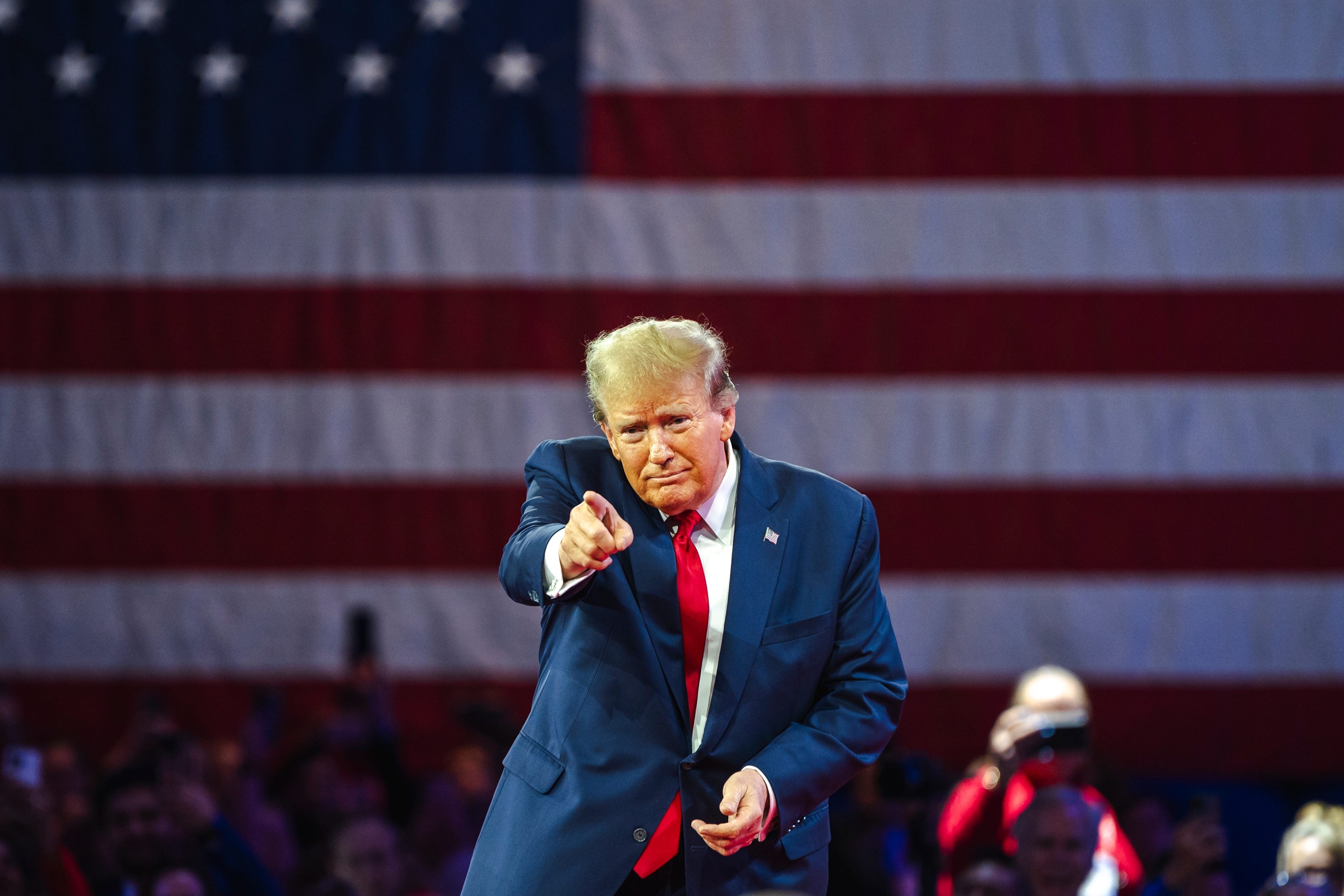
That anybody ever admired Donald Trump’s negotiating and dealmaking skills, and thought that these skills would avoid international conflict and bring America’s adversaries to their knees by sheer force of his manly strength — many Americans still believe this — is hard for me to metabolize.
Let’s sully these pages with Trump’s ravings so we have a full image of the vulgar object in front of us. I am quoting it in full because I do not think the prose can be paraphrased without losing what it is.
Assuming Iran agrees to give what has been agreed to, which is, perhaps, a big assumption, the already legendary Epic Fury will be at an end, and the highly effective Blockade will allow the Hormuz Strait to be OPEN TO ALL, including Iran. If they don’t agree, the bombing starts, and it will be, sadly, at a much higher level and intensity than it was before. Thank you for your attention to this matter!
This is the most powerful man in the world communicating about a war he started. The bombing campaign he is referring to is one he has named Operation Epic Fury and is describing, in his own composition, as already legendary. The Strait of Hormuz he is offering to open to all is the strait that has been closed because of the war he started. The highly effective Blockade he is taking credit for is the blockade that has caused jet fuel prices to double, killed Spirit Airlines, and stranded twenty percent of the world’s seaborne oil supply behind a maritime conflict the United States is one of the principal authors of. The bombing starts he is threatening is a threat to escalate a war that has already slaughtered Iranian schoolchildren. He signs off by thanking the reader for their attention to this matter, in the register of a customer-service email about a delayed shipment.
⁂
This is the man whose dealmaking skills millions of Americans bought as a reason to vote for him. Twice.
The actual record of his Iran-dealmaking is worth walking through, briefly, because the record is important and the mythology persists in spite of it.
In 2015, the United States and five other major powers — Britain, France, Germany, Russia, China — concluded the Joint Comprehensive Plan of Action with Iran. The agreement froze Iran’s nuclear program, opened it to International Atomic Energy Agency inspection, and was holding. By every measurable standard the agreement was working. Iran was not enriching uranium past civilian thresholds. Inspectors were on the ground. The architecture was sound.
In 2018, Donald Trump, who at that point had been President for fourteen months, withdrew from the agreement. He withdrew against the unanimous advice of his own intelligence services. Against the public opposition of the other five signatories. Against the recommendation of the IAEA. Against the wishes of essentially every American foreign policy professional who had spent any time on the Iran question. He withdrew because he had said during his campaign that he would withdraw, and because the agreement had been negotiated by Barack Obama, and because the agreement was therefore — by the only reasoning he has ever offered for any foreign policy decision — bad. The dealmaker tore up the deal.
He then, across his first term and into the brief intermission of the Biden administration, refused to negotiate any successor agreement with Iran. The Iranian nuclear program, no longer constrained by the JCPOA, advanced. Enrichment increased. The breakout time — the period required for Iran to produce a nuclear weapon if it decided to — shortened from about a year under the JCPOA to a matter of weeks by 2024. This is not contested. This is the IAEA’s reporting and the U.S. intelligence community’s public assessment.
In 2025, Donald Trump returned to the presidency and decided that Iran’s nuclear advancement, which his own first-term policy had produced, was now an unacceptable threat. He sent his son-in-law to Geneva to meet with Iran’s foreign minister. The talks failed. Trump, alongside Israel, then launched a bombing campaign that escalated rapidly into the closure of the Strait of Hormuz, the worst global oil shock since the 1970s, the failure of an American airline, the collapse of consumer-aviation networks across the Northern Hemisphere, and the deaths of an unknown but substantial number of Iranian civilians, including children.
This week, after multiple rounds of negotiations the White House has not characterized publicly, the administration is reportedly close to securing what Axios’s Barak Ravid is calling a one-page memorandum of understanding to end the war.
A one-page memorandum.
The original JCPOA was 159 pages. It contained substantive provisions for inspection, for staged sanctions relief, for centrifuge limits, for uranium stockpile caps, for monitoring of conversion facilities, for verification timelines extending out to 2031. It was a real arms-control agreement, negotiated across years, by professionals, with technical detail that addressed the technical realities of Iran’s nuclear program.
The dealmaker tore that up. He then started a war over the consequences of having torn it up. The war cost the world tens of billions of dollars in disrupted trade. It killed an unknown number of people. It destroyed a major American airline. It brought the United States closer to direct nuclear-state conflict than at any point since the 1962 Cuban Missile Crisis. And now, after all of that, his administration is going to come back to the table with the same Iranian government and produce — if Mr. Ravid’s reporting is accurate — a one-page document.
The JCPOA was characterized as a failure by the people who supported tearing it up, and the characterization is what holds the whole story together. It deserves to be looked at directly.
The argument, as I heard it from people I knew and respected, ran like this. The international inspections were happening. The IAEA was on the ground. There was no actual evidence that Iran was in violation of the agreement. But Iran was obviously violating the agreement, because that is what the Mullahs would obviously be doing behind our backs, and if you do not believe that, you are a fool. Any deal made with the Iranians was, by the structure of the Iranian regime, simply Iran playing you for a fool. So the deal was bad. So the deal had to be torn up. So we tore it up and went to war with them, since that was apparently the only option under this unfalsifiable framing of reality. And now we are here.
I had friends who thought this. Smart people. People with whom I had spent hours arguing about other things, productively, in good faith, with mutual respect. On Iran, the conversation could not happen. The framing was sealed. Every piece of evidence got absorbed into it. Inspections finding nothing meant the inspections were inadequate. Iran complying with the terms of the agreement meant Iran was being clever. The framework was unfalsifiable in the technical Popperian sense — there was no possible empirical state of the world that could have, by the framework’s own internal logic, counted against the framework’s central claim. Whatever was happening was always already evidence that the framework was right.
This is the epistemic substrate underneath the dealmaker mythology. The dealmaker is the master dealmaker not because his deals are good but because the idea of any deal with the wrong kind of foreign government is, in the framework, a category mistake. Tearing up such a deal is therefore wisdom. Going to war over the absence of the deal is therefore decisive action. Producing, after the war, a one-page memorandum that is vastly inferior to the deal you tore up, is therefore — by the logic of the framework — the only kind of deal that was ever possible, given who you were dealing with.
These are the same people who consider themselves experts on foreign policy and on the psychology of the Iranian regime. They have, for reasons I have never fully understood, a great deal of influence inside the Republican Party. They support unconditional support for Israel regardless of whether Israel’s current disposition is aligned with American interests, regardless of whether the Israeli government is engaged in conduct that previous American governments would have called by its name, regardless of any factual development in the region. The unconditionality is the giveaway. A foreign-policy framework that arrives at the same conclusion regardless of evidence is not a foreign-policy framework. It is a commitment dressed in the costume of analysis. The commitment is what the framework actually is. Everything else is the costume.
These same people thought Antony Blinken was a moron. Naive. Easily pushed around by America’s adversaries. A child playing at diplomacy in a world that required harder men. The premise was that professional foreign-policy competence — the kind that produces 159-page agreements with technical inspection regimes — was itself the problem. The professionals had been outwitted, the framework held, by adversaries who took advantage of professional good faith. What the country needed was someone who would not be outwitted, because the someone in question would not be operating inside any framework an adversary could exploit.
That someone, by the framework’s logic, was Donald Trump. They would say to me — these were people who said this to me directly, in conversations I can still remember — that yes, Trump was a moron, but his moronicness was precisely what made him effective. He projected, in the phrase that recurred in these conversations, a mad man strength. The adversaries did not know what he would do, because he himself did not know what he would do, and the unpredictability stunned the world into stability. His first term, the framework held, had established this. The peace of the moronic strongman was the peace the foreign-policy professionals had been too clever to produce.
You can see what the framework is doing here. It has converted the dealmaker-is-a-moron evidence — which is real, observable, and inescapable — into confirmation of the dealmaker’s strength. The moronicness is the asset. The mad-man unpredictability is the strategic posture. Anything incoherent Trump does gets reabsorbed as the mad-man strength operating in real time. The framework is not just unfalsifiable on the question of Iranian compliance. It is unfalsifiable on the question of what counts as competent American foreign policy. Whatever Trump does is, by the framework’s own logic, the right thing — because the rightness comes from the man rather than from anything the doing could be measured against.
The goons at the Wall Street Journal Editorial Board bought into this kind of thinking and have spent the last decade institutionalizing it at the level of elite opinion. Their readership, for reasons unknown to me, continues to welcome their judgments. The mad-man framework — call it Bret Stephens conservatism, call it Kim Strassel conservatism, call it whatever you like — is the framework that produced the political support for tearing up the JCPOA, for the bombing campaign that closed the Strait of Hormuz, and for the one-page memorandum that will, when it is signed, be celebrated as a triumph of the dealmaker’s bold unpredictability rather than recognized as the vastly inferior agreement it actually is. The framework will not register the inferiority. The framework cannot register it. The framework is built in such a way that it cannot.
Meanwhile, this exact same group of civilizational arsonists is going all-in on the idea that Graham Platner’s tattoo will be the weak link in the chain for the Democrats — that American voters are about to wake up and realize that the left has embraced Nazism. No, seriously. This is the narrative they are actively trying to construct in real time. The same operators who tore up a working nuclear-arms-control agreement on the unfalsifiable theory that the Iranians must be cheating are now constructing the unfalsifiable theory that a left-populist Marine Corps veteran from Maine, who has explicitly and repeatedly condemned Nazism and antisemitism, must be a Nazi because of a drunk tattoo decision he made at twenty-two in Croatia. Same epistemic move. Same mechanism. Same week.
It is so dishonest, so post-truth, so irresponsible, that I have to say plainly that sometimes when I watch this group move in unison toward this kind of partisan fuckery I think I am staring into the face of pure evil. The framework I have been describing in this Dispatch has a body count. The body count is not metaphorical. The people executing the framework know it has a body count and continue to execute it anyway. Iranian children killed in the bombing campaign. American workers who lost their jobs at Spirit Airlines, and the families those jobs were supporting. The next generation of voters who will inherit the consequences of a Republican Party purged, by the Platner is a Nazi operation, of any candidate willing to name the donor class as the source of American dispossession. The framework is what is producing all of this. The framework is what the people I am describing are operating inside.
⁂
Many Americans still believe Donald Trump is a master dealmaker. They believe it after he tore up the JCPOA, and they will continue to believe it after he ends his own war with a one-page memorandum that will, on any honest accounting, be vastly inferior to the agreement he destroyed.
This is what I find hard to metabolize. The mythology has not just survived the contradicting evidence. The mythology has been reinforced by it. Each new failure gets reframed, in the apparatus that sustains the mythology, as evidence of the dealmaker’s bold strategic vision. The withdrawal from JCPOA was strong leadership. The bombing campaign was decisive action. The closure of the Strait of Hormuz was the highly effective Blockade. The one-page memorandum, when it is signed, will be celebrated as the kind of art-of-the-deal triumph that only Donald Trump could have produced. The same constituency that watched the price of jet fuel double, that watched their cousin lose her job at Spirit Airlines, that watched the gas pump tick higher every week through this autumn, will read the announcement of the one-page memorandum and conclude that the dealmaker has done it again.
The mythology is doing what mythology does. It is converting evidence into confirmation. The structural reason the conversion works is the same reason I named in the Platner Dispatches: brand identities cannot update against evidence because the brand is the asset. The constituency that bought master dealmaker in 2016 has built its political identity around the proposition that they bought correctly. To accept that they bought wrongly would require them to revise their political identity. The revision is too costly. So the evidence is reframed instead. Already legendary is what the apparatus tells the constituency, and the constituency repeats it because repeating it is what membership in the constituency now requires.
⁂
This mythology has cost a great deal, and the cost is worth naming directly.
It has cost roughly two hundred billion dollars in disrupted global trade through the Strait of Hormuz, by the early estimates that have been circulating in the financial press. It has cost the lives of an unknown but real number of Iranian civilians, including children, killed in airstrikes targeting facilities the IAEA had been monitoring under the JCPOA before Trump tore it up. It has cost Spirit Airlines, which made its final flight last week, ninety years after the company was founded. And in the present moment, this same group of goons is busy trying to blame the Spirit Airlines failure on Elizabeth Warren and Lina Khan — on the senator who built her career on consumer protection and on the FTC chair who actually challenged airline consolidation as a regulatory matter. The blame-shifting is happening in real time. The same operators who tore up the agreement that contained the Iranian program, started the war that closed the Strait, doubled the price of jet fuel, and killed the airline are now constructing the narrative that Warren and Khan are responsible for the airline’s death. This is what the framework does when its catastrophes come due. It does not absorb responsibility. It identifies new villains. The villains are always the people who tried to constrain the framework’s operators in the first place.
It has cost — though we will not know the figure for years — the careers of people who held jobs in the aviation sector, the manufacturing supply chains that depended on the aviation sector, the small businesses that depended on the supply chains, the families that depended on the small businesses. It has cost the credibility of American non-proliferation diplomacy, which was already strained and is now likely to be inoperative for the rest of the century.
And it has produced, after all of that, a one-page memorandum.
The dealmaker did this. The dealmaker is the man whose Truth Social post yesterday morning thanked his readers for their attention to the matter of whether the bombing of Iran would resume. The dealmaker is the man who named the bombing campaign Epic Fury and then, writing about it himself, called it already legendary. The dealmaker is the man whose Secretary of State, Marco Rubio, used the construction they will lose, the hard way, the easy way, the long way, the short way, they will lose — a sentence that reads as if it were written by a generative model trained on schoolyard taunts — as the official diplomatic posture of the United States toward a country whose nuclear program the dealmaker himself unleashed by tearing up the agreement that had been holding it.
And many Americans still believe this man is the kind of leader who will, by the sheer force of his manly strength, bring America’s adversaries to their knees and prevent international conflict. The persistence of that belief, in the face of the record I have just described, is what is hard to metabolize.
I do not know what to do about it. I write these Dispatches partly to find out whether anything can be done about it. The mythology persists. The cost accumulates. The Truth Social posts continue to arrive, in the same register, thanking the reader for their attention to the matter of whether the bombing will resume. The reader, on whose behalf this catastrophe has been authored, continues to read.
Go Deeper into the Circus
The Party That Hates Children

Donald Trump, who remains the President of the United States for reasons that are unclear to me, took a shit on a little girl’s dreams because of his malignant narcissism today. That happened.
The Industry’s Court in a Stolen Republic

On April 18, 2026, the New York Times published the most consequential breach of Supreme Court confidentiality since the Dobbs draft leak — and, I would argue, a more consequential one. Adam Liptak and Jodi Kantor obtained internal memos that the justices wrote to one another during the five days in February 2016 when the Court was deciding whether to b…
"When I watch this group move in unison toward this kind of partisan fuckery I think I am staring into the face of pure evil."
That would be because you are. Also the face of pure stupidity. People conditioned by TV to believe that Donald Trump is a "dealmaker." He is. A bad one. Anyone else would have been in prison by now. His father may not have loved him, but he certainly made a paternal commitment to bail Trump out of every stupid "deal" he made, even bankrolling another casino as the flames closed over the wreckage of the first. Trump adulation is the triumph of belief over truth, and it always ends badly. Scott Adams, creator óf Dilbert, believed that in Trump he had seen an influence skills wizard, followed that belief to the point where he didn't have a career anymore. Even the money from Dilbert couldn't keep newspapers on side, and he ended up as a Trump evangelist, pissing off most of his loyal readers on a variety of platforms. An irony, as Trump lacked a single percent of the talent that Adams had at his best.
I have a theory: for people like myself Trump is the antithesis of what we expect humans to be, but for others it's like discovering cocaine that you can mainline into your brain, then start gibbering about three-dimensional chess. He fills something lacking in these people, like the last piece of a psychological jigsaw puzzle. We will never understand it, because all we see is a fat guy with a preposterous haircut bullshitting. But if you look at all the enterprises people have stumped up cash to support him in (often to their own detriment) there is definitely some appeal there. God knows what it is, and the sooner it's gone the better. But remember this: like Jim Jones' followers these people are marked for life, and will always respond to the same stimulus. Whatever the fuck it is.
Thank you. I can’t metabolize any of it either.